
Differences in surface tension cause fluid motion through the Marangoni effect. Because an area with higher surface tension pulls more strongly on nearby liquid than an area of low surface tension, fluid will flow toward areas of higher surface tension. Here surfactants, shown in white, are constantly injected onto a layer of water dyed blue. You can also see the flow in motion in this video. Outside of the central source flow, the pattern features lots of 2D mushroom-like shapes reminiscent of Rayleigh-Taylor instabilities. But these shapes are driven by variations in surface tension rather than unstable density variations. For more, check out the original paper or learn about other examples of Marangoni effect. (Photo credit: M. Roché et al.)
Search results for: “art”
Fluid Sculptures From Bursting Bubbles
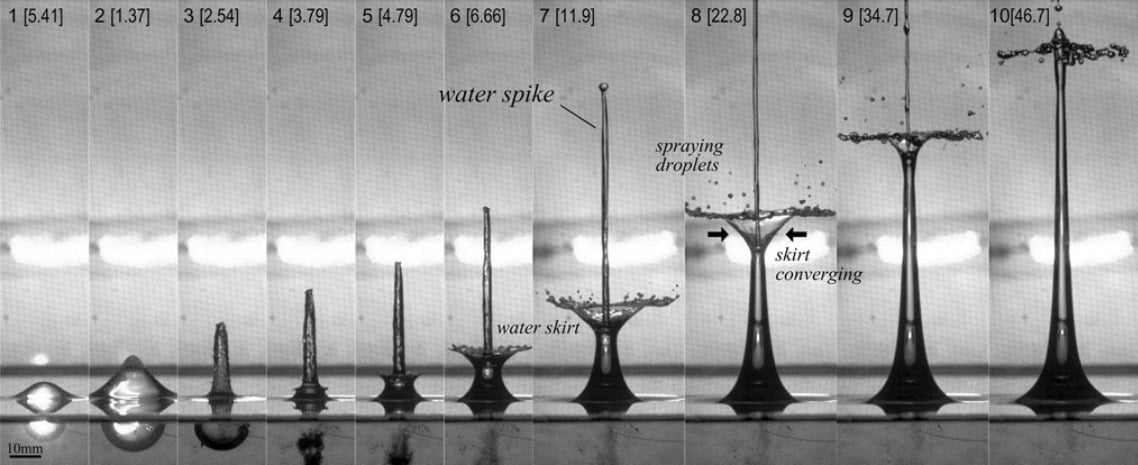
A bubble initiated near a free surface–like the air-water interface here–can generate some spectacular dynamics. Beginning at the far left, the expanding subsurface bubble causes a dome at the surface that sharpens into a spike. By Frame 3, the bubble is collapsing but overshoots and rebounds, which introduces the tiny instability in Frame 4 that grows in subsequent time steps to form the water skirt that surrounds the spike. Although generated entirely differently, the end result is reminiscent of the water sculptures made by artists like Marcus Reugels, Corrie White, Jack Long, and others. (Image credit: A. M. Zhang et al.)
Fluids Round-up – 20 October 2013
Some very cool fluids applications in this week’s fluids round-up. On to the links!
- Like many colleges, MIT has campus myths about those unbelievably windy spots. But, unlike many others, they have a CFD analysis deconstructing the myths.
- Even rocks can behave like fluids sometimes. Check out this article from @s_i_r_h_c on fluid instabilities left behind in rocks.
- Reader Julian de Charentenay demonstrates some DIY aerodynamic analysis on Pixar’s Lightning McQueen. One of the neat features here is using photos of an object to construct a 3D model, a technique I used in my own research at one point.
- Physics.org explains why teapots drip.
- Phys.org reviews a paper suggesting that fluid dynamics influenced the evolution of lung structure.
- io9 discusses new research on how the brain gets rid of waste products, which includes experiments with flow visualization in mice brains.
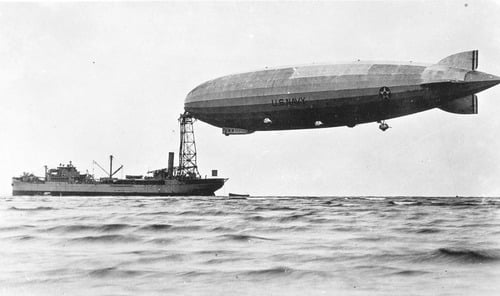
- Finally, our lead image shows the airship USS Los Angeles moored to the USS Patoka and comes from The Atlantic’s In Focus series on airships past and present.
ETA: I somehow forgot to include the first of the upcoming APS presentations to get wide media recognition: Law of Urination, which has shown up all over the place.
(Photo credit: San Diego Air and Space Museum Archive/In Focus)

The Cheerios Effect and Tiny Swimmers
Anyone who has eaten a bowl of Cheerios is familiar with the way solid objects floating on a liquid surface will congregate. This is a form of capillary force driven by the wetting of the particles, surface tension, and buoyancy. Using ferromagnetic particles and a vertical magnetic field, one can balance capillary action and lock the particles into a fixed configuration relative to one another. By adding a second, oscillating magnetic field, it’s possible to make the beads dance and swim together. Like all of this week’s videos, this video is an entry in the 2013 Gallery of Fluid Motion. (Video credit: M. Hubert et al.)
Overflowing Foam
Hitting a glass bottle full of a non-carbonated drink can shatter the bottle due to cavitation, but doing the same with a carbonated beverage can make the bottle overflow with foam. The video above breaks down the physics of this bar prank. It all begins with nucleation and the tiny bubbles of carbon dioxide that form in the liquid. Striking the top of the bottle generates a compression wave that travels through the liquid, shrinking bubbles as it passes. When it hits the bottom of the bottle, it gets reflected as an expansion wave that expands the bubbles. This reflection happens several times between the free surface of the liquid and the bottom of the bottle. The rapid collapse-and-expansion of the bubbles makes them implode into a cloud of tinier bubbles that expands until the local supply of carbon dioxide is used up. At this point, the buoyancy of the bubbles carries them upward in plumes, creating more bubbles with the dissolved carbon dioxide nearby. And, all of a sudden, you’ve got foam everywhere. Like all of this week’s videos, this video is an entry in the 2013 Gallery of Fluid Motion. (Video credit: J. Rodriguez-Rodriguez et al.)
Self-Propelled Droplets
Leidenfrost drops hover and move above hot surfaces on a thin layer of their own vapor. Over a flat surface, this vapor flows radially out from under the droplet, but creating rachets in the surface forces the vapor to flow in a single direction. The vapor then acts like exhaust, generating propulsion in the droplet and making it roll. How quickly the drop moves depends both on the droplet’s size and the rachets’ aspect ratio. For a given length, deeper rachets propel a drop faster than their shallower counterparts. The droplet’s size also affects the thrust with different scalings depending on the drop’s initial size. Like all of this week’s videos, this video is an entry in the 2013 Gallery of Fluid Motion. (Video credit: A. G. Marin et al.)
Fluid Juggling
It’s that time of the year – the 2013 APS Division of Fluid Dynamics meeting is not far off, and entries to this year’s Gallery of Fluid Motion are starting to appear. This week we’ll be taking a look at some of the early video submissions, beginning with one that you can recreate at home. This video demonstrates a neat interaction between a slightly-inclined liquid jet and a lightweight ball. The jet can stably support–or, as the authors suggest, juggle–the ball under many circumstances, as seen in the video. Initially, the jet impacts near the bottom of the ball and then spreads into a thin film over the surface. This decrease in thickness between the jet and the film is accompanied by an increase in speed due to conservation of mass. That velocity increase in the film corresponds to a pressure decrease because of Bernoulli’s principle. This means that there is a region of higher pressure where the jet impacts the ball and lower pressure where the film flows around the ball. Just as with airflow over an airfoil, this generates a lift force that holds the ball aloft. (Video credit: E. Soto and R. Zenit)
Fluids Round-up – 13 October 2013
There were so many good fluids links this week that I decided for an off-week fluids round-up. Here we go!
- Jefferson Lab has a cool demo on how to make a cloud chamber using dry ice, isopropyl alcohol, and a radioactive source. There is all kinds of fun physics to explain in this one!
- io9 has a great article and videos on the efficiency of jellyfish propulsion (spoiler alert: there are vortex rings).
- Half-blimp, half-jet transport option could change shipping landscape. In a similar vein, Jalopnik takes a look back at the golden age of the dirigible.
- For the armchair daredevils, check out this 360-degree view of BASE jumping with a wingsuit off a Swiss mountain. (via Janeen M)
- Also from io9, an article on my favorite fluids demo: reversible laminar flow. If you’d like to try this at home, here’s a DIY version.
- National Geographic talks about the differences between hurricanes, cyclones, and typhoons.
- Finally, our lead video comes from #5facts and Sesame Street’s Grover who bring us 5 DIY science experiments, 4 of which are fluids demos. Sit back and enjoy!
(Video credit: #5facts/Sesame Street)
Schlieren in Flight
Schlieren photography is a common method of visualizing shock waves in wind tunnel experiments, but it’s much harder to pull off for aircraft in the sky. This video from NASA shows off some stunning work out of NASA Dryden capturing schlieren video of shock waves from a F-15B aircraft at Mach 1.38. You’ll notice that shock waves extend off the nose, wings, tail, and other parts of the airplane and extend well beyond the camera’s field of view. It’s these shock waves hitting the ground level that causes distinctive sonic booms. These tests are part of NASA’s on-going research into minimizing the effects of sonic boom so that civilian supersonic flight over land is feasible in the future. When the U.S. government shutdown ends, you’ll be able to learn more about this work at NASA Dryden’s GASPS page. (Video credit: NASA Dryden)

Fluids Round-up – 5 October 2013
This is the last week that my IndieGoGo project is open for donations. All money above and beyond what is needed for the conference will go toward FYFD-produced videos. Also, donors can get some awesome FYFD stickers.
As a reminder, those looking for more fluids–in video, textbook, or other form–can always check out my resources page. And if you know about great links that aren’t on there, let me know so that I can add them. On to the round-up!
- Popular Science has look at what it was like to fly on the Concorde, the only supersonic commercial airliner ever flown.
- For the cyclists and CFD folks out there, Zipp has put out a new video discussing their Firecrest wheels’ aerodynamics.
- io9 explains how superhydrophobic surfaces impart a charge to water droplets and how this can be used to increase efficiency at power plants.
- BuzzFeed UK has 32 fun science GIFs, several of which are fluids-related, and several of which will look familiar to long-time readers. (via Flow Visualization on FB)
- Wired has an intriguing short on Acoustic Archives, a group that focuses on capturing the acoustic qualities of historic locations using custom-designed 3D microphones.
- Congratulations to Richard over at Flow Viz for hitting his 100th post! Here’s to many more.
- Finally, our lead image comes from Martin Klimas. Smithsonian’s blog has a feature on his work in which he transforms songs from artists like Pink Floyd, Daft Punk, and Bach into sonic sculptures using paint on speakers. (via Flow Visualization on FB)
I had a lot of fun earlier this week giving a talk for the Texas A&M Applied Mathematics Undergraduate Seminar series. I didn’t get a chance to record it, but the slides are up here if anyone is interested.(Photo credit: M. Klimas)