Search results for: “aerodynamics”

  • Formula 1 Aerodynamics

    [original media no longer available]

    Computational fluid dynamics (CFD) and the advent of supercomputing have forever changed the way engineers design. Here the use of CFD in the design of Formula 1 racing cars is discussed. Although CFD is used by many companies in place of wind tunnel testing, each method has its advantages.  CFD provides information about all flow quantities at all points in the flow but can only do so with an accuracy dependent on the grid and models used.  It remains impossible to solve the equations of motion exactly for any problem of practical application because the computational cost is simply too high; instead software packages like FLUENT utilize turbulence models that approximate the physics.  Wind tunnel testing, on the other hand, is physically accurate but typically yields only limited data and flow quantities due to the difficulty of instrumentation. (Video credit: BBC News; submitted by carhogg)

    (Source: /)
  • Featured Video Play Icon

    London 2012: Soccer Aerodynamics

    Corner kicks and free kicks are tough to defend in football (soccer for Americans) because the ball’s trajectory can curve in a non-intuitive fashion. Known as the Magnus effect, the fluid dynamics around a spinning ball cause this curvature in the flight path. When an object spins while moving through the fluid, it drags the air near the surface with it. On one side of the spinning ball, the motion opposes the direction of freestream airflow, causing a lower relative velocity, and on the opposite side, the spin adds to the airflow, creating a higher velocity. According to Bernoulli’s principle, this causes a lower pressure on the side of the ball spinning with the flow and a higher pressure on other side. This difference in pressure results in a force acting perpendicular to the direction of travel, causing the unexpected curvature in the football’s path. In the case of the corner kick above, the player kicks the ball from the right side, imparting an anti-clockwise spin when viewed from above. As the ball travels past the goal, air is moving faster over the side nearest the goal and slower on the opposite side. The difference in velocities, and thus pressures, creates the sideways force that drives the ball into the goal even without touching another player. The same effect is used in many other sports to complicate play and confuse opponents. In tennis and volleyball, for example, topspin is used to make the ball drop quickly after passing the net.

    ETA: Check out this other great example of a free kick sent in by reader amphinomos.

    FYFD is celebrating the Olympics by featuring the fluid dynamics of sport. Check out some of our previous posts including the flight of a javelin, how divers reduce splash, and what makes a racing hull fast.

  • Featured Video Play Icon

    London 2012: Running Aerodynamics

    Running is not an event typically associated with aerodynamics, though any runner will tell you that a headwind can slow them down.  For comparison, a swimmer on world record pace sees 40 to 50 times the drag force of a runner over the same distance. But despite the relatively small influence of drag on a runner, there are measurable effects due to wind and altitude when races are judged by hundredths of a second. Given this, it comes as no surprise that researchers (and presumably manufacturers) are starting to considering how to optimize aerodynamics in running. The video above describes results of a study on running shoes that suggests modest savings may be derived from shoes with dimpled surfaces, much like a golf ball. Socks, on the other hand, don’t show any aerodynamic savings from special surfaces. Of course, the bulk of a runner’s drag comes from their hair and clothing; this is, in part, why runners wear form fitting clothes. While there may be some aerodynamic savings to be had, I don’t think we’ll see world records falling like crazy in Rio because of the latest new shoes.

    FYFD is celebrating the Olympics by featuring the fluid dynamics of sport. Check out our previous posts on how the Olympic torch works, what makes a pool fast, the aerodynamics of archery, the science of badminton, how cyclists get “aero”, and how divers reduce splash.

  • Jump Rope Aerodynamics

    Jump Rope Aerodynamics

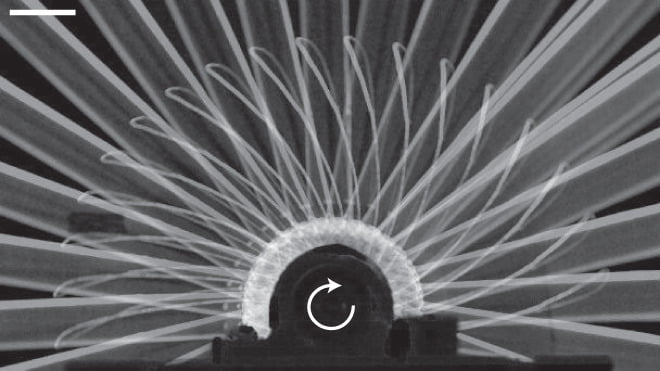
    Researchers have used high-speed video and numerical simulation to capture the effects of aerodynamics on jump roping. After videoing an athlete jumping rope and constructing a jump roping robot (shown above imaged multiple times with a strobe light), they found that the U-shaped tip of the jump rope bends away from the direction of motion. When they built a computer model capable of deforming the jump rope based on its drag, they found the same behavior. They concluded that the “best” jump ropes are lightweight, short, and have small diameters to maximize speed and minimize the drag. #

  • Featured Video Play Icon

    Aerodynamics with Bill Nye and Samuel L. Jackson

    Bill Nye, Samuel Jackson, golf balls, Reynolds number, dimples, and boundary layers. It doesn’t get much better than this. – Khristopher O (submitter)

    It definitely beats Jackson’s other foray into aerodynamics! The dimples on a golf ball cause turbulent boundary layers, which actually decrease drag on the ball and make it fly farther. Why bluff bodies experience a reduction in drag as speed (and thus Reynolds number) increases was a matter of great confusion for fluid mechanicians early in the twentieth century, but it’s not too hard to see why it happens with some flow visualization.

    On the top sphere, the laminar boundary layer separates from the sphere just past its shoulder. This results in a pressure loss on the backside of the sphere and, thus, an increase in drag. On the bottom sphere, a trip-wire placed just before the shoulder causes a turbulent boundary layer, which separates from the sphere farther along the backside. This late separation results in a thinner wake and a smaller pressure loss behind the sphere, thereby reducing the overall drag when compared to the laminar case. (Photo credit: An Album of Fluid Motion)

  • Pterosaur Aerodynamics

    Pterosaur Aerodynamics

    The pterosaur was an enormous prehistoric reptile that flew with wings of living membrane stretched over a single long bone, unlike any of today’s flying creatures. New research using carbon fiber wing analogues and wind tunnel testing suggests that the pterosaur would have been a slow, soaring flyer well adapted to using thermals for lift. Once on a thermal, the pterosaur could coast, perhaps for hours at a time, with little to no flapping necessary. See the research paper or the Scientific American article for more. #

  • Flying Fish Aerodynamics

    Flying Fish Aerodynamics

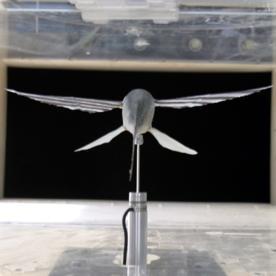
    New research using wind tunnel measurements of (dead) flying fish is giving new insight into how these fish are able to fly over the waves. Lift and drag data indicates that flying fish have a gliding ability comparable to soaring birds like hawks! #

  • Milano Cortina 2026: Ski Jumping Suits

    Milano Cortina 2026: Ski Jumping Suits

    Ski jumping is in the news this Olympic cycle after rumors that male competitors may be cheating in order to wear larger suits. In particular, the suggestion is that male athletes are injecting fillers into their genitals before their pre-season 3D body scan in order to appear large enough to allow them to wear a larger suit. This comes after two Norwegian ski jumpers were punished for illegally restitching the crotches of their suits to make them larger.

    Ski jumping is a sport that relies heavily on aerodynamics; during the flight phase, jumpers try to maximize their lift-to-drag ratio so that they stay aloft as long as possible. A 2025 study underscores the importance of suit size in this calculus. In the work, the researchers used a baseline suit that was 4 centimeters larger in circumference than their jumper–the loosest configuration that regulations allow. They compared that suit’s flight performance (in wind tunnels and simulation) to a suit 2 cm larger and one 2 cm smaller. The extra 2 centimeters of circumference made a notable difference: the larger suit increased the drag by ~4% and lift by ~5%. That was enough, in their simulation, to let a jumper fly an extra 5.8 meters.

    It’s worth noting, though, that the study was looking at the effects of adjusting the suit’s circumference along the entire length between the arm pits and the knees; they never changed anything about the suit’s crotch. I don’t think there’s enough scientific data to say that packing a bit more there would really offer aerodynamic advantages. And the risks of such injections are non-negligible. (Image credit: T. Trapani; research credit: M. Virmavirta et al.; via Ars Technica)

    A ski jumper in flight, viewed from behind.
    Fediverse Reactions
  • Gliding Like a Grasshopper

    Gliding Like a Grasshopper

    Many biorobots are built after flies and bees–insects that rely heavily on flapping flight. For small robots, this means carrying heavy batteries or remaining tethered in order to power their motors. Instead, researchers have turned to grasshoppers for a lesson in small-scale gliding.

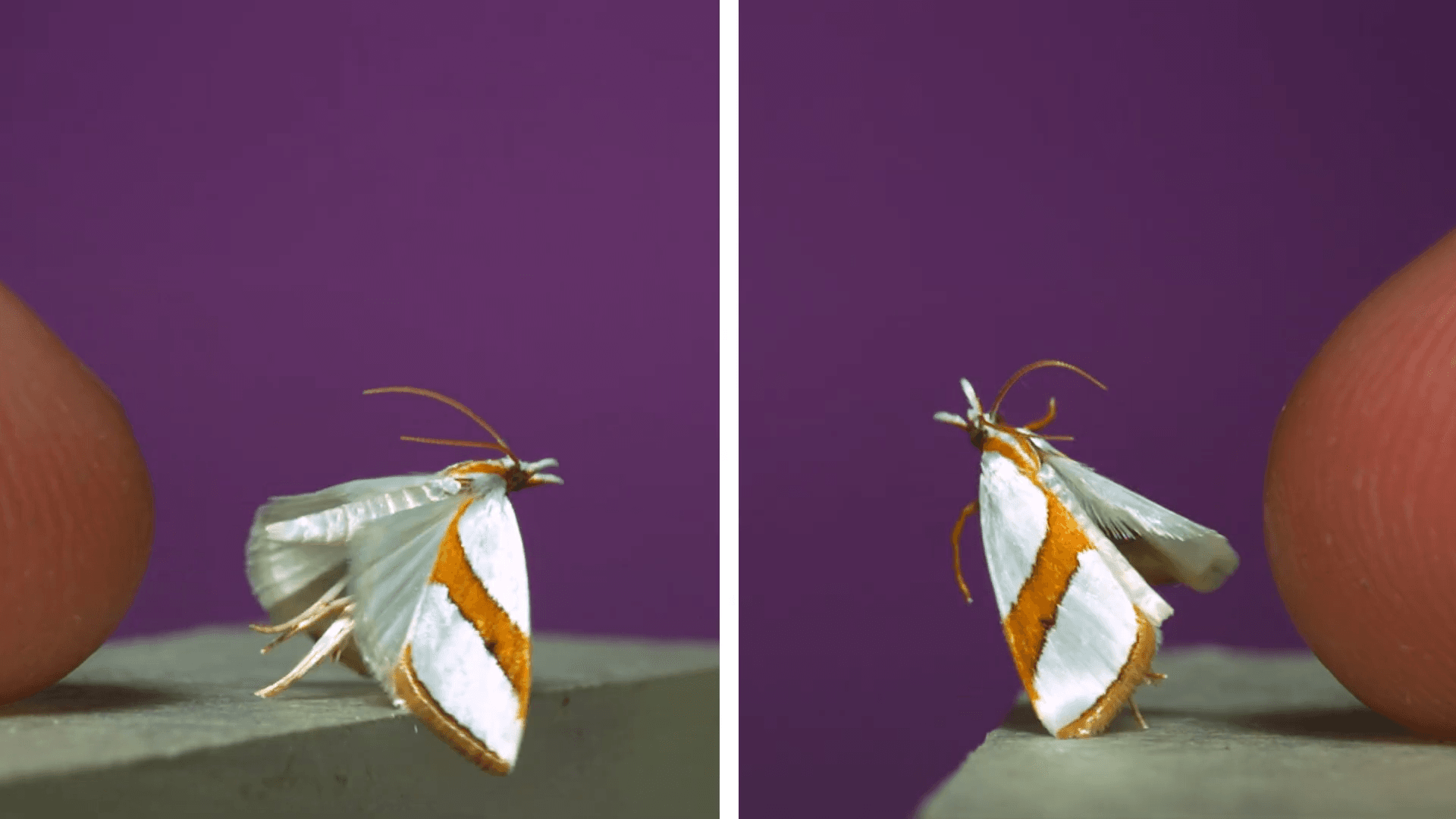
    Grasshoppers have two sets of wings. The forward set provide protection and camouflage, while the hindwings are used to fly. The team studied the corrugated, foldable hindwings of the American grasshopper, then 3D-printed model wing designs and attached them to gliders. They found that the corrugated wings performed well at low angles of attack, but that non-corrugated wings–which still shared the outline and camber of the insect’s wings–were more efficient gliders over a range of conditions.

    The team hopes that their grasshopper-inspired gliders give insect-like biorobots more efficient flying options. (Image credit: Princeton/S. Khan/Fotobuddy; research credit: K. Lee et al.; via Physics World)

    Fediverse Reactions
  • Escape From Yavin 4

    Escape From Yavin 4

    In an ongoing tradition, let’s take another look at some Star Wars-inspired aerodynamics. This year it’s the TIE fighter’s turn. Here, researchers simulate the spacecraft trying to escape Yavin 4’s atmosphere at Mach 1.15. The research poster’s blue contours show pressure contours, with darker colors connoting higher pressures. The bright low pressure region immediately behind the craft suggests a difficult, high-drag ascent and a turbulent, subsonic wake despite the craft’s supersonic velocity. (Image credit: A. Martinez-Sanchez et al.)

    Fediverse Reactions