Category: Research

  • Chains of Salps

    Chains of Salps

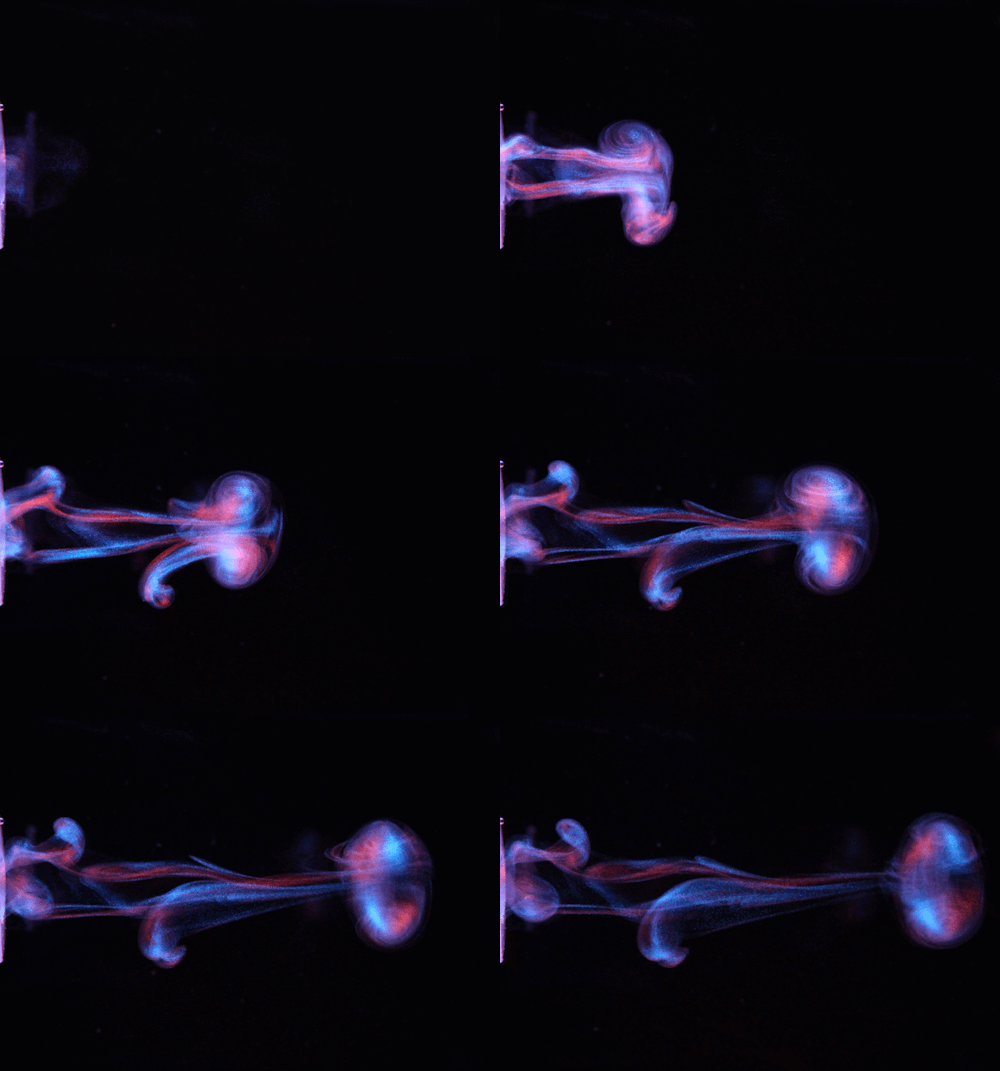
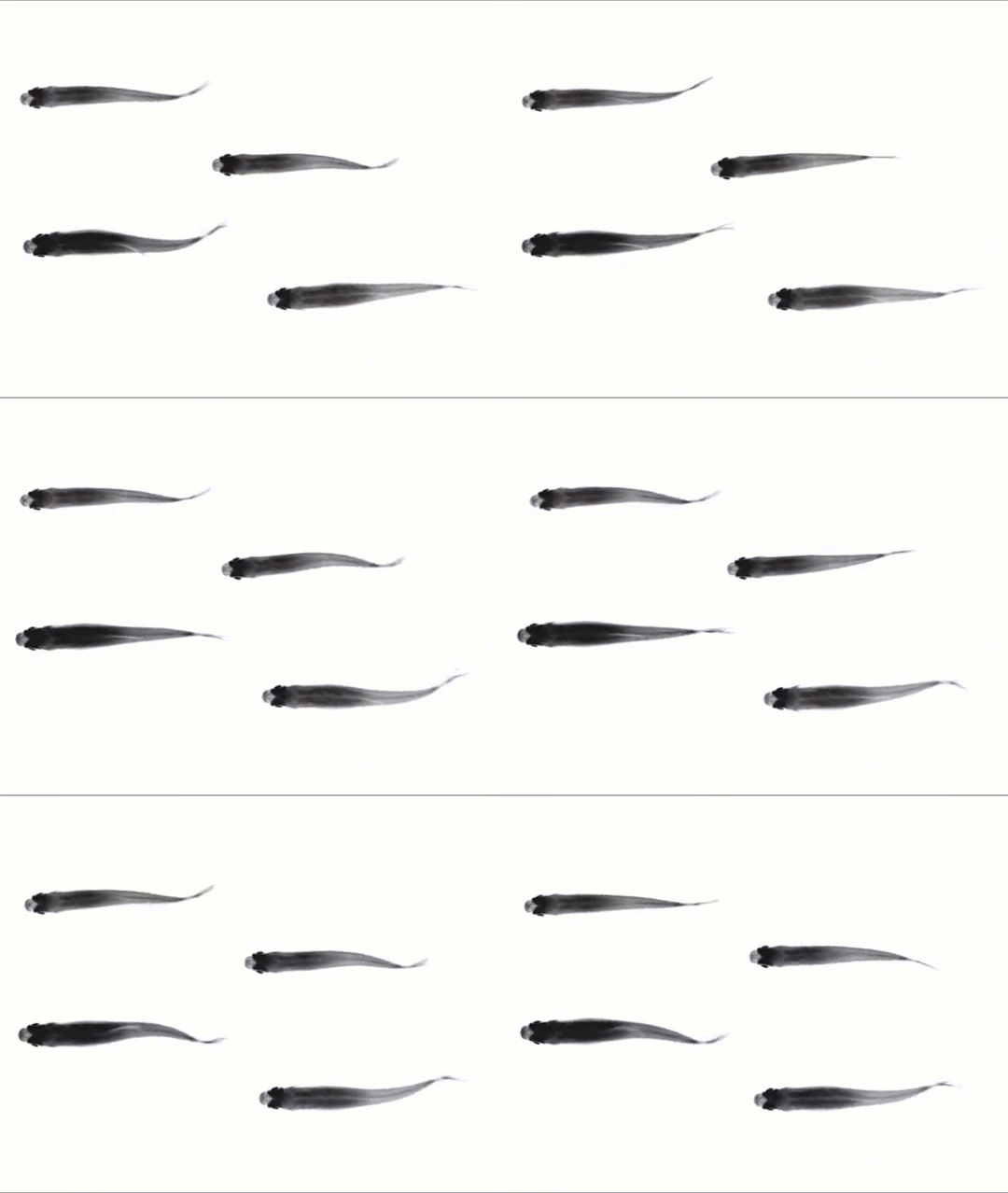
    Salps are small, jellyfish-like marine invertebrates that swim by ejecting a pulsatile jet. They are unusual creatures whose lives have two major stages: one in which salps swim individually and one in which they link together and swim in large chains. In the chain, salps don’t synchronize their jetting; each salp jets with its own phase and frequency. A new study suggests that, in spite of this lack of synchronicity, the salp chain’s swimming reduces the animals’ drag. There are several  factors that contribute to this result. One is that drag is generally lower on a body moving at constant speed compared to one moving in bursts. When linked together and firing randomly, all the individual jets tend to average out into one continuous swimming speed. There’s even a benefit to being out of sync: previous work showed that synchronized jets lose some of their thrust when they are too close together. Salps avoid that loss by keeping to their own beat. (Image and research credit: K. Sutherland and D. Weihs, source; via Gizmodo)

  • Wrinkling Drops

    Wrinkling Drops

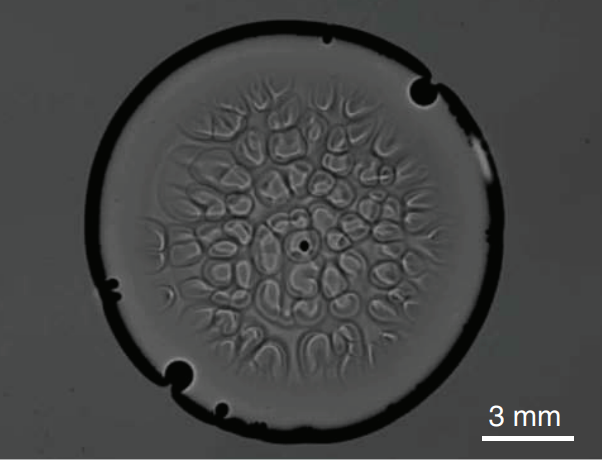
    When a viscous drop falls into a pool of a less viscous liquid, the drop can deform into some beautiful and complex shapes. Typically, shear forces between the drop and its surroundings cause a vortex ring to roll up and advect downward, thereby stretching the remainder of the drop into thin sheets that can buckle and wrinkle. Here the drop is about 150 times more viscous than the pool and impacts at 1.45 m/s, making a rather energetic entry. The vortex ring (not visible) has stretched the drop’s remains downward while a buoyant bubble caught by the impact pulls some of the drop back toward the surface. As a result, the thin sheets of the drop’s fluid are buckling and folding back on themselves like an elaborate and delicate glass sculpture. This entire paper is full of gorgeous images and videos. Be sure to check them out! (Image and research credit: E. Q. Li et al.; see supplemental info zip for videos)

  • Featured Video Play Icon

    When Fire Ants are a Fluid

    Substances don’t have to be a liquid or a gas to behave like a fluid. Swarms of fire ants display viscoelastic properties, meaning they can act like both a liquid and a solid. Like a spring, a ball of fire ants is elastic, bouncing back after being squished (top image). But the group can also act like a viscous liquid. A ball of ants can flow and diffuse outward (middle image). The ants are excellent at linking with one another, which allows them to survive floods by forming rafts and to escape containers by building towers. 

    Researchers found the key characteristic is that ants will only maintain links with nearby ants as long as they themselves experience no more than 3 times their own weight in load. In practice, the ants can easily withstand 100 times that load without injury, but that lower threshold describes the transition point between ants as a solid and ants as a fluid. If an ant in a structure is loaded with more force, she’ll let go of her neighbors and start moving around.

    When they’re linked, the fire ants are close enough together to be water-repellent. Even if an ant raft gets submerged (bottom image), the space between ants is small enough that water can’t get in and the air around them can’t get out. This coats the submerged ants in their own little bubble, which the ants use to breathe while they float out a flood. For more, check out the video below and the full (fun and readable!) research paper linked in the credits. (Video and image credits: Vox/Georgia Tech; research credit: S. Phonekeo et al., pdf; submitted by Joyce S., Rebecca S., and possibly others)

    ETA: Updated after senoritafish rightfully pointed out that worker ants are females, not males. 

  • Squishy Impacts

    Squishy Impacts

    How spheres impact water has been studied for more than a century. The typical impact for a rigid sphere creates a cavity like the one on the upper left – relatively narrow and prone to pinching off at its skinny waist. If the sphere is elastic –squishy – instead, the cavity ends up looking much different. This is shown in the upper right image, taken with an elastic ball and otherwise identical conditions to the upper left image. The elastic ball deforms; it flattens as it hits the surface, creating a wider cavity. If you watch the animations in the bottom row, you can see the sphere oscillating after impact. Those changes in shape form a second cavity inside the first one. It’s this smaller second cavity that pinches off and sends a liquid jet back up to the collapsing splash curtain

    From the top image, we can also see that the elastic sphere slows down more quickly after impact. This makes sense because part of its kinetic energy at impact has gone into the sphere’s shape changes and their interaction with the surrounding water. 

    If you’d like to see more splashy stuff, be sure to check out my webcast with a couple of this paper’s authors. (Image credits: top row – C. Mabey; bottom row – R. Hurd et al., source; research credit: R. Hurd et al.)

  • Leaping Droplets

    Leaping Droplets

    Many fungi use coalescing water droplets to launch and spread their spores. The process is recreated in the laboratory in the animation above. Initially, there is a small spherical drop and a second, flattened drop stuck to the backside of the spore. In the animation, the large object on the right is actually both spore and droplet. The spore is spherical on one side and flattened on the other and starts out tipped up on its edge. When the spherical drop gets large enough to reach the flattened drop, they merge. This reduces the total surface area of the drop and thus releases some surface energy. It’s that surface energy that drives the spore’s jump. Even launching just a centimeter away from the host fungus is enough for a breeze to carry the spore further, allowing the fungus to reproduce.  (Image and research credit: F. Liu et al., source; submitted by Kam-Yung Soh)

  • Featured Video Play Icon

    The Hydraulics Behind a Tuna’s Turns

    Tuna are remarkably agile for their size. Many species reach lengths exceeding the height of a human adult, yet they can still make tight turns, especially when hunting. A recent study described one mechanism that aids the fish – a built-in hydraulic system for raising its second dorsal and anal fins. The tuna use fluid from their lymphatic system – which produces and transports white blood cells in both humans and tuna – to pressurize chambers at the base of some fins, causing the fin to rise. The extra support puts the fin in a hydrodynamically advantageous position and helps stabilize the fish when turning quickly, allowing them to change direction without slowing. (Video credit: Science; research credit: V. Pavlov et al.)

  • Watching Flow Inside Rock

    Watching Flow Inside Rock

    Flow through porous substances has been a major interest in fluid dynamics for the last hundred years because rocks are porous. For most of that period, we’ve used Darcy’s law to calculate how a fluid flows through pores in a rock. (Incidentally, it can also be used for determining the perfect length of time for dunking a cookie in milk.) Often, however, there is more than one fluid in a pore – for example, both a liquid and a gas could be trapped there. In that case, researchers made a few assumptions that allowed them to extend Darcy’s law for these multiphase situations. For a long time, that was the best anyone could do because it was impossible to observe what’s actually happening in the pores inside an actual rock.

    Recently, however, scientists have begun observing these multiphase flows inside sandstone pores using x-ray imaging. They’re only able to take an image every 45 seconds or so, but even that is frequent enough to show that the flow is surprisingly unsteady. An example image is shown above. The colored areas show pores filled with nitrogen inside the rock. Brine is also being injected into the rock but not being shown. The colors indicate how connected the nitrogen-filled pores are to other pores nearby. Red areas are highly connected; blue have moderate connections; and green areas are smaller and have fewer connections. The network connections inside the rock change relatively rapidly, even with steady-state injection conditions. That varying connectivity implies that some of the injection energy is going into shifting interfaces around rather than actually moving the fluids through the pores. More work will be needed to unravel what’s really happening inside the porous network, but the results have far-reaching implications for understanding groundwater filtration, fossil fuel extraction, and, in the future, the possibility of carbon sequestration. (Image credit: C. Reynolds et al., source; submitted by Simon D.)

  • Featured Video Play Icon

    The Elastic Leidenfrost Effect

    Drop some hydrogel beads in a hot frying pan and they’ll bounce, hiss, and screech. Normally, if you drop a ball, it bounces to ever smaller heights until it comes to rest. In contrast, on a hot surface the hydrogel can bounce to a steady height for minutes at a time, raising a question: where does it get the energy for its incessant bounce? 

    Upon close examination of the impact, researchers found the hydrogel beads are actually slapping the surface over and over on each bounce. The frequency of the slapping exactly matches that of the audible screech, so what you’re actually hearing is this bounce-slap. Now what causes the slapping?

    Contact with the hot surface vaporizes some of the water inside the hydrogel. If it were a droplet, this vapor would form a thin, almost frictionless layer the droplet could glide on; that’s the classic Leidenfrost effect. Here the shell of the bead prevents that until the pressure really builds up. When the pressure gets high enough, the vapor finally escapes, opening up a gap. As the gap reaches its largest point, the bead rebounds elastically, bringing it back in contact with the surface and starting the process again. Each of these cycles acts like a tiny engine, harvesting energy that drives the larger bounce. This elastic Leidenfrost effect may be particularly helpful in soft robotics, providing robots with a new mechanism for movement. (Image and video credit: S. Waitukaitis et al.,arXiv)

  • Equatorial Streaming

    Equatorial Streaming

    Here you see a millimeter-sized droplet suspended in a fluid that is more electrically conductive than it. When exposed to a high DC electric field, the suspended drop begins to flatten. A thin rim of fluid extends from the drop’s midplane in an instability called “equatorial streaming”. As seen in the close-up animation, the rim breaks off the droplet into rings, which are themselves broken into micrometer-sized droplets thanks to surface tension. The result is that the original droplet is torn into a cloud of droplets a factor of a thousand smaller. This technique could be great for generating emulsions of immiscible liquids–think vinaigrette dressing but with less shaking! (Image credit: Q. Brosseau and P. Vlahovska, source)

  • Break-Up of the Chelyabinsk Meteor

    Break-Up of the Chelyabinsk Meteor

    In 2013, a meteor about 20-meters in diameter broke up over Chelyabinsk, Russia in a dramatic display that damaged buildings within 100 km and injured more than 1200 people. To better understand the threat presented by such objects, NASA has been conducting 3D, hypersonic simulations like the one shown here. The meteor material is shown in gray and black. Brighter colors like red and yellow indicate the hot, high-pressure shock wave caused when the meteor slams into the atmosphere. Aerodynamic effects quickly erode the meteor, ripping it into pieces that disperse energy explosively in the atmosphere. While you might think the meteor breaking up is good for us, it’s actually the blast waves from its break-up that cause the most damage.  (Image and video credit: NASA, source; via Gizmodo)