Category: Research

  • Eroding Candy

    Eroding Candy

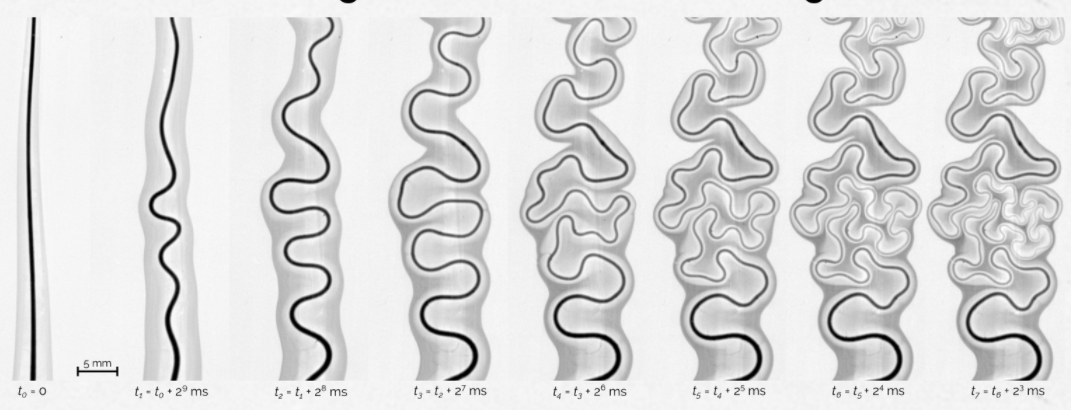
    When you pop a hard candy in your mouth, you probably don’t give much thought to the fluid dynamics involved in dissolving it. The series above shows a hard candy suspended in water being slowly eaten away. As sugars in the candy dissolve into the water, the fluid becomes denser and falls away. This creates the downward flow visible in the center of the image. As sugar-laden water sinks, fresher water is pulled in alongside the walls of the candy. That flow helps erode the candy, creating a rougher surface. Since rough surfaces have a greater surface area exposed (than a smooth surface), they prompt further and faster dissolution. That strengthens the downward flow, pulls in more ambient water, and keeps the whole process going. (Image credit: M. Wykes)

  • Stabilizing Films

    Stabilizing Films

    Liquids don’t typically survive very long as thin films. If you try to make one from water, gravity drains it away immediately. (Not so in space.) To make a liquid film stick around, we add surfactants like soap. These extra molecules congregate at the surface of the film and provide a stabilizing force to oppose gravity’s drainage. Exactly what that stabilizing force is depends on the surfactant.

    Surfactants that are insoluble are often quite viscous. These molecules distribute themselves across the interface and then they stay. They resist both gravity or even just moving thanks to their high viscosity. That produces a soap film pattern like the one on the right – symmetric and slow to change.

    Other surfactants may be soluble in the film and have no appreciable viscosity themselves. These surfactants constantly move and shift on the interface as surface tension variations occur. When weak spots form, the surfactant molecules shift, via the Marangoni effect, to stabilize the film. This creates a film pattern like the familiar one on the right, with an ever-shifting palette of colors. (Image and research credit: S. Bhamla et al., source; submission by S. Bhamla)

  • Inside Ink Jet Printing

    Inside Ink Jet Printing

    Inkjet printers produce droplets at an incredible rate. A typical printhead generates droplets that are about 10 picoliters in volume – that is, ten trillionths of a liter – moving at about 4 meters per second. Resolving the formation of those droplets would require ultra-high speed imaging at millions of frames per second. Instead researchers devised an alternative method to capture droplet formation, based on stroboscopic techniques. In this case the strobe is a 7 nanosecond laser pulse (7 billionths of a second) that illuminates a given droplet twice. By doing this for many droplets, the researchers can create a highly detailed time series like the one above, which shows the inkjet breakup and droplet formation. Here each droplet is 23 micrometers wide – about one-third the width of a human hair. (Image credit: A. van der Bos et al., source)

  • A Drip’s Vortex

    A Drip’s Vortex

    Drip food coloring into water and you can often see a torus-shaped vortex ring after the drop’s impact. That vortex rings form during droplet impact has been well known for over a century, but only recently have we begun to understand the process that leads to that vortex ring. Part of the challenge is that the vortex formation is very small and very fast, but recent work with x-ray imaging has allowed experimentalists to finally capture this event.

    When a drop impacts a pool, surface tension draws some of the pool liquid up the sides of the drop. At the same time, the impact causes ripple-like capillary waves down the sides of the drop. This causes pool liquid to penetrate sharply into the drop, triggering the spirals that mark the forming vortex ring. When drops impact with even higher momentum, multiple vortex spirals can form, as seen on the lower right image. The authors observed as many as four rings during an impact. For more, check out the (open access) article.  (Image and research credit: J. Lee et al., source)

  • Self-Propelled Hovercraft

    Self-Propelled Hovercraft

    When placed on an extremely hot substrate, some drops levitate and can be propelled over specially textured surfaces. Inspired by this work, researchers are using similar principles to explore manipulation of levitating plates using surface texture. Their apparatus consists of a semi-porous, grooved surface that ejects air upward to levitate Plexiglas objects – think air hockey table with grooves. With enough airflow, the Plexiglas levitates. The grooves force air in a particular direction – in the case of the herringbone pattern, this is in the direction of opening – and, as the air moves, it drags its Plexiglas hovercraft along. As shown in the second animation, grooves can do more than move the glass linearly; with patterns offset by 90-degrees, they can make the hovercraft rotate.

    Here’s an interesting next step for anyone out there with an air hockey table and a 3D printer: does the directional manipulation work if the grooves are on the object and not the table? In other words, can you create an air hockey puck that preferentially goes to your opponent’s goal? (Image and resource credit: D. Soto et al., source)

  • Superhydrophobic Splashes

    Superhydrophobic Splashes

    Superhydrophobic surfaces have a complicated microscale structure that changes how water interacts with them, like the hairs on a lotus leaf or the scales of a butterfly’s wing. The photo above shows snapshots at each millisecond as a water drop hits a superhydrophobic surface covered in rows of 18 micron-tall posts. The drop hits with enough speed to drive some water into the space between posts, as shown by the dark area near the center of the splash. As the rest of the droplet spreads, four microjets form along the directions of the micropost array. Those jets remain apparent until the drop reaches its maximum radius and starts to recoil. The rectangular shape of the post array affects how the water pulls away from the surface, or depins, causing the round droplet to instead take on a square-like shape as it pulls back. (Image credit: M. Reyssat et al.)

  • The Perseus Cluster’s Bay

    The Perseus Cluster’s Bay

    The Perseus cluster is a group of galaxies in the constellation Perseus. When viewed in x-ray, the cluster includes a concave feature known as the “bay”, shown in the white oval of the upper left image. A recent study uses x-ray and radio observations and computer simulations to argue that this feature is, in fact, a Kelvin-Helmholtz wave, like the breaking wave clouds that appear here on Earth.

    The simulations start with a cluster similar to Perseus, with a “cold” core of gas about 30 million degrees Celsius and an outer gas region about three times hotter. A second galaxy cluster moves by, just grazing Perseus, and sets its cold gas to sloshing in an expanding spiral. After about 2.5 billion years, the difference in velocity between the cold and hot gases results in a Kelvin-Helmholtz wave near the outer arm of the spiral. One such simulation is shown in the upper right. The Kelvin-Helmholtz wave forms near the end of the cycle at a roughly 2 o’clock position. 

    If the bay is, in fact, a Kelvin-Helmholtz roll, then this is fluid dynamics on an almost unimaginable scale. That wave is about 160 thousand light-years across! (Image credits: Perseus cluster and movie – Chandra X-Ray Observatory; simulation – John ZuHone/Harvard-Smithsonian Center for Astrophysics; research credit: S. Walker et al.; via Vince D.)

  • Spots of Turbulence

    Spots of Turbulence

    One of the enduring mysteries of fluid dynamics lies in the transition between smooth laminar flow and chaotic turbulent flow in the area near a wall. That region, known as the boundary layer, has a major impact on drag and other effects. The process begins with disturbances that are too tiny to see or measure, but eventually, those disturbances can grow large enough to generated an isolated turbulent spot, like the one imaged above. Flow in the photograph is from left to right. Turbulent spots have a distinctive wedge-like shape that expands as the spot grows and widens. These turbulent spots can merge together to create still larger spots, and when a surface eventually becomes completely covered in them, we call it fully-developed turbulent flow. (Image credit: M. Gad-El-Hak et al.)

  • The Coalescence Cascade and Surfactants

    The Coalescence Cascade and Surfactants

    Drops of a liquid can often join a pool gradually through a process known as the coalescence cascade (top left). In this process, a drop sits atop a pool, separated by a thin air layer. Once that air drains out, contact is made and part of the drop coalesces. Then a smaller daughter droplet rebounds and the process repeats.

    A recent study describes a related phenomenon (top right) in which the coalescence cascade is drastically sped up through the use of surfactants. The normal cascade depends strongly on the amount of time it takes for the air layer between the drop and pool to drain. By making the pool a liquid with a much greater surface tension value than the drop, the researchers sped up the air layer’s drainage. The mismatch in surface tension between the drop and pool creates an outward flow on the surface (below) due to the Marangoni effect. As the pool’s liquid moves outward, it drags air with it, thereby draining the separating layer more quickly. The result is still a coalescence cascade but one in which the later stages have no rebound and coalesce quickly. (Image and research credit: S. Shim and H. Stone, source)

    image
  • Self-Digging Seeds

    Self-Digging Seeds

    Some plants in the Pelargonium family produce seeds with long helical tails. These appendages, formally known as awns, are humidity-sensitive. On humid nights or after rainfall, the awn begins to straighten. With its end anchored on the ground, this unfurling spins the seed and helps it burrow into the soil. A study looking at the physics of this system found that rotating reduces the drag a burrowing seed experiences in a granular material. Normally much of the force that opposes motion into a granular material is the result of intergranular contacts creating what are known as force chains. (Many science museums have great displays that visualize force chains.) The rotating seed drags grains near its surface along with it, helping to break up the force chains and reduce resistance. (Image and research credit: W. Jung et al., source)