Category: Reader Questions

  • Reader Question: Fire as a Fluid?

    Reader Question: Fire as a Fluid?

    Reader David L asks:

    I understand that fire is a form of energy rather than a fluid in the physical/tangible sense. However, is it possible for fire to exhibit fluid-like behaviours to a certain extent.

    In other words, could the dynamic properties of fire be described with pseudo-variables analogical to variables that describe a physical fluid (i.e. viscosity, density, Re, etc.)?

    Actually, combustion is a major topic of research among fluid dynamicists. Since the part of fire that we identify as visible flame is a reacting mixture of gas and some solid particles, it moves according to the same equations of motion as any other gas. However, when studying combustion thermodynamical equations and chemical reactions must also be tracked in addition to mass and momentum, which makes modeling fire very difficult. Combustion plays a major role in internal flows like those in car, jet, and rocket engines. (Photo credit: master.blitzy)

  • Reader Questions: What Majors Study Fluids?

    squky asks:

    Your blog has truly inspired me to want to major in the field of fluid dynamics, and for that I wholeheartedly thank you. But I’m having some confusion over which discipline (major) it falls under. Would it fall under physics or engineering? And if engineering, which type? (My two-year college doesn’t have an engineering department or much of an upper-level physics department, so there’s little guidance on the particulars.) If you can give me some clarification it would help me a lot.

    Firstly, that’s awesome! I’m thrilled that FYFD has been inspiring as that is one of its goals. The study of fluid dynamics is remarkably interdisciplinary. Researchers who study it can be found most often in physics, engineering, theoretical mechanics, and mathematics departments, though also in meteorology, chemistry, planetary science, or even biology. Which one is most likely depends on the school.

    Traditionally, fluid mechanics falls under the topic of classical physics but many physics departments focus on modern physics instead. Mechanical and aerospace engineering departments are the most common places to study fluid dynamics–unlike physicists who moved on to quantum mechanics and relativity, engineers have to understand fluid dynamics due to its practicality and applications. Chemical and civil engineers may also study fluid mechanical topics for these reasons. And because the mathematics of fluid dynamics are so rich and full of unsolved problems, mathematicians are also drawn to the subject.

    I would recommend looking into the research interests of the professors in your physics and mathematics departments and see if there’s anyone studying fluid dynamics there already. Even if there isn’t, take what courses you can in physics, calculus, partial differential equations, and numerical methods. All of those will stand you in good stead when looking for further programs down the line.

  • Reader Question: Creeping Flow

    [original media no longer available]

    David asks:

    I’m taking an undergraduate fluid dynamics course, and I’m having trouble understanding what a Creeping Flow exactly is. The only thing I understand about that is that the Re should be 0 or close to 0 for the flow… Could you post an example of a creeping flow please? Thank you!

    Absolutely! Creeping flow, also called Stokes flow, is, like you said, a very low Reynolds number flow. It would be hard to say that the Reynolds number is zero because that would seem to imply no flow at all. Think of it instead as a Reynolds number much, much less than one. When the Reynolds number is very low, it means that viscous forces are dominating the flow. The video above shows creeping flow around a cylinder; notice how the streamlines stay attached all the way around the surface of the cylinder.  There’s no separation, no turbulent wake, no von Karman vortex street. Viscosity is so dominant here that it’s damped out all of that inertial diffusion of momentum.

    We’ve posted some other great examples of creeping flow, as well, though not by that name. There are the reversible laminar flow demos and various experiments in Hele-Shaw cells, all of which qualify as creeping flow because of their highly viscous nature. If you have the time, there’s also a great instructional video from the 1960s called “Low Reynolds Number Flow” (Parts 1, 2, 3, 4) starring G. I. Taylor (a famous fluid dynamicist) that is full of one demo after another.

  • Reader Question: Rocket Propulsion

    Reader Question: Rocket Propulsion

    staunchreality-deactivated20120 asks:

    Hey there – Love the blog. Most interesting science blog I follow 🙂 This may be a silly question – is propulsion through space purely a function of exit velocity and catching gravity slingshots around planets, or is there enough of anything to push against for rocket propulsion?

    Thanks! Glad you enjoy the blog. And your question is not silly at all.

    Whether in the atmosphere or not, rocket engines always operate on the same principle: Newton’s 3rd law.  For every force exerted, there is an equal and opposite reaction force.  For a rocket, this means that the momentum of the rocket exhaust provides forward momentum–thrust–for the rocket.  When acting in an atmosphere, the exhaust doesn’t push against the atmosphere in order to move the rocket–in fact, rockets have to overcome aerodynamic drag when in the atmosphere, which opposes their thrust.

    While the operating principle of a rocket remains the same regardless of its surrounding, the ambient pressure (essentially zero in space and non-zero in an atmosphere) does affect the efficiency of the rocket’s nozzle, which can affect the exit velocity of the exhaust, and, thus, the efficiency of the rocket. Under ideal conditions, the exhaust should exit the nozzle at the same pressure as the ambient conditions–whatever they are. If the exhaust pressure is lower than the ambient, the exhaust can separate from the nozzle, causing instabilities in the flow and potentially damaging the nozzle. On the other hand, if the exhaust pressure is too high, then there is exhaust that could be turned into thrust that is going to waste. Unfortunately, matching the exhaust pressure to the ambient pressure is a function of the geometry of the nozzle, which is usually fixed. Engineers of rockets intended to fly from within the atmosphere to space usually have to pick a particular altitude to design around and deal with the inefficiencies while the rocket flies at other ambient conditions.

    Outside of the physical mechanics of how thrust is produced, propulsion in space is dominated by the influence of orbital mechanics. Once in an orbit, a spacecraft will stay on that orbital path without expending any thrust.  To change between orbits, it is necessary for the spacecraft–rocket or otherwise–to change its velocity–typically referred to as delta-v–by firing an engine or thruster. It’s also possible to change orbits using the gravity of other celestial bodies (Jupiter is a popular one) to change a spacecraft’s delta-v without expending propellant. However, fluid dynamics don’t play a big role in the process aside from the problems of fuel sloshing aboard the spacecraft and the actual mechanism by which thrust is produced.

    That said, if anyone is interested in getting a better feel for how orbit mechanics work, I have two recommendations.  The first is to watch this video of water droplets “orbiting” a charged knitting needle aboard the ISS. And the second is to play the game Osmos. It is like rocket propulsion and orbit mechanics in action!

    (Photo credits: NASA, The Aerospace Corporation, Hemisphere Games)

  • Reader Question: How Airfoils Produce Lift

    doughboy3-deactivated20120305 asks:

    I’m a Undergrad Aeronautical Engineering student. I’m curious as to your opinion as to how airfoils produce lift. I know the usual theory told in this situation. However my aerodynamics professor says that there are many things going on during the flow around an airfoil. I’m hoping to get a better idea of the different mechanisms responsible for lift.

    There’s a common misconception of Bernoulli’s principle that’s often used to explain how an airfoil creates lift (which I assume is the “usual theory” to which you refer), and while there are many correct (or, perhaps, more correct) ways of explaining lift on an airfoil, I think the only opinions involved are as to which explanation is best. After all, opinions don’t keep a plane in the air, physics does!

    I tackled the air-travels-farther-over-the-top misconception and presented one of my preferred ways of looking at the situation in a previous post; in short, the airfoil’s shape causes a downward deflection of the flow, which, by Newton’s 3rd law, indicates that the air has exerted an upward force on the airfoil. There’s a similar useful video from Cambridge on the topic here.

    Another explanation I have heard used concerns circulation and its ability to produce lift (see the Kutta-Joukowski theorem for the math). In this case, it’s almost easier to think about lift on a cylinder instead of lift on a more complicated shape like an airfoil.  If you spin a cylinder, you’ll find that the circulation around that object results in a force perpendicular to the flow direction. This is called the Magnus effect and, in addition to explaining why soccer balls sometimes curve strangely when kicked, has been used to steer rotor ships. One of my undergrad aero professors used to do a demonstration where he’d wrap a string around a long cardboard cylinder and demonstrate how, by pulling the string, the cylinder’s spinning produced lift, making the cylinder fly up off the lectern and attack the unsuspecting students.

    An airfoil doesn’t spin, but its shape produces the same type of circulation in the flow field.  Without delving into the mathematics, it’s actually possible through conformal mapping and the Joukowski transform to show that the potential flow field around a spinning cylinder is identical to that around a simple airfoil shape! Although that mathematical technique is not all that useful in a world where we can calculate the inviscid flow around complicated airfoils exactly, it’s still pretty stunning that we can analytically solve potential flow around (and thus estimate lift for) a host of airfoil shapes on the back of an envelope.

    In short, your aerodynamics professor is right in saying that there are many things going on during the flow around an airfoil. If you get a roomful of aerodynamicists together and ask them to explain how airfoils generate lift, you would be faced with a lively discussion with about as many competing explanations as there are participants. As you learn more in your classes, you’ll gain a better intuitive feel for how it works and you’ll learn more of the nuances, which will help you understand why there is no one simple-to-understand explanation that we use!**

    ** Lest I confuse someone into thinking that aerodynamicists don’t know how airfoils produce lift, let me add that the argument here is over how best to explain the production of lift, not over how the lift is produced. We have the equations to describe the flow and we can solve them. We know that lift is there and why. We simply like to argue over how to explain it to people without all the math.

  • Reader Question: How to Get Started in Fluid Dynamics

    unboundid-deactivated20131116 asks:

    Hi. I’m a freshman engineering student at UCSD, and I was hoping to get more into fluid dynamics. Could you possibly give a quick shake-down of what I should look into if I’m just kind of starting? I want to either work in studying specifically fluid dynamics or in studying interactions of oil and petroleum.

    Glad to hear that you’re interested in fluid mechanics!  I usually answer these kind of questions privately, but I’m going to go ahead and publish my answer here because I think the advice is useful for any undergraduates interested in fluids.

    First of all, most engineering courses of study won’t cover fluid mechanics–outside of pipe flow–until the junior or senior-level courses. This is because, unlike many other engineering topics, fluid mechanics relies heavily on foundational material in other subjects. Although fluid mechanics is still essentially F = ma, writing and manipulating the fundamental equations requires advanced calculus. So you will definitely benefit from paying a lot of attention in your math courses, especially vector calculus and differential equations. I also highly recommend learning to solve differential equations numerically using tools like Matlab or Mathematica. These are super useful skills for just about any form of engineering, but they can really pay off in fluid mechanics.

    Now, while this classroom work is very important, you don’t have to wait until you’ve finished four semesters of calculus and physics before getting into fluid mechanics. Look up the professors at your school and the research they do.  Find some topics/projects you want to learn more about, and go meet with those professors. In my experience, professors are willing to have undergraduates–yes, even freshmen–volunteer in their labs. I can’t guarantee that you’ll get paid, but I can tell you that you will learn a lot, especially from the graduate students you will probably be assisting. As you gain experience, you’ll gain responsibility. Right now, my research group has a sophomore preparing to be the lead on a new data collection campaign in one of our best research wind tunnels.

    Many professors recruit their future graduate students this way. And, if it turns out that you don’t want to work in that lab through graduate school, you will still have a leg up getting into grad school because you’ll have significant research experience and a professor who can write you a strong recommendation, having seen your work. You could even have co-authorship on a publication, and that sort of achievement is going to look good on your resume, whether you pursue graduate school or an industrial job.

    In short: talk to professors about their research and find a lab where you can become a part of that research. The earlier you do this, the more impressive the results by the time you graduate. Good luck!

  • Reader Question: How Hot Can It Be Before a Fan Stops Cooling You?

    lazenby asks:

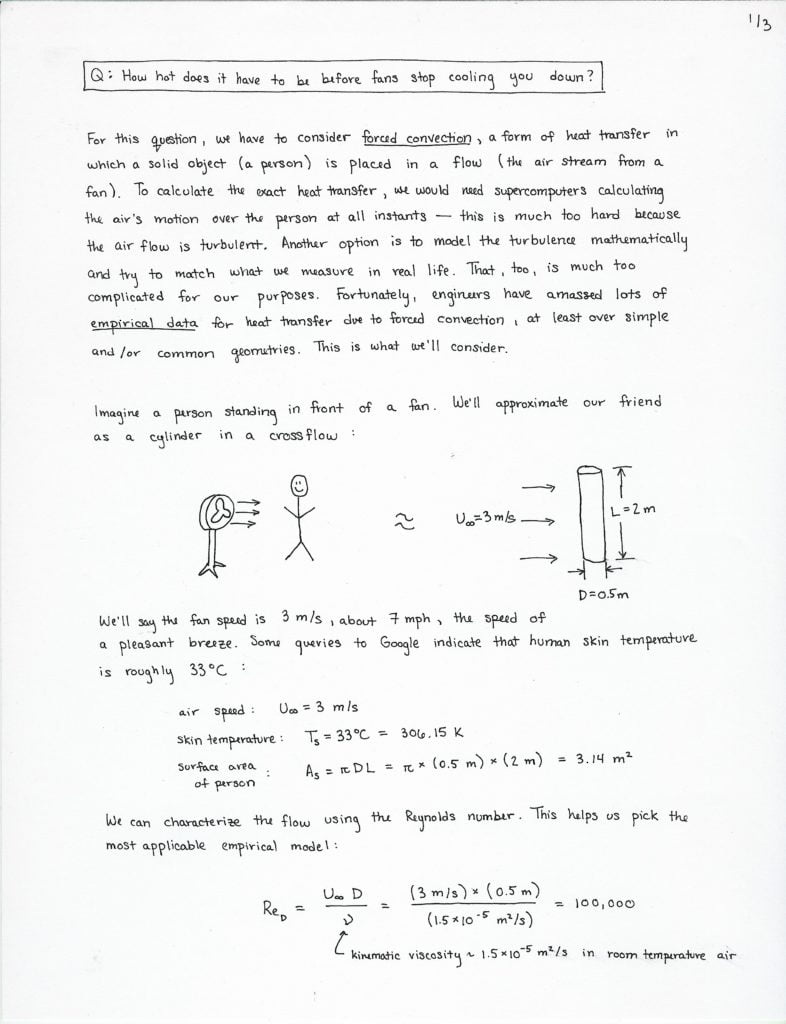
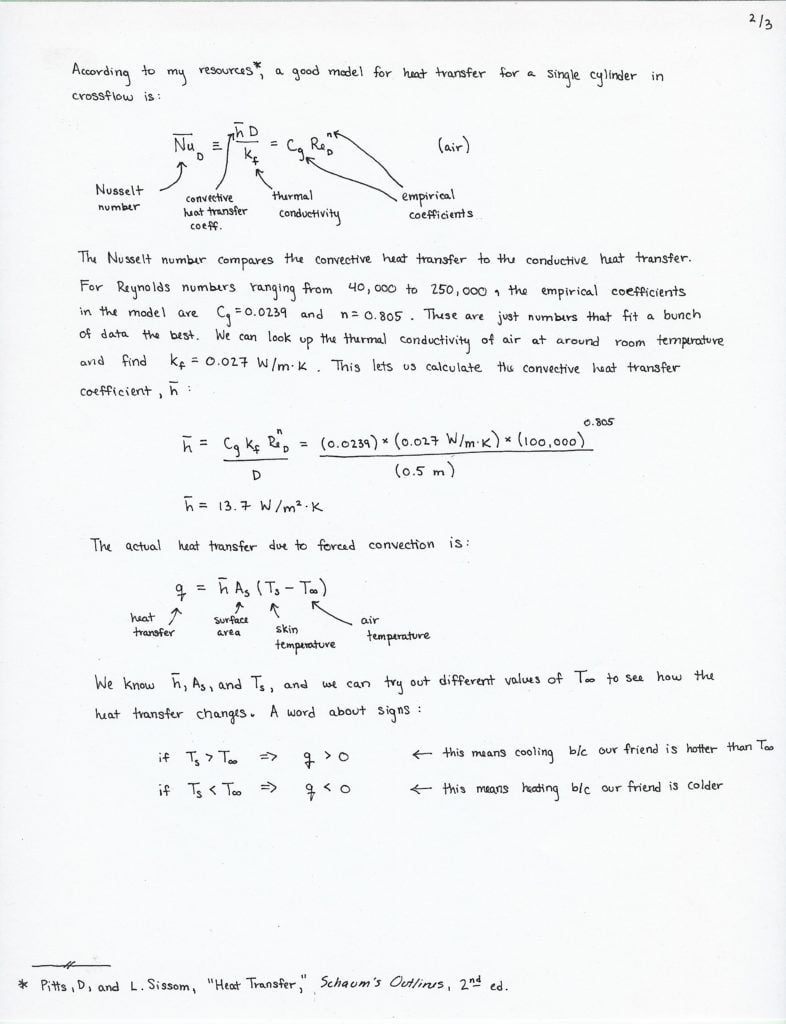
    This isn’t strictly a dynamics question, but I was wondering how hot a stream of fluid has to be before it can no longer lower the average temperature of a body placed in its flow. As an example, how hot a day does it have to be before fans stop cooling you down? What’s the relation and the math to reach for here?

    Wonder no further! You seek the subject of heat transfer–specifically forced convection. Here’s a brief look at how to calculate the cooling due to a fan. Click to enlarge each page.

  • Featured Video Play Icon

    Reader Question: Faucet Physics

    jessecaps-blog-deactivated20170 asks:

    With respect to the laminar/turbulent flow in the faucet, at the end he explains that the diameter is smaller inside the valve compared to the nozzle and therefore the velocity is greater and turbulence is achieved there before it leaves the nozzle. But turbulence is characterized by the Reynolds number not the velocity, so a larger velocity with a smaller diameter will yield the same Reynolds number, why would we expect turbulence in the nozzle before the stream?

    ETA: As pointed out in the comments, I made a very silly mistake when calculating the Reynolds number last night. While most of what I say below is still true in general, it’s not in the case in the faucet, and so I’ve edited the entry to reflect that.

    Great question! A quick control volume analysis of an incompressible fluid shows that, while the flow speed is higher through the faucet’s valve, the Reynolds number (based on diameter) at the valve is the same as higher than the Reynolds number at the nozzle by a factor of (nozzle diameter)/(valve diameter). Thus transition can occur at the valve before the nozzle. A word of caution, though: although we often use Reynolds number as a method of characterizing when a flow becomes turbulent, it is not a hard and fast rule.

    As undergraduates we learn that pipe flow transitions to turbulence at a Reynolds number of 2,300 based on the pipe’s diameter. However, under the right laboratory conditions, it’s possible to maintain laminar flow in a pipe to a Reynolds number an order of magnitude larger. (#) It all depends on the initial conditions of the flow and the influence of factors like surface roughness. What this means in the case of the faucet is that the same Reynolds number (based on diameter) may not correctly indicate whether the flow is laminar or turbulent at a given point.

    Now, while it may be possible that the contraction at the valve introduces some small turbulence that decays prior to the flow’s exit from the nozzle, that does not seem overly likely to me. Even though, by Reynolds number, transition can occur at the valve before the nozzle, I suspect most of the sound we hear comes from the increased flow rate caused by turning the faucet. It may also be that the sound is associated with the onset of turbulence at the valve but the turbulence is still slight enough that we do not notice it by eye in the external flow.

  • Reader Question: Similar Blogs?

    thegreatfenceof-deactivated2013 asks:

    Hello! I was wondering if you follow any similar blogs to your awesome blog? I like the idea of learning about awesome mechanical engineering stuff without learning so if you know of anything please help me out.

    As you might imagine, I started this blog because I didn’t know of any that were doing something similar. Fluid dynamics is kind of an overlooked discipline falling somewhere between classical physics and  practical engineering. However, I do follow some similar Tumblrs on different topics, such as physicsphysics, fuckyeahmath, fyeahchemistry, and freshphotons. Beyond Tumblr, there are lots of (general) science blogs like those on Discover magazine, Wired Science, or Scientific American.

    Anyone else have some suggestions? Sound off in the comments.

  • Reader Question: Locust Follow-up

    Reader Question: Locust Follow-up

    omaewayowai-blog asks:

    in your latest post, is that bug mounted with a yaw angle or what? because the bugs antenna and its head are not disturbing the flow. and the flow perfectly follows the surface of the bug’s aft body. how does this happen? is it something about low reynolds number?

    The locust in that post is fully immersed in the flow and its antenna and head are disturbing the air, just not the smoke. The smoke generator is placed in a single vertical plane that’s offset from the bug’s midsection. According to the published paper, the smoke visualization corresponds to:

    “[…] the vertical plane that intercepts the hindwing at the mid-wing position when the wing is horizontal.”

    That’s why you can see perfectly smooth lines of smoke between the camera and the locust’s head.