We are used to associating convection with differences in temperature, but what’s actually necessary for a Rayleigh-Taylor-type instability is a density variation (and a gravitational field). The solutal convection seen above when mixing liqueur with cream is caused by the interaction of density and surface tension. When the alcohol of the liqueur mixes with the cream, it forms a less dense alcohol-cream that tries to rise to the surface. The alcohol also breaks the surface tension of the cream, causing it to contract and open cells where the alcohol surfaces. As the alcohol evaporates, the alcohol-cream mixture gets denser and sinks back down where it can pick up more alcohol and start the process again. (via jshoer and io9)
Category: Phenomena

Fluidized Sand
What’s shown in this video are some pretty spectacular demonstrations of fluidization, where a gas is introduced at the bottom of a bed of granular particles–like sand. At the critical gas velocity, the aerodynamic forces exerted on each particle by the gas will balance the gravitational force on the particle and it will become suspended. All of a sudden, the macroscopic behavior of the solid particles will be like that of a fluid; you can even make it “boil”!

The Silence of Owls
Owls are among the most silent hunters in nature, thanks to their feathers. The leading edge of the wing, shown in the bottom part of the photo, has a serrated comb-like edge, which breaks flow over the wing into small vortices, which are quieter than larger ones. The fringe-like trailing edge breaks the flow up further and helps absorb the sound produced by the turbulence. The fluffy feathers along the owl’s body can also help muffle noise. Researchers are investigating ways to use these techniques to quiet aircraft. # (via jshoer)

xkcd and Lift
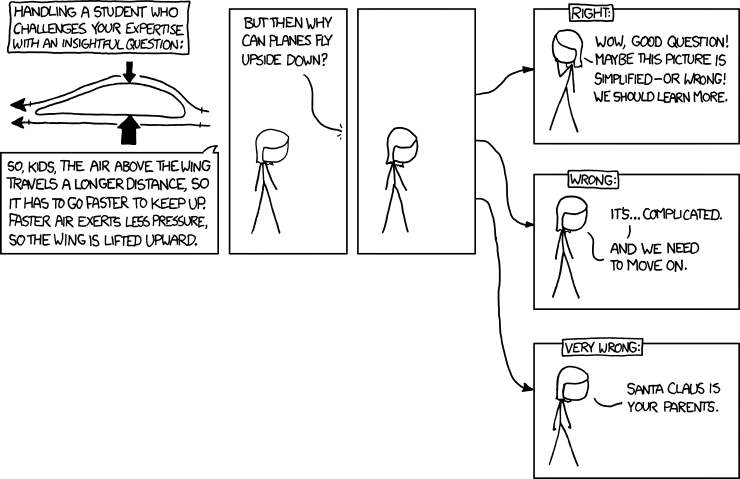
xkcd identifies a very common misconception about how airfoils work! (via Vinnchan and jasonas14) #
Steam Devils
The formation of the ethereal steam devil is quite similar to the formation of a fire tornado. In this case, the first frost of the season cooled air temperatures substantially below the temperature of the water of the lake, creating conditions for steam and for updrafts of rising, warmer air. A slight breeze across the lake is enough to create pockets of vorticity, which stretch due to the updrafts and intensify due to conservation of angular momentum. This creates the narrow spinning vortex filaments that pull steam up and dance across the lake’s surface. #

Jupiter and the Kelvin-Helmholtz Instability
Jupiter, known for its colorful bands of stormy clouds, is a beautiful subject for fluid dynamics in action. As the planet turns, the cloud bands move at different relative speeds. This velocity difference at the interface of the bands can trigger the Kelvin-Helmholtz instability, resulting in a line of whorls where the cloud bands meet. The instability has been observed on Saturn and is thought to be fairly common among gas giants.
Non-Newtonian Fluids
[original media no longer available]
Non-Newtonian fluids have even made it into pop culture. #
Paper Plane Physics
[original media unavailable]
It’s a little surprising that this would be so stable, but I don’t have any reason to believe it impossible. #
Wild Ferrofluid Shapes
In this fluid experiment, a ferrofluid–typically a liquid with a suspension of ferric particles–is exposed to rotating magnetic fields, which results in some wild shapes. #
Benard Cells
When a fluid in a gravitational field is heated from below, it can develop a Rayleigh-Benard instability which causes the formation of convection cells as in the video above. The hexagonal shape of the cells is due to the boundary conditions of the fluid. It’s possible to form other shapes like spirals. The same mechanism drives the formation of granules on the photospheres of stars like our sun.