Sixty years ago yesterday the original Tacoma Narrows Bridge (a.k.a. Galloping Gertie) collapsed as a result of aeroelastic flutter during 42 mph winds. Flutter is a phenomenon in which the fluid dynamics and structural dynamics of a system are closely coupled, in this case resulting in a dramatic failure. The high sustained winds provided an energy source for self-excitation of one of the bridge’s torsional modes; as the bridge contorted, the motion caused additional vortices to be shed from the bridge deck, causing further vibrational forces on the bridge. For an analysis of the bridge’s collapse and its common misrepresentations, see Billah and Scanlan. The bridge’s spectacular collapse prompted reconsideration and redesign of the decks of modern suspension bridges.
Category: Phenomena

Protecting an Egg with Oobleck
Using non-Newtonian fluids as “liquid armor” is an active area of research and development. Here students demonstrate the efficacy of shear-thickening as a defense against sudden impact by dropping a bag of oobleck containing a raw egg from different heights.
The No-Slip Condition
Viscosity plays an important role near surfaces in fluid mechanics. Friction between the fluid and the solid surface creates a “no slip” condition at the wall. In the video, dye injected near the wall remains there because there is little or no velocity of the fluid near the wall. As the dye filament is pulled away, the speed of the bulk flow–the freestream–is apparent. A strong velocity gradient exists between the wall and the freestream; this narrow region of changing velocity is called a boundary layer and is a major topic of research due to its importance in determining drag and thermal loads on vehicles.
Flow Visualization
This video, created by undergraduates as part of a fluid dynamics laboratory course, shows flow visualization of a von Karman vortex street in the wake of a cylinder in comparison to a computational fluid dynamics (CFD) simulation of the same phenomenon. If you’re wondering about the black-and-white segments and the peculiar speech patterns, look no further. The students are parodying a series of videos made by MIT in the 1960s that are still used in classrooms today.

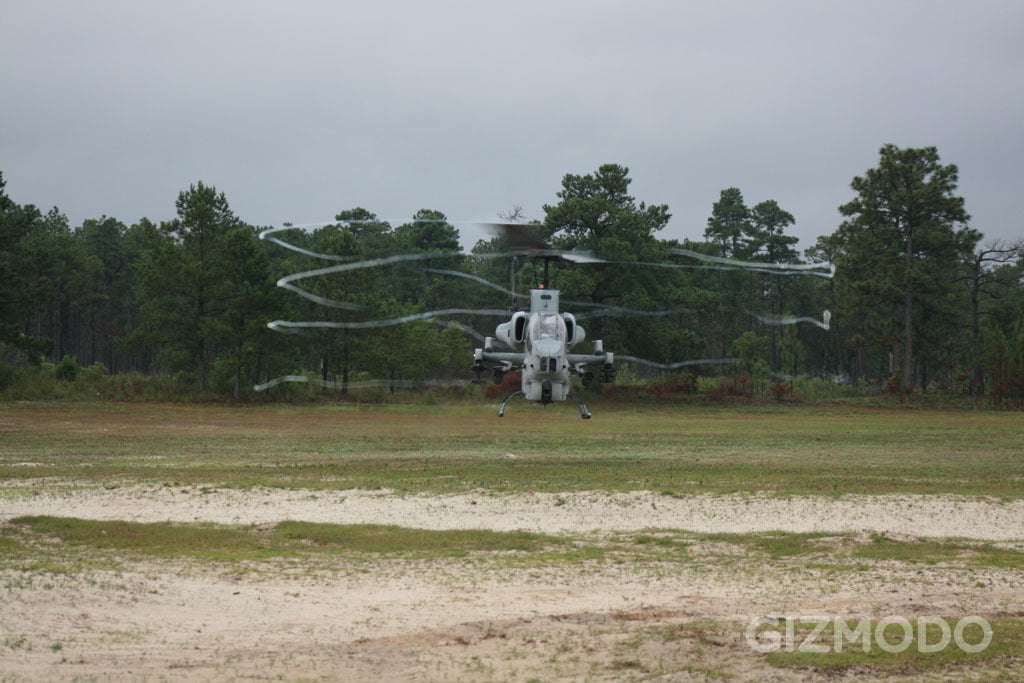
Tip Vortices
Like airplane wings, helicopter blades have tip vortices. In this photo, the air’s humidity was great enough that the acceleration caused by the passing of the blades caused a pressure drop great enough to condense the moisture, making the tip vortices visible to the naked eye. (See also Prandlt-Glauert singularity.)
Photo credit: Gizmodo.
Effects of Viscosity
[original media no longer available]
Today’s video demonstrates the effect of viscosity, which measures a fluid’s resistance to deformation. On the left is a column of highly viscous fluid; the fluids become less viscous as one moves right. When a jet of dye is released into the highly viscous fluid, the jet is very slow to penetrate, whereas, in the rightmost column, the dye expands quickly into a turbulent jet. Between these extremes, we see a laminar dye jet entering the liquid. The mushroom-like shape the laminar jet takes is the result of the Rayleigh-Taylor instability, which occurs when a denser fluid is on top of a lighter fluid in a gravitational field.
Zero-G Water Bubbles
Astronaut Don Pettit narrates some of his experiments with air and water droplets in microgravity in this video. The lack of body forces and buoyancy in microgravity means that surface tension effects frequently dominate. Pettit’s demonstrations also involve some fun basic physics with bubble behaviors inside of water droplets. See more of Pettit’s Saturday Morning Science videos for additional microgravity fluid mechanics.
Stirring with Electromagnetism
If a fluid is electrically conductive, then magnetohydrodynamics (often abbreviated as MHD) describe its behavior. Electric and magnetic fields can be used to stir such a fluid, as in the video above. By inducing a potential difference across the electrodes lining the walls and the disk-shaped electrodes far from the walls, complicated flow patterns can be produced. #
Wave Pool
This Japanese pool, lined with computer-controlled actuators, uses the principle of wave interference to create complex shapes at the center of the pool. While we may be more familiar with wave interference using light or sound, the principles remain the same for a wave in a fluid. (via Gizmodo and phredgreen)
Seeing Shock Waves with Schlieren
Schlieren photography is actually a pretty commonly used system in high-speed experimental aerodynamics. A typical schlieren system will shine a collimated light source on the target (a wind tunnel test section or, above, a candle), bounce that light off a mirror, block half the light with a knife-edge at the focal point, and then record the subsequent images with a camera (high-speed or otherwise). The density of air is closely related to its index of refraction, so light that hits air of a different density will be bent more or less than a neighboring ray. This uneven bending of the light rays due to density gradients is what causes the light and dark areas on the schlieren images. Since the density of air changes drastically across a shock wave, the schlieren system is perfect for visualizing shock waves and has, in fact, been used for that purpose since 1864!