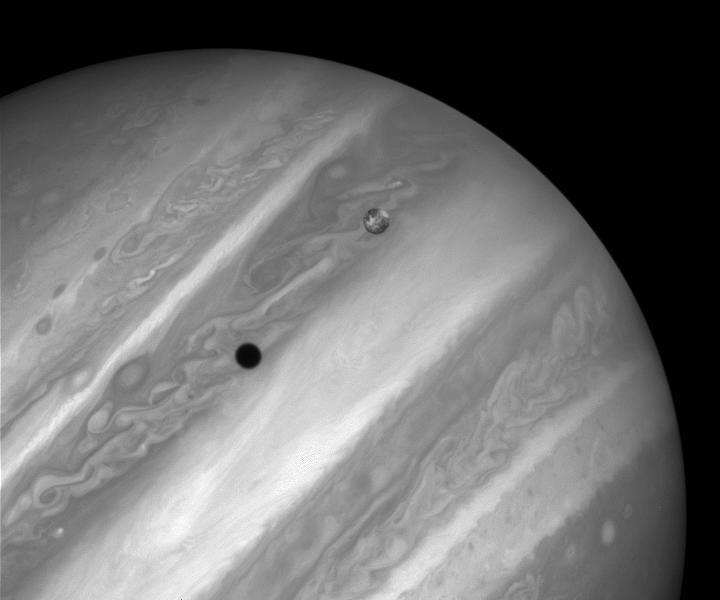
When layers of a fluid are moving at different relative velocities, they shear against one another. This shear can trigger the Kelvin-Helmholtz instability, which develops as a waves along the interface. Here Hubble captures Kelvin-Helmholtz waves along the cloud bands of Jupiter, but such clouds are also not uncommon here on Earth. (Photo credit: J. Spencer and NASA)
Category: Phenomena

Solar Tornadoes
NASA’s Solar Dynamics Observatory captured this video of swirls of darker, cooler plasma caught between competing magnetic forces over the course of 30 hours. The plasma strands rotate like tornadoes caught on magnetic field lines. It sometimes feels incredible to observe such familiar-looking fluid behavior in such unfamiliar places, but it’s just a reminder that physics works no matter where you are.

Flow Around Traffic
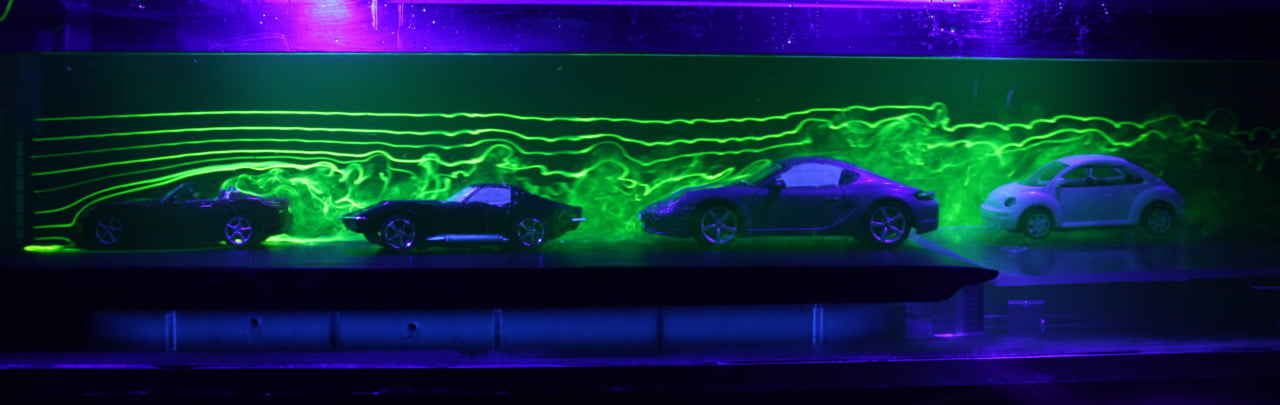
Flow visualization in a water tunnel shows what the flow around a line of traffic looks like. Note the progressively more turbulent flow around each car as it sits in the wake of the car before it. Turbulent flow is usually associated with increased drag forces, but because turbulence can actually help prevent flow separation it is sometimes desirable as a method for decreasing drag. In the case of these cars drafting on one another, it is clear that the cars further back in the line cause less effect on the fluid–and thus have less drag to overcome–than the front car. (Photo credit: Rob Bulmahn)
Wind Tunneling Testing for BASE Jumpers
While we usually think of wind tunnel testing airplane models, the truth is that wind tunnels today test a much wider array of subjects. From oil rigs and skyscrapers to athletes and police sirens, if you can imagine it, it’s probably been stuck in a wind tunnel. This video shows some wind tunnel testing of a tracking suit used for BASE jumping. The primary focus seems to be on lift and drag at angle of attack–which can be used to determine glide ratios for the pilot–but there is also some study of localized turbulence generation, as evidenced by the use of smoke generators and the streamers attached to the suit’s arms and legs. (submitted by Jason C)
Pāhoehoe Lava
Lava flows come in many varieties but one of the most captivating is the pāhoehoe flow, meaning “smooth, unbroken lava” in the native Hawaiian. This type of basaltic lava features a smooth or undulating surface formed by the fluid lava beneath a cooler, congealing surface crust. They often feature low viscosity (by the standards of lava) and very high temperatures between 1100 and 1200 degrees Celsius. Here the flow shows features of viscous fluids like honey, including rope-coiling motions.

Seeing Shock Waves
In this still image from a video of a 2008 demonstration of a U.S. Navy railgun, the shock waves in front of the projectile are momentarily visible. When travelling faster than the speed of sound in air, information (in the form of pressure waves) is unable to travel ahead of the projectile, meaning that the air cannot deform around the object as it does at low speeds. Instead, a front known as a shock wave forms on or in front of the object, depending on its speed and shape. Across this shock wave, thermodynamic properties of the gas are discontinuous; the pressure, temperature, and density of the air rise drastically, but the air is also deformed so that it passes around the object. (See also: bullet from a gun.)

Flow Over Swept Wings
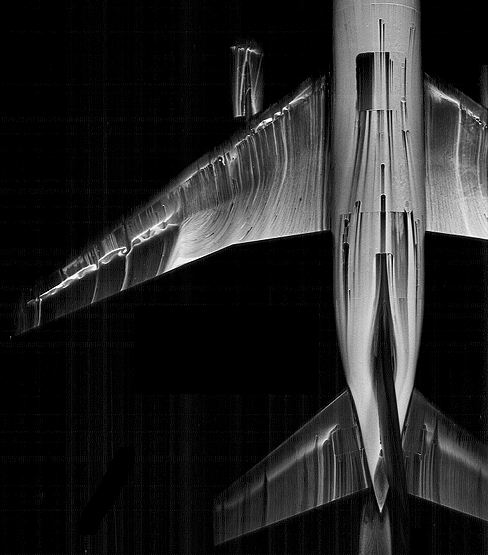
Flow over a swept wing behaves very differently than a straight fixed wing or an airfoil. Instead of flowing straight along the chord of the wing in a two-dimensional fashion, air is also directed along the wing, parallel to the leading edge. The above oil flow visualization on a swept wing airplane model shows this curvature of streamlines. As a result of this three-dimensional flow behavior, boundary layers on swept wings are subject to the crossflow instability, which manifests as co-rotating vortices aligned to within a few degrees of the streamlines. Triggering this boundary layer instability can lead to turbulence and higher drag for the aircraft.
Fano Flow
Adding polymers to fluids can lead to strangely counter-intuitive behavior. Here two examples of bizarre extensional flow, sometimes called Fano flow, are shown. First, in the “tubeless siphon” fluid is drawn into a syringe from the level of the free fluid surface. When the syringe is raised above the free surface of the fluid, the polymer-laden fluid continues to flow upward and into the syringe. A similar effect is shown in the “open channel siphon” where, once initiated, the flow up and over the side of a beaker continues after the free surface of the fluid has fallen below the level of the beaker’s spout. In both of these cases, the cross-linking and entanglement of polymers within the fluid makes it capable of exerting normal stress when extensionally strained (e.g. stretching a rubber band). In other words, when the syringe is drawn out of the pool, the stretching of the fluid causes the polymers to exert a force that counteracts the weight of the fluid column, enabling the flow to continue upward despite gravity.
Circulation Around an Airfoil
As a followup to yesterday’s question about ways to explain lift on an airfoil, here’s a video that explains where the circulation around the airfoil comes from and why the velocity over the top of the wing is greater than the velocity around the bottom. Kelvin’s theorem says that the circulation within a material contour remains constant for all time for an inviscid fluid. Before the airplane moves, the circulation around the wing is zero because nothing is moving. As shown in the video, as soon as the plane moves forward, a starting vortex is shed off the airfoil. As the plane flies, our material contour must still contain the starting position and thus the starting vortex. However, in order to keep the overall circulation in the contour zero, the airfoil carries a vortex that rotates counter to the starting vortex. This is the mechanism that accelerates the air over the top of the wing and slows the air around the bottom. Now we can apply Bernoulli’s principle and say that the faster moving air over the top of the airfoil has a lower pressure than the slower moving air along the bottom, thus generating an upward force on the airfoil. (submitted by jessecaps)

“Tidal Wave” vs. “Tsunami”
This is part of the trouble when the same term has a scientific meaning and a lay meaning. See also: fluid.