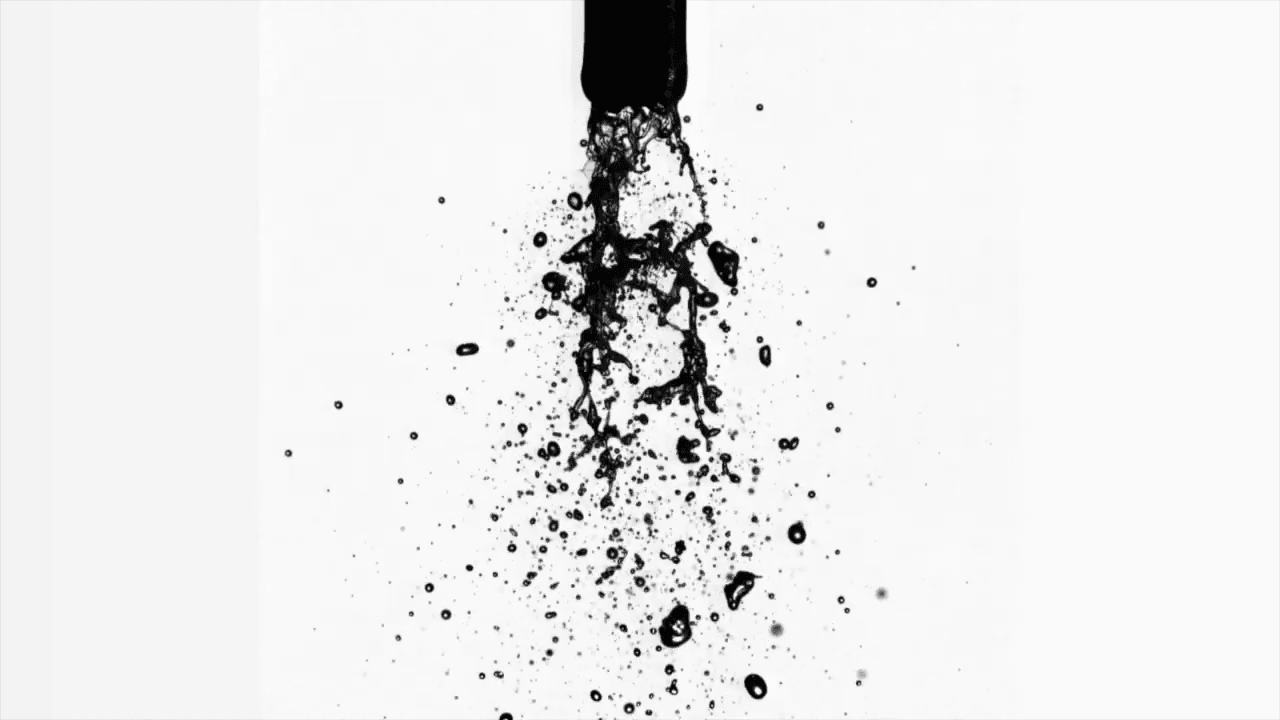
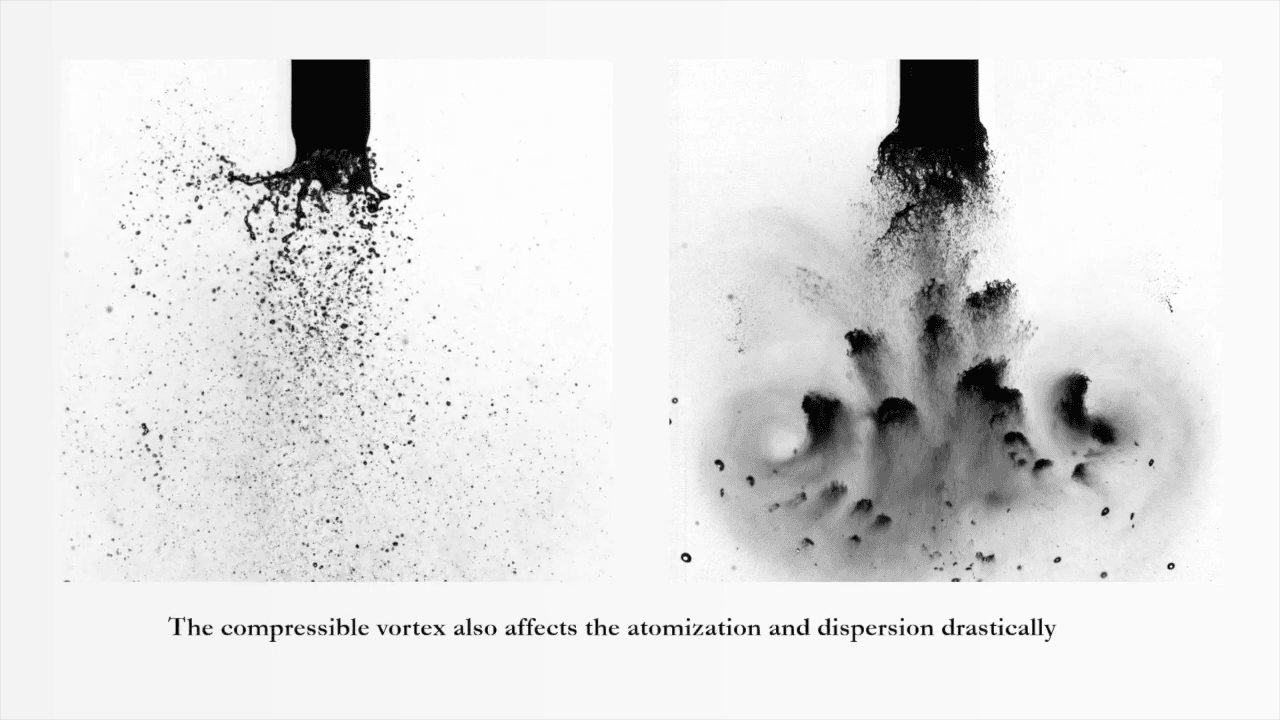
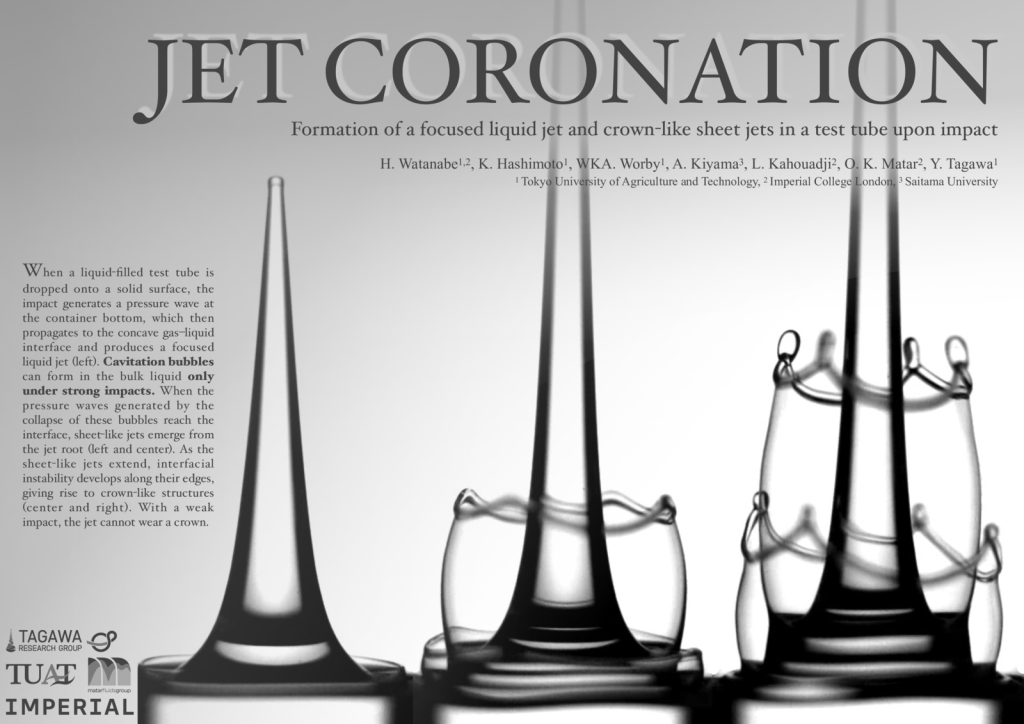
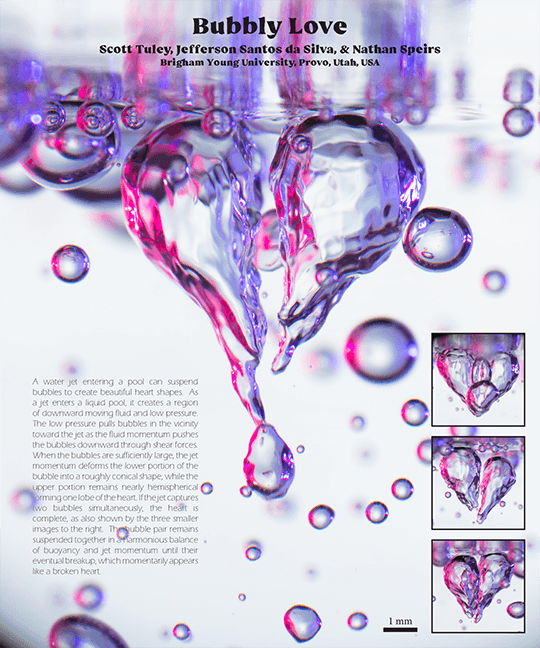
Next time you fill your water bottle, watch closely and see if you can spot a bubble heart like these. When a jet falls into a pool, it pulls air in with it. The low pressure of the jet pulls bubbles inward, even as shear pulls the bubbles downward with the sinking liquid. If the bubbles are large and there’s enough momentum in the jet, the lower portion of the bubble will get pulled into a conical shape, while the upper portion remains a hemisphere. That forms one lobe of the heart. The other half requires a second bubble. But with a little patience and luck, you can form a complete heart. Happy Valentine’s Day! (Image credit: S. Tuley et al.)
Tag: jets

Entraining Bubbles
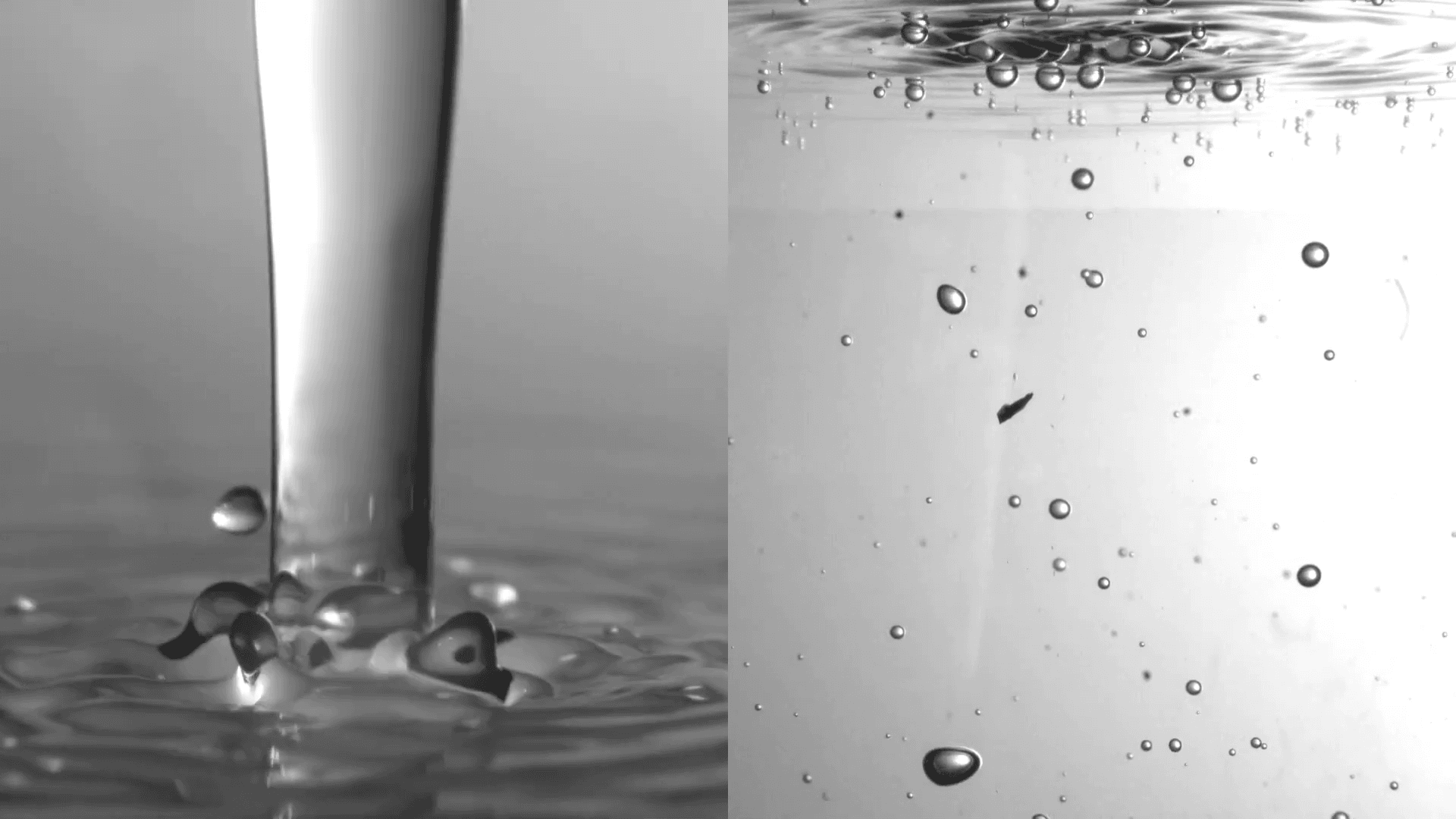
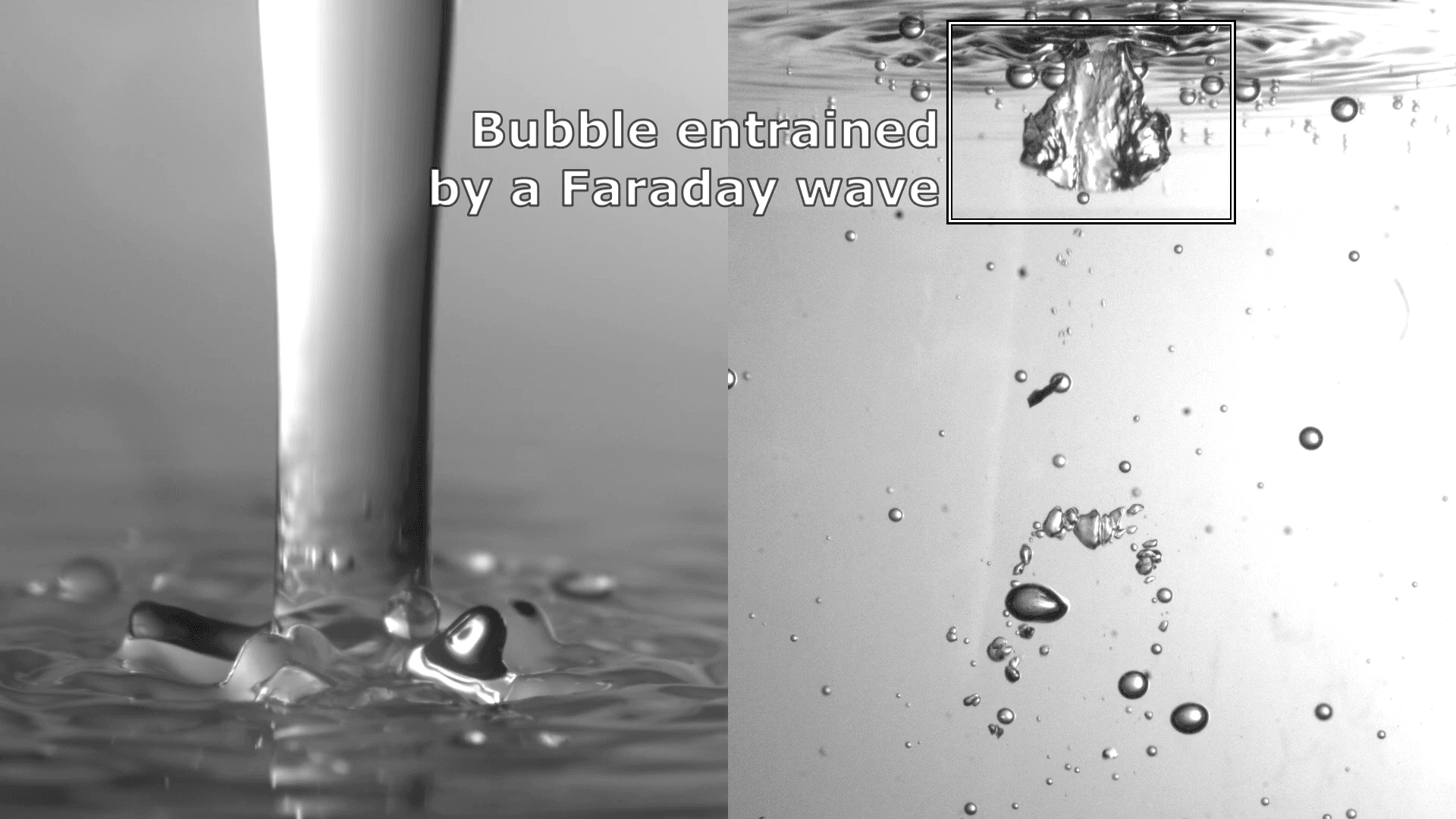
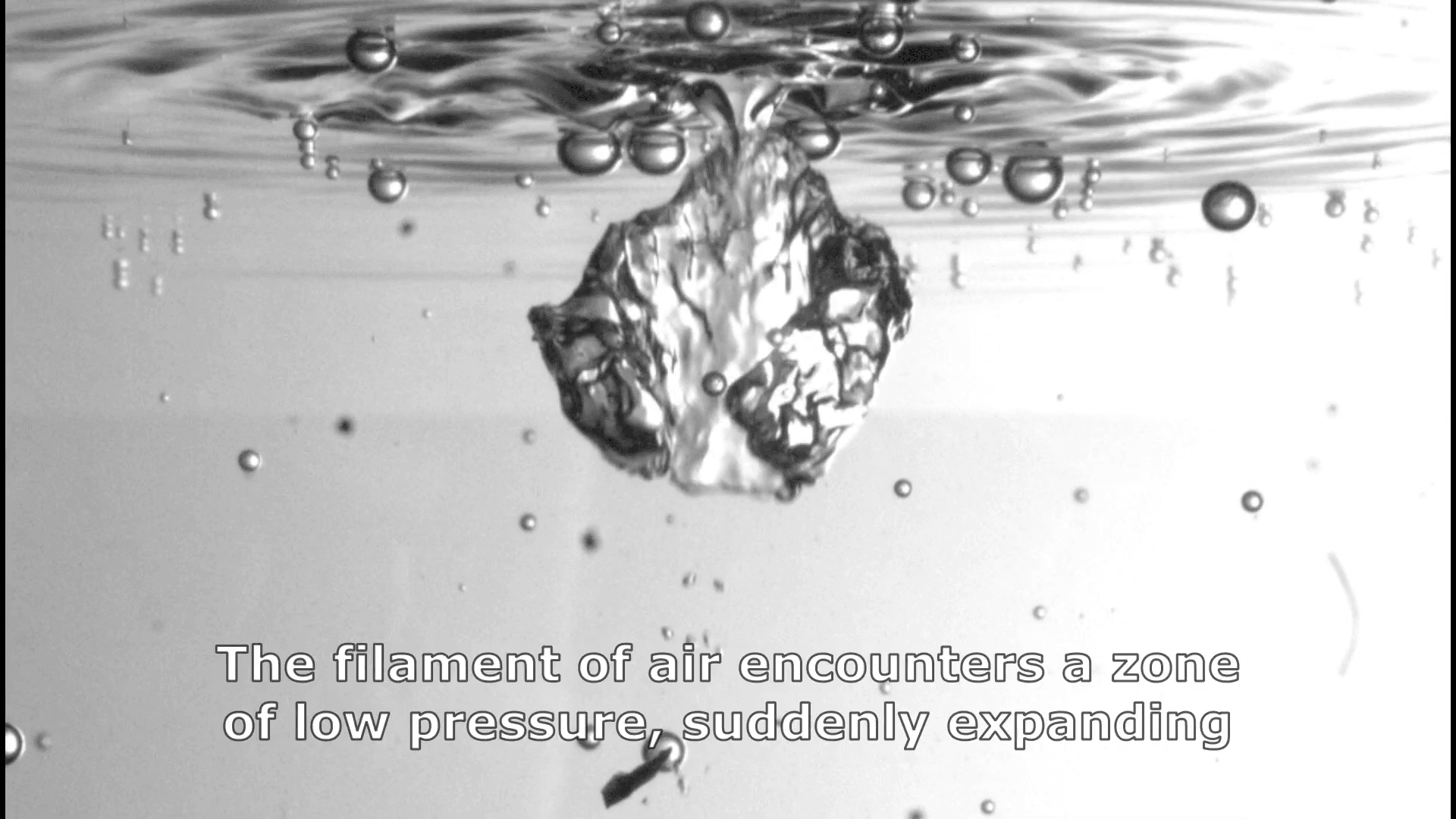
Every time I fill a glass at my refrigerator, I watch how the falling jet creates a cloud of bubbles. The bubbles form when the impacting water jet pulls air in with it, though, as this video shows, the exact origins can vary. Here, researchers take a closer, slowed-down look at the situation; they connect disturbances in the jet and waves at its base to the entrained bubbles that form. (Video and image credit: S. Relph and K. Kiger)

Pour-Over Physics
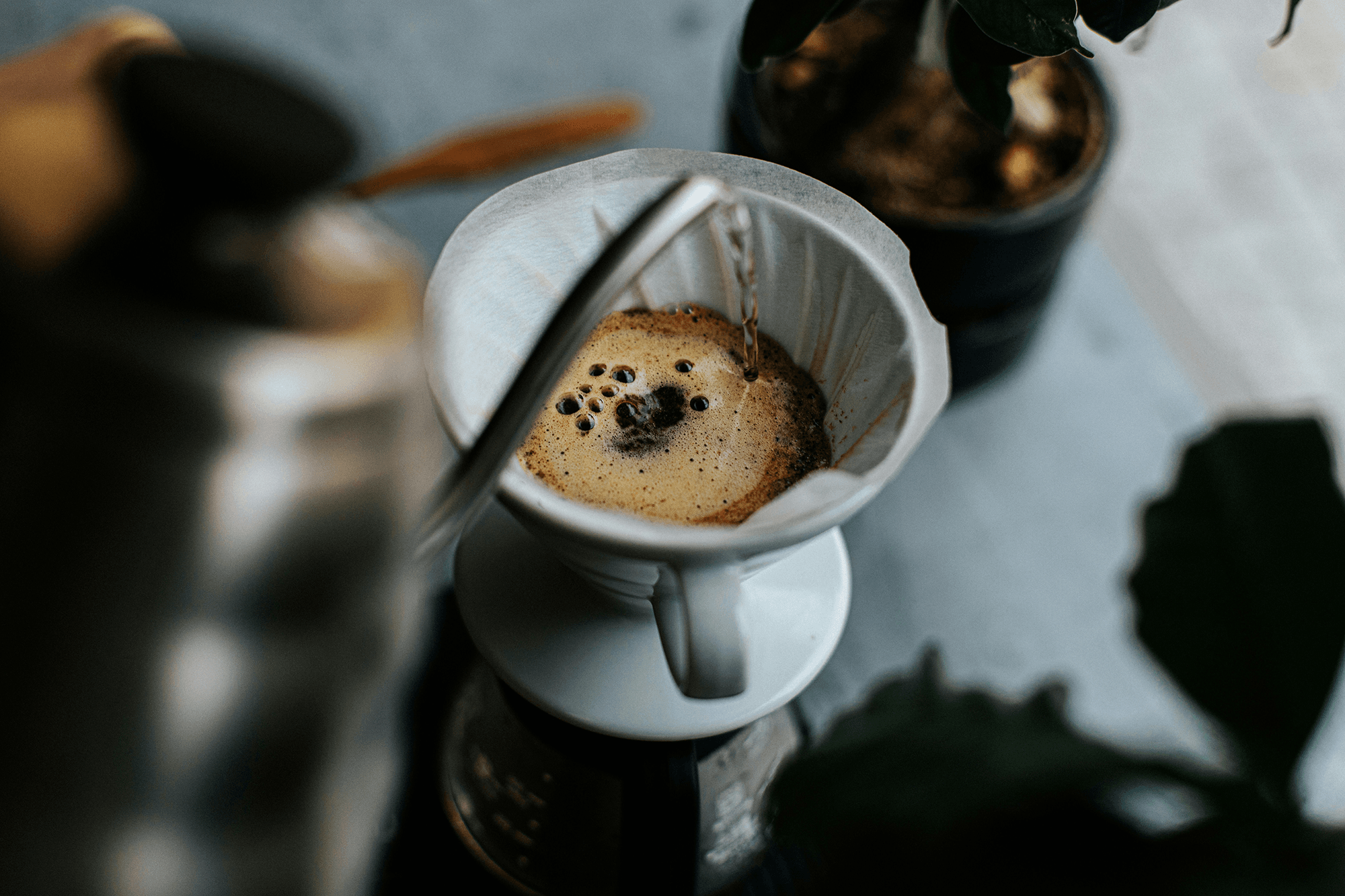
Fluids labs are filled with many a coffee drinker, and even those (like me) who don’t enjoy coffee, can find plenty of fascinating physics in their labmates’ mugs. Espresso has received the lion’s share of the research in recent years, but a new study looks at the unique characteristics of a pour-over coffee. In this technique, coffee grounds sit in a conical filter and a stream of hot water pours over the top of the grounds. Researchers found that the ideal pour creates a powerful mixing environment in a coffee-studded water layer that sits above a V-shaped bed of grains created by the falling water jet.
The best mixing, they find, requires a pour height no greater than 50 centimeters (to prevent the jet from breaking into drops) but with enough height that the falling jet stirs up the grounds. You also want to pour slowly enough to give plenty of time for mixing, without letting the jet stick to the kettle’s spout, which (again) causes the jet to break up.
That ideal pour extracts more coffee flavor from the grounds, allowing you to get the same strength of brew from fewer beans. As climate change makes coffee harder to grow, coffee drinkers will want every trick to stretch their supply. (Image credit: S. Satora; research credit: E. Park et al.; via Ars Technica)
Interstellar Jets
This JWST image shows a couple of Herbig-Hero objects, seen in infrared. These bright objects form when jets of fast-moving energetic particles are expelled from the poles of a newborn star. Those particles hit pockets of gas and dust, forming glowing, hot shock waves like those seen here in red. The star that birthed the object is out of view to the lower-right. The bright blue light surrounded by red spirals that sits near the tip of the shock waves is actually a distant spiral galaxy that happens to be aligned with our viewpoint. (Image credit: NASA/ESA/CSA/STScI/JWST; via APOD)

“Kirigami Sun”
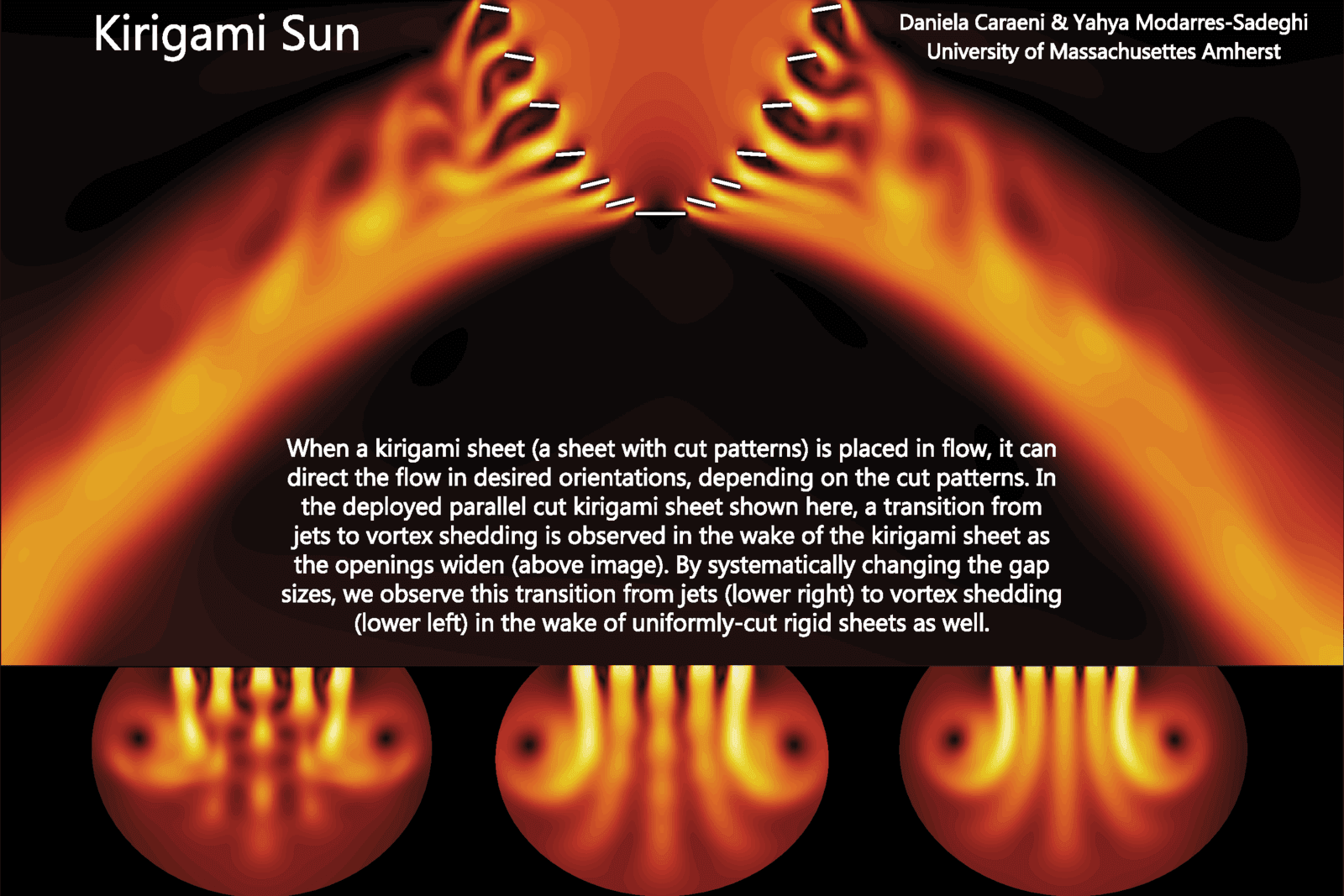
Kirigami is a variation of origami in which paper can be cut as well as folded. Here, researchers look at flow through a cut kirigami sheet and how that flow changes with the cuts’ length. In the top central image, white lines mark the paper boundaries. As the cut gaps get larger, flow through them transitions from a continuous jet to swirling vortex shedding. Along the bottom, we see similar patterns emerge in the wake of uniformly-cut sheets, too. On the right, the flow comes through in jets; moving leftward, it transitions to an unsteady vortex shedding flow. (Image credit: D. Caraeni and Y. Modarres-Sadeghi)

Cavitation Near Soft Surfaces
Collapsing cavitation bubbles are sometimes used to break up kidney stones, and they may find other uses in medicine as well. Here, researchers investigate the collapse of laser-triggered cavitation bubbles near tissue-mimicking hydrogel. The bubbles take on a very different form than they do near solid surfaces. Near hydrogel, the bubbles become mushroom-shaped. During their collapse, they release a rainy microjet that moves at nearly 2,000 meters per second! Even at 5 million frames per second, the jet is practically a blink-and-you-miss-it phenomenon. (Image and video credit: D. Preso et al.)

Jets, Shocks, and a Windblown Cavity
As material collapses onto a protostar, these young stars often form stellar jets that point outward along their axis of rotation. Made up of plasma, these jets shoot into the surrounding material, their interactions creating bright parabolic cavities like the one seen here. This is half of LDN 1471; the protostar’s other jet and cavity are hidden by dust but presumably mirror the bright shape seen here. (The protostar itself is the bright spot at the parabola’s peak.) Although the cavity is visibly striated, it’s not currently known what causes this feature. Perhaps some form of magnetohydrodynamic instability? (Image credit: NASA/Hubble/ESA/J. Schmidt; via APOD)

Inside the Squirting Cucumber
Though only 5 cm long, the squirting cucumber can spray its seeds up to 10 meters away. The little fruit does so through a clever combination of preparation and ballistic maneuvers. Ahead of launch, the plant actually moves water from the fruit into the stem; this reorients the cucumber so that its long axis sits close to 45 degrees. It also makes the stem thicker and stiffer.

This high-speed video shows the explosive release of the squirting cucumber’s seeds. When the burst happens, fruit spews out a jet of mucus that propels the seeds at up to 20 m/s. The initial seeds move the fastest — thanks to the fruit’s high-pressure reservoir — and fly the furthest. As the pressure drops, the jet slows and the fruit’s rotation sends the seeds higher, causing them to land closer to the original plant. With multiple fruits in different orientations, a single plant can spread its seeds in a fairly even ring around itself. (Research and image credit: F. Box et al.; via Gizmodo)

Billowing Ouzo
Pour the Greek liquor ouzo into water, and your glass will billow with a milky, white cloud, formed from tiny oil droplets. The drink’s unusual dynamics come from the interactions of three ingredients: water, oil, and ethanol. Ethanol is able to dissolve in both water and oil, but water and oil themselves do not mix.
In this video, researchers explore the turbulent effects of pouring ouzo into water. In particular, pouring from the top creates a fountain-like effect, due to a tug-of-war between the ouzo’s momentum and its buoyancy. Momentum wants the ouzo to push down into the water, and buoyancy tries to lift it back up. For an extra neat effect, they also show what happens when the ouzo is confined to a 2D plane and what happens when momentum and buoyancy act together instead of oppositely. (Image and video credit: Y. Lee et al.)

The Shape of Rain
In our collective imagination, a raindrop is pendant shaped, wide at the bottom and pointed at the top. But, in fact, a falling raindrop experiences much more complicated shapes. Here, researchers blow a jet of air onto a still droplet, a good facsimile for a raindrop falling through the atmosphere. The jet of air first squishes the drop, then inflates it into a shape known as a bag. The thin sides of the bag stretch and eventually break, spraying tiny droplets. As the disintegration continues, the thick rim of the bag breaks up into big droplets. As the video demonstrates, viscosity and viscoelasticity can affect the break-up, too. (Image and video credit: I. Jackiw and N. Ashgriz)