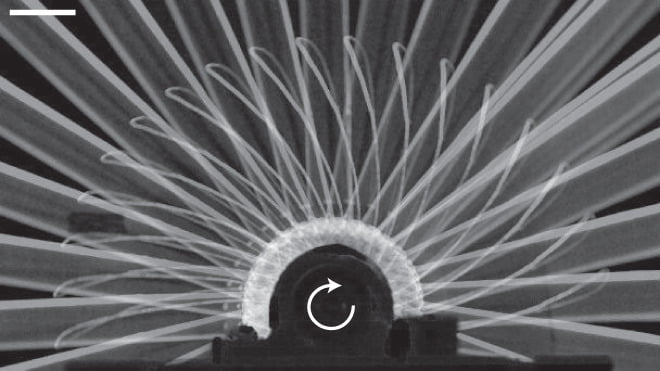
Researchers have used high-speed video and numerical simulation to capture the effects of aerodynamics on jump roping. After videoing an athlete jumping rope and constructing a jump roping robot (shown above imaged multiple times with a strobe light), they found that the U-shaped tip of the jump rope bends away from the direction of motion. When they built a computer model capable of deforming the jump rope based on its drag, they found the same behavior. They concluded that the “best” jump ropes are lightweight, short, and have small diameters to maximize speed and minimize the drag. #
Tag: article

Drafting Flags
Wired Science has published a gallery of fluid dynamics photos and videos, several of which have been featured here previously. There’s some neat stuff there, well worth checking out. #
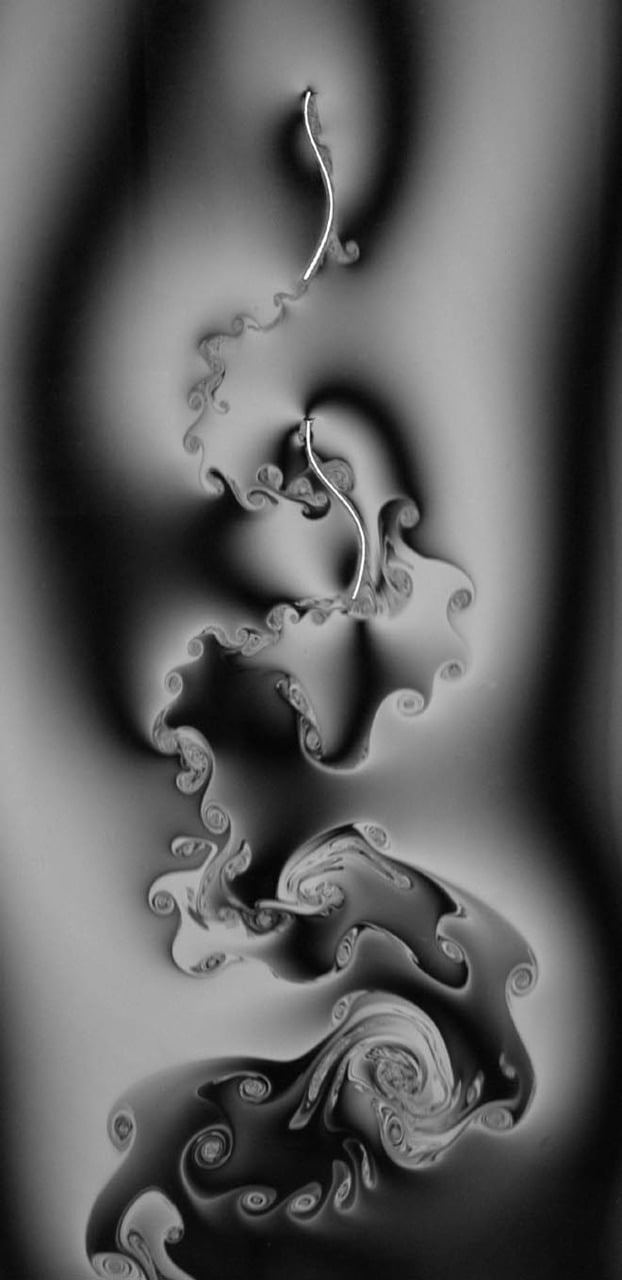
This image shows two flags oriented in line with a film flowing top to bottom. The second flag interrupts the wake of the first one, which reduces the drag experienced by the first flag and increases that on the second. This is called inverted drafting and occurs because the flags are passive objects that bend to every change in the flow. #

White Hole Analogues
A white hole–the cosmological opposite of a black hole–is a singularity from which matter emerges but which matter can never enter from beyond the event horizon. Hydraulic jumps, those rings that sometimes appear in the kitchen sink, turn out to be a physical analog of this behavior. The photo above shows a hydraulic jump with a needle placed inside the event horizon. In the wake of a needle, there’s a Mach cone, just like when an object moves faster than the speed of sound. For more, see the Photonist. (via freshphotons)
Note that we mentioned this item a few months ago, but the full paper has just been published.

Venom Properties
Most venomous snakes deliver venom to their prey via grooves in their fangs, rather than through a pressurized bolus through hollow fangs. New research shows that these venoms are shear-thinning non-Newtonian fluids. The surface tension of the venom is such that a drop of venom will tend to flow into and down the groove. Once moving, the shear-thinning properties of the venom decrease the venom’s viscosity, increasing its flow rate down the fang and into the snake’s prey. (via Scientific American; Photo: green mamba, banded snake fang)
Frost on Superhydrophobic Surfaces
Frost formation and ice adhesion on superhydrophobic surfaces
For anyone with further interest in the ice formation on superhydrophobic surfaces story we posted recently, the published paper is currently offered by AIP for free. #

How Cats Drink
While humans use suction and dogs scoop water using their tongues*, cats use a dainty fluid mechanism to drink. Researchers used high-speed video to find that cats drink by touching the surface of their tongue to the water and drawing their tongue rapidly back into their mouth. Friction between their tongue and the water creates a fluid column about which the cat closes its jaw before gravity breaks off the column. They also built an artificial tongue to test different frequencies and found an optimal lapping frequency dependent upon the mass of the feline.
- Reis et al. in Science (11/11/10 edition)
- Wired article
- Scientific American article
*ETA: More recent research show that dogs actually use the same technique as cats, not a scooping method.
(Image credit: P. Reis et al.)

Wind Turbines and Weather
A new study reports that wind turbine farms may be changing local surface temperatures, resulting in warmer temperatures at night and cooler temperatures during the day. The result is neither surprising nor new; the motion of the propellers increases the turbulence downstream of the turbines. Turbulent flow mixes much better than laminar flow, so air from above the ground is getting mixed into surface air in the wakes. At night, the air next to the ground cools more quickly than air higher up, so the mixing of higher, warmer air results in localized warmer air on the ground. Orange farmers use this effect when they put out fans at night to keep their crops from freezing. #

Sailing Faster than the Wind
Is it possible to create a vehicle that uses the wind to move itself directly downwind faster than the wind does? Strangely enough, it is. The concept has been the subject of debate for years, but one team has confirmed the physics by building a vehicle that uses wind but can travel 2.8x faster than the wind does. See their article on Wired. #

How to Grow Straight Icicles
New research suggests that icicles grow straighter when exposed to moving air while exposure to still air can cause icicles to sprout at their tips. To grow icicles, the researchers built a refrigerated box that dripped water from the top while the growing icicle rotated. Understanding ice growth is important for flight aerodynamics and icing on airplane wings. For videos and more on icicle growth, see the article at Wired Science. #