Tag: astrophysics

  • A Supernova in Motion

    A Supernova in Motion

    In 1604, astronomers first caught sight of Kepler’s Supernova Remnant, a massive explosion some 17,000 light-years away. Twenty-five years of observations from the Chandra X-ray Observatory went into making this timelapse, which shows the supernova remnant‘s material pushing into the surrounding gas and dust.

    Zoomed version of a timelapse showing 25 years of change in Kepler's Supernova Remnant.

    In its fastest regions, the supernova remnant is moving around 2% of the speed of light–some 22 million kilometers per hour. Slower parts of the remnant are moving at just 0.5% of light-speed. (Image credit: NASA/CXC/SAO/Pan-STARRS; via Gizmodo)

    Zoomed version of a timelapse showing 25 years of change in Kepler's Supernova Remnant.
    Fediverse Reactions
  • The Start of a Supernova

    The Start of a Supernova

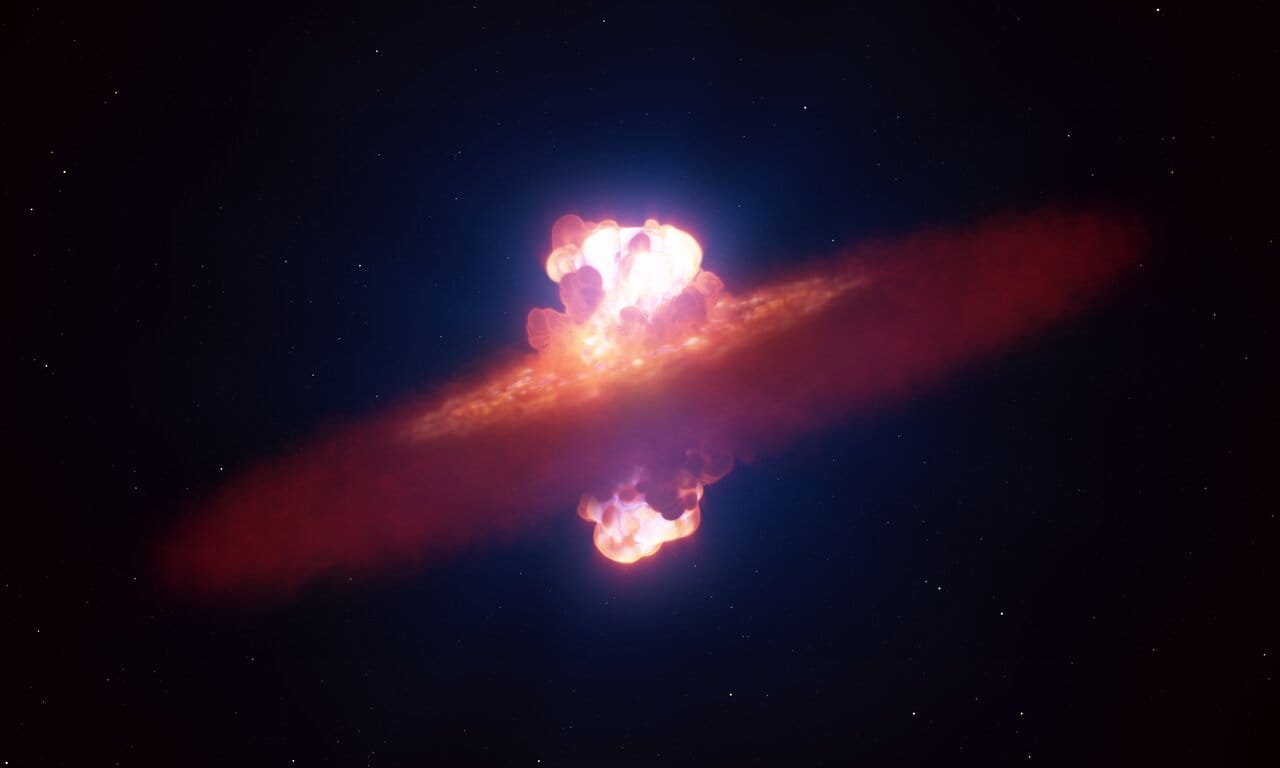
    Stars about eight times more massive than our sun end their lives in supernovas, incredible explosions that rip the star apart. The earliest stages of this explosion are something we’ve never observed firsthand, until now. A new study reports observations of the supernova explosion SN 2024ggi, detected here on Earth on 10 April 2024. Only 26 hours later, researchers pointed the Very Large Telescope at it, capture data that revealed its oblong shape as the initial explosion reached the star’s surface.

    What you see above and below are not the actual supernova. They are an artist’s conception of the event, based on the researchers’ observation data. That data is enough to rule out several existing supernova models and will no doubt guide new models of star death going forward. (Image credit: ESO/L. Calçada; research credit: Y. Yang et al.; via Gizmodo)

    Fediverse Reactions
  • “500,000-km  Solar Prominence Eruption”

    “500,000-km  Solar Prominence Eruption”

    It’s difficult at times to fathom the scale and power of fluid dynamics beyond our day-to-day lives. Here, twists of the Sun‘s magnetic field propel a jet of plasma more than 500,000 kilometers out from its surface in an enormous solar prominence eruption. To give you a sense of scale for this random solar burp, that’s bigger than ten times the distance to satellites in geostationary orbit. (Image credit: P. Chou; via Colossal)

  • Wobbling Plasma Could Help Planets Grow

    Wobbling Plasma Could Help Planets Grow

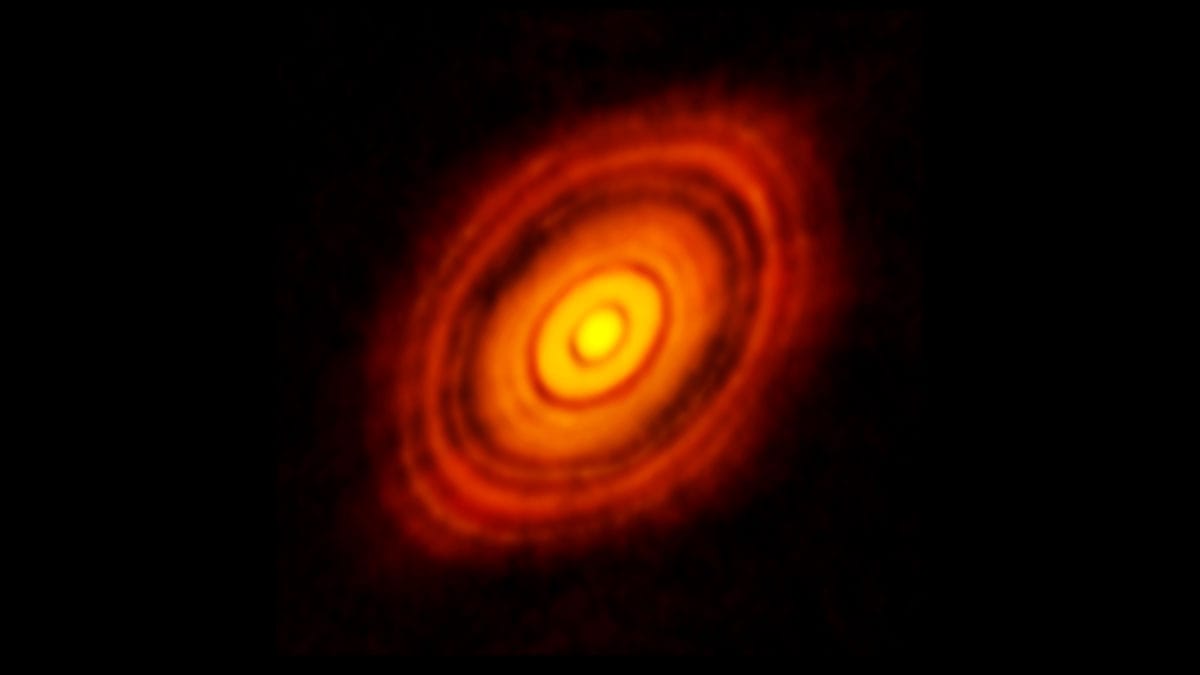
    To form planets, the dust and gas around a star has to start clumping up. While there are many theories as to how this could happen, it’s a difficult process to observe. A recent study shows that a magnetorotational (MR) instability could do the job.

    The team used a Taylor-Couette set-up (where an inner cylinder rotates inside an outer cylinder) filled with a liquid metal alloy. With the cylinders moving relative to one another at over 2,000 rotations per minute, the team measured how the magnetic field changed in the churning fluid. Parts of the liquid metal formed free shear layers, and within these, the MR instability occurred, causing some regions to slow down and others to speed up.

    The experiments suggest that triggering a MR instability is easier to achieve than once thought, which supports the possibility that it occurs in protoplanetary disks, helping to drive dust together into planets. (Image credit: ALMA/ESO/NAOJ/NRAO; research credit: Y. Wang et al.; via Eos)

    Fediverse Reactions
  • “Orion, the Horsehead and the Flame in H-alpha”

    “Orion, the Horsehead and the Flame in H-alpha”

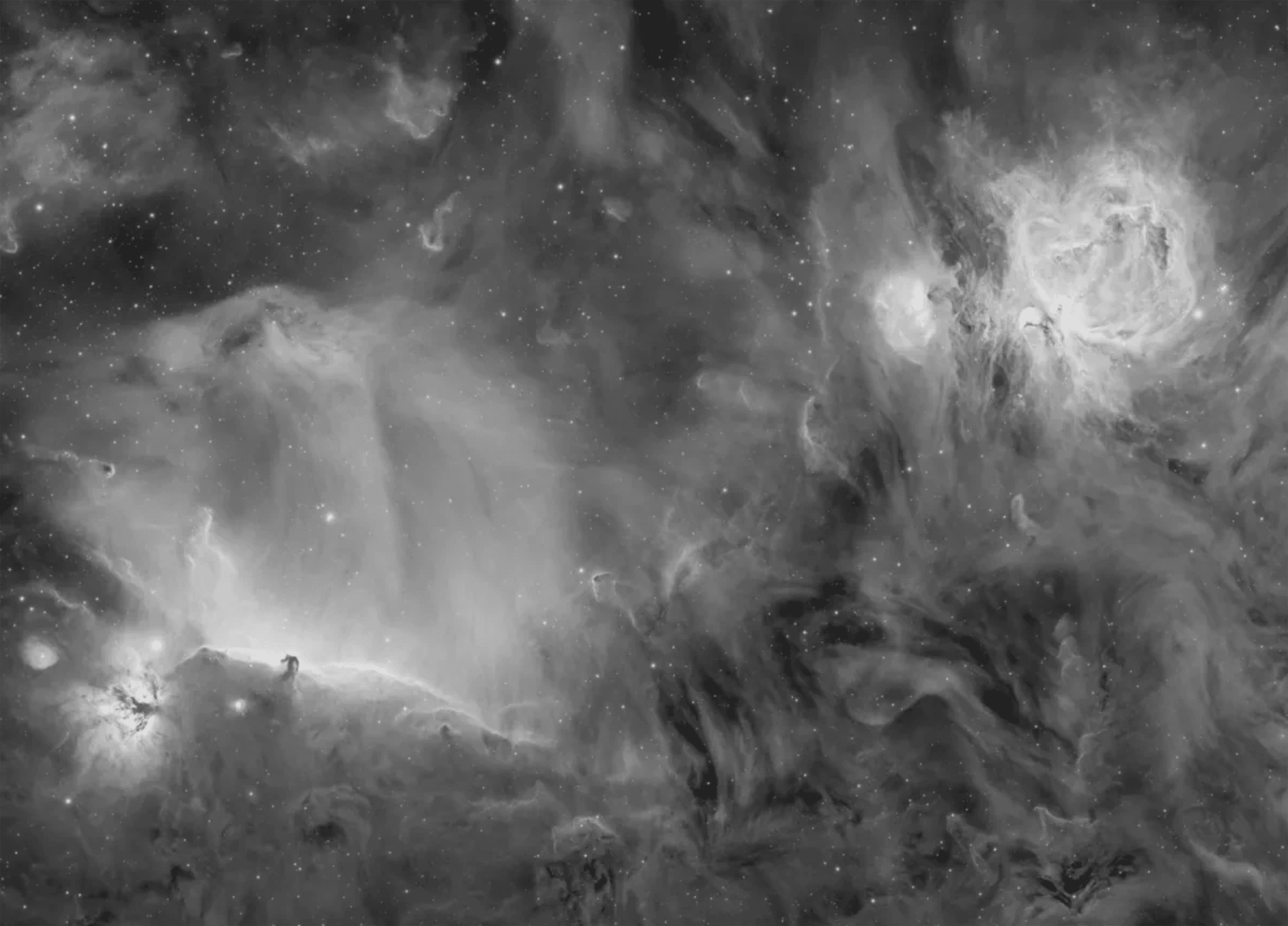
    Photographer Daniele Borsari captured this gorgeous composite image of nebulas in black and white, emphasizing the motion underlying the gas and dust. In the upper right, the Orion Nebula shines, bright with new stars. In the lower left, you can pick out the distinctive shape of the Horsehead Nebula and, further to the left, the Flame Nebula. We often see nebulas in bright colors, but I love the way black and white highlights the turbulence surrounding them. (Image credit: D. Borsari/ZWOAPOTY; via Colossal)

    Fediverse Reactions
  • Double Detonation in Type 1a Supernovae

    Double Detonation in Type 1a Supernovae

    Type 1a supernovae are agreed to be explosions of white dwarf stars, the remains of stars similar in mass to our Sun. They’re thought to be triggered when extra mass — from a nearby companion star, for example — triggers a runaway fusion reaction in their carbon and oxygen, elements that white dwarfs generally don’t have enough mass to successfully fuse. The runaway fusion then blows the star apart.

    But there’s another theory — demonstrated through numerical simulations — that suggests an alternate mechanism: a small explosion on the star’s surface could compress the interior enough to trigger fusion of the heavier elements there, thereby triggering a second detonation. The two explosions would happen in quick succession, making them difficult to detect, but astronomers predicted that each explosion could create a shell of calcium; given enough time, those two shells could drift apart, allowing astronomers to see a shell of sulfur between them.

    The team looked to a supernova remnant about 300 years old, and using a spectrograph from the Very Large Telescope, they were able to image — as predicted — a two shells of calcium, separated by sulfur, supporting the double-detonation hypothesis.

    The impact of double-detonation in Type 1a supernovae could be far-reaching. Right now, the intensity of these objects seems to be consistent enough that astronomers use their brightness to estimate their distance. Over the years, those distance estimates have been used to measure the universe’s expansion and provide evidence for the existence of dark matter. But if Type 1a supernovae are not all the same intensity, we may need to reevaluate their use as a universal yardstick. (Image credit: ESO/P. Das et al.; research credit: P. Das et al.; via Ars Technica)
    Fediverse Reactions
  • Veil Nebula

    Veil Nebula

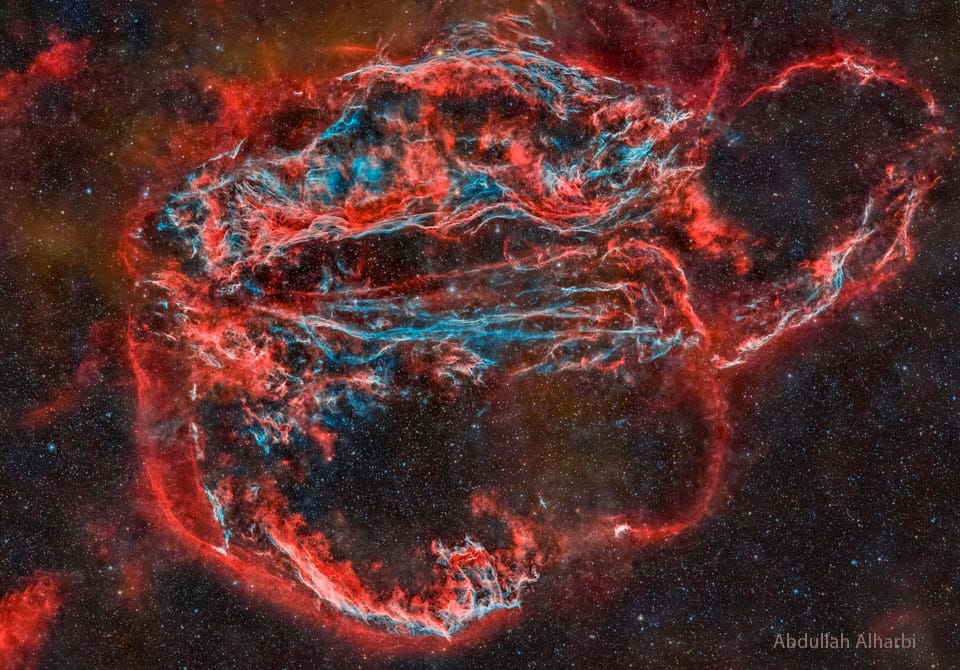
    These glowing wisps are the visible remains of a star that went supernova about 7,000 years ago. Today the supernova remnant is known as the Veil Nebula and is visible only through telescopes. In the image, red marks hydrogen gas and blue marks oxygen. First carried by shock waves, these remains of a former star now serve as seed material for other stars and planetary systems to form. (Image credit: A. Alharbi; via APOD)

    Fediverse Reactions
  • Featured Video Play Icon

    See the Solar Wind

    After a solar prominence erupts, strong solar winds flow outward from the sun, carrying energetic particles that can disrupt satellites and trigger auroras if they make their way toward us. In this video, an instrument onboard the ESA/NASA’s Solar Orbiter captures the solar wind in the aftermath of such an eruption. The features seen here extended 3 solar radii and lasted for hours. The measurements give astrophysicists their best view yet of this post-eruption relaxation period, and the authors report that their measurements are remarkably similar to results of recent magnetohydrodynamics simulations, suggesting that those simulations are accurately capturing solar physics. (Video and image credit: ESA; research credit: P. Romano et al.; via Gizmodo)
    Fediverse Reactions
  • Stunning Interstellar Turbulence

    Stunning Interstellar Turbulence

    The space between stars, known as the interstellar medium, may be sparse, but it is far from empty. Gas, dust, and plasma in this region forms compressible magnetized turbulence, with some pockets moving supersonically and others moving slower than sound. The flows here influence how stars form, how cosmic rays spread, and where metals and other planetary building blocks wind up. To better understand the physics of this region, researchers built a numerical simulation with over 1,000 billion grid points, creating an unprecedentedly detailed picture of this turbulence.

    The images above are two-dimensional slices from the full 3D simulation. The upper image shows the current density while the lower one shows mass density. On the right side of the images, magnetic field lines are superimposed in white. The results are gorgeous. Can you imagine a fly-through video? (Image and research credit: J. Beattie et al.; via Gizmodo)

  • Cat’s Eye Halo

    Cat’s Eye Halo

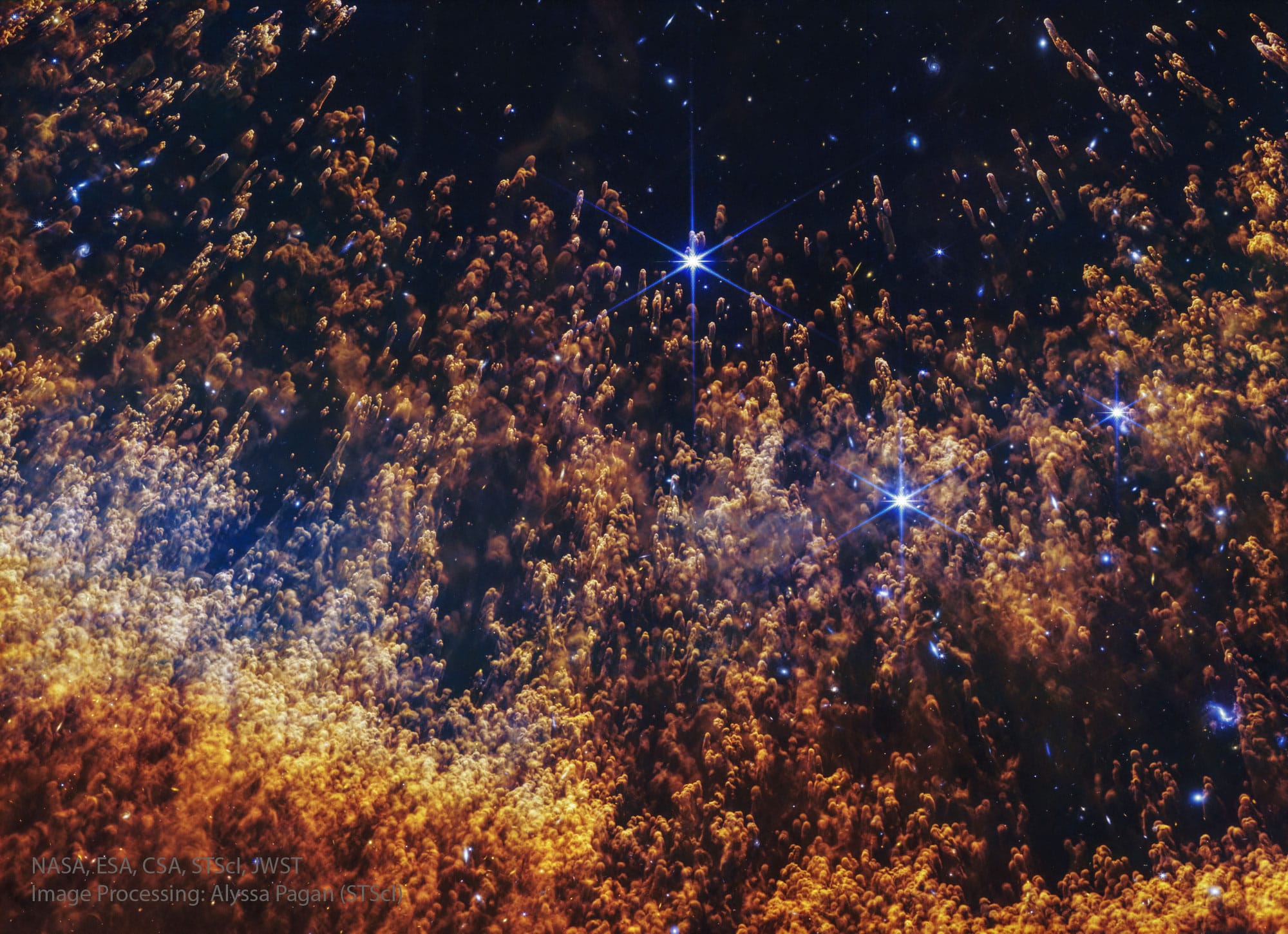
    The Cat’s Eye Nebula is a planetary nebula located in the Draco constellation. At its center is a dying star. Seen here is the faint halo that stretches 3 light-years around the central nebula. The filaments of the halo are estimated to be 50,000 to 90,000 years old and were shed during earlier periods in the star’s evolution. Their shape is reminiscent of Rayleigh-Taylor instabilities, to my eye. (Image credit: T. Niittee; via APOD)

    Fediverse Reactions