Urinal Dynamics Win Ig Nobel Prize

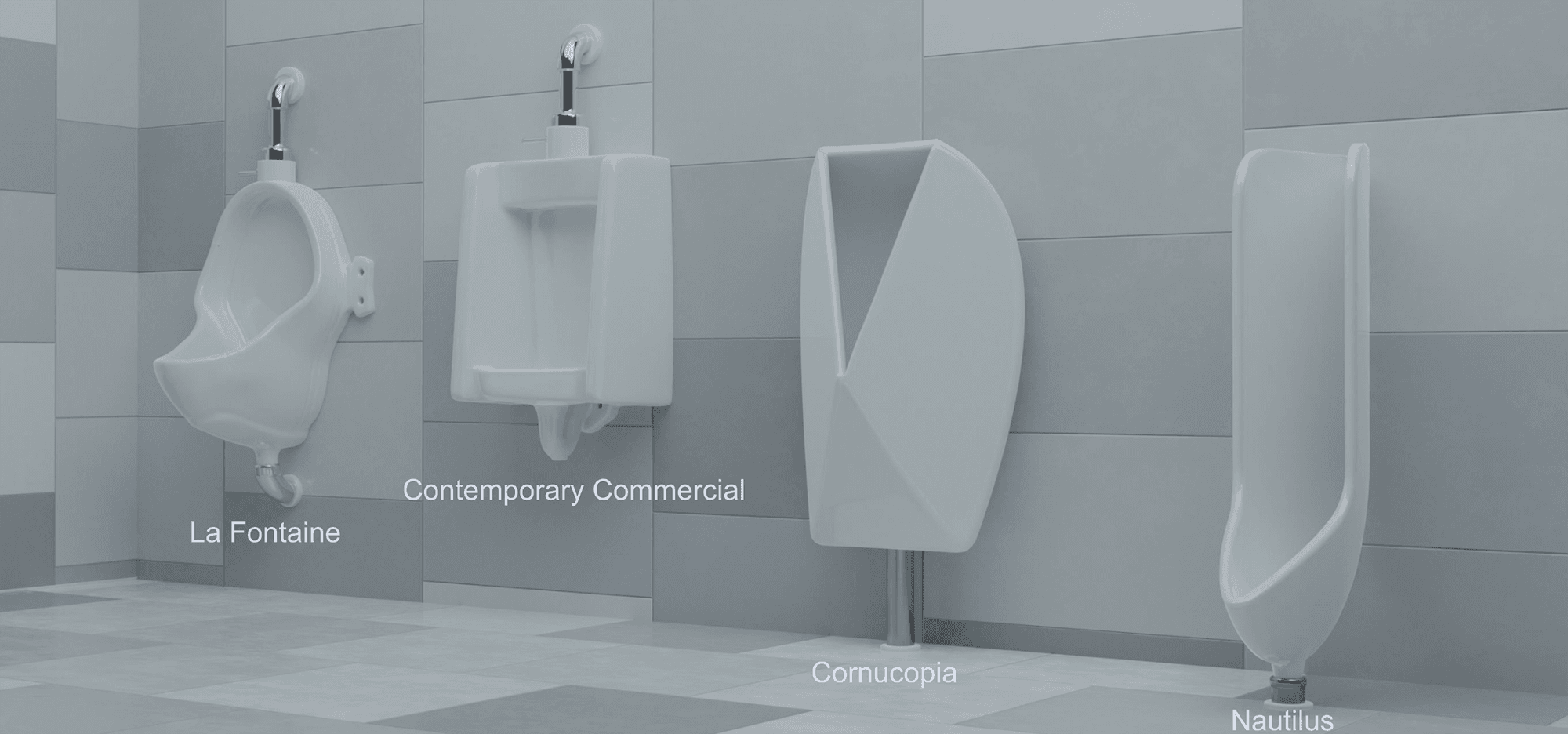
A rendered image of four tested urinal designs: one past, one present, and two proposed.

Thirteen years ago, I made a prediction that work on how to avoid urinal splashback would win an Ig Nobel Prize. Today, I am, at last, vindicated. Randy Hurd, Zhao Pan, Tadd Truscott, and Kaveeshan Thurairajah shared the 2026 Ig Nobel Prize in Physics for their work designing a splash-free urinal.

The culmination of this decade-plus of research are two urinal designs, the Cornucopia (“Cornucopeea”) and the Nautilus (“Nauti-Loo”). Both designs minimize splash, in part, through their geometry. As you may have noticed when rinsing dishes, having a stream of droplets hit a surface at a high impact angle creates lots of splash. But at a low impact angle, very little splash occurs. The team took this observation and created designs that minimized impact angle no matter where a user aimed.
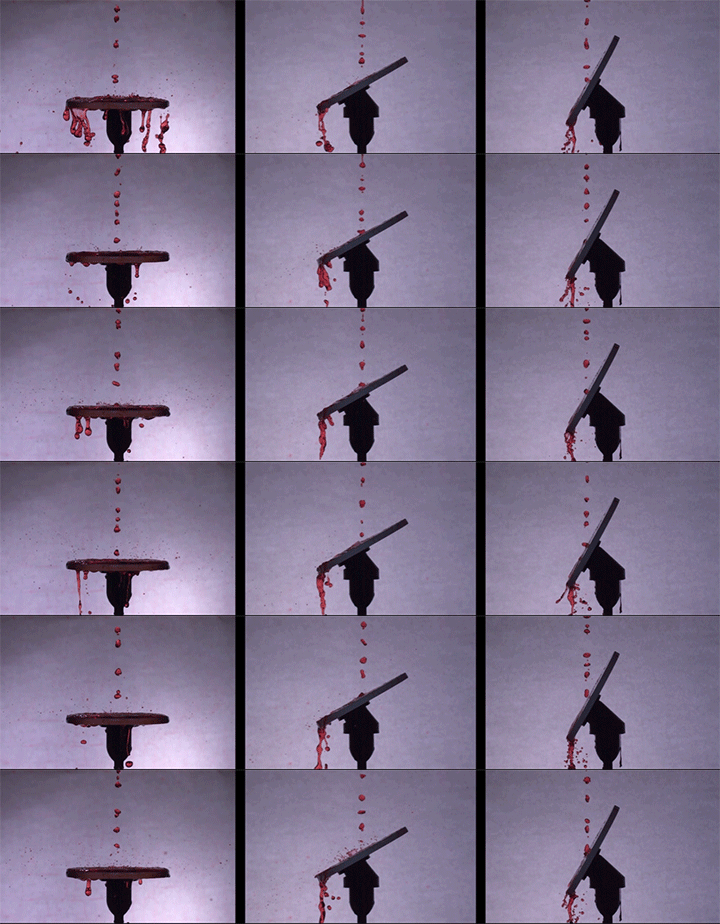
How splashback varies with impact angle. High and medium impact angles (left and middle, respectively) generate a lot of splashing from a stream of impacting droplets. In contrast, below a critical impact angle, the splashing is negligible (right).

Naturally, they tested the two new designs, alongside two existing urinal designs, finding that the new urinals reduced splashing by as much as 95% across a range of flow rates and user heights. Although the Cornucopia was the least splashy urinal, the team gave the Nautilus an overall edge because its design is easier to clean and works for children, adults, and wheelchair users.

Considering the estimated 1 million liters of urine contemporary urinals splash across U.S. restrooms daily, the Nautilus could save significant labor and cleaning costs, if implemented. (Image credits: urinals and experiment – K. Thurairajah et al., poster – R. Hurd et al.; research credit: K. Thurairajah et al. and R. Hurd et al.)

P.S. – As indicated, I’ve followed this work for a long time. In addition to this post, we did a webcast (10 years ago, yikes!) that touched on the topic. But my most in-depth coverage of the story is still to appear in print; you’ll get to enjoy the whole tale–stretching all the way back to 2012–in a chapter of my forthcoming book. More on that soon! In the meantime, please enjoy this gem of a scientific poster from the project’s early days in 2013:
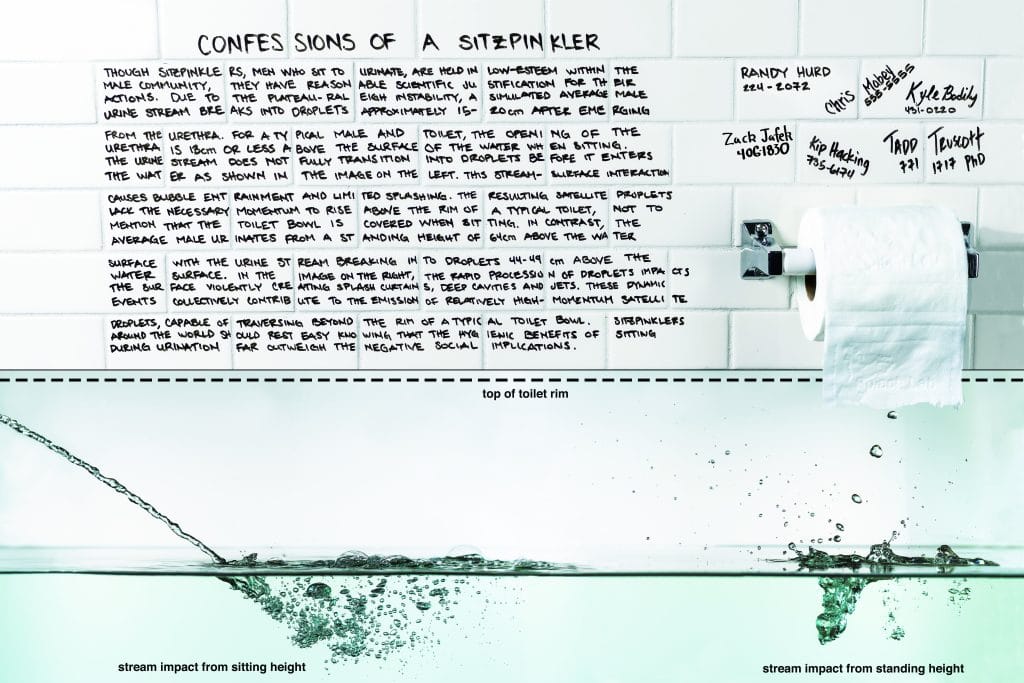
One of the best research posters of all time, designed to look like it's been written on a tiled bathroom wall. The text reads, "Confessions of a Sitzpinkler. Though Sitzpinklers, men who sit to urinate, are held in low-esteem within the male community, they have reasonable scientific justification for their actions. Due to the Plateau-Rayleigh instability, a simulated average male urine stream breaks into droplets approximately 15-20 cm after emerging from the urethra. For a typical male and toilet, the opening of the urethra is 13 cm or less above the surface of the water when sitting. The urine stream does not fully transition into droplets before it enters the water as shown in the image on the left. This stream-surface interaction causes bubble entrainment and limited splashing. The resulting satellite droplets lack the necessary momentum to rise above the rim of a typical toilet, not to mention that they toilet bowl is covered when sitting. In contrast, the average male urinates from a standing height of 64 cm above the water surface with the urine stream breaking into droplets 44-49 cm above the water surface. In the image on the right, the rapid procession of droplets impacts the surface violently, creating splash curtains, deep cavities and jets. These dynamic events collectively contribute to the emission of relatively high-momentum satellite droplets, capable of traversing beyond the rim of a typical toilet bowl. Sitzpinklers around the world should rest easy knowing that the hygienic benefits of sitting during urination far outweigh the negative social implications."
One of the best research posters of all time, designed to look like it’s been written on a tiled bathroom wall. The text reads, “Confessions of a Sitzpinkler. Though Sitzpinklers, men who sit to urinate, are held in low-esteem within the male community, they have reasonable scientific justification for their actions. Due to the Plateau-Rayleigh instability, a simulated average male urine stream breaks into droplets approximately 15-20 cm after emerging from the urethra. For a typical male and toilet, the opening of the urethra is 13 cm or less above the surface of the water when sitting. The urine stream does not fully transition into droplets before it enters the water as shown in the image on the left. This stream-surface interaction causes bubble entrainment and limited splashing. The resulting satellite droplets lack the necessary momentum to rise above the rim of a typical toilet, not to mention that they toilet bowl is covered when sitting.

In contrast, the average male urinates from a standing height of 64 cm above the water surface with the urine stream breaking into droplets 44-49 cm above the water surface. In the image on the right, the rapid procession of droplets impacts the surface violently, creating splash curtains, deep cavities and jets. These dynamic events collectively contribute to the emission of relatively high-momentum satellite droplets, capable of traversing beyond the rim of a typical toilet bowl.

Sitzpinklers around the world should rest easy knowing that the hygienic benefits of sitting during urination far outweigh the negative social implications.”

Fediverse Reactions

Comments

Leave a Reply

Your email address will not be published. Required fields are marked *

This site uses Akismet to reduce spam. Learn how your comment data is processed.