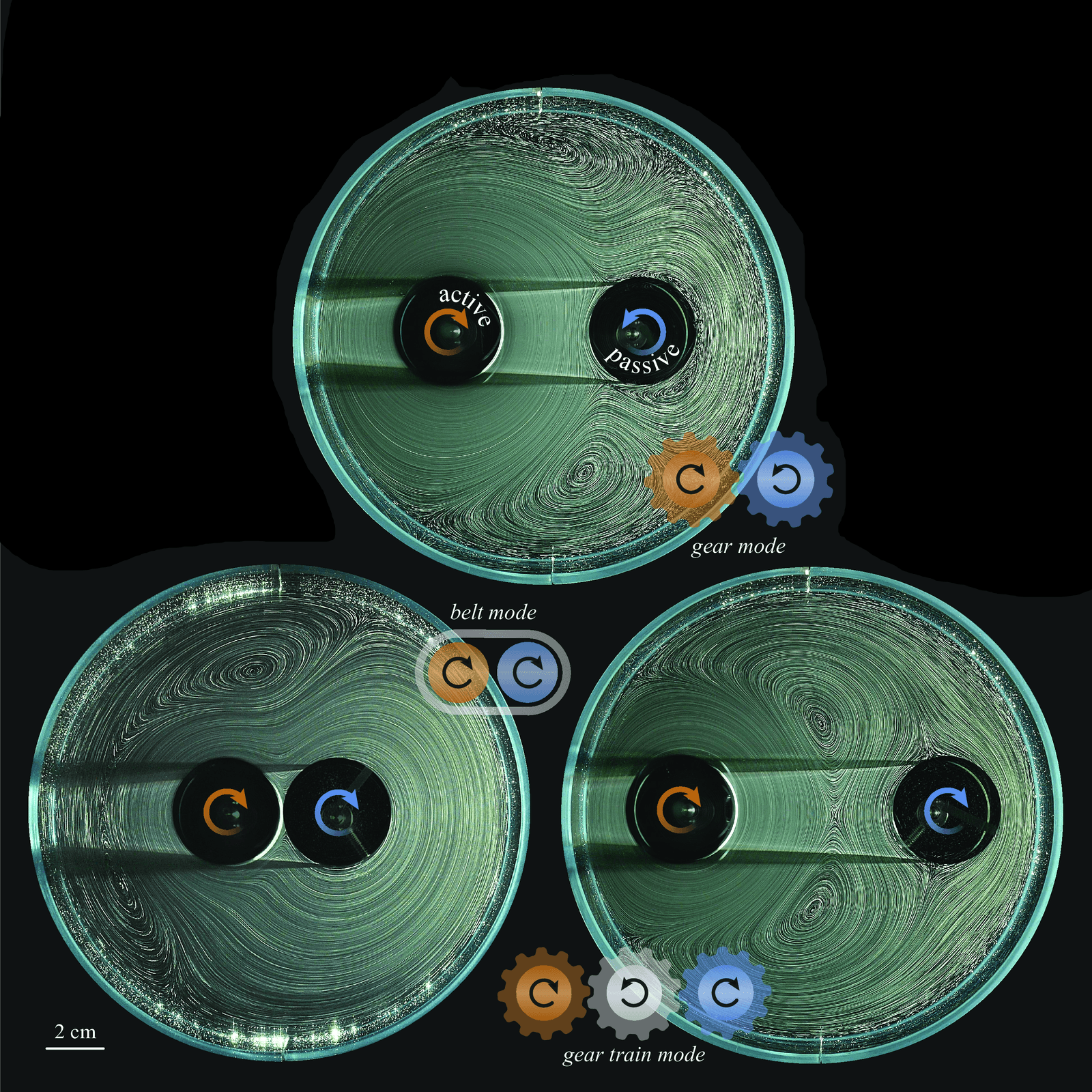
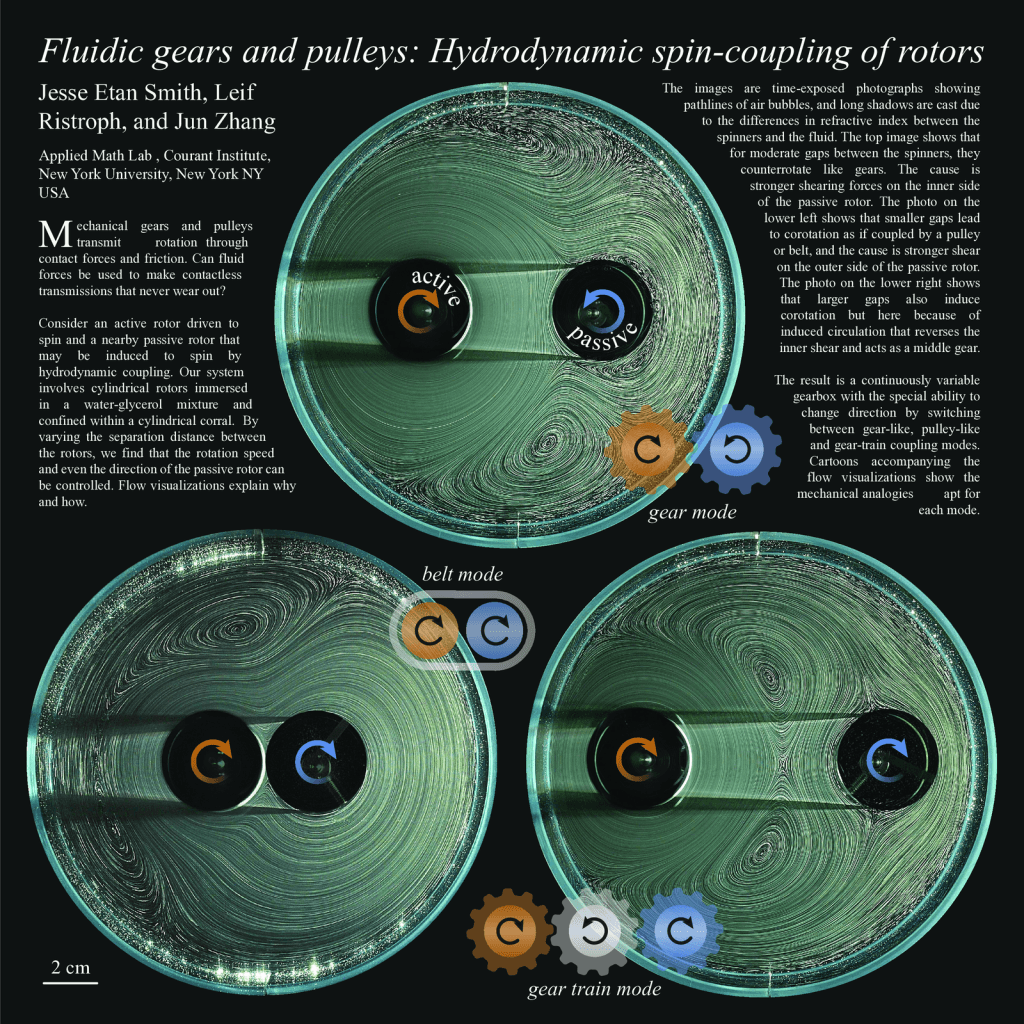
In mechanical systems, gears and pulleys transmit rotation from one location to another. Here, researchers explore a fluid dynamical version of such systems. The set-up consists of two rotors contained in a cylindrical corral filled with a water-glycerin mixture. One of the rotors is active, marked here with orange; the other (blue) one is passive, meaning that it can rotate due to the forces on it but it is not actively driven by a motor.
The three flow visualizations illustrate different configurations the rotors can take on, depending on their separation distance. In the top image, the rotors have a moderate separation distance and the passive one rotates opposite of the active one. That rotation direction is set by the high-shear flow on its inner side. If the rotors are close together (left image), they rotate in the same direction, aided by strong shear on the outside edge of the passive rotor; this mimics being linked with a belt. And, finally, if the rotors are widely separated, they also corotate, with the fluid in between acting like a virtual gear linking them. (Image credit: J. Smith et al.)




Leave a Reply