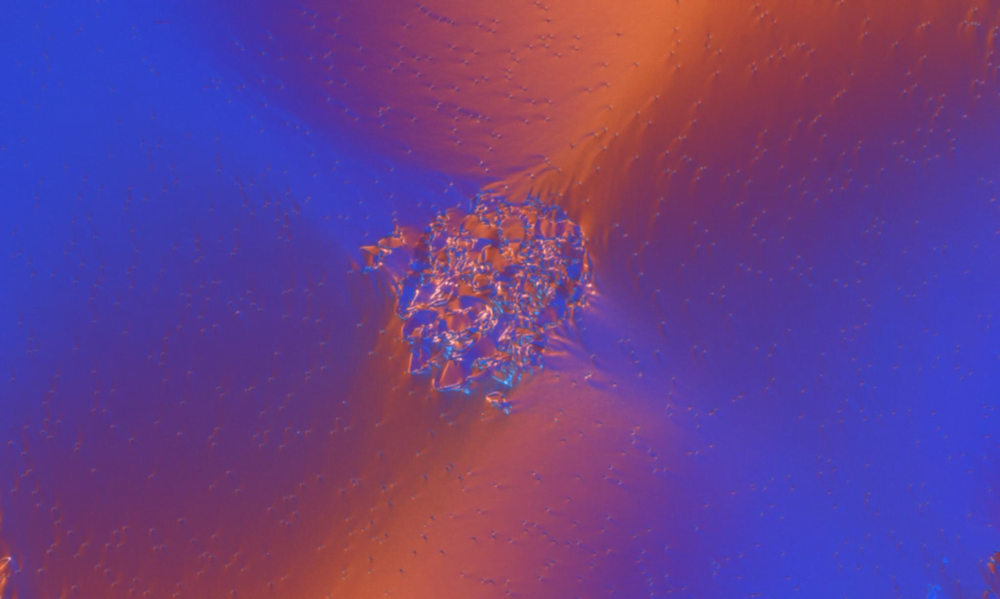
Liquid crystals are now ubiquitous in displays, but scientists are still discovering new properties for this state of matter. Here, a team explores nematic liquid crystals, whose rod-like shape rotates in three dimensions as they apply a voltage. The layer of liquid crystals is held between polarizing filters, creating regions of light and dark that depend on the liquid crystals’ orientations.
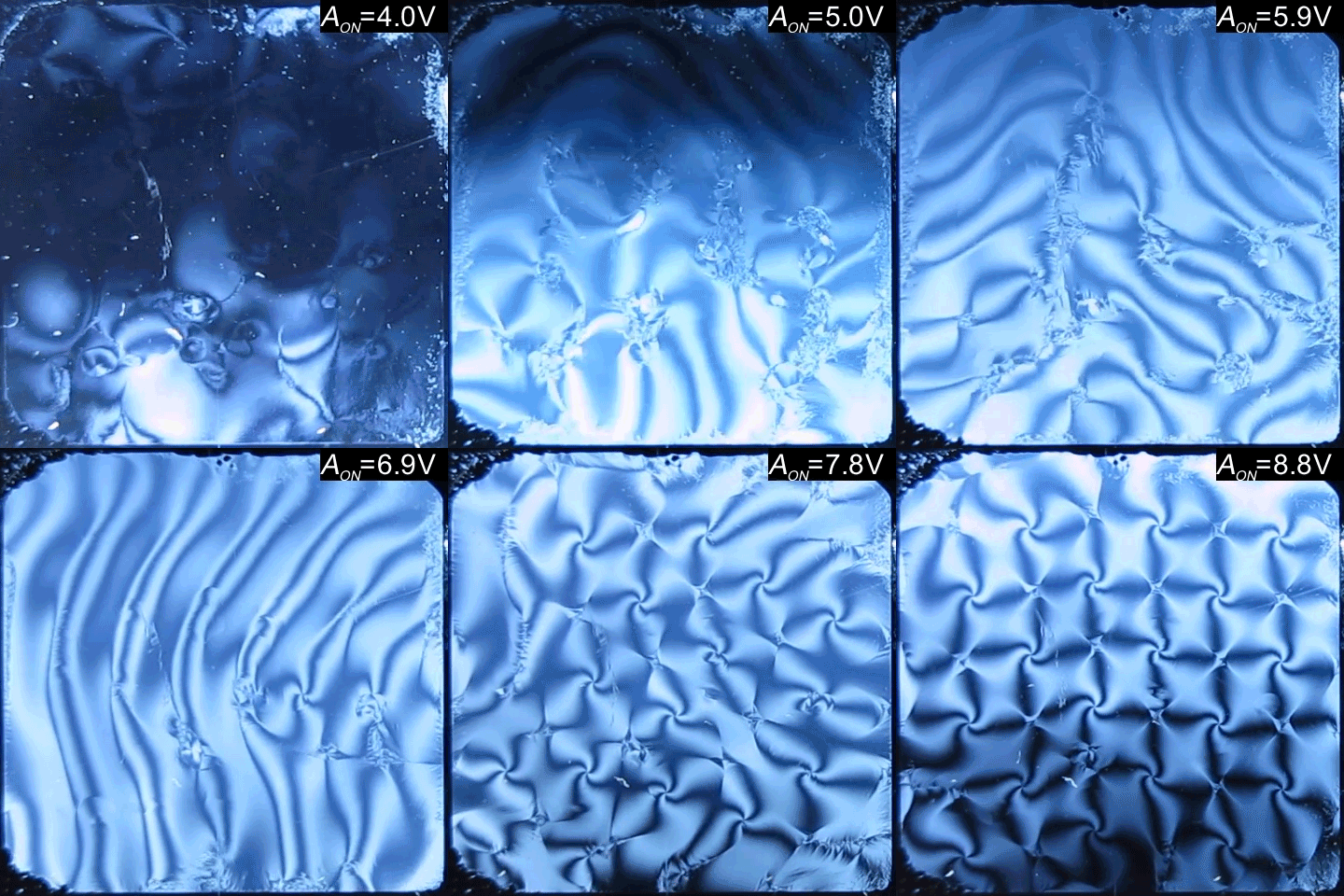
As the researchers increase the voltage, traveling waves form. With higher voltages, the waves appear to slow a stop. The slowing waves result from the molecules tilting far from a vertical orientation, which makes it harder for individual molecules to rotate since they experience greater resistance from their neighbors. (Image, video, and research credit: V. Panov et al.; via APS Physics)
Leave a Reply