
This surreal image comes from an aurora on Halloween 2013. Photographer Ole C. Salomonsen captured it in Norway during one of the best auroral displays that year. The shimmering green and purple hues are the glow of oxygen and nitrogen in the upper atmosphere reacting to high-energy particles streaming in from the solar wind. These geomagnetic storms can disrupt GPS satellites, compromise radio communication, and even corrode pipelines, but they also create these stunning nighttime displays. (Image credit: O. Salomonsen; via APOD)
Month: October 2024

Marangoni Blossoms


When surface tension varies along an interface, fluids move from regions of low surface tension to higher surface tension, a behavior known as the Marangoni effect. Here, a drop of (dyed) water is placed on glycerol. The two fluids are miscible, but water has much a lower viscosity and density yet a higher surface tension. The drop’s interface quickly becomes unstable; viscous fingers form along the edge as the less viscous water pushes into the more viscous glycerol. Eventually, the surface-tension-driven Marangoni flow breaks those fingers off into lip-like daughter drops. The researchers also show how the interplay between viscosity and surface tension affects the size of fingers that form by varying the water/glycerol concentration. (Image and video credit: A. Hooshanginejad et al.)

The Great Red Spot’s Cycle
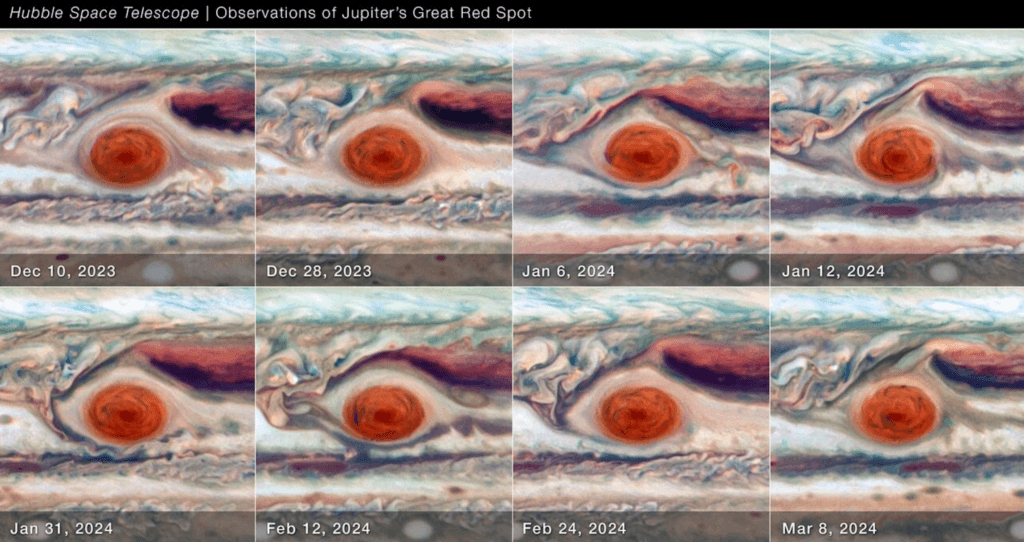
First spotted by humanity in 1664, Jupiter‘s Great Red Spot is a seemingly endless storm. Strictly speaking, there is debate as to whether observations prior to 1831 were of the same storm, but there’s no denying that the storm has raged unabated since regular observations began in the first half of the nineteenth century. Despite its longevity, the Great Red Spot is not unchanging. Overall, its major axis is shrinking, making the storm more circular over time. The storm also has a 90-day cycle in which its size, shape, and brightness vary, as seen below. Researchers note that the changes are relatively subtle — at least to the eye — but now that they’ve been identified, it may be possible to use amateur astronomers’ data to track these variations more closely. (Image credits: GRS – K. Gill/NASA, snapshots – A. Simon et al.; research credit: A. Simon et al.; via Gizmodo)

Over a 90 day cycle, Jupiter’s Great Red Spot oscillates in size, shape, and other characteristics. A Plasma Arc Lights
Plasma lighters — as their name indicates — use plasma in place of burning butane. Plasma — our universe’s most common state of matter — is a gas that’s been stripped of its electrons, ionizing it so that it’s electrically and magnetically active. In these lighters (as well as other plasma generators), a high-voltage current jumps between two nodes to ignite the spark. In effect, it’s a tiny lightning bolt you can hold in your hand. (Though I don’t recommend that you try to literally hold it; plasma burns suck.) (Video and image credit: J. Rosenboom; via Nikon Small World in Motion)

An arc of plasma from a plasma lighter dances. 
“Last Breath of Autumn”
On a rainy autumn day, Agorastos Papatsanis headed to the forest in search of fungi. There he captured this fairytale-like scene with falling rain and drifting spores. Near the forest floor, any breeze is slight, so mushrooms use their own humidity to move air and spread their spores. As water evaporates from the mushroom’s cap, it cools the air nearby, causing it to spread outward. Since that water vapor is lighter than air, it rises, too, carrying the mushroom’s spores along with it. (Image credit: A. Papatsanis; via Wildlife PotY)

Self-Cleaning With Salt Critters
Even freshwater contains trace salts and minerals that cause scaly buildups as they evaporate. Getting rid of the scale usually requires toxic chemicals and/or lots of scrubbing, neither of which are desirable at the industrial level. At the same time, we’re extremely limited in the amount of freshwater that we have available; only about 1% of Earth’s water is liquid and fresh. If we could use salt water in more industrial processes, that would preserve freshwater for drinking and agriculture. But how do we tackle the scaly buildup?

(A) On microtextured surfaces, salt from evaporating drops can work its way into the gaps, destroying the superhydrophobicity of the surface. (B) In contrast, nanotextured surfaces give the salt nowhere to adhere, resulting in “salt critters” that grow upward and detach. Enter “salt critters.” Researchers found that when salt water evaporated from microtextured surfaces designed to shed water, salt would eventually build up in the gaps, breaking the hydrophobic effect and allowing scale to build up. In contrast, a nanotextured surface left nowhere for the salt to adhere. On these surfaces, evaporating salt water built jellyfish-like salt critters that rose from the surface and, eventually, broke off and rolled away, leaving the surface pristine. (Image credit: S. McBride; research credit: S. McBride et al.; via Physics Today)

Lenticular Landscape
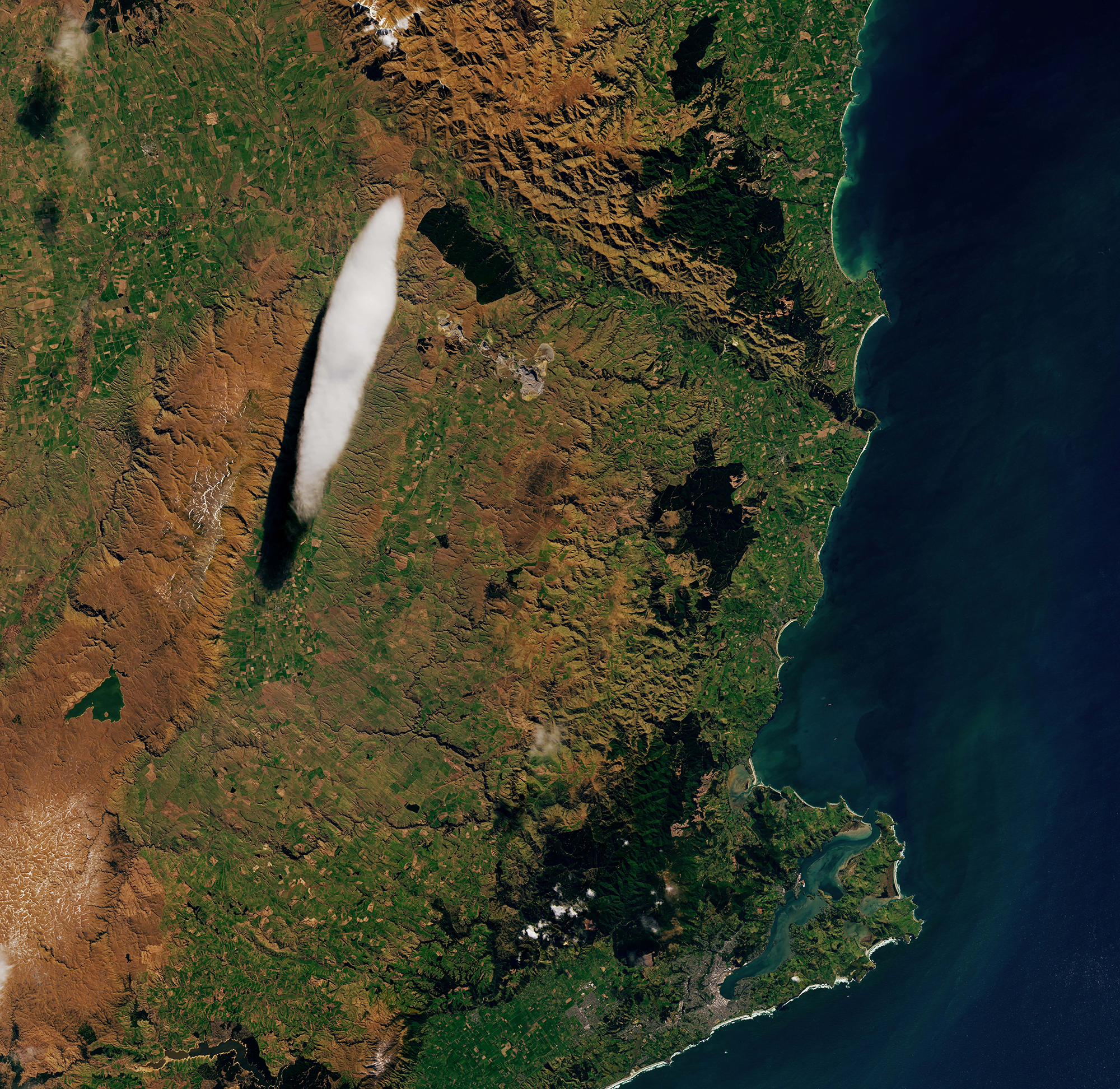
Mountain ridgelines push oncoming winds up and over their peaks, creating the conditions for some spectacular condensation. If the displaced air is moist enough, it cools and condenses into a cloud that appears to hover over the peak. In reality, winds are constantly moving up and over the mountain, condensing into visible cloud where the temperature is cool enough and then morphing back to water vapor once temperatures increase. This process can create stacked lenticular clouds like those seen here. This spot in New Zealand sees lenticular clouds so often that the formation has its own name: Taieri Pet! (Image credit: satellite image – L. Dauphin, b/w – National Library; via NASA Earth Observatory)

Black-and-white photo of an instance of the Taieri Pet lenticular cloud structure. 
Waves Break Up Floating Rafts
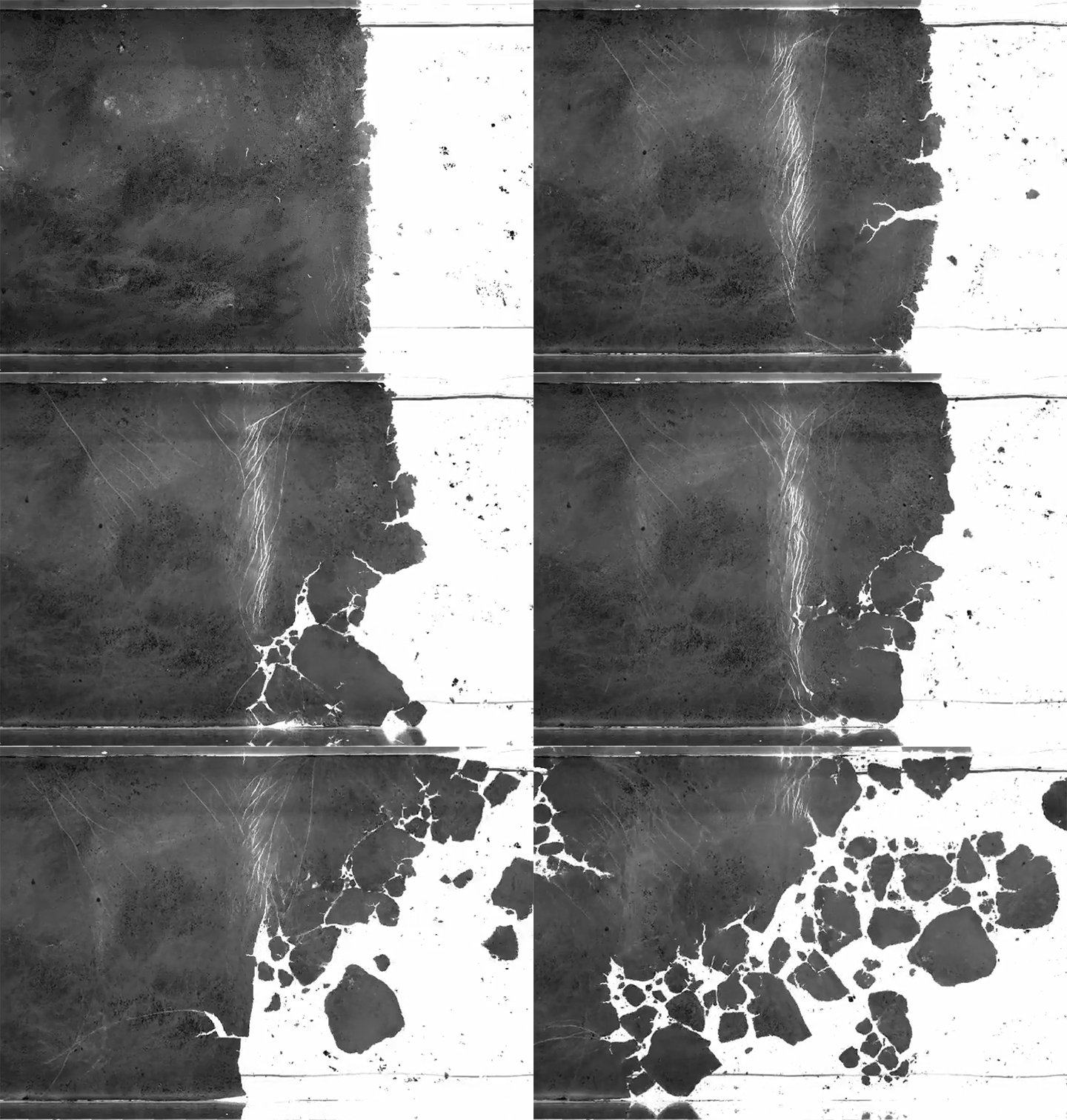
Small particles can float on a liquid, held together as a raft through capillary action. But those rafts — like the tea skin below — break up when waves jostle them. In this study, researchers looked at how standing waves broke up a raft of graphite powder. Although the raft’s break-up resembles fields of sea ice breaking apart, the researchers found that different mechanisms were responsible. In their experiment, waves pushed and pulled horizontally at the raft, causing it to fracture. But that push-and-pull is negligible in sea ice, where sheets instead break from the up-and-down motion of waves vertically bending the ice. Nevertheless, the new insights are valuable for various biofilms and some ice floes. (Image and research credit: L. Saddier et al.; via APS Physics)

The skin atop a cup of tea breaks up into polygons after stirring with a spoon. Although the effect resembles sea ice breakup, the specific wave mechanism differs. 
Feeding Hurricanes
With the strong hurricane season pummeling the southern U.S. this year, you may have heard comments about how warm oceans are intensifying hurricanes. Let’s take a look at how this works. Above is a map of ocean surface temperatures in late September, as Helene was developing and intensifying. For hurricanes, the critical ocean surface temperature is about 27 degrees Celsius — above this temperature, the warm waters add enough energy and moisture to the storm to intensify it. In this image, the waters colored from medium red to black are at or above this temperature. In fact Helene’s path — shown in a dotted white line — took it across particularly warm (and therefore dark) eddies with temperatures up to 31 degrees Celsius.
Many factors affect a hurricane’s formation and intensification; understanding and predicting storms, their path, and their strength remains an active area of research. But warmer ocean temperatures are better at sustaining the hurricane’s warm core, and their moisture is easier to evaporate, thereby fueling the storm. Unfortunately, as the climate warms, we have to expect that warmer oceans will help rapidly intensify tropical storms and hurricanes. (Image credit: W. Liang; via NASA Earth Observatory)
“Colors of Glacial Rivers”


As glaciers flow, they grind down rock, creating fine sediment that dyes waterways a milky color. In Jan Erik Waider’s aerial film, we get a bird’s eye view of the result, watching pockets of sediment move downstream in pulsating waves and swirls. Along the coast, ocean waves pass over the internal ones, creating a mesmerizing crisscrossed wavescape. You can also compare Waider’s aerial footage to Roman De Giuli’s tabletop-scale films and be amazed by their similarities. (Image and video credit: J. Waider; via Colossal)









.png)