Year: 2023

  • Featured Video Play Icon

    “aBiogenesis”

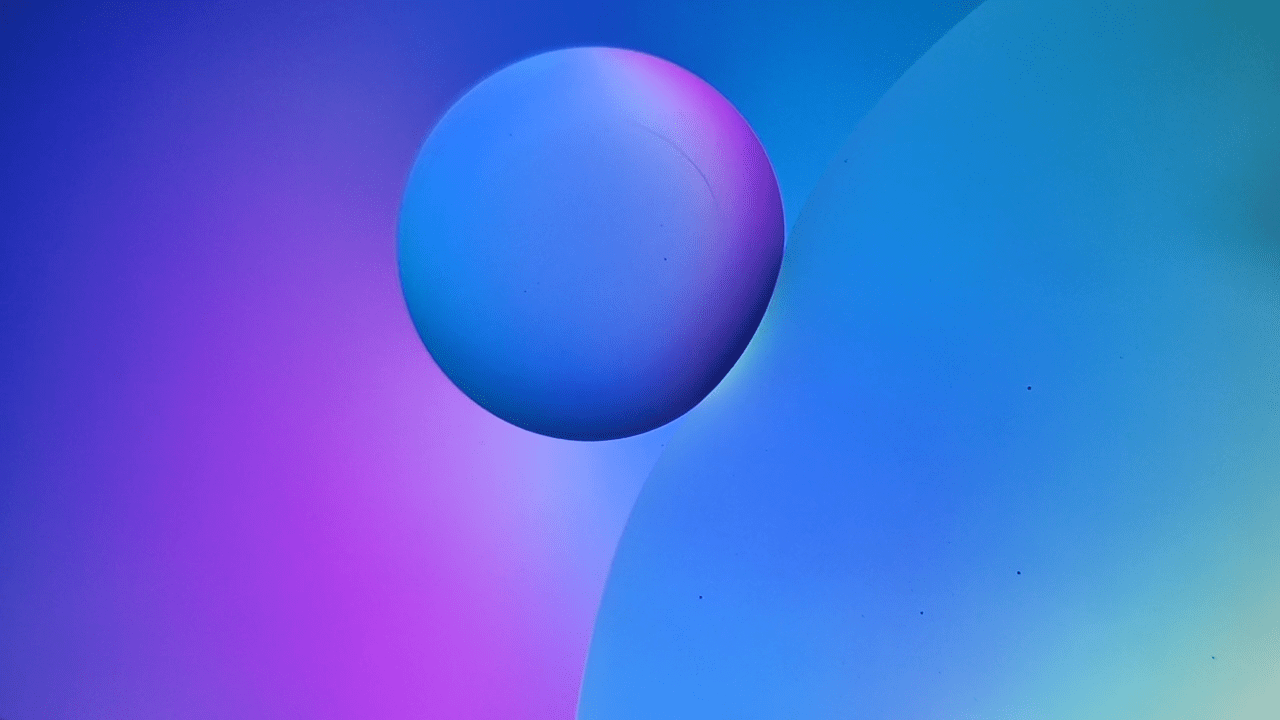
    Many theories posit the physical and chemical origins of life. In the short film “aBiogenesis”, CGI artist Markos Kay imagines one such theory — the lipid world theory — in which cellular life began as a soup contained within immiscible fatty membranes. Chemicals trapped within these vesicles interacted and ultimately formed the building blocks of life as we know it, including RNA. Kay’s interpretation is a beautiful exploration of this intersection of physics, chemistry, and biology. (Image and video credit: M. Kay; via Colossal)

  • Featured Video Play Icon

    Listen to a Martian Dust Devil

    A lucky encounter led the Perseverance rover to record the first-ever sound of a dust devil on Mars. The rover happened to have its microphone on (something that only happens a few minutes every month) just as a dust devil swept directly over the rover. Check out the video above to see and hear what Perseverance captured.

    Using the rover’s instrumentation, researchers worked out that the dust devil was at least 118 meters tall and about 25 meters wide. The team was even able to determine the density of dust in the vortex from the sound of individual grain impacts captured in the acoustic signal! Serendipitous as the experience was, planetary scientists may now look to include microphones on more missions, since we now know how to get useful meteorological data from them. (Video credit: JPL-Caltech/NASA; image credit: LPL/NASA; research credit: N. Murdoch et al.; via AGU Eos; submitted by Kam-Yung Soh)

  • Black Holes in a Bathtub

    Black Holes in a Bathtub

    Physicist Silke Weinfurtner studies fluids, not for themselves, but for what they can teach us about black holes, cosmic inflation, and quantum gravity. Black holes are notoriously difficult to study directly, but, mathematically speaking, it’s possible to set up a fluid system that behaves in the same way a black hole does. The result is a bathtub-like arrangement with a central vortex, seen above. And within this “bathtub,” Weinfurtner and her colleagues can directly measure sound waves equivalent to Hawking radiation, the theoretical means by which black holes emit heat. Learn more about these analogue gravity experiments in her interview over at Quanta Magazine. (Image credit: P. Ammon; via Quanta Magazine; submitted by clogwog)

  • Drag Reduction for Swimming Shrimp

    Drag Reduction for Swimming Shrimp

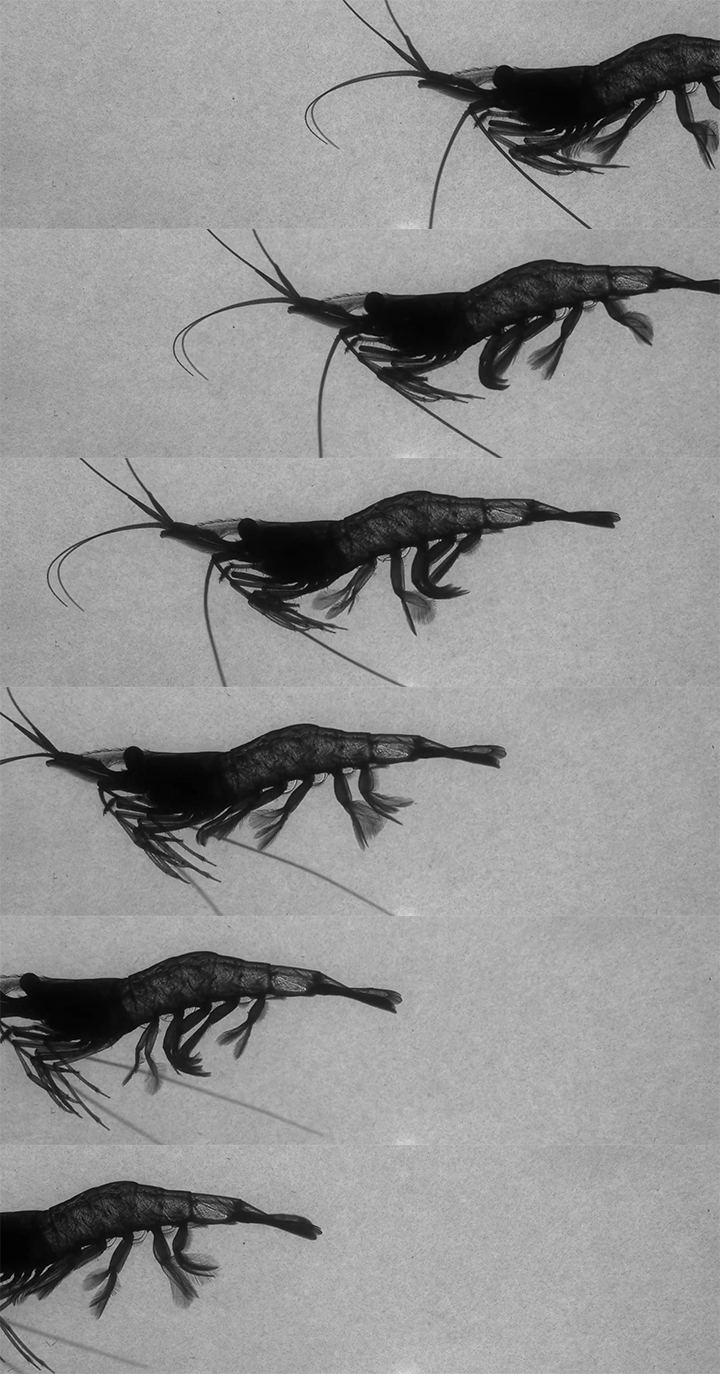
    Marsh grass shrimp, despite their small size, are zippy swimmers. They move using a series of closely-spaced legs that stroke asynchronously. Researchers found that the flexibility and stiffness of the legs are critical for the shrimp’s efficiency. During the power stroke, the shrimp’s leg is held stiff, maximizing the force it’s able to transfer to the water. But during the forward-moving recovery stroke, the shrimp bends its legs almost horizontal and presses both legs in the pair together tightly. This action minimizes the area of the leg pair and reduces the drag they cause as they move into position for the next stroke. (Image, video, and research credit: N. Tack et al.; via Ars Technica; submitted by Kam-Yung Soh)

    https://www.youtube.com/watch?v=hWOtF0RXTwk
    A close-up view of the shrimp’s leg as it swims.
  • Featured Video Play Icon

    Spinning Liquids With Lego

    One way to explore the effects of spinning liquids at high-speeds is to build an expensive and precise lab apparatus. Another method is to raid the Lego bin. Here, a YouTuber builds ever-more-elaborate Lego constructions to spin a sphere of water. He begins with a relatively straightforward magnetic stirrer that creates a bathtub vortex in his sphere, but as the set-up grows, he eventually encases the sphere to spin the entire thing at high-speed. It’s a cool way to see how spinning liquids react, from forming a vortex to spin coating the interior of the sphere and to generating a parabolic interface between air and liquid. Set-ups like these are not merely for fun, though; scientists use them to simulate the interiors of planets. (Image and video credit: Brick Technology; submitted by clogwog)

  • Featured Video Play Icon

    “Iridescent”

    Soft colors and sudden coalescence combine in this short film from Susi Sie’s team. The visuals rely on liquid lenses (likely oil) floating atop a water bath. You can see how the fluids get manipulated in their behind-the-scenes video, which also provides a peek at how the sound effects get made. (Video credit: S. Sie et al.)

  • Toilet Plumes

    Toilet Plumes

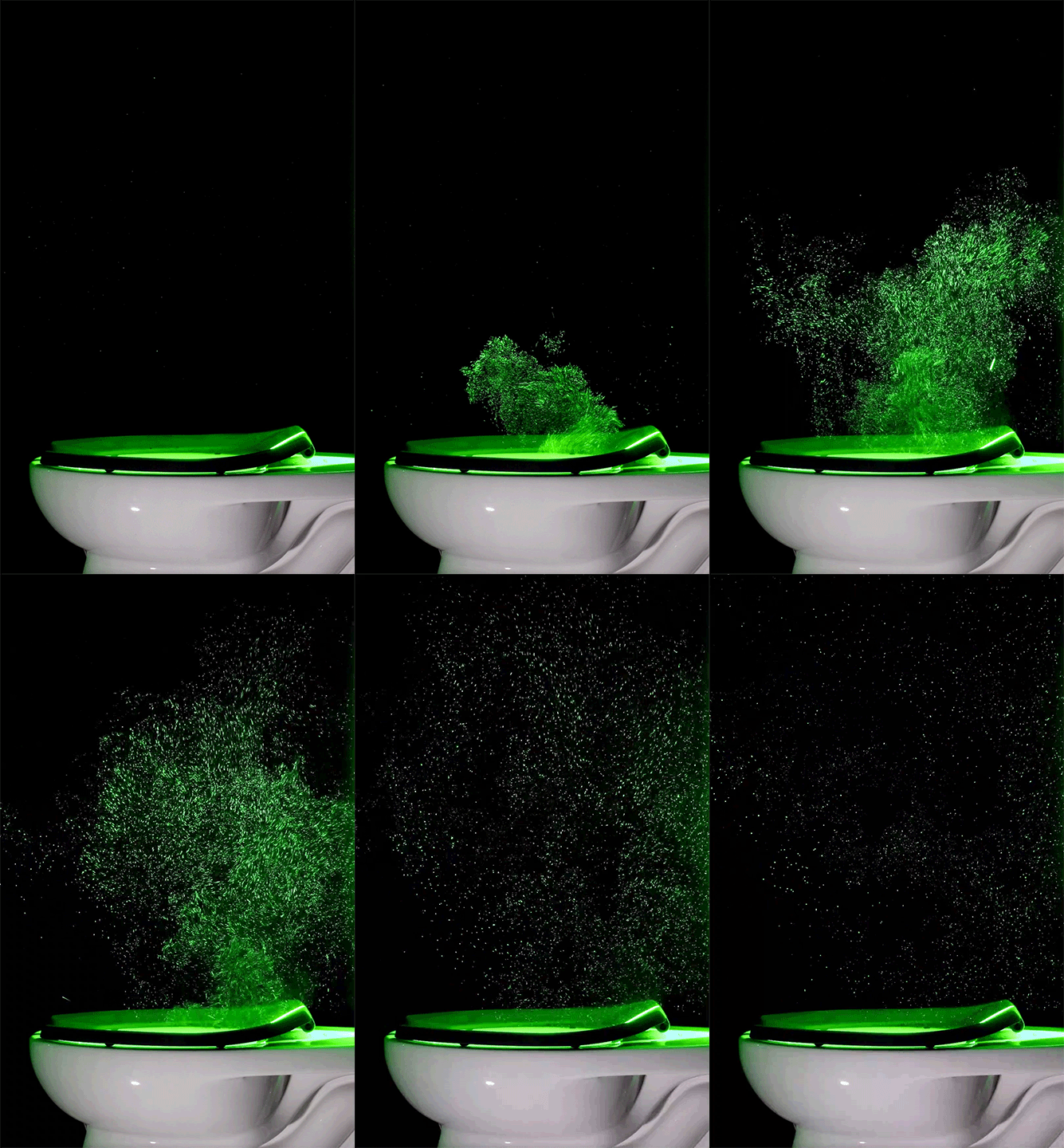
    Toilet flushes are gross. We’ve seen it before, though not in the same detail as this study. Here, researchers illuminate the spray from the flush of a typical commercial toilet, like those found in many public restrooms. They found that flushing generates a plume of droplets that reaches 1.5 meters in under 8 seconds, producing many thousands of droplets across a range of sizes.

    The experiments were conducted in a ventilated lab space, and the flushes involved only clean water — no fecal matter or toilet paper — so they don’t perfectly mimic the confines of a public toilet stall. But the implications are still pretty gross. Without a lid to contain the flush’s spray, these energetic toilets are spraying droplets capable of carrying COVID, influenza, and other nastiness all over our bathrooms. (Image and research credit: J. Crimaldi et al.; via Gizmodo)

  • Where Fresh and Salty Meet

    Where Fresh and Salty Meet

    Waterways twist through the wetlands of Adair Bay in this astronaut-captured image of northwestern Mexico. The estuary marks the transition between the Great Altar Desert and the Gulf of California. Fresh and salt water mix in the sediment-rich waterways. Mangroves and other salt-tolerant vegetation flourish in the coastal marsh. During low tides, evaporating water leaves behind salt flats, seen here in gray and white. High tides flood the area with nutrients that support both the vegetation and abundant aquatic life. (Image credit: NASA; via NASA Earth Observatory)

  • Bending in Bubbles

    Bending in Bubbles

    Inside a cavity with a square cross-section, bubbles form an array. The shapes of their edges are determined by surface tension and capillarity (lower half of center image). Adding an elastic ribbon into the bubbles (upper half of center image) means that the bubbles’ shapes are determined by a competition between the elasticity of the ribbon and the capillarity of the fluid. Researchers found that they could tune the rigidity of the ribbon to dictate the shape of the bubble array, or, conversely, they could use the bubbles to set the shape of a UV-curable ribbon. (Image and research credit: M. Jouanlanne et al., see also)

  • Featured Video Play Icon

    Kelvin-Helmholtz Flows Downhill

    Gravity currents carry denser fluids into lighter ones, like cold air drifting under your door in winter or dense fogs flowing downhill in San Francisco. Here, researchers visualize the situation using denser salt water flowing into fresh water. Once the gate separating the two fluids rises, the salt water slides down an artificial slope into the fresh water.

    Very quickly the flow forms a Kelvin-Helmholtz instability due to the different flow speeds between the two fluids. Kelvin-Helmholtz waves form distinctive swirls and billows that are reminiscent of a cat’s eye. As the swirls rotate, they can flow over one another, and break up into turbulence. (Image and video credit: C. Troy and J. Koseff)