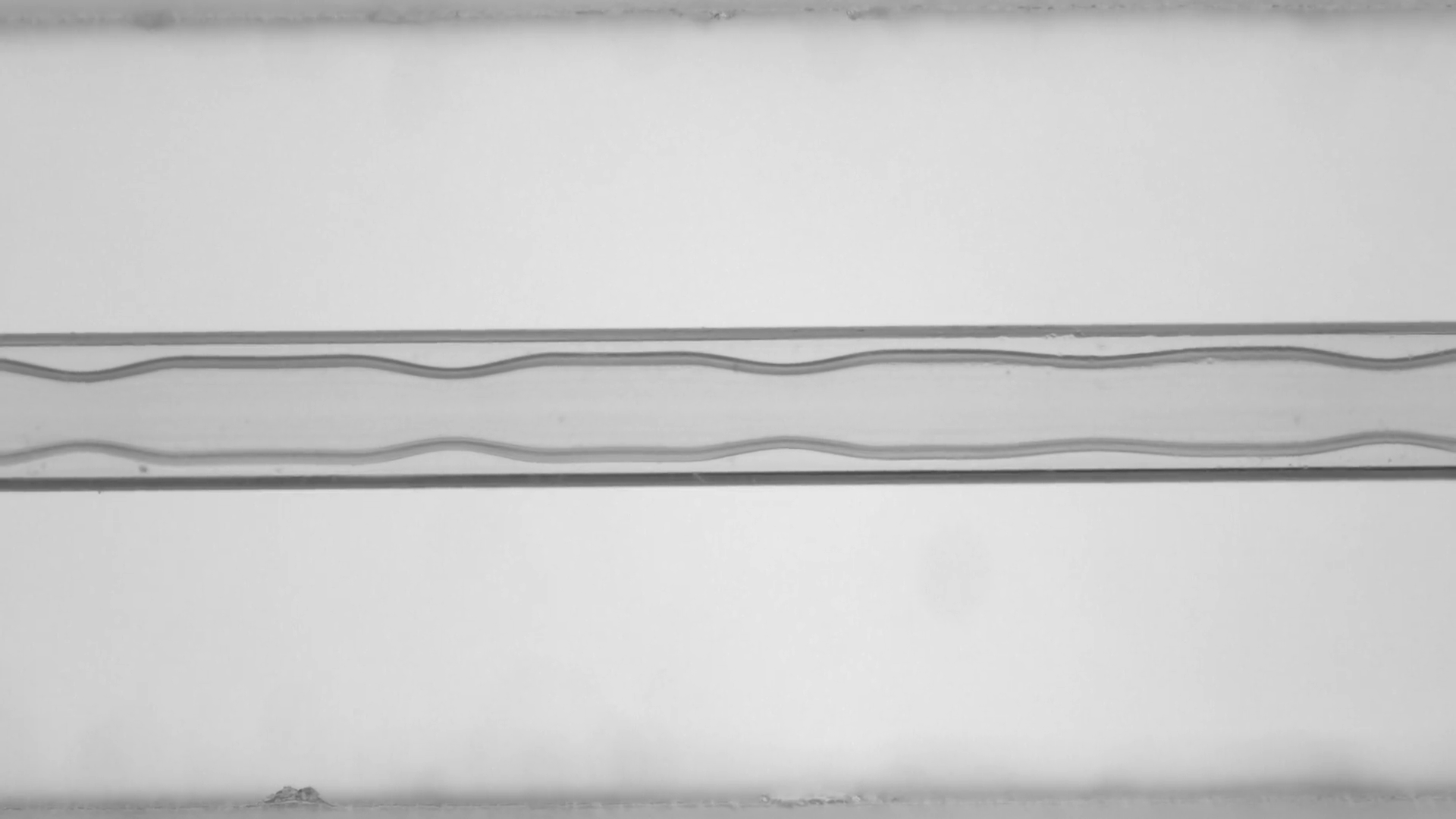
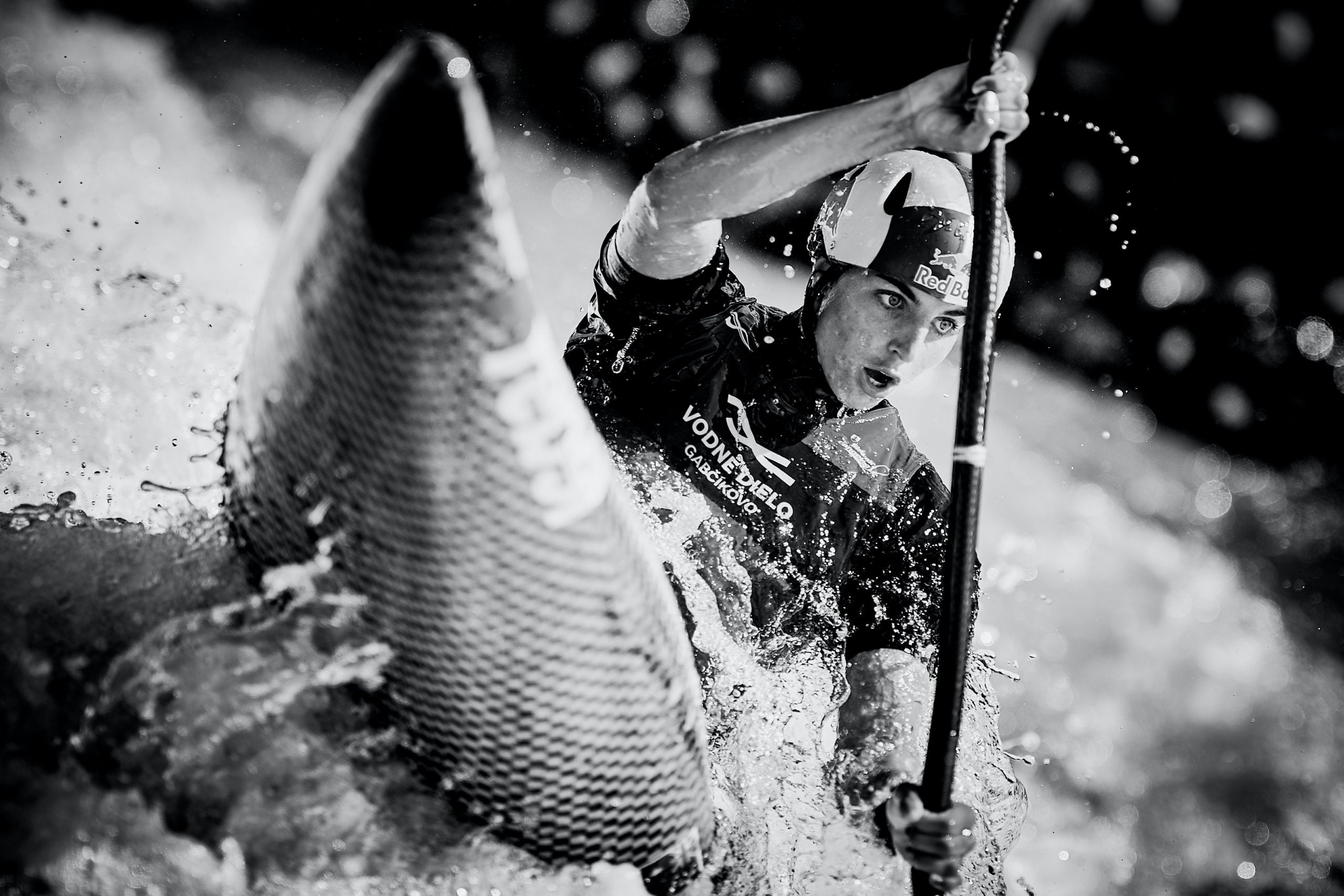
One of the most important and underappreciated pieces of urban infrastructure is the sewage system. We rely on them to make our waste vanish, as if by magic. In reality, these systems are carefully engineered and built to be largely self-cleaning and future-proof. Gravity is the primary driver of the system, and engineers design the slope of sewage lines so that flow inside the pipes is fast enough to keep solid waste suspended. There are, of course, plenty of challenges involved; check out the full video for an overview. (Image and video credit: Practical Engineering)
Though fluid dynamicists have long theorized about the hydrodynamic benefits of fish swimming in schools, nailing down the actual physics has been quite difficult. Fish rarely swim exactly as an experimenter would like, and measuring quantities like swimming efficiency in a living fish is tough to do. In the numerical realm, it’s tough to simulate multiple fish swimming at realistic conditions. So some teams have turned to biomimetic robotic platforms to study schooling, as in this new research.
Once you’ve built a robotic fish that swims in a realistic way, that fish will have no problem swimming the same experimental patterns over and over. In this work, the researchers compared their robots swimming solo and swimming with a partner. In the partnered studies, they looked at fish swimming in phase — with their undulations matching one another — and out of phase — where the fish move opposite one another. They found that having a nearby partner improved the speed and efficiency for both fish, regardless of phase. But they also found a peculiar exception.
If one fish modifies their tailbeat frequency relative to their partner, they can slightly increase their power efficiency. But if they do so, it costs their partner more energy. That implies that fish could employ competitive dynamics, but, of course, it doesn’t tell us that they do! (Image and research credit: L. Li et al.; submitted by Kam-Yung Soh)
Towering mountains of convection and ominous colors are staples of Adam Kyle Jackson’s storm photography. His dramatic portraits of supercell thunderstorms highlight the majesty and power of these turbulent phenomena. Make sure to follow him on Instagram for lots more! (Image credit: A. Jackson; via Nat Geo)
Between November 2019 and March 2020 Betelgeuse, the red supergiant star in the constellation Orion’s left shoulder, experienced what’s being called the Great Dimming. Usually, the star is one of the ten brightest stars in the sky, often visible even in the suburban sprawl. But as of February 2020, it had dimmed by a factor of 2.5.
Observers speculated all sorts of causes, including the idea that this was a precursor to a supernova explosion. Instead, it’s a relatively normal occurrence for a star like Betelgeuse. The image above is from a numerical simulation of the star, and it shows approximately what it would look like to the human eye over a 7.5 year time span. As you can see, its brightness varies noticeably, and its surface seems almost to boil. This has to do with convection in the star. Compared to a star like our sun, Betelgeuse has fewer — and much larger — convection cells.
With a little more time and data, astronomers pinned down the exact source of Betelgeuse’s flickering during the Great Dimming. The year before the star belched an enormous bubble of gas into space. Then, when part of the star cooled in the aftermath, that gas condensed and formed a dust cloud which partially obscured the star. You can see an artist’s conception of the situation in the video below. (Image and research credit: B. Freytag; research credit: M. Montargès et al.; video credit: ESO/L. Calçada)
Adding just a little polymer to a fluid can make it viscoelastic and drastically change how it drips. A pure, viscoelastic fluid (left) necks down to a thin filament thanks to the polymers’ resistance to being stretched. But what happens when you add particles, too?
That’s the focus of this recent study, which adds particles of different sizes to dripping viscoelastic fluids. The researchers found that particles sped up how quickly the filament thinned and formed bead-like droplets. And larger particles (right) made the process even faster than small ones (middle), in experiments where the overall volume fraction of particles within the fluid matched. (Image and research credit: V. Thiévenaz and A. Sauret)
Mars is quite dusty. It periodically gets swallowed by planet-spanning dust storms, but it’s also home to regular dust devils whose size can put Earth’s to shame. Exactly how so much dust gets picked up by Mars’ incredibly thin atmosphere — only 1% of Earth’s — is still something of a mystery. So scientists were excited after the Ingenuity helicopter’s fourth flight, where cameras on the Perseverance rover caught a billowing dust cloud following Ingenuity as it flew. Knowing how the helicopter flies, they may be able to unravel just how its wake picks up and carries dust. Since Ingenuity’s only purpose was to demonstrate flight on another planet, this would be a big scientific bonus for an already successful mission! (Image credit: NASA/JPL-Caltech/ASU/MSSS/SSI; via Nature; submitted by Kam-Yung Soh and jpshoer)
To coat the interior of a capillary tube, you typically fill the tube with a viscous liquid, then pump air in to displace the liquid, leaving behind a thin film of the viscous fluid. Keeping that film uniform and thin is a challenge, though, since the pumps used often struggle to keep a consistent low flow rate. Instead, a team of researchers used spin coating to treat the interior of capillary tubes.
Their apparatus consisted of a repurposed computer fan, stripped of its blades and fitted with a 3D-printed platform that could hold capillary tubes (left). When spinning, an oil slug inside each tube gets forced outward from the center of the platform, leaving behind a thin, uniform film coating in the tube. The group found that some fluids develop a wavy, Plateau-Rayleigh instability in the film once spinning stops (right), which is useful for creating a consistent wavy interior for the tube, particularly when using curable polymers for the coating. (Image, research, and submission credit: B. Primkulov et al.)
For a long time, people thought baseball aerodynamics were simply a competition between gravity and the Magnus effect caused when a ball is spinning. But the seams of a baseball are so prominent that they, too, have a role to play. Here’s a baseline image of flow around a non-spinning baseball:
An non-spinning baseball with a straight, unaltered wake.
As in our previous post on golf, the colors indicate the direction of vorticity but don’t matter much to us here. What’s important is that the wake behind the ball is straight, indicating that there is no additional force beyond gravity and drag acting on the ball. Contrast this to the spinning baseball below:
Flow around a baseball spinning clockwise.
This ball is spinning in a clockwise motion, which causes flow to separate from the ball earlier on the advancing (bottom) side and later on the retreating (top) side. As a result, the wake is tilted downward. This indicates an upward force on the ball, caused by the Magnus effect.
But what if the seams fall in a place where they affect the flow? Here’s another baseball that’s not spinning:
Flow around a non-spinning baseball with a seam-shifted wake caused by early separation on the top surface of the baseball.
Notice that seam sitting just past the widest point on the top of the baseball. Flow around that wide point (called the shoulder) is very sensitive to disturbances essentially because the boundary layer is just barely hanging on to the ball. The blue arrow marks where the boundary layer separates from the ball on the top, which takes place earlier than the flow separation on the bottom, marked by the red arrow. As a result, the wake of the ball is tilted upward, indicating a downward force on the ball. The researchers who first proved this effect call it a seam-shifted wake, and it turns out to be a very common effect in baseball. They’ve got a great blog dedicated to baseball aerodynamics where you can learn tons more if you’re interested. (Image credit: top – Pixabay, others – B. Smith; research credit: B. Smith; see also Baseball Aerodynamics)
Today wraps up our Olympic coverage, but if you missed our earlier posts, you can find them all here.
The Kasai Canoe Slalom Course is Japan’s first man-made whitewater venue. To test the design and its multiple configurations, engineers at CTU in Prague built this large-scale hydraulic model. Check out the video below to see it under construction and in action.
The course is adaptable so that it can be used for high-level competitions like the Olympics, then reconfigured for recreational use. You can even see what it’s like to run part of the course in a multi-person raft, thanks to a miniature, GoPro-equipped boat! (Image credit: top – M. Trizuliak, others – CTU Prague; video credit: CTU Prague)
In Olympic high-diving, athletes leap from a maximum of 10 meters above the water. Although the force of their water impact is substantial, it’s small enough that they can enter the water head first. For cliff divers — who may jump from 27 meters! — the impact force is too great to risk a head-first entry, so they enter the water feet first. But this does not eliminate their risk of injury.
As the diver’s body enters the water, each leg creates its own cavity, and the proximity of the two cavities generates a repulsive force. If the diver isn’t prepared to resist that force, it will force their legs apart, potentially injuring them. (Image and research credit: T. Guillet et al.)