Month: December 2018

  • Waves

    Waves

    Photographer Ray Collins is known for his striking portraits of waves, some of which I’ve featured on previous occasions. Collins is colorblind, so he focuses heavily on shape and texture in the wave, which produces some stunningly dramatic views of moving water frozen in time. There’s great power and beauty in breaking waves, and researchers are still actively learning just how significant they are to our planet’s cycles. 

    Note the spray blurring the edges of every wave here; these are some of the largest droplets the wave will make. As it crashes forward, the wave traps pockets of air, and, as those bubbles burst, they will create a spray of tinier droplets that carry moisture and salt into the atmosphere to seed clouds and, eventually, rain.

    Collins’ work reminds us both of the ocean’s power and its fragility as it undergoes rapid changes due to humanity’s influence. For more photos as well as a great interview with Collins, check out My Modern Met. (Image credit: R. Collins; via My Modern Met and James H.)

  • Entrained

    Entrained

    When an object hits water whether it draws air in with it depends on its shape, impact speed, and surface characteristics. In this experiment, though, there’s a bit of a twist. Here the sphere is passing through an interface with surfactants added. On the left, the sphere passes through smoothly without entraining air or creating a cavity. On the right, the same sphere impacts at the same speed but this time the interface is covered in a layer of bubbles. As a result, the sphere pulls a large air cavity into the water with it. Why the big difference?

    As the sphere passes through the bubbles, they burst, spraying the sphere with droplets. On impact, those droplets disrupt the layer of water traveling up the sides of the sphere, causing it to pull away from the surface and form a splash. Instead of smoothly coating the sphere in water, air can now stick to the sphere and get pulled in with it. (Image and research credit: N. Speirs et al., source)

  • Featured Video Play Icon

    “Haboob”

    Mike Olbinski’s latest storm chasing timelapse, “Monsoon V,” is once again spectacular. Although I do think the name could have been “Haboob” instead, given how many sweeping dust clouds encroach on the viewer. These towering wall clouds of dust can form from downdrafts at the leading edge of a cold front, or from the fading remains of a thunderstorm. In dry, dusty regions like Arizona, the strong downward winds spread outward as they near the ground, picking up dust and sand. Below you can see two examples of haboobs racing ahead of fronts. 

    The middle image shows a microburst, where a sudden, localized downdraft falls out of the storm. Notice how the wind and rain sweep outward as they near the ground. This is typical of any flow heading straight toward a wall! Check out the full video for lots more gorgeous fluid dynamics in action. (Video and image credit: M. Olbinski)

  • Featured Video Play Icon

    Fire Tornado in a Bubble

    File this one under awesome tricks you shouldn’t try at home. Here bubble artist Dustin Skye demonstrates his handheld inverted fire tornado. First, he blows a large encapsulating bubble, then blows butane and smoke into a smaller secondary bubble. When he breaks the wall between the two, the mixture swirls into the larger bubble. Then, by breaking a narrow hole into the remaining bubble, Skye forms a swirling tornado. He’s using conservation of angular momentum here to concentrate the vorticity he created by blowing into the original butane bubble. As the big bubble shrinks, the vorticity inside gets pulled inward and speeds up – like when a spinning ice skater pulls his arms in. That’s how you get the tornado. And from there, it’s just a matter of lighting the exiting butane and air mixture. (Video credit: D. Skye; via Gizmodo)

  • Featured Video Play Icon

    “Winter’s Magic”

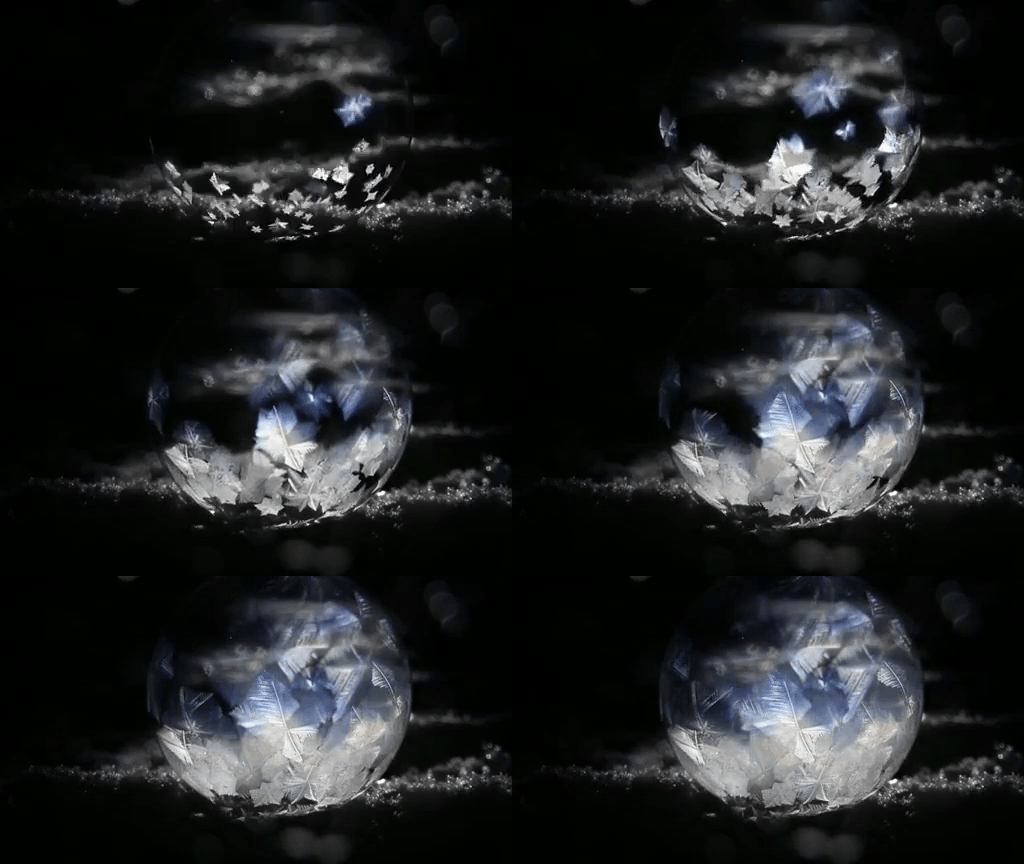
    Don Komarechka’s beautiful short film, “Winter’s Magic,” captures the beauty of soap bubbles as they freeze. It’s a delicate process and one difficult to capture in video. The bubble freezes first at the bottom, where it touches the cold surface – in this case, snow. That freezing releases latent heat and creates a temperature gradient along the thin liquid film. With that temperature gradient comes a variation in surface tension, and it’s this that creates the flow that lifts the ice crystals from the surface and turns the bubble into a snow globe. Eventually, as the frozen crystals continue growing, flow in the bubble walls comes to halt as the film solidifies.

    For more on the physics of freezing bubbles, check out this interview with the researchers, or, to learn more on how to film freezing bubbles, check out Komarechka’s description. (Video and image credit: D. Komarechka; via Laughing Squid; h/t to Jennifer O.)

  • Understanding Jupiter

    Understanding Jupiter

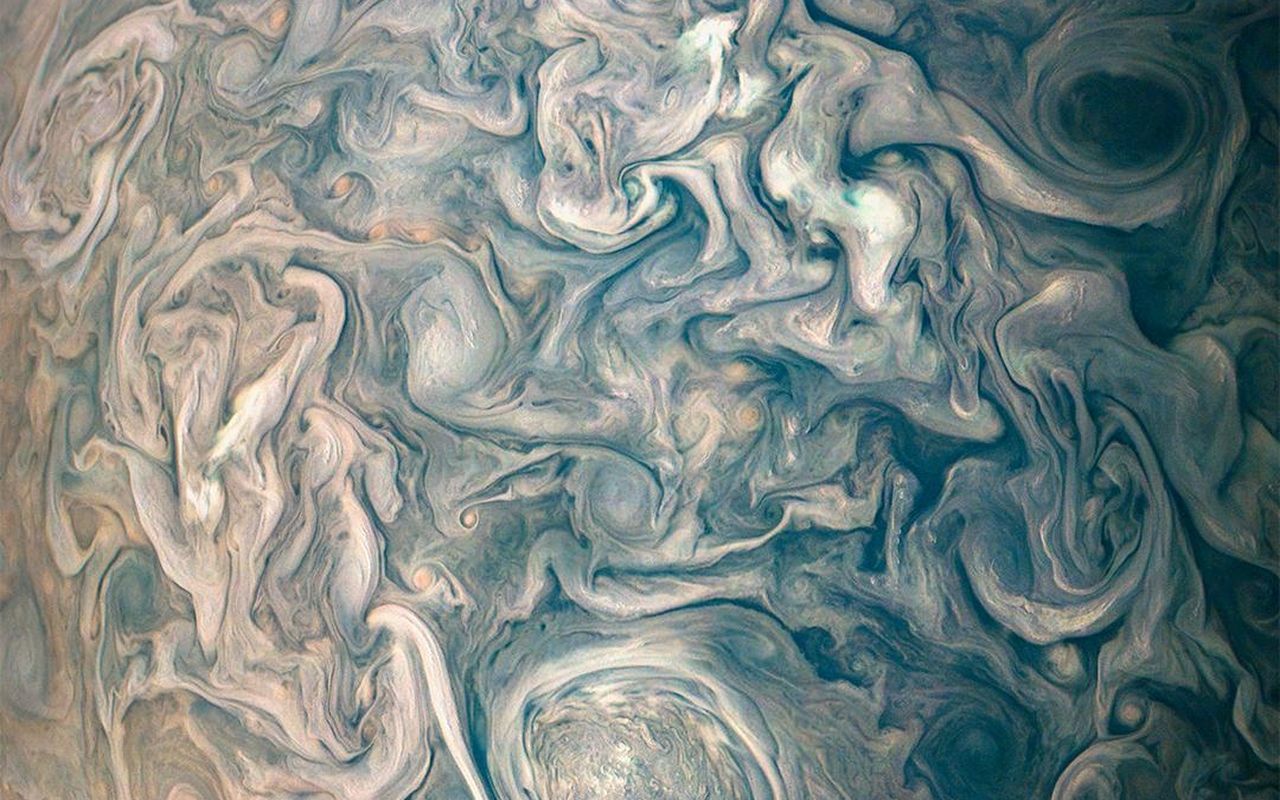
    The swirling clouds of Jupiter hide a complicated and mysterious interior. For decades, scientists have worked to puzzle out the inner dynamics of Jupiter’s atmosphere and what could be going on inside it to generate the flows we see visibly. Near Jupiter’s equator, we see strong jets that flow either east or west, depending on their latitude; this creates the stunning cloud bands we’re used to seeing on the planet. Toward the poles, though, things look more like what we see above – swirling but unbanded.

    Through theory, experiments, and simulations, scientists have tried to work out exactly what ingredients are necessary to make Jupiter look this way, but it’s pretty tough to recreate the conditions simply because Jupiter is so extreme. You need a lot of rotation, a lot of turbulence, and a way to stretch that turbulence if you want to imitate Jupiter. There’s been progress recently, though, and it suggests that the jets we see on Jupiter are far more than skin-deep. Instead, they likely stretch deep into the Jovian atmosphere at the equator and ride somewhat shallower toward the poles. (Image credit: NASA JPL; research credit: S. Cabanes et al.)

  • A Groovy Hovercraft

    A Groovy Hovercraft

    Not long ago, researchers discovered that droplets hovering over a hot grooved surface would self-propel. The extension to this was to investigate a hovercraft on a grooved, porous surface (top half of animation)–think an air hockey table with grooves. In that case, air inside the grooves flows from the point toward the edges, and it drags the hovercraft with it, thanks to viscosity. So the hovercraft travels in the direction opposite the points. This raised an obvious question: what happens if the hovercraft is grooved instead of the surface?

    That’s the situation we see in the bottom half of the animation. Air flows from the table and interacts with the grooves on the bottom of the hovercraft. And this time, the hovercraft propels in the direction of the points. That means there’s a completely different mechanism driving this levitation. When the grooves are onboard the hovercraft, pressure dominates over viscous effects. The air still gets directed down the grooves, but now, like a rocket, the exhaust pushes the hovercraft in the other direction – toward the points. For more on this work, check out the mathematical model of the problem and our interview with one of the researchers in the video below. (Research credit: H. de Maleprade et al.; image and video credit: N. Sharp and T. Crawford)

  • Inside a Heart

    Inside a Heart

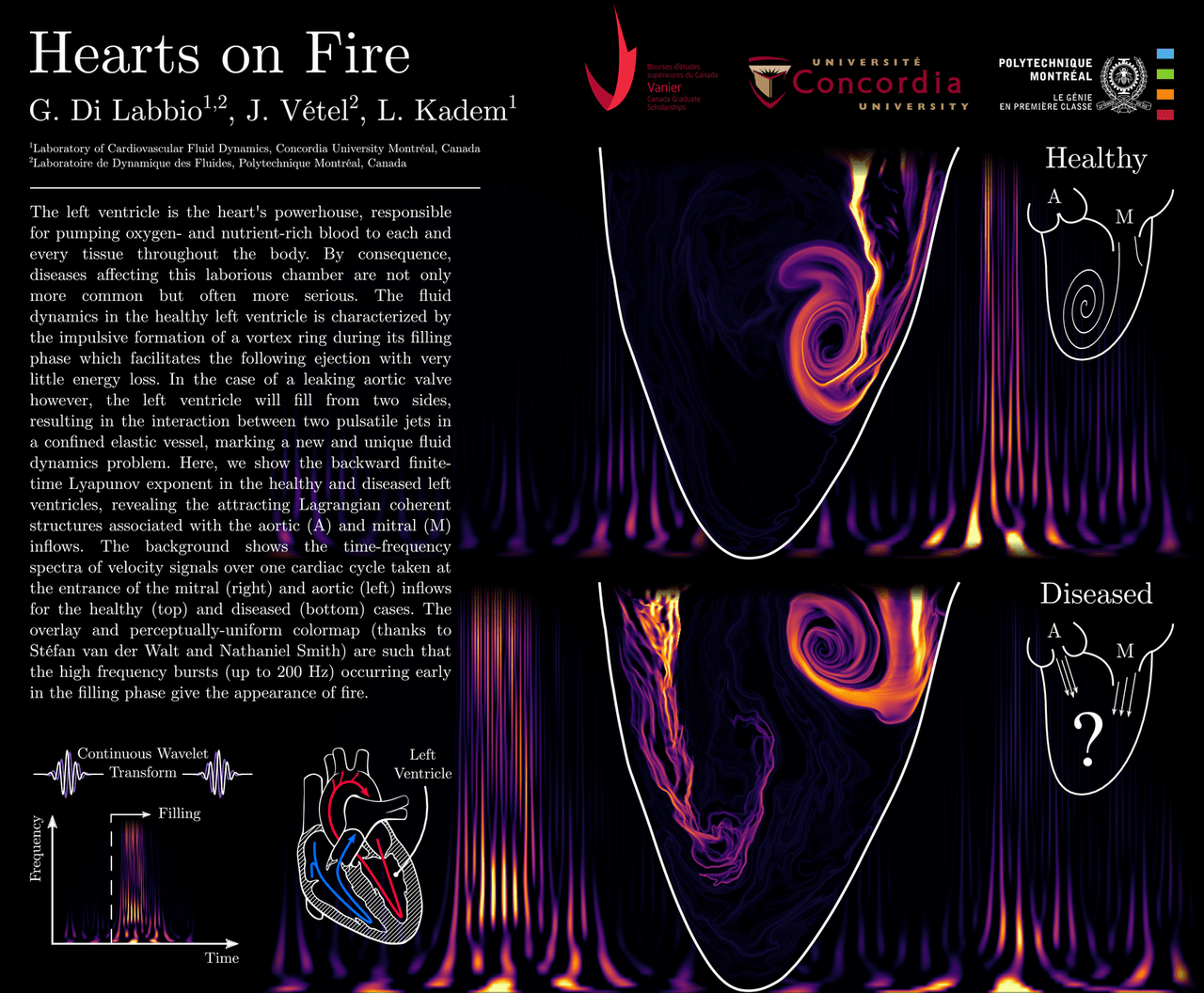
    You may not give it much thought, but there is important fluid dynamics happening inside you every moment of every day, especially inside your heart. Of the four chambers of the heart, the left ventricle has the thickest walls, reflecting its important task: pumping oxygenated blood throughout the body. In a healthy heart (top of poster; click here for the full-size version), a vortex ring and trailing jet fill the ventricle when the mitral valve opens. Then the ventricle contracts and pumps blood out the aortic valve and into the rest of the body.

    But for individuals with a leaking aortic valve (bottom of poster), things look different. Blood leaks back through the aortic valve at the same time that the mitral valve opens to allow freshly oxygenated blood back in. The two inflows disrupt mixing in the chamber, and, instead of pumping fully-oxygenated blood into the body, the left ventricle has to struggle to pump a less-oxygenated mixture into the body. (Image credit: G. Di Labbio et al.)

    ETA: (Research paper: G. Di Labbio et al., arXiv)

  • Featured Video Play Icon

    A Musical Splatter

    High-speed video is wonderful for appreciating fluid motion in ways we can’t on our own. In this video from Warped Perception, we see what happens when a vibrating tuning fork is lowered into water. The tines of the tuning fork create a spray of tiny droplets, reminiscent of what happens in ultrasonic atomization or when blowing through an immersed straw. The ejected droplets fall slowly back onto the disturbed surface; many of them bounce rather than coalescing. This is because the surface’s vibration pushes the drops aloft again before the air layer separating the drop from the surface has the time to drain away. (Video credit: Warped Perception)

  • Fighting a Viscous World

    Fighting a Viscous World

    Vaucheria is a genus of yellow-green algae (think pond scum), and some species within this genus reproduce asexually by releasing zoospores. Once mature, the zoospore has to squeeze out of a narrow, hollow filament in order to escape into the surrounding fluid (top). To do so, it uses tiny hair-like flagella on its surface. Despite the minuscule size of these micron-length flagella, they generate some major flows around the zoospore (middle and bottom). Even several body lengths away, the flow field shows significant vorticity. All this active entrainment of fluid from the surroundings helps the zoospore escape its confinement and swim away to start a new plant. (Image and research credit: J. Urzay et al., source)