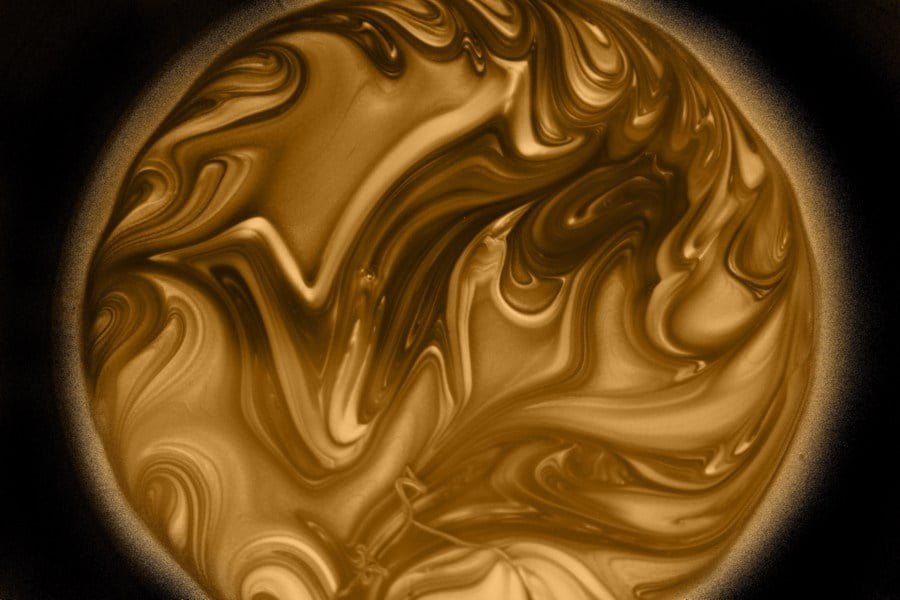
As much as I love exploring flashy examples of fluid dynamics, like shock waves around aircraft or what happens when non-Newtonain fluids get crushed by a hydraulic press, my favorite moments are the simple, everyday ones. Getting to see fluid dynamics in my daily life, whether I’m standing in the kitchen cooking or trying to wash my hands, is what excites me the most. The photo above is an example of this kind of simple, satisfying fluid experience. The image shows wax being melted in a crockpot. As it melts and its optical characteristics change, the wax reveals the mixing pattern inside the container. There’s nothing earth-shattering or scientifically important about something like this. But it’s still a moment where the otherwise unseen and unnoticed becomes visible and beautiful. It’s the fluid dynamical equivalent of stopping to smell the roses. When did you last pause to appreciate the flows around you? (Image credit: A. Unger et al.)
Month: December 2018

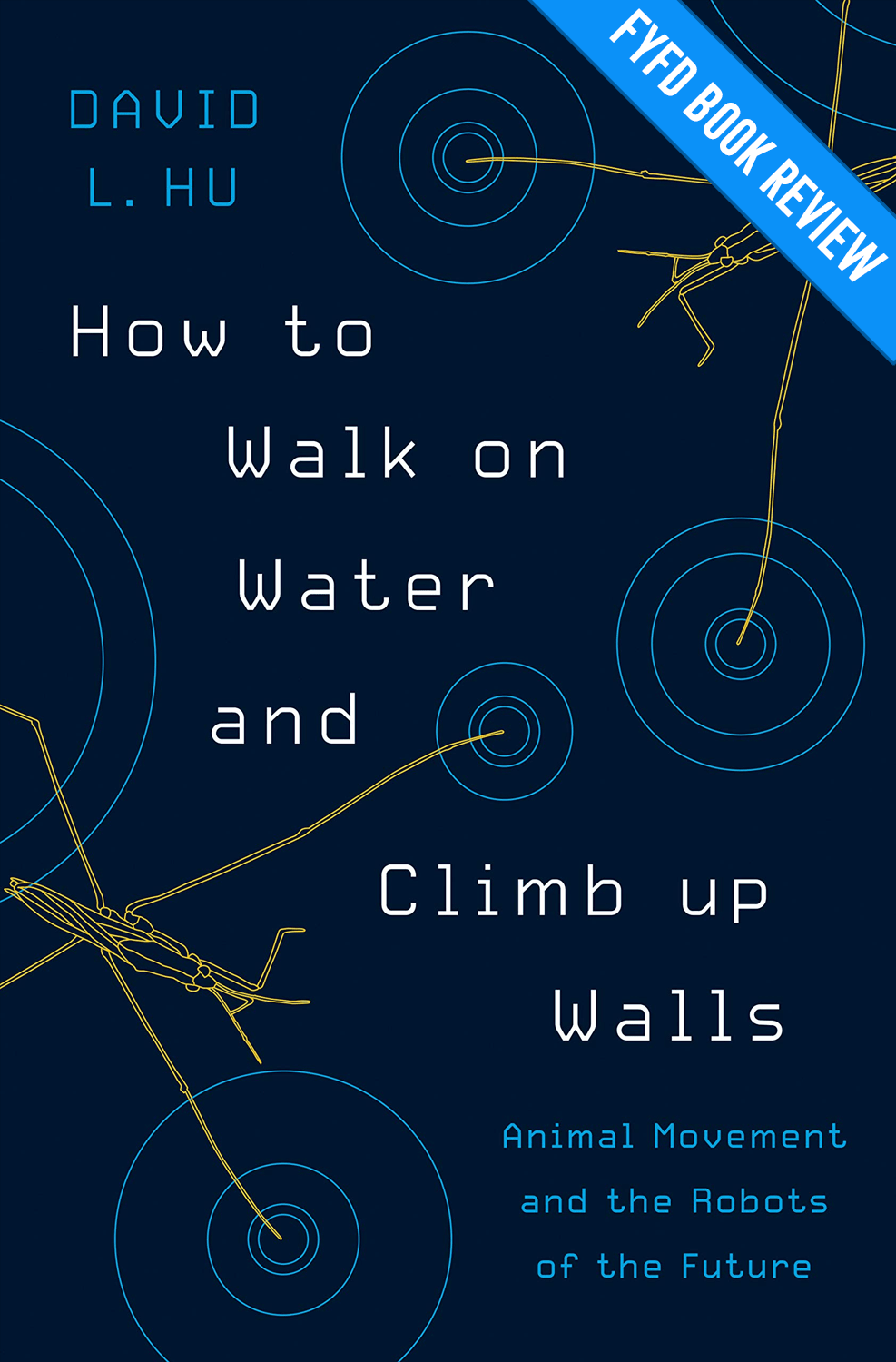
Review: “How to Walk on Water and Climb Up Walls”


“An eight-year-old girl kicked her feet back and forth on the seat of a Long Island Railroad train. I beckoned her to cover over and pointed to the top of my winter jacket, which I slowly unzipped. Inside, nestling against me for warmth, were ten snakes, their forked tongues waving back and forth. The child shrieked and ran back over to her mother, who was napping. ‘That man has a coat full of snakes,’ she shouted.”
So begins Chapter 2 of Dr. David Hu’s new book, How to Walk on Water and Climb Up Walls (*), a captivating and funny journey through animal locomotion and biorobotics. Don’t let that fool you, though; this book has plenty of fluid dynamics to it. Long-time FYFD readers will recognize some of the topics, such as the fluid-like behavior of fire ants, how eyelashes keep our eyes clean and moist, and why swimming behind an obstacle is so easy even a dead fish (like the one shown above) can do it.
There are plenty of exciting, new stories as well, like how sandfish – a type of lizard – can swim under sand and why a lamprey’s nervous system may lead to better robots. The explanation of how cockroaches are virtually unsquishable and able to squeeze themselves into crevices a quarter of their height absolutely floored me.
Hu’s book offers a front-row seat to research at the cutting edge of biology, engineering, and physics, with anecdotes, explanations, and applications that will stick with you long after you put the book down. If you’re looking for a holiday gift for yourself or another science-lover, check this one out for certain (*).
*Disclosures: I purchased my copy of this book using my own funds, and this review is not sponsored in any way. This post contains affiliate links – marked with (*); if you click on one of these links and purchase something, FYFD may receive a small commission at no additional cost to you.
(Image credits: book – Princeton University Press; fish – D. Beal et al.; ants – Vox/Georgia Tech; eyelashes – G. Diaz Fornaro; shark denticles – J. Oeffner and G. Lauder)

How Water Towers Work
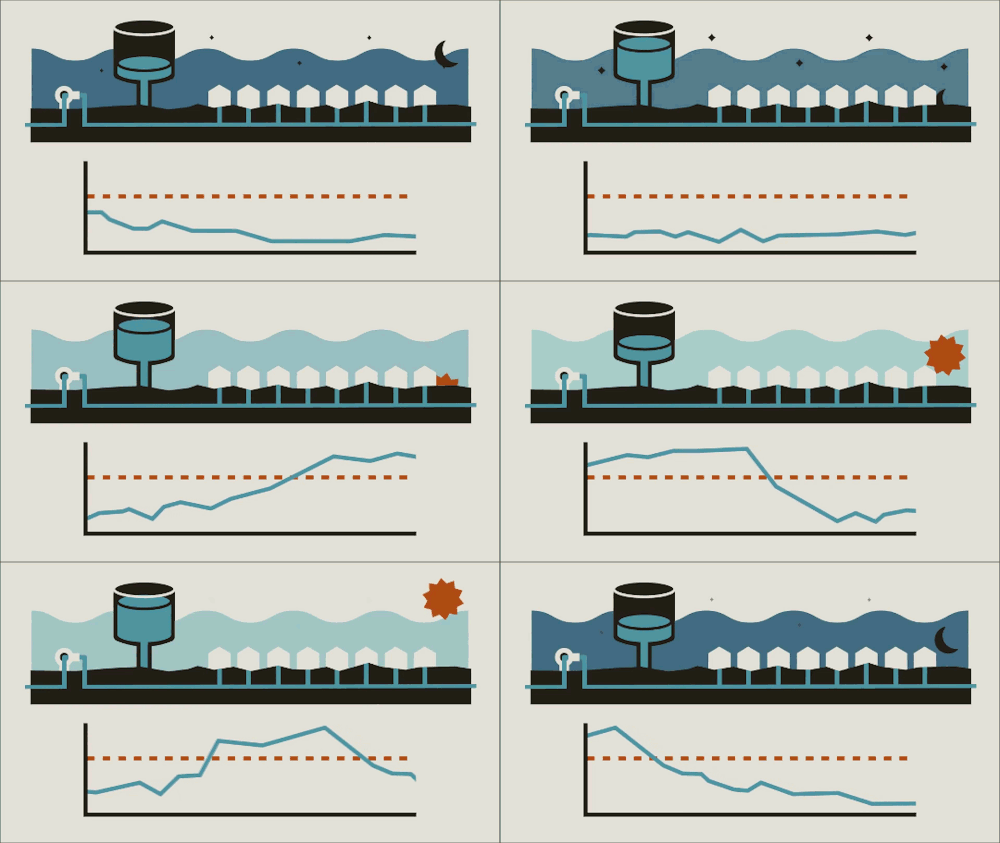
You may have noticed a water tower rising up over your town, but you may not have given much thought to how it works. Practical Engineering has a nice video overview of this important piece of infrastructure, which municipalities use to store and pressurize water in public distribution systems.
During off-peak hours, pumps fill the water tower, which creates potential energy (and therefore, water pressure) that depends on the height of the water level. If you’ve ever lost power, you can appreciate how the water tower ensures that your faucet still runs. Without power, there are no pumps to pressurize the water line. But with the hydrostatic pressure of water in the tower, your water will still run like normal. For many people who live outside of municipal water zones, that’s not the case. A loss of power means an immediate loss of water also since the pumps that work their wells go offline. (Video and image credit: Practical Engineering)


Water-Walking Geckos


Many animals can run on water. The tiniest creatures, like water striders, use surface tension to keep themselves atop the water. Larger creatures like the basilisk lizard or the grebe slap the water’s surface to generate a vertical impulse that keeps them aloft. Geckos, it turns out, can run on water, too, but they’re too big to stay up with surface tension and too small to support their weight by slapping. So they’ve developed their own method.
As you see in the top image, geckos use the slapping method for part of their support. Their slaps generate a little less than half of the force needed to keep them out of the water.
Surface tension is an important component, too. Geckos are extremely water repellent, which helps boost the lift they get from surface tension. In the bottom image, you see a gecko attempting to run on soapy water, which has a lower surface tension. The gecko is mostly submerged and more swimming than running – a clear demonstration that surface tension is important to its water-walking.
Finally, the gecko undulates its body as it runs, much the way an alligator swims. The researchers suspect this helps the gecko generate forward thrust. Altogether, it creates a water-walking gait that, for now, is unique among observed mechanisms. (Image and research credit: J. Nirody et al.; via Ars Technica; submitted by Kam-Yung Soh)

Blackwater Rivers
Blackwater rivers, like the Suwannee River in Florida, carry waters so laden with organic material that they’re dyed a deep, dark brown. For the Suwannee, most of this material comes from the rich peat deposits of the Okefenokee Swamp that lies upstream. As vegetation in the swamp decays, tannins from the plants dissolve into the water, giving it its distinctive color, which the river maintains along its full 400-kilometer journey to the Gulf of Mexico. The dark waters of the river act as a tracer, revealing how the fresh river water mixes with the ocean in the enhanced-color satellite image above. It’s amazing to see how far the river’s influence spreads before delicate wisps of color pierce the darkness. (Image credit: U.S. Geological Survey; via NASA Earth Observatory)

The Great Smog of London
Our atmosphere is active and ever-changing – except when it isn’t. Some areas, including many cities, are prone to what’s known as a temperature inversion, where a layer of cooler air gets trapped underneath a warmer one. Because this means that a dense layer is caught under a less dense one, the situation is stable and – absent other changes in circumstances – will stick around. There are several ways this can happen, including overnight when areas near the ground cool faster than the atmosphere higher up.
When temperature inversions persist, they can trap pollutants and create health hazards. One of the worst of these recorded occurred in December 1952 in London. An anticyclone created a temperature inversion over the city that trapped smoke from coal burned to warm homes and reduced visibility – sometimes even indoors – to only a meter or two. Thousands of people died from the respiratory effects of the five-day smog, and it prompted major efforts to improve emissions and air quality. Temperature inversions cannot be avoided, but the Great Smog of London taught us the necessity of reducing their danger. (Image credit: Getty Images)
Underwater Snakes, Gusty Flying, and Microswimmers


If you like your fluid dynamics with a healthy dose of biology, this video’s for you! Learn about the hydrodynamics of snake strikes, how birds fly in gusty crosswinds, and the mathematical underpinnings of a microswimmer’s journey. This is the final video in our FYFD/JFM collaboration featuring research from the 2017 APS DFD meeting. If you missed any of the previous videos, you can see them all here. Which one is your favorite? Would you like to see the series continue? Let me know in the comments or on Twitter! (Image and video credit: N. Sharp and T. Crawford)

Rattling Feathers for Attention
Peacocks are known for their colorful mating displays, but it turns out there’s more to them than meets the eye. To help them gain a penhen’s attention, peacocks will sometimes rattle their train-feathers. The sound this makes is mostly below the range of human hearing, but the rustle creates subtle vortices in the air that cause the feathers atop a peahen’s head to vibrate. Playing back the sound at peahens from typical train-rattling distances also gets the females’ attention. Researchers found the playback makes peahens’ crests vibrate at a resonant frequency, suggesting that these feathers are for more than display; they’re used for communication as well! (Image and research credit: S. A. Kane et al.; video credit: Science)

“Ice Formations”


As perfect as ice can appear, it always starts with a defect. Without a speck of dust or soot to act as a seed, supercooled water simply will not freeze. But these imperfections can lead to beauty. In “Ice Formations,” photographer Ryota Kajita captures some of the oddities of ice in Alaska’s interior swamps and ponds. In Kajita’s images bubbles are frozen in suspension, plates of ice form strange shapes, and star-shaped cracks peek through the snow. Whether the ice formed too quickly or too slowly, there are interesting signatures left behind. See the full set of images, spanning the last eight years, here. (Image credit: R. Kajita; via Colossal)
The Clever Cat’s Tongue
Cats spend almost a quarter of their waking hours grooming, and their tongues are wonderfully specialized for this task, allowing them to clean, cool, and untangle themselves with ease. Anyone who’s ever been licked by a cat knows their tongues feel sandpaper-y. This is due to rear-facing hook-like structures called papillae that have a stiffness comparable to human fingernails.
The papillae are hollow, and their U-shaped tip helps them wick up saliva, which the cat deposits deep into its undercoat when it licks. Although the papillae only hold about 5% of the volume of saliva on the cat’s tongue, this wicking action is key because most of the tongue surface can’t reach the inner coat; only the papillae do. The saliva that reaches these dense inner hairs is important not only for cleaning the fur, but for helping the cat cool off. As the saliva evaporates, it carries heat away with it, just like sweating does for us.
The papillae are key to untangling fur, but their shape also makes it easy to remove hairs caught on the tongue. Researchers built a 3D-printed cat-inspired hair brush to show how efficient and easy to clean a cat’s tongue can be! (Video credit: Science; research credit: A. Noel and D. Hu)