Month: August 2018

  • Featured Video Play Icon

    “Volumes”

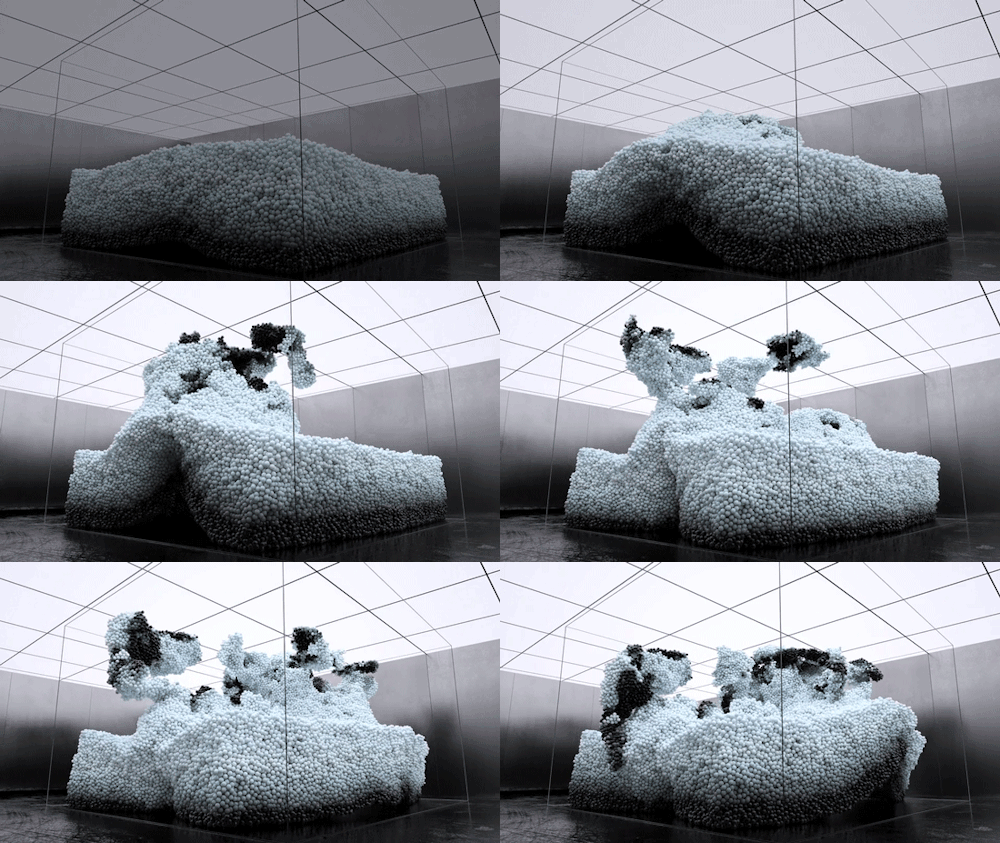
    “Volumes” is an experimental art film by Maxim Zhestkov using physics-based particle animation. Waves and unseen forces send billions of color-changing particles aloft in the film. The motions – especially the way the particles seem to tear themselves – are reminiscent of a complex fluid, like yogurt. These substances have both liquid-like (viscous) and solid-like (elastic) properties depending on the forces they experience. Zhestkov’s particles are similar; they move like a fluid but tear more like a solid.

    I particularly like the sequence beginning at 1:30. The upwelling of particles leaves behind a lower layer that looks like a snapshot of convection in a planetary mantle while the upper layer resembles the clash of ocean waves. The whole film is quite mesmerizing. Check it out! (Video and image credit: M. Zhestkov; GIFs via Colossal)

  • Using Paper to Avoid Splashback

    Using Paper to Avoid Splashback

    Daily life and countless pool parties have taught us all that objects falling into water create a splash. Sometimes that splash is undesirable, and while there are many ways to tune a splash – by adding surfactants or changing the fluid’s viscosity – there’s a relatively common one that’s escaped scientific study until now. Researchers looked at how splashes change when you add a thin, penetrable fabric – commonly known as toilet paper – to the water surface. 

    Now, the common assumption is that adding a sheet of toilet paper can prevent splashback, but the story is not quite that simple. On the left, you see a splash generated without toilet paper. Because the ball is hydrophilic (water-loving), it does not pull any air into a cavity as it passes. There’s a nice axisymmetric Worthington jet formed, and it doesn’t splash very high, although some of the satellite droplets go quite a bit higher.

    On the right, we see a splash with a single sheet of toilet paper. In this case, the impact of the sphere penetrates the paper, and the way the paper deforms causes air to get sucked down into a cavity behind the ball. That creates a wider, amorphous jet that rebounds higher than the jet in clean water, though it does not shed satellite drops. 

    The researchers found that single and even double sheets of toilet paper can actually increase the height of the splash jet if the object penetrates them. The hole the object makes actually helps focus the jet. Adding a couple more layers, though, can eliminate splashing completely. (Image and research credit: D. Watson et al.)

  • The Sensitivity of a Seal’s Whiskers

    The Sensitivity of a Seal’s Whiskers

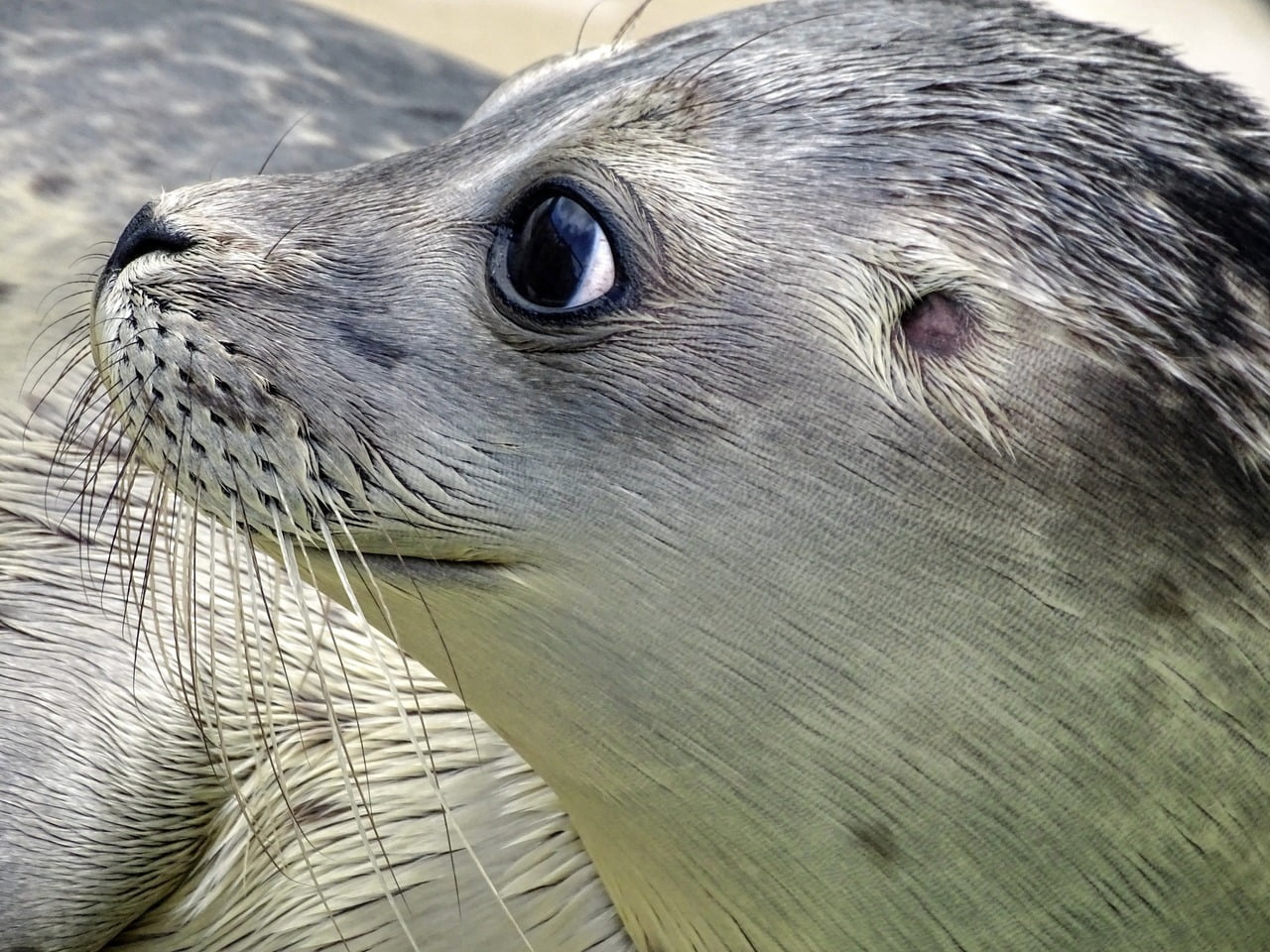
    Harbor seals and their brethren have a superpower that lets them track their prey even without sight or sound. It’s their whiskers, which are sensitive enough to follow the trail left by a single fish thirty seconds earlier. The secret to the whisker’s sensitivity lies in its shape. Instead of a uniform, circular cross-section, the seal’s whisker is oval-shaped and its width varies along the length in a wavy pattern. So unlike a straight cylinder, which vibrates when towed through water, the seal’s whiskers are unperturbed by their own movement. They shed only weak vortices and do not vibrate as a result.

    But, if you expose the whiskers to any external turbulence, like the vortices trailing a fish, the whisker ‘slaloms’ back-and-forth in time with the wake. That motion gets transmitted to the nerves in the seal’s cheek, carrying potential information about both the size and speed of the wake’s originator. Researchers hope similar bio-inspired whiskers could help underwater vehicles track schools of fish or locate underwater drilling leaks. (Image credit: M. Richter; video credit: MIT; research credit: H. Beem and M. Triantafyllou; via the Economist; submitted by Russ A. and Kam-Yung Soh)

  • The Protection of the Peloton

    The Protection of the Peloton

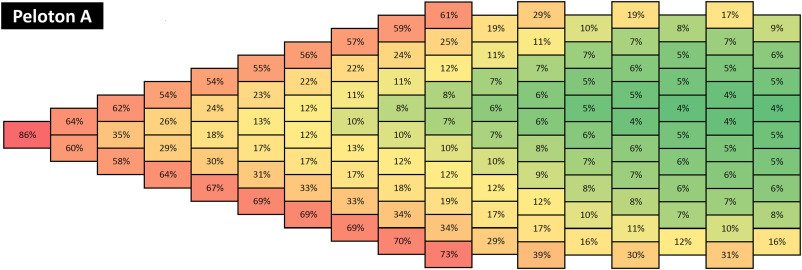
    It’s well-known by professional cyclists that sitting in the middle of the peloton requires little effort to overcome aerodynamic drag, but now, for the first time, there’s a scientific study to back that up. Researchers built their own quarter-scale peloton of 121 riders to investigate the aerodynamic effect of cycling in such a large group versus riding solo. Through wind tunnel studies and numerical simulation, they found that riders deep in the peloton can experience as little as 5-10% of the aerodynamic drag of a solo cyclist. 

    Tactically, this means teams should aim to position their protected leader or sprinter mid-way in the pack, where they’ll receive lots of shelter without risking one of the crashes common near the back of the peloton. It also suggests that teams wanting to isolate another team’s leader should try to push them toward the outer edges of the peloton rather than letting them sit in the middle. It will be interesting to see whether pro teams shift their race strategies at all with these numbers in hand.

    Of course, this study considers only a pure headwind. But other groups are looking at the effects of side winds on cyclists. (Image credit: J. Miranda; image and research credit: B. Blocken et al.; submitted by 1307phaezr)

  • Coalescence

    Coalescence

    Simple acts like the coalescence of two droplets sitting on a surface can be beautiful and complex. As the droplets come together, they form a thin neck between them, and the curvature of that surface causes capillary forces that drive fluid into the neck. For two dissimilar droplets, like the ones above, there can be additional forces. Here, the upper drop is pure water, but the lower one has added surfactants, which reduce its surface tension. That difference in surface tension creates a Marangoni flow that tends to pull fluid away from the neck. The result is that full coalescence takes longer. Depending on other factors in this tug-of-war between capillary action and Marangoni flow, the process of coalescence can look very different. In this example, there’s a fingering instability that occurs as the neck spreads. Change the circumstances slightly and the drops may chase each other instead of merging or will merge with a perfectly smooth contact front. (Image and research credit: M. Bruning et al.)

  • Featured Video Play Icon

    The Mystery of Carnegie Hall’s Sound

    For nearly a century, the acoustics of Carnegie Hall were touted as among the very best in the world. But after a much-needed renovation in 1986, musicians and critics felt the magic of the old sound had been lost. In this video, Gizmodo explores the mystery of what changed. Was it a hole in the ceiling? The curtains that had been removed?

    Eventually, a second renovation – this time for warping of the stage floor – revealed the likely culprit. Concrete had been installed to reinforce the stage in the first renovation, and this changed the stage’s resonance. Previously, instruments like the bass had caused the wooden floor to vibrate, which amplified their sound. The concrete damped that vibration, cutting out a key ingredient in Carnegie’s acoustics. When the second renovation restored the all-wooden stage, suddenly the venerable concert hall had its sound back. (Video credit: Gizmodo)

  • The Sound of Bubbles

    The Sound of Bubbles

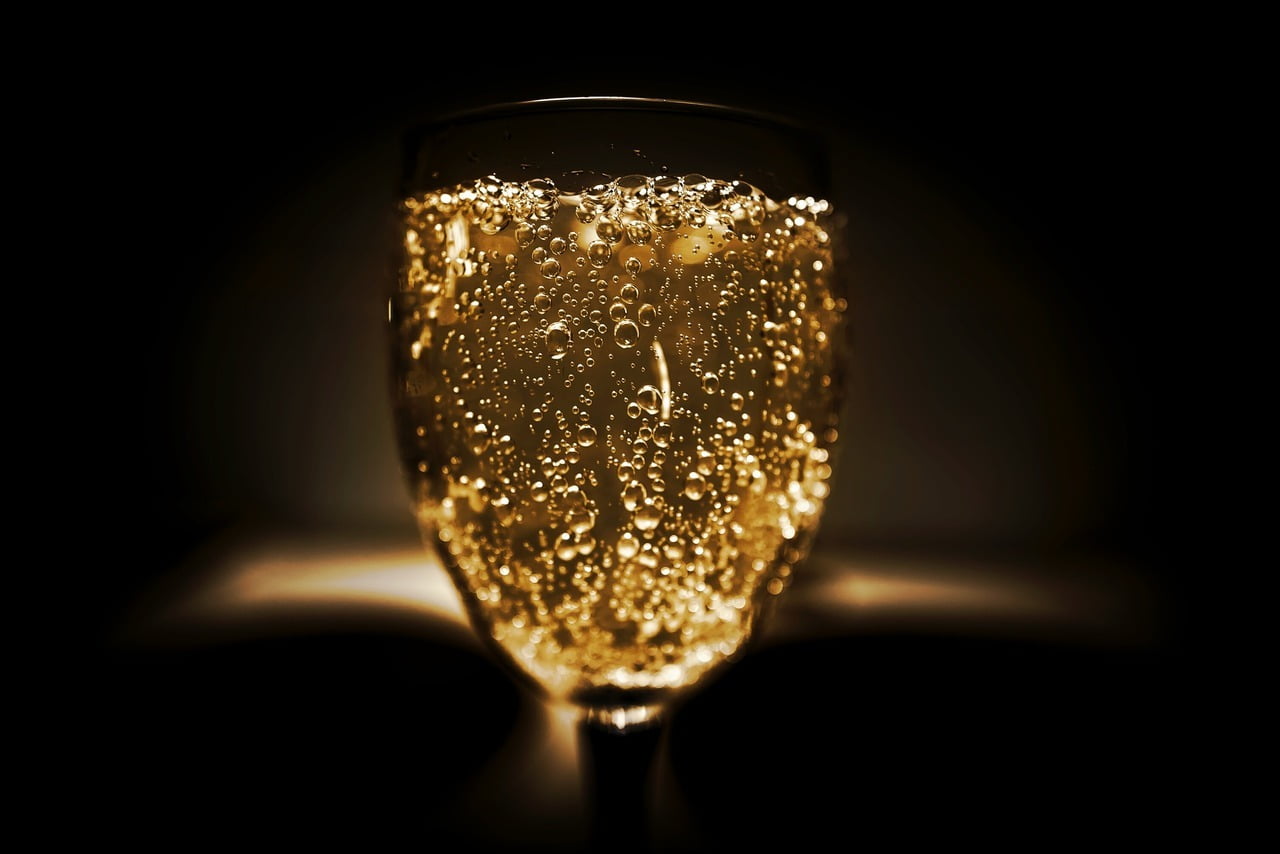
    When you enjoy the sound of a babbling stream on a hike, what you’re actually hearing is bubbling. Air bubbles caught in the water resonate at a frequency that depends on their size. In fact, you can use a hydrophone – basically an underwater microphone – to listen to these bubbles and learn about them. Researchers recently did exactly that with glasses of sparkling wine. By listening to the bubbles and applying a simple physical model, the researchers could characterize differences in two brands of sparkling wine, including just how bubbly they were and what size their typical bubbles are. They hope eventually to develop acoustic techniques that can monitor quality control for sparkling wines and other carbonated beverages. (Image credit: J. Kääriäinen; research credit: K. Spratt et al.; submitted by Kam-Yung Soh)

  • Reducing Viscosity With Bacteria

    Reducing Viscosity With Bacteria

    Conventional wisdom – and the Second Law of Thermodynamics – require all fluids to have viscosity, with the noted and bizarre exception of superfluids, which can flow with zero viscosity. In essence, you cannot have work (i.e. flow) for free. Some effort has to be lost to resistance.

    But scientists have discovered, bizarrely, that adding bacteria to water can result in zero or even negative viscosities – meaning that effort is required to keep the flow from accelerating. Before you ask, no, this is not a recipe for a perpetual motion machine. What happens when the bacteria-filled fluid is sheared is that the bacteria align and start collectively swimming. The local effects of each bacteria combine en masse to create a fluid that seemingly flows on its own. In the end, though, it’s the bacteria that are supplying that work. It certainly raises interesting prospects, though, for harnessing the power of bacterial superfluids. See the links below for more. (Image credit: M. Copeland, source; research credit: S. Guo et al.A. Loisy et al.; via Quanta; submitted by Kam-Yung Soh)

  • Grain Networks

    Grain Networks

    Granular materials are complicated beasts. When packed, forces between grains create a network (above) that shifts as force is applied. And, while grains can stick and resist that force, push a little further and they may slip and avalanche. A new study of this stick-slip behavior monitors disks similar to those above by listening for changes leading up to the slip. Researchers found that vibrations inside a granular material changed measurably before the grains slipped. The scientists hope this will one day allow for monitoring of landslide and avalanche-prone areas. While the changes are not enough to definitively predict when a slide will occur, they may provide valuable estimates of when one is likely. (Research credit: T. Brzinski and K. Daniels; image credit: OIST, source; via J. Ouellette)

  • A Star Drop

    A Star Drop

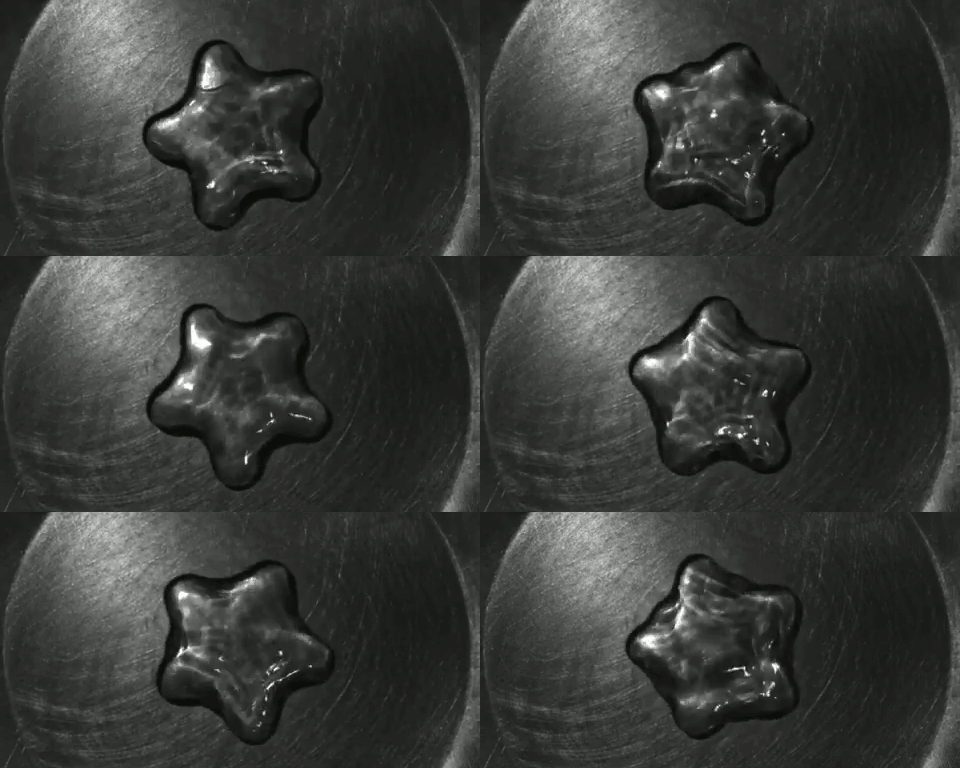
    There are many ways to make a droplet oscillate in a star-shape – like vibrating its surface or using acoustic waves to excite it – but these methods involve externally forcing the droplet’s oscillation. Leidenfrost drops – liquids levitating on a film of their own vapor caused by the extremely hot surface below – turn themselves into stars. It all starts with the constant evaporation driven by the heat below. This creates a thin, fast-moving layer of vapor flowing beneath the drop. That vapor shears the drop, causing capillary waves – essentially ripples – that travel through the drop in a characteristic way. Those ripples in turn cause pressure oscillations in the vapor layer, alternately squeezing and releasing it. Feedback from the vapor layer then drives the droplet into star-shaped oscillations. Under the right conditions, water drops can form stars with as many as 13 points! (Image and research credit: X. Ma and J. Burton, source)