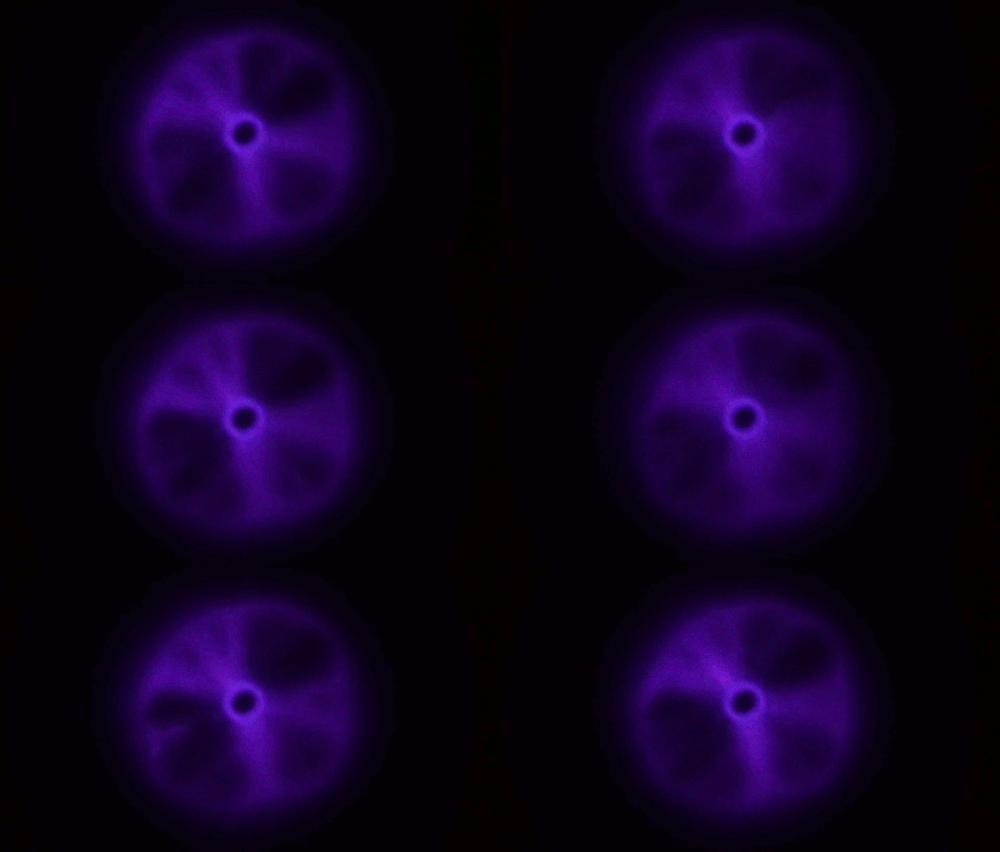
Month: April 2018

  • Plasma From a Jet of Water

    Plasma From a Jet of Water

    There aren’t many naturally occurring plasmas in our daily lives; by far the most common one is lightning. So it’s something of a surprise that a stream of water hitting a material like glass is able to produce a toroid of plasma like the one above. The key here, though, is that the jet has to be fast – to the tune of 200 meters per second or faster. When a jet of deionized water strikes a surface at that speed, the water has to take a very sharp, 90-degree turn, and, thanks to the polar nature of water, this causes a (negative) charge to build up at that turn. It’s akin to rubbing a balloon to build up a static charge, and it’s known as a triboelectric effect. At rest (and without high shear rates), water and glass in contact tend to create in a positive charge in the water. The plasma is created when an arc forms through air between those two charged areas.

    Experiments in helium environments create a different color of plasma, confirming that the arc definitely travels through the gas. Similarly, if you use regular water instead of deionized water, the conductivity of the dissolved salts in the water is enough to prevent the necessary build up of charge. (Image and research credit: M. Gharib et al.; video credit: Applied Science; submitted by Kam-Yung Soh)

  • Spinning Paint

    Spinning Paint

    Several years ago Fabian Oefner started spinning paint, and it’s been a perennial favorite online ever since. Here the Slow Mo Guys revisit their own paint-spinning antics by super-sizing their set-up. In some respects, it’s a little dissatisfying; as with their first time around, they don’t moderate the drill speed at all, so after the initial spin-up, the centrifugal acceleration is so strong that it just shreds the paint instead of showing off the interplay between the acceleration and surface tension’s efforts to keep the paint together.

    In their largest experiment, though, the Slow Mo Guys get some interesting physics. Here there’s only a single slot for paint to exit, so the set-up doesn’t lose all its paint at once. The centrifugal acceleration flings the paint out in sheets that stretch into ligaments and then tear into droplets as they move further out. But there’s some more complicated phenomena, too. Notice the bubble-like shapes forming in the yellow paint on the lower right. These are known as bags, and they form because of the relative speed of the paint and the air it’s moving through. This is actually the same thing that happens to falling drops of rain! (Video and image credit: The Slow Mo Guys)

  • Breaking Ground

    Breaking Ground

    Pushing a fluid into a porous granular material can fracture it into branching, lightning-like patterns. Here, air is injected into wet grains as a laboratory analog to hydrocarbon extraction or fracturing to treat contaminated soil. The injection of air compacts grains along the branch boundaries, keeping individual branches separated from one another. The patterns that form change with grain shape and ultimately result from the interactions of pressure, surface tension, friction and viscous forces. Studies like these help optimize fluid flow, decontaminate polluted soil faster, and determine risk in gas-driven fracturing of hydrocarbon reservoirs. (Image and video credit: J. Campbell et al.; submitted by B. Sandnes)

  • Nestling Droplets

    Nestling Droplets

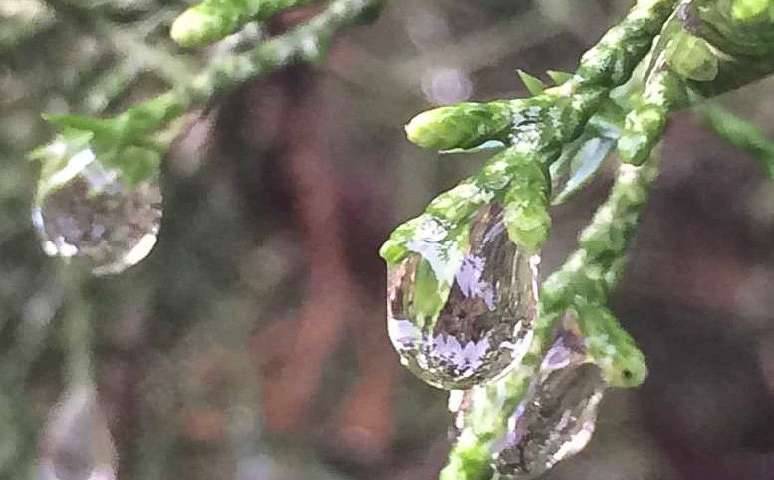
    Pay attention after a rainfall, and you may notice beads of water gathering in the corners of a spider’s web or along the leaves of a cypress tree (bottom right). Look closely and you’ll notice that the largest droplets don’t form along a straight fiber. Instead they nestle into the corners of a bent fiber (top image). Researchers recently characterized this corner mechanism and found that the angle at which the largest droplets form is about 36 degrees. This angle provides the optimal conditions for capillary action and surface tension to hold large drops in place. At smaller angles, a growing droplet’s weight pulls it down until the thin film holding the droplet near the top ruptures and the droplet falls. At larger angles, a heavy droplet will slowly detach from one side of its fiber and shift toward the other side until its weight is too great for the wetted length of fiber to hold. Then it detaches completely and falls. (Research and image credit: Z. Pan et al.; via T. Truscott)

  • What Makes Joints Pop?

    What Makes Joints Pop?

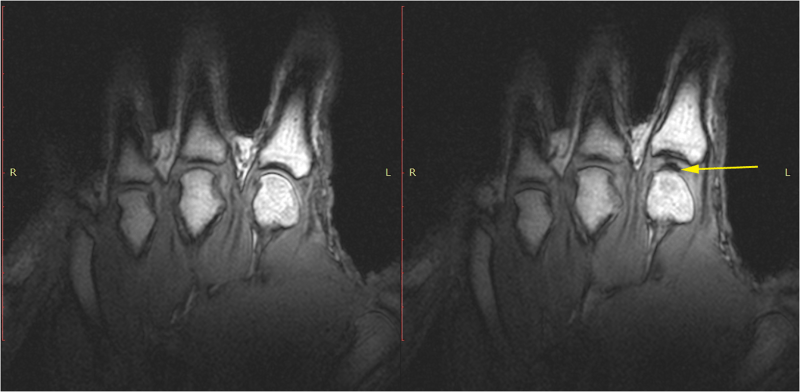
    Cracking one’s knuckles produces an unmistakable popping noise that satisfies some and disconcerts others. The question of what exactly causes the popping noise has persisted for more than fifty years. It’s generally agreed that separating the two sides of a joint causes low enough pressures to form a cavitation bubble in the sinovial fluid of the joint. But researchers have been divided on whether it’s the formation or the collapse of this bubble that’s responsible for the sound. Studying the phenomenon firsthand is difficult with today’s imaging technologies – none of them are fast enough to capture a behavior that takes only 300 milliseconds. As a result, scientists are turning to mathematical modeling and numerical simulation.

    A recent study tackled the problem by modeling a joint that already contains a bubble and examining the bubble’s response to changes in pressure inside the joint. The pressure changes alter the bubble’s size and cause it to generate sound. When compared to experiments of people cracking their knuckles, the simulated sounds are remarkably similar in both amplitude and frequency. It’s not even necessary for the bubble to collapse completely to make the noise. Just a partial collapse is enough to sound just like that old, familiar pop. (Image credit: G. Kawchuk et al.; research credit: V. Chandran Suja and A. Barakat; via Gizmodo)

  • Jupiter’s Belts and Zones

    Jupiter’s Belts and Zones

    Jupiter’s distinctive bands of colored clouds, known as belts and zones, have been an iconic part of the planet since they were first observed by Galileo. (The scientist, not the space mission!) They are considered part of Jupiter’s weather layer, the region of its atmosphere where storms reign. Thanks to gravitational measurements by the Juno spacecraft, we now know how deep these bands persist; they stretch about 3,000 kilometers into Jupiter! That means that Jupiter’s weather layer accounts for about one percent of the planet’s total mass. By comparison, Earth’s entire atmosphere makes up less than one millionth of its mass. What lies beneath Jupiter’s colorful clouds is also intriguing. The same gravitational measurements that indicate the weather layer’s depth also suggest that, beneath these storms, the rest of Jupiter rotates like a solid body. (Image credit: NASA, source; research credit: Y. Kaspi et al., submitted by Kam-Yung Soh)

  • Fissures in Africa

    Fissures in Africa

    Pictures of an enormous fissure in Kenya’s East African Rift Valley have gone viral in recent weeks along with breathless reports about how part of the African continent is splitting away. And while Africa is splitting – very, very slowly – this crack, impressive as it is, may not have anything to do with it. Geologists familiar with the area are confident that the fissure is the result of recent torrential rains and flooding – not fresh seismic activity. For one, there have been no earthquakes in this area stretching back for several years. One theory is that the crack had actually been present for quite some time but was filled with softer volcanic ash that’s been swept away by the rains. Geologists will need to study it more closely to be certain.

    One thing geologists agree on, though, is that the tectonic plates that make up Africa are slowly pulling apart, or rifting. (That’s why the area is known as a rift valley in the first place.) This happens as mantle convection causes two land masses to move away from one another. That’s happening right now along a fault running through Ethiopia, Kenya, and Tanzania, and it’s happened before. A similar rift caused the South American and African continents to separate. This doesn’t mean that the countries in East Africa are in danger of being parted by ocean any time soon, though. Geologists predict it will take on the order of 50 million years for the break to happen. (Image credit: Getty Images; Reuters/T. Mukoya; DailyNation)

  • How Trees Pull Water

    How Trees Pull Water

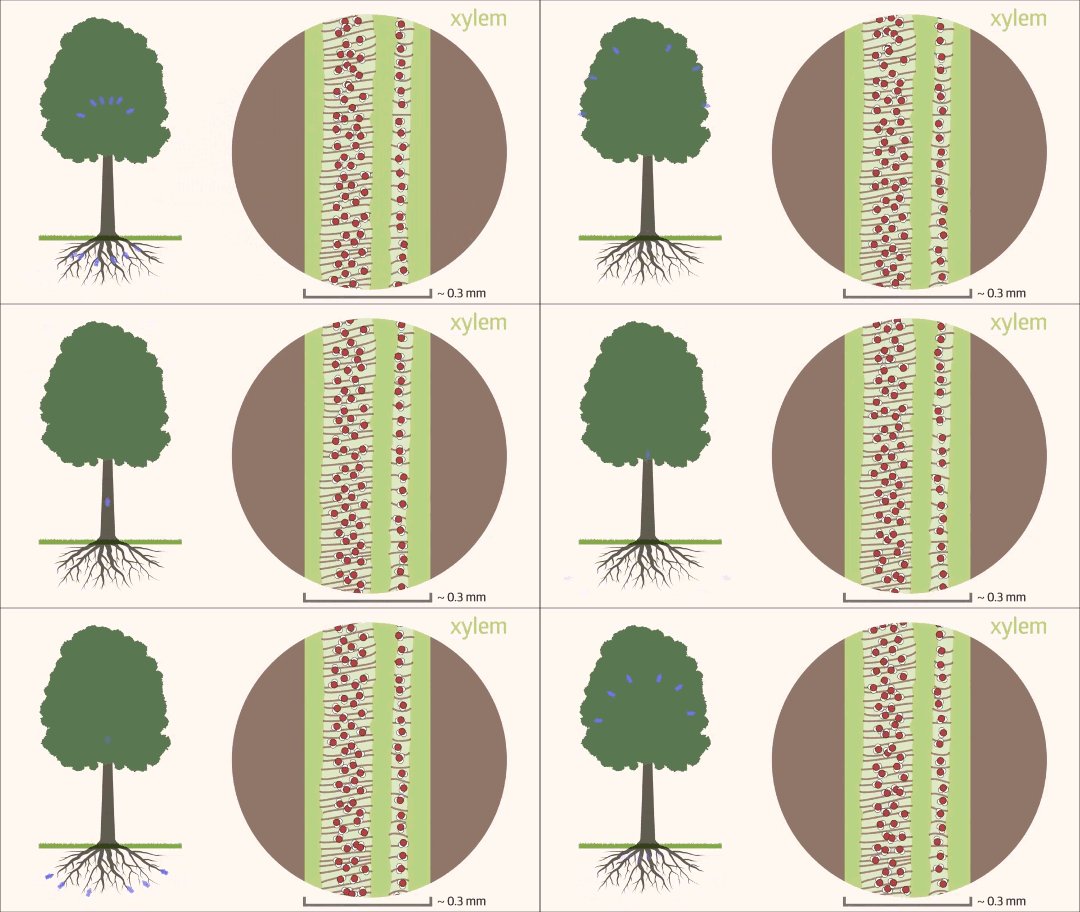
    Trees are incredible organisms, and the physics behind them baffled scientists until relatively recently. Inside trees, there is a constant flow of water up from the roots, through the xylem and out the leaves. We often think of atmospheric pressure and capillary action as the mechanisms for pushing water up against the force of gravity, but this is not how trees work. Instead, the evaporation of water from the tree’s leaves actually pulls the entire water column up the tree. Water molecules really like sticking to one another, which actually allows them to hold together under this tension. 

    The result of all this pulling is a negative pressure inside the tree, and, with some clever manipulation, it’s possible to measure just how negative the pressure inside a tree is using a device called a pressure bomb. You can see the whole process in action in the Science IRL video below. The magnitude of a tree’s negative pressure fluctuates over a day, depending on how quickly it’s losing water, but typical values can range from 2-3 atmospheres of negative pressure to 17 or more! To get the equivalent (positive) pressure, you’d have to be nearly 2.7 kilometers under water. (Image and video credit: Science IRL)

  • Fly Away!

    Fly Away!

    Spiders are often among the first colonists on newly formed volcanic islands. Thanks to their aerial skills, they are able to travel nearly anywhere by ballooning on strands of their own silk. Exactly how spiders as large as 20 milligrams manage this is still relatively known. A new study shows that crab spiders, like any careful aviator, use a foreleg to monitor wind conditions for 5 or more seconds before attempting take-off. The spiders will only spool out ballooning threads if the wind is warm and gentle. Wind speeds higher than 3 meters per second are an automatic no-go. When the spider decides conditions are favorable, they release as many as 60 nanoscale fibers that are several meters in length. The wind catches the silks and lifts them away to their next adventure. (Image credit: Science Magazine, source; research credit: M. Cho et al.)

  • Surfaces That Scrape Off Ice

    Surfaces That Scrape Off Ice

    Ice can be a terrible pest, freezing to surfaces like roads and airplane wings and causing all sorts of havoc. Some surfaces, though, can actually prompt a freezing drop to scrape itself off. There are a couple key effects in play here. The first is that the surface is nanotextured – in other words, it has extremely small structures on its surface. This makes it hydrophobic, or water-repellent. The second key ingredient is that the drop is cooling evaporatively; that means heat is escaping along the air-water interface instead of conducting through the solid surface. As a result, the freezing front forms at the interface and pushes inward. Water expands as it freezes, which tries to force the interior liquid out, toward the bottom of the drop. On a normal surface, this would force the contact line – where air, water, and surface meet – to push outward. But the nanotexture of the hydrophobic surface pins that line in place. So the expanding ice pushes the frozen drop upward, scraping it off the surface! (Video and image credit: G. Graeber et al., source)