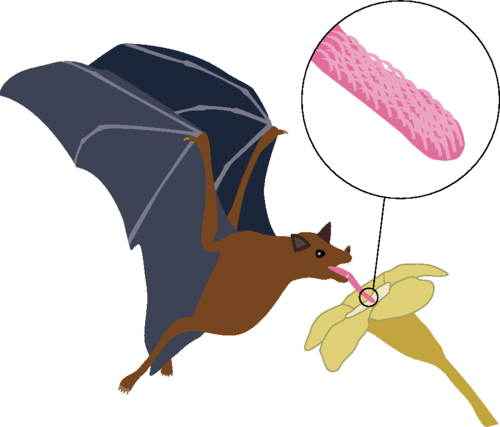
Nectar-drinking bats, honey possums, and honeybees all use hair-like protrusions on their tongues to help them drink. In bats, these papillae have blood vessels that swell when drinking, stiffening the hairs. To investigate this drinking mechanism, researchers built their own version of a bat tongue by fabricating hairy surfaces and testing how well they trapped viscous oil when dipped and withdrawn. Through a combination of experiment and mathematical modeling, the researchers found that the optimal fluid uptake depended on the density of hairs, fluid viscosity, and the withdrawal speed. When they compared their results to actual bats, honey possums, and honeybees, they found that those animals’ tongues have hair densities very close to the predicted optimal value, suggesting that their model is capturing the important physical mechanisms that have driven evolutionary advantages for these species. (Image and research credit: A. Nasto et al.; submitted by Kam-Yung Soh)
Month: February 2018

When Friction Isn’t Enough
If you try to build a pyramid of dry glass beads, you’ll have a hard time of it. The frictional forces simply aren’t enough to hold the beads together against the force of gravity. If you add a little water, though, the story is different. The intermolecular forces inside water give it a lot of cohesion, which helps it fill the narrow gaps between beads. That added capillary force gives just enough additional sticking power to hold a pyramid of beads together. (Image and video credit: amàco et al.)

Skiing, Avalanches, and Freezing Bubbles




To wrap up our look at Olympic physics, we bring you a wintry mix of interviews with researchers, courtesy of JFM and FYFD. Learn about the research that helped French biathlete Martin Fourcade leave PyeongChang with 3 gold medals, the physics of avalanches, and how bubbles freeze.
If you missed any of our previous Olympic coverage, you can find our previous entries on the themed series page, and for more great interviews with fluids researchers, check out our previous collab video. (Video credit: T. Crawford and N. Sharp; image credits: GettyImages, T. Crawford and N. Sharp)

PyeongChang 2018: Curling


Curling is a deceptively engrossing sport with some unique physics among Winter Olympic events. Athletes slide 19kg granite stones at a target 28 meters away. Along the way, teammates sweep the pebbled ice with brooms, melting it with frictional heating to help the stone slide further. The underside of the stones is concave, so they only touch the ice along a narrow ring. Researchers think roughness in the leading edge of the sliding stone cuts into the ice, leaving scratches that the trailing edge tries to follow. This is what causes the stone’s trajectory to curl. By melting the ice, sweeping also prevents curling, so competitors must know exactly when and how much to sweep. Ice conditions shift throughout a match, and the best players can read the ice to keep their stones where they want them. (Image credit: AP; W. Zhao/GettyImages)

PyeongChang 2018: Cross-Country Skiing


Cross-country skiing, also known as Nordic skiing, is a part of many longstanding disciplines in the Winter Games. Unlike downhill skiing, cross-country events typically involve mass starts, which allow athletes to interact, using one another for pacing and tactics. Drafting can be a valuable method to save energy and reduce drag. A following skier sees a 25% drag reduction while drafting; the lead skier gets about a 3% reduction in drag compared to skiing solo. Competitors usually wear tight-fitting suits to minimize drag, but unlike speedskating, for example, cross-country skiers don’t get much benefit from roughened surfaces and impermeable fabrics. Typical race speeds are 4 – 9 m/s, and most of these high-tech fabrics don’t provide tangible benefits until higher speeds. (Image credit: Reuters/S. Karpukhin, US Biathlon, GettyImages/Q. Rooney)

PyeongChang 2018: Ice-Making


When it comes to winter sports, not all ice is created equal. Every discipline has its own standards for the ideal temperature and density of ice, which makes venue construction and maintenance a special challenge. Figure skating, for example, requires softer ice to cushion athletes’ landings, whereas short-track speed skating values dense, smooth ice for racing. The Gangneung Ice Arena hosts both and can transition between them in under 3 hours. Gangneung Oval hosts long-track speed skating and makes its ice layer by layer, spraying hot, purified water onto the rink. This builds up a particularly dense and therefore smooth ice.
The toughest sport in terms of ice conditions is curling, which requires a finely pebbled ice surface for the stones to slide on. Forming those tiny crystals on the ice sheet can only be done at precise temperature and humidity conditions. This is a particular challenge for Gangneung Curling Center due to its coastal location. To keep the temperature and humidity under control at full crowd capacity, officials even went so far as to replace all the lighting at the facility with LEDs! (Image credit: Pyeongchang 2018, 1, 2, 3)

PyeongChang 2018: Bobsleigh


In bobsleigh, two- and four-person teams compete across four runs down an ice track. The shortest cumulative time wins, and since typical runs are separated by hundredths of a second, teams look for any advantage that helps them shave time. The size, weight, and components of a sled are restricted by federation rules; for example, teams cannot use vortex generators to improve their aerodynamics. Instead bobsledders work with companies like BMW, McLaren, and Ferrari to engineer their sleds. Both computational fluid dynamics and wind tunnel tests with the actual team in the sled are used to make each sled as aerodynamic as possible. (Image credit: IOC, Gillette World Sports, source)
PyeongChang 2018: Snow-Making
These days artificial snow-making is a standard practice for ski resorts, allowing them to jump-start the early part of the season. Snow guns continuously spray a mixture of cold water and particulates 5 or more meters in the air to generate artificial snow. The tiny droplet size helps the water freeze faster and the particles provide nucleation sites for snow crystals to form. As with natural snow, the shape and consistency of the snow depends on humidity and temperature conditions. Pyeongchang is generally cold and dry, so even the artificial snow there tends to be similar to snow in the Colorado Rockies. Recreational skiers tend to look down on artificial snow, but Olympic course designers actually prefer it. With artificial snow, they can control every aspect of an alpine course. For them, natural snowfall is a disruption that puts their design at risk. (Video credit: Reactions/American Chemical Society)

PyeongChang 2018: Speedskating


Four years ago in Sochi, Under Armour’s suits for the U.S. speedskating team took a lot of flak after the team failed to medal. The company defended the physics and engineering of their suits, and an internal audit of the speedskating program ultimately placed blame on flaws in their training regimen, unfamiliarity with the new suits, and overconfidence.
This time around Under Armour has taken a more hands-on approach with the team, helping with training regimens in addition to providing suits. Under Armour spent hundreds of hours testing the suits in Specialized’s wind tunnel, including testing many fabrics before settling on the slightly rough H1 fabric used in patches on the skater’s arms and legs. Like the previous suit’s dimpled design, the roughness of the fabric promotes turbulent flow near it. Because turbulent flow follows curved contours better than laminar flow does, air stays attached to the athlete for longer, thereby reducing their drag. The suit is also designed with asymmetric seams that help the athlete stay low and comfortable in the sport’s frequent left turns.
U.S. speedskaters have been competing in a version of the suits since last winter, ensuring that athletes are familiar with the equipment this time around. Whether the new suits and training program will pay off remains to be seen. After their disastrous experience in Sochi, both the team and the company are shy about setting expectations. (Image credits: D. Maloney/Wired; US Speedskating)

PyeongChang 2018: Skeleton


Skeleton, the sliding event in which athletes race down an ice track head first, is a fast-paced and punishing sport. Skeleton racers can reach speeds of 125 kph (~80 mph) during their descents. This is a little slower than the feet-first luge, in part because the skeleton sled runs on circular bars rather than sharp runners.
Body positioning is key in the sport. It’s the athlete’s primary method of steering, and it controls how much drag slows them down. But skeleton runs are brutally taxing; athletes pull 4 or 5g in the turns – more than astronauts experience during a launch! All that jostling means athletes cannot stand more than about 3 trips down the track in a day. To practice positioning without the bone-jarring descent, athletes can work in a wind tunnel. While the wind tunnel provides the aerodynamic equivalent of their usual speed, athletes focus on holding their bodies in the most streamlined position. Some wind tunnels are even able to provide screens that let the athletes see their drag values in real-time, letting them adjust to learn what works best for them. (Image credit: N. Pisarenko/AP, Bromley Sports)


