Month: September 2017

  • Galapagos Week: Introduction

    Galapagos Week: Introduction

    One hundred and eighty-two years ago today, the H.M.S. Beagle reached the Galapagos archipelago carrying, among others, naturalist Charles Darwin. The ship would spend the next month exploring the islands, and Darwin’s experiences during that time, and the specimens he collected, would ultimately lead him to propose the concept of evolution.

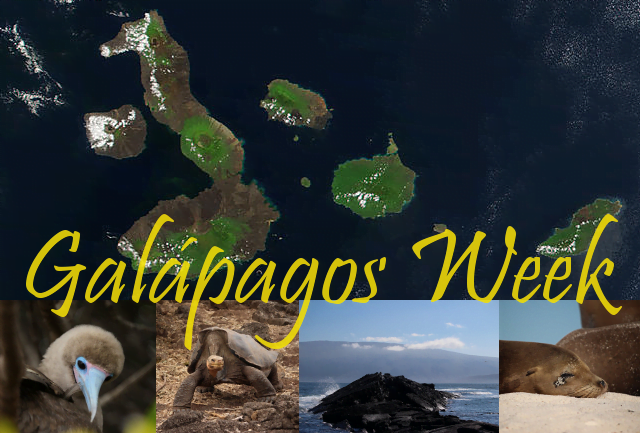
    I had the incredible opportunity to visit the Galapagos Islands last October, and, like so many before me, I was fascinated by the islands and their remarkable ecosystems. The Galapagos Islands are located at the equator, but they owe much of their rich biodiversity to sitting at the confluence of several ocean currents, both warm and cold. In particular, the cold Cromwell Current’s upwelling on the western side of the archipelago carries valuable nutrients up from the deep and helps support vibrant marine life from bioluminescent plankton to leaping mobula rays. (And, yes, I geeked out over both.)

    Over the next week, FYFD will be exploring some of the fluid dynamics of the Galapagos Islands and their denizens on land, sea, and air. Be sure to check back every day for a new post! (Image credit: N. Sharp and J. Shoer)

  • Farewell, Cassini!

    Farewell, Cassini!

  • Featured Video Play Icon

    Lift Over Wings

    One of the most vexing topics for fluid dynamicists and their audiences is the subject of how wings generate lift. As discussed in the video above, there are a number of common but flawed explanations for this. Perhaps the most common one argues that the shape of the wing requires air moving over the top to move farther in the same amount of time, therefore moving faster. The flaw here, as my advisor used to say, is that there is no Conservation of Who-You-Were-Sitting-Next-To-When-You-Started. Nothing requires that air moving over the top and bottom of a wing meet up again. In fact, the air moving over the top of the wing outpaces air moving underneath it.

    In the Sixty Symbols video, the conclusion presented is that any complete explanation requires use of three conservation principles: mass, momentum, and energy. In essence, though, this is like saying that airplanes fly because the Navier-Stokes equations say they do. It’s not a terribly satisfying answer to someone uninterested in the mathematics.

    Part of the reason that so many explanations exist – here’s one the video didn’t touch on using circulation – is that no one has presented a simple, intuitive, and complete explanation. This is not to say that we don’t understand lift on fixed wings – we do! It’s just tough to simplify without oversimplifying.

    Here’s the bottom line, though: the shape of the wing forces air moving around it to change direction and move downward. By Newton’s 3rd law (equal and opposite reactions), that means the air pushes the wing up, thereby creating lift. (Video credit: Sixty Symbols)

  • Elastic Bounces

    Elastic Bounces

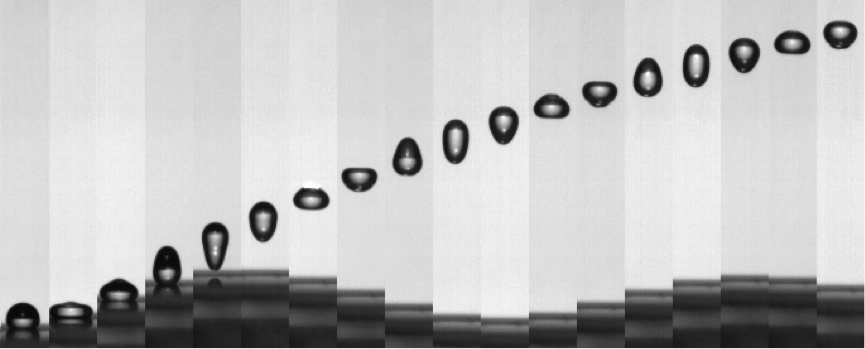
    A rigid ball accelerated by a moving surface can only ever move as fast as the surface propelling it. But that’s not true for squishy objects like a water droplet. The composite image above shows the trajectory of a water droplet launched from a moving superhydrophobic surface. As the surface starts rising, it squishes the droplet like a pancake, triggering a deformation cycle where the droplet will squish and extend repeatedly. How quickly the drop changes shape depends on factors like its size and surface tension. The researchers found that a droplet’s launch was strongly affected by the ratio of the droplet’s shape-changing frequency and the frequency of the plate’s motion. When the drop’s shape changed three times faster than the surface’s motion, it would catapult off the surface with 250% of the kinetic energy of a rigid ball!

    Launching elastic balls works the exact same way as droplets, indicating that the phenomenon depends on the way the projectiles deform. The process is similar to jumping on a trampoline. If a trampolinist times her jump just right, she’ll get more energy from the trampoline and fly higher. The droplet does the same when its deformation is properly tuned to its catapult. (Image credit: C. Raufaste et al.; via APS Physics; submitted by Kam-Yung Soh)

  • Flying Fish Aerodynamics

    Flying Fish Aerodynamics

    Flying fish, strange as it sounds, have aerodynamic prowess comparable to hawks. The fish aren’t true fliers, but they do glide for hundreds of meters using their large pectoral and pelvic fins as wings. Wind tunnel research shows the fish have their maximum lift at an angle of attack around 30-35 degrees, matching their typical take-off angle (top). Their best gliding performance occurs when they’re roughly parallel to the water (middle). The researchers even found that the fish use ground effect to enhance their lift. Although their aerodynamics allow flying fish to get out of reach of their aquatic predators, the fish must be wary of flying too high, as this makes them a target for frigatebirds (bottom). These acrobatic seabirds can’t get wet, but they have some impressive aerodynamics of their own to help make up for it.  (Image credit: BBC Earth, source; research credit: H. Park and H. Choi; see also SciAm)

  • Sunset Vortices

    Sunset Vortices

    Often our atmosphere’s transparency masks the beautiful flows around us. This spectacular image shows a flight landing in Munich just after sunrise. Low-hanging clouds get sliced by the airplane’s passage and curl into its wake. The swirls are a result of the plane’s wingtip vortices, which wrap from the high-pressure underside of the wing toward the low-pressure upperside. The vortices stretch behind in the plane’s wake, creating turbulence that can be dangerous to following planes. In fact, these vortices are a major determining factor in the frequency of take-off and landing on a given runway. The larger a plane, the larger its wingtip vortices and the more time it takes for the turbulence of its passage to dissipate to a safe level for the next aircraft. (Image credit: T. Harsch; submitted by Larry S.)

  • Jupiter On Display

    Jupiter On Display

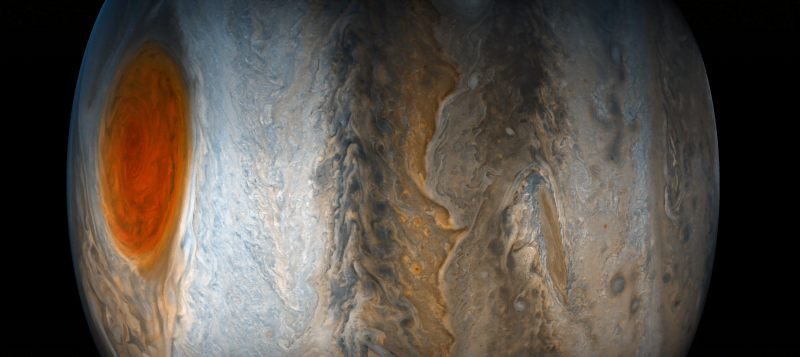
    The rich detail of Jupiter’s atmosphere is on full display in this enhanced-color image from the Juno spacecraft. (Full resolution version here – trust me, you want to click that link.) To the north, on the left side of the image, Jupiter’s Great Red Spot swirls. To the center and right, the cloud bands of Jupiter’s southern region are coming into view. The color enhancements really highlight eddies on the edge of these bands. These are examples of Kelvin-Helmholtz instabilities caused by shear between cloud bands moving at different speeds. Within the bands, smaller vortices spin. Some of these are anti-cyclones, high-pressure storm systems found all over the planet. Jupiter’s atmosphere still holds many mysteries for scientists, but I love how every gorgeous image Juno sends back shows fluid physics written larger than life across our solar system’s biggest planet. (Image credit: NASA/JPL-Caltech/SwRI/MSSS/G. Eichstädt /S. Doran; via Gizmodo)

  • Adaptive Meshing

    Adaptive Meshing

    The use of numerical simulations in fluid dynamics has exploded over the past half century with new computational techniques being developed constantly. Most methods involve solving the equations of motion (or an approximation thereof) on a grid of points known as a mesh. To accurately capture the physics, meshes must often be quite closely packed in areas where detail is needed, but they can be more widely spaced in areas where the flow is not changing quickly. An increasingly common technique is adaptive meshing in which the mesh of grid points shifts between time steps; this places more grid points where the flow requires them and removes them from less important areas in order to reduce computational time.

    An example of adaptive meshing is shown above. On the left particles are falling into salt water. The colors show the concentration of particles. The right side shows the solid particles and the fluid mesh around them. Notice how the grid shifts as the particles fall. (Image credit: C. Jacobs et al., source)

  • Wriggling Threads

    Wriggling Threads

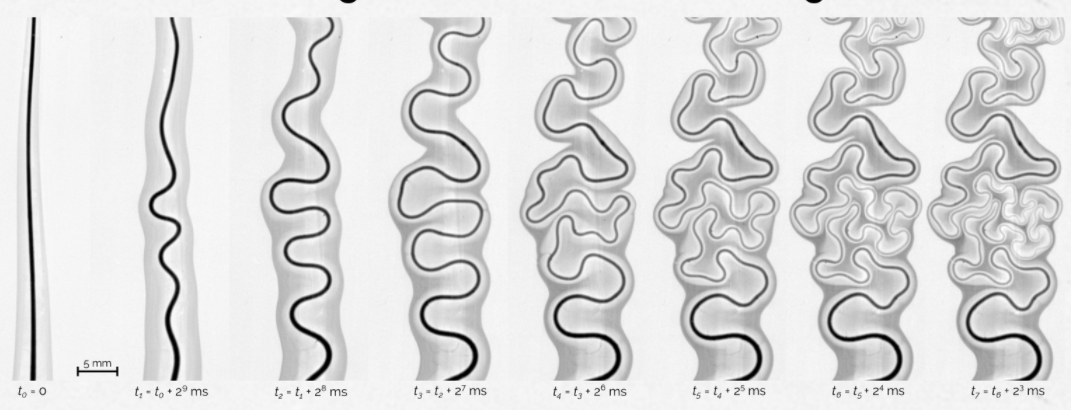
    A thread of mineral oil laid across a pool of water twists and turns like a river run wild. Because the oil has a lower surface tension than the water, Marangoni forces spread it outward (far left). Small variations in the thread make the areas of highest oil concentration start to bend just a bit. Inside the bends, the gradient of surface tension – the difference between the lowest and highest surface tensions – is very high, which pulls at these regions more than others. So bends beget more bends, causing the entire thread to wrinkle. Although the behavior is driven by a completely different process than the one that causes rivers to meander, the end result looks remarkably similar; this is because, in both cases, forces act to make each bend increasingly sinuous. (Image credit: B. Néel et al., source)

    Editor’s note: Starting tomorrow I’ll be on a trip that takes me out of range of the Internet until next week. Regular posts are queued up and should post as usual, but we’ll all have to trust Tumblr to handle everything because I won’t be able to check. Thanks!

  • Featured Video Play Icon

    Life at the Interface

    Water striders are masters of life at the interface of water and air. Their spindly legs are skinnier than the capillary length of water, meaning that, at their size, surface tension is strong enough to overcome gravitational effects. Thus, their feet leave dimples on the interface, but the water itself holds them up. To keep from getting accidentally drenched (and thus weighed down), the striders are covered in tiny hairs that trap a layer of air that makes them hydrophobic or water-repellent. To get around, these masters of the interface use their middle legs in a manner similar to oars. They push against the dimple around their legs, which generates vortices under the surface and helps propel them. Even more impressive, the water strider can jump off the surface, a feat that requires remarkable adaptation in order to maximize the jump without breaking surface tension. (Video credit: Deep Look)