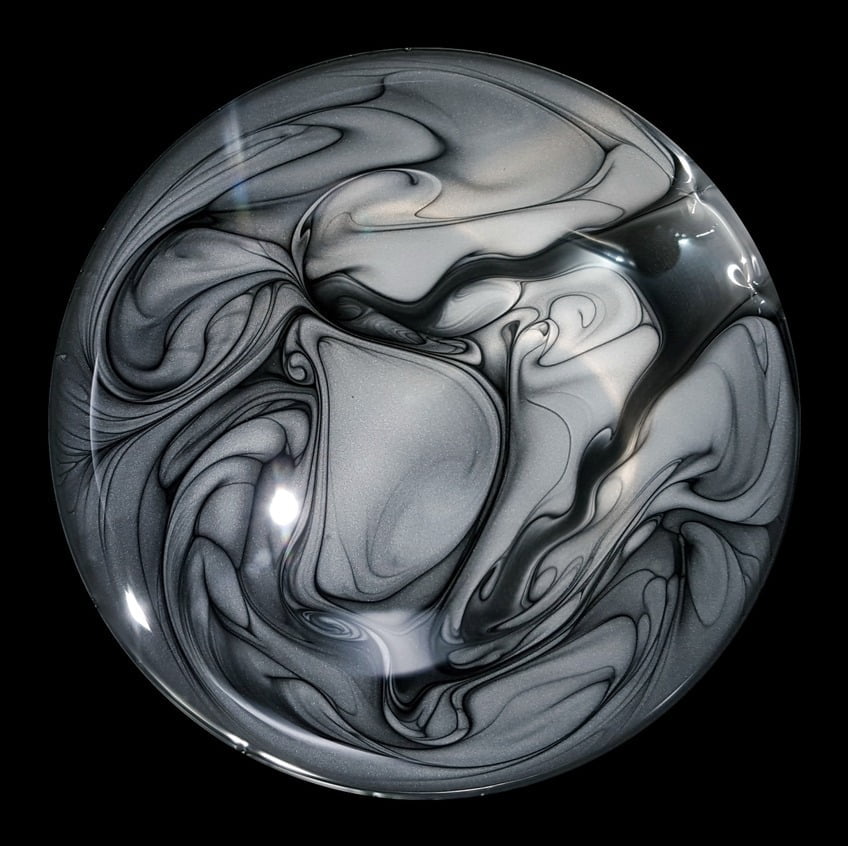
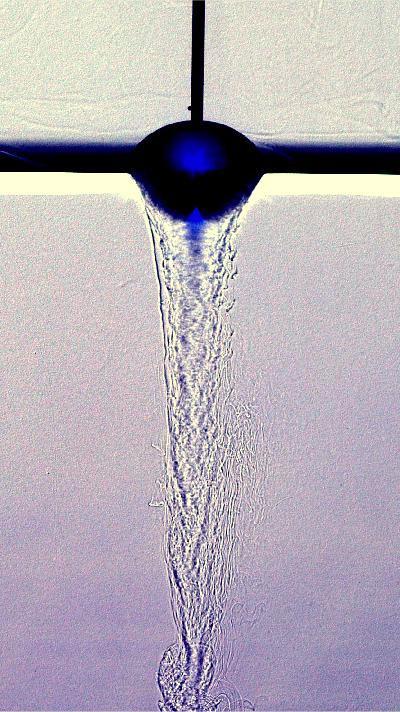
Graphene powder swirls in alcohol in this prize-winning photo from this year’s Engineering and Physical Sciences Research Council photography competition in the UK. The image was captured while producing graphene ink that can print circuits directly onto paper. According to the researcher’s description, this ink is forced through micrometer-sized capillaries at high pressure to rip the layers apart and produce a smooth, conductive ink in solution. In this photo, we seem to see more conventional mixing driven by the powder’s injection and the variations in surface tension due to the alcohol and its evaporation. The graphene leaves behind beautiful streaklines that highlight its path as it mixes. (Image credit: J. Macleod; via Discover)
Month: June 2017

Reconnecting
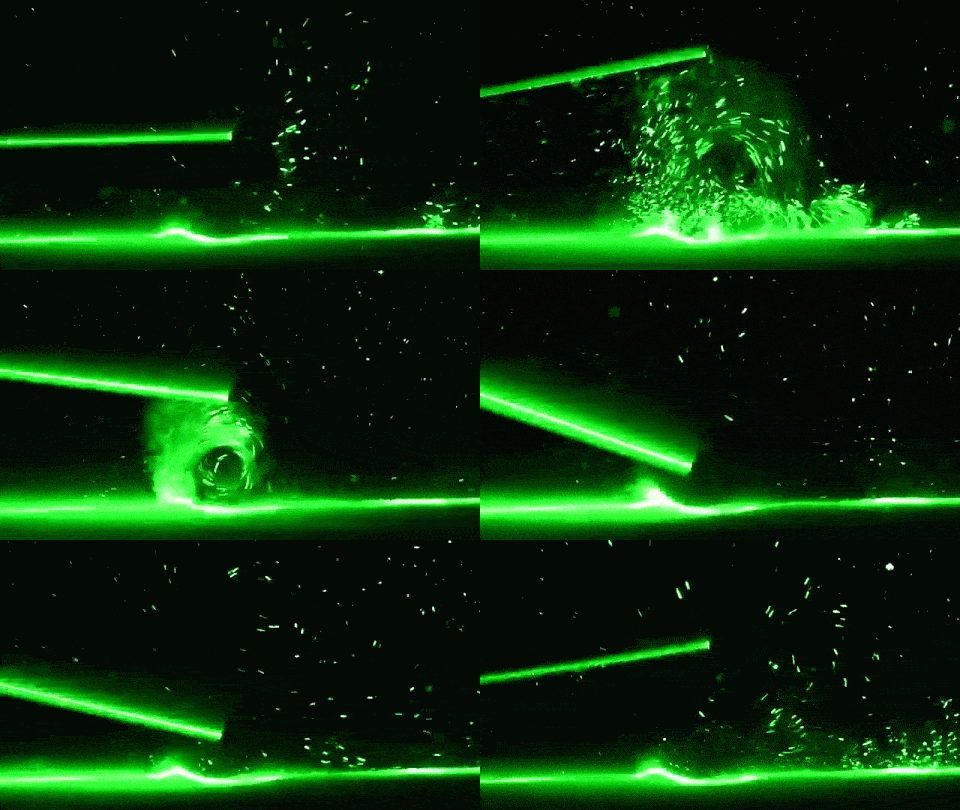
Vortices are a common feature of many flows. Here we see a helical vortex tube spinning in a swirling flow. The vortex itself is visible thanks to air trapped in its low-pressure core. As the vortex spins, two sections of it come together. This results in what’s known as vortex reconnection: the vortex lines break apart and rejoin in a new configuration – as a small independent vortex ring and a shorter section of helical vortex. Events like this are common but usually hard to observe directly. They’ve been previously visualized using vortex knots and have even been sighted in the quantum vortices of superfluid helium. (Image credit: S. Skripkin, source; research credit: S. Alekseenko et al., pdf)

Breaking Up
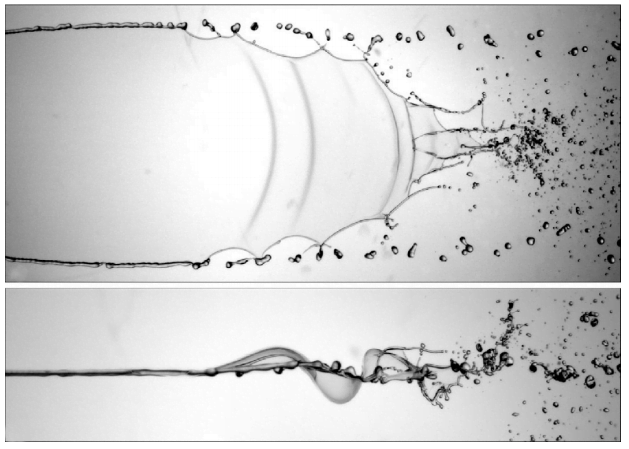
Liquid sheets break down in a process known as atomization. Above are top and side views of a liquid sheet created by two identical liquid jets impacting head-on. The jets themselves are off-screen to the left. Their collision generates a thin sheet of liquid that flows from left to right. In the center of the images, the sheet has begun to flap and undulate, shedding large droplets from its edges as it does. At the far end of the sheet, much finer droplets are sprayed out from the center as the sheet collapses completely. This is an example of an instability in a fluid. Initially, any disturbance in the liquid sheet is extremely tiny, but circumstances in the flow are such that those disturbances gather energy and grow larger, creating the large undulations. Those undulations are unstable as well and kick off a fresh set of disturbances that grow until the flow completely breaks down. (Image credit: N. Bremond et al., pdf)

The Japanese Pufferfish
[original media no longer available]
If you’ve ever dived or snorkeled over a sandy lake or ocean bottom, you’ve probably seen some neat patterns there. But it’s hard to compete with the Japanese pufferfish for pure artistry. This small fish creates enormous and elaborate designs in the sand in order to attract a mate. The male fish moves the sand into place by flapping his fins very close to the surface. Above a critical flapping velocity, his fins generate vortices capable of picking up sand, as seen below. With repeated passes, the fish is able to excavate the trough that is key to his creation. It’s a constant fight against the current, though.
Puffers aren’t the only ones who flap their fins to move the sands. Rays and flounders use this technique to bury themselves and hide (Video credit: BBC Earth; image credit: A. Sauret, source; research credit: A. Sauret et al.)

A Real Tatooine

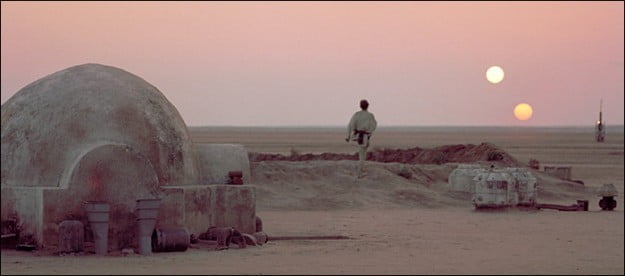
Since at least the release of “Star Wars”, we have wondered what life would be like on a circumbinary planet – a planet orbiting two stars. In the past few decades, we have discovered several such planets, but we are still in the early days of modeling the climate of these worlds. One recent study uses the stars of the Kepler 35 system, which are only slightly less luminous than our sun, to explore the climate of an Earth-like water planet.
According to the study, this fictional planet would maintain Earth-like habitability at a distance of 1.165–1.195 astronomical units from its suns’ center of gravity – just a little further out than our own orbital distance. Variables like the planet’s mean global surface temperature and precipitation vary with two distinct periods – the time required for the stars to orbit one another and the time it takes for the planet to orbit its stars. Both factors affect how much sunlight the planet receives. The planet’s climate response to these changes is complex and varies depending on location, but the overall variations observed in the climate are small. It does show, however, that places like Tatooine don’t have to be desert planets! (Image credit: Tatooine – Star Wars; Kepler 35 system – L. Cook; research credit: M. Popp and S. Eggl)

Sorting by Bubble

Microfluidic devices, also known as labs-on-a-chip, require clever techniques for processes like sorting particles by size. One such technique uses an oscillating bubble to sort particles. When the bubble vibrates back and forth (left) it creates what’s known as a streaming flow – large regions of recirculation (shown as gray ellipses in the right image). If the bubble is placed inside a channel, we say that two flows have been superposed; the device combines both the left-to-right flow of the channel and the recirculating streaming flow.
Introduce a micron-sized particle into this combined flow, and it will get carried to the bubble and then bounced around by its effects (left). In fact, the larger the particle is, the more the bubble deflects it relative to the flow. You can see this in the image on the right as well. Here the frame rate has been matched to the bubble’s vibration, so the bubble appears stationary, and the particle paths look smooth. The gray lines show the fluid’s path, and individual solid particles are introduced at the left. The largest particle gets strongly deflected as it passes the bubble and exits at the top-right. A fainter, smaller particle follows after it. Being smaller, the bubble’s deflection on it is weaker, and this second particle exits along a path to the center-right. The result is a fast and simple method for particle sorting. (Image and research credit: R. Thameem et al., source)

Asperitas Sunset


Asperitas clouds, previously known as undulatus asperatus, are the most recently recognized cloud type. These clouds make the sky look like the ocean rolling in waves. Photographer Mike Olbinski, on a recent storm chase earlier this month, caught these spectacular asperitas clouds near sunset. The clouds’ effect is unusual under normal circumstances and completely surreal with this lighting. Check out the video for the full effect. Olbinski caught the clouds on the outskirts of a dying storm cell. That’s a common place to see these formations; despite their ominous appearance, they do not develop storms and are more often seen as storms are ending. (Video and image credit: M. Olbinski; h/t to Paul vdB)

Mosquito Flight


Mosquitoes are unusual fliers. Their wings are long and skinny, and they beat at around 700 strokes a second – incredibly quickly for their size. Examining how they move has uncovered some interesting mechanics. Despite their short stroke length, the mosquito generates a lot of lift on both its upstroke (when the wing is moving backward) and its downstroke (when the wing moves forward). Some features of the mosquito’s flight are highlighted in the images above. In the animation, blue indicates areas of low pressure and red indicates high pressure.
Like most flapping fliers, the mosquito generates a leading-edge vortex during its downstroke (and its upstroke). This vortex helps concentrate low pressure on the upward-facing wing surface, thereby creating lift. One of the things that makes the mosquito unique, however, is that it also creates trailing-edge vortices on both half-strokes. To do this, the mosquito rotates its wings precisely to catch the wake of its previous half-stroke. The flow gets trapped near the trailing edge of the wing and forms a vortex and low-pressure region. Like the leading-edge vortex, this low-pressure area on the upward-facing wing surface creates lift. For more secrets of mosquito flight, check out this video from Science or the original paper. (Image credit: R. Bomphrey et al., source)

Eroding Candy


When you pop a hard candy in your mouth, you probably don’t give much thought to the fluid dynamics involved in dissolving it. The series above shows a hard candy suspended in water being slowly eaten away. As sugars in the candy dissolve into the water, the fluid becomes denser and falls away. This creates the downward flow visible in the center of the image. As sugar-laden water sinks, fresher water is pulled in alongside the walls of the candy. That flow helps erode the candy, creating a rougher surface. Since rough surfaces have a greater surface area exposed (than a smooth surface), they prompt further and faster dissolution. That strengthens the downward flow, pulls in more ambient water, and keeps the whole process going. (Image credit: M. Wykes)
Perijove
The Juno spacecraft continues to send back incredible photos of Jupiter’s atmosphere. This video animates images from the sixth close pass of Jupiter to give you a sense of what Juno sees as it swoops by our system’s largest planet. The trajectory passes from the north pole to the south, showing Jupiter’s whitish zones, dark belts, and massive storms. Up close Jupiter looks like an Impressionist painting, all vortices and shear instabilities. The large white spots you see are enormous counterclockwise rotating vortices known as anticyclones – many of them larger than our entire planet. (Video credit: NASA / SwRI / MSSS / G. Eichstädt / S. Doran)