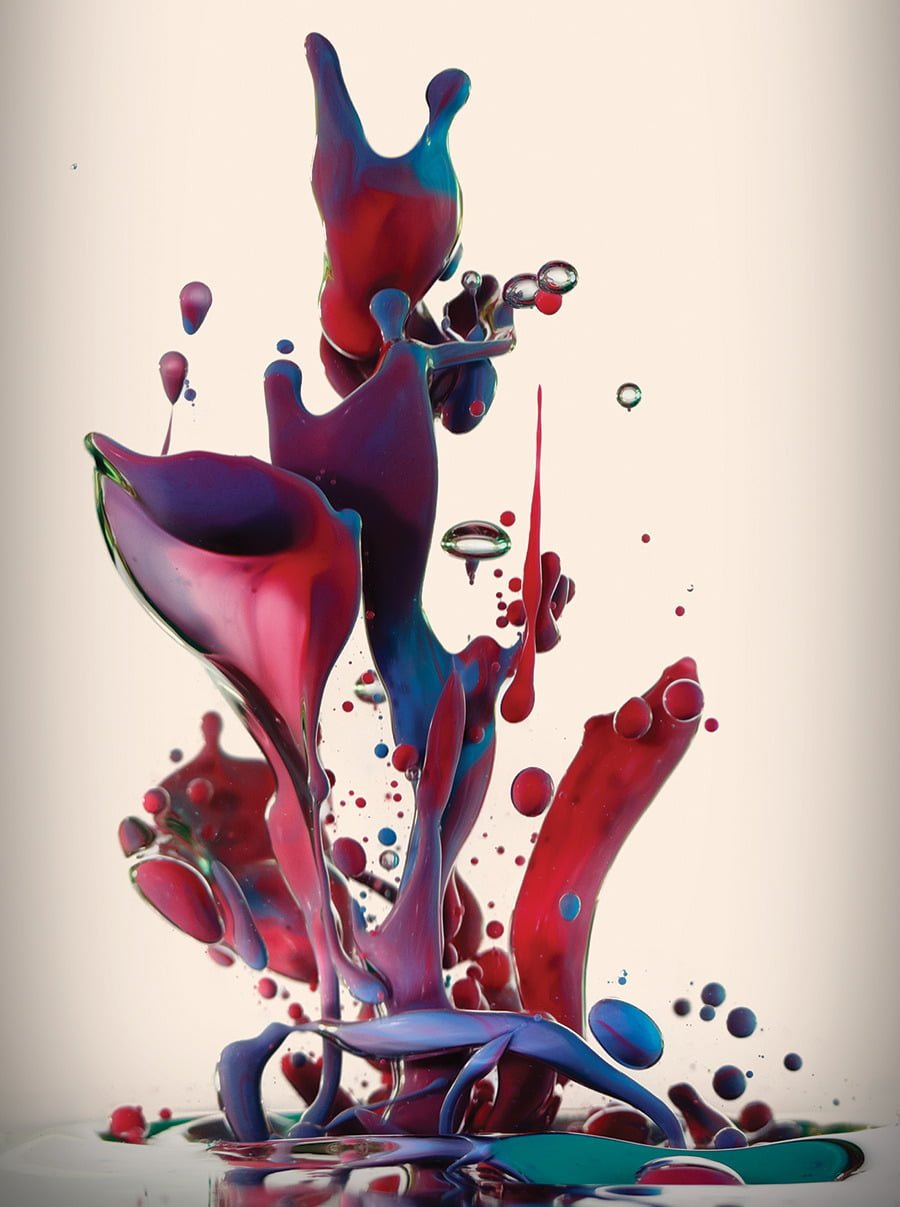
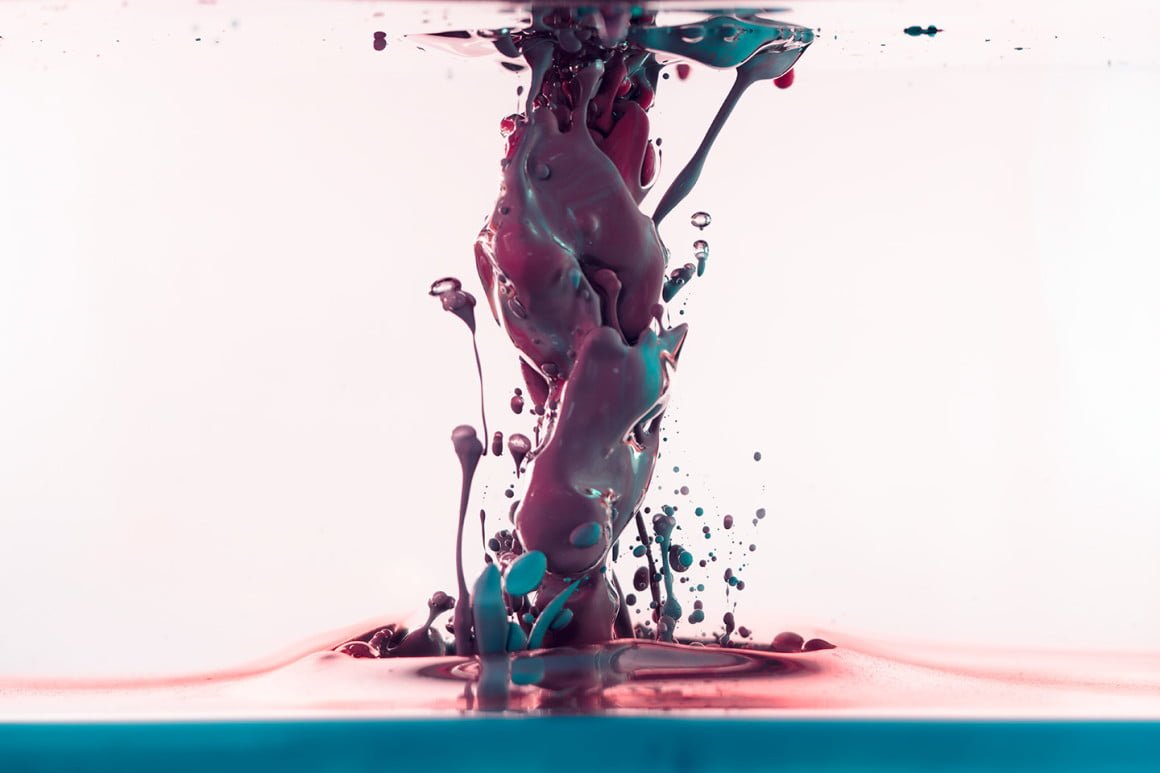
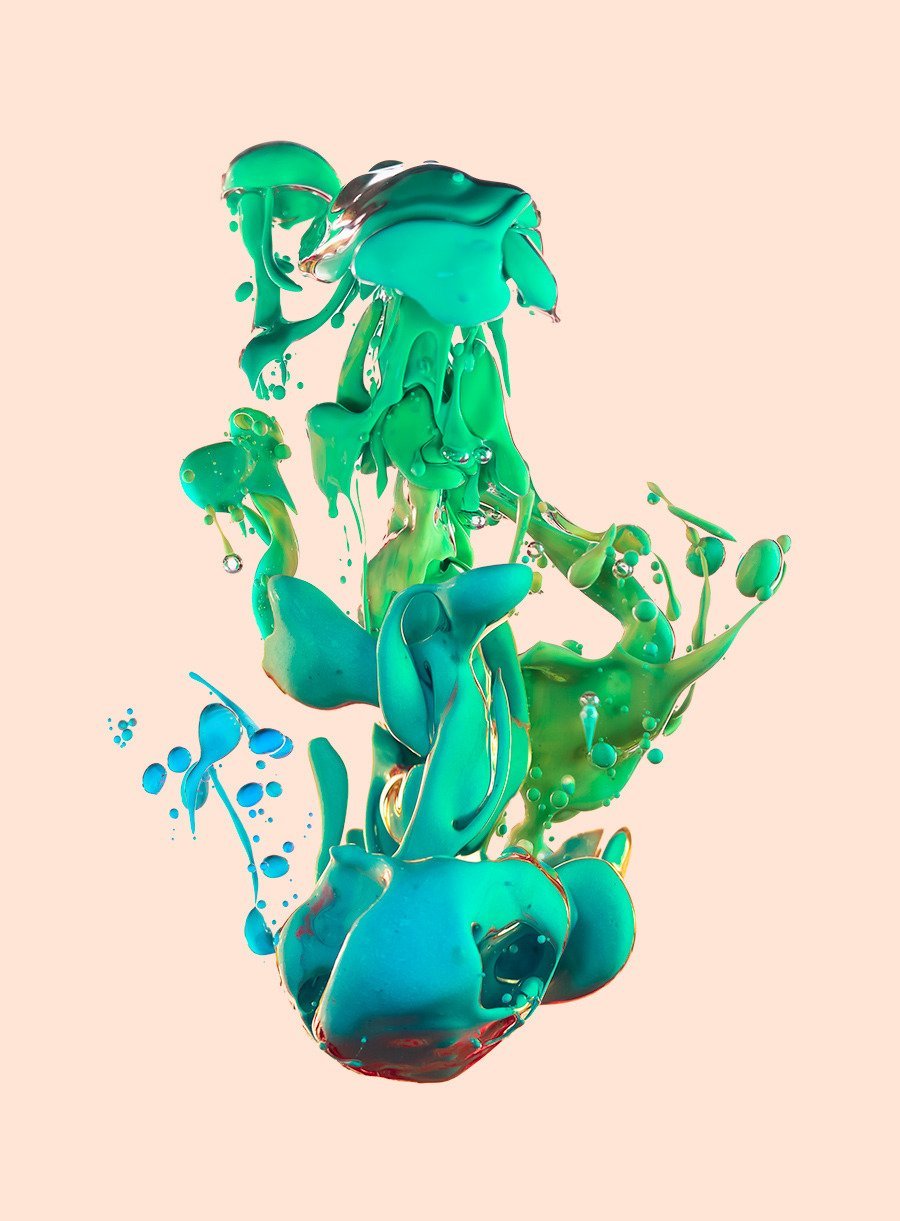
Photographer Alberto Seveso is well-known for ink in water art, some of which FYFD has featured previously (1, 2, 3). More recently, he’s been experimenting with alternative methods, dropping fluids like acrylic paint into sunflower oil. The effect is quite different but no less beautiful. Because the paint and oil are immiscible, the boundaries between the two fluids are much more clearly defined and highlighted in an iridescent sheen. Instead of appearing like billowing waves of silk, the paint forms abstract and alien shapes driven by gravity, inertia, and density differences. For many more great examples, check out Seveso’s website. (Photo credit: A. Seveso)
Month: March 2017

How Rainfall Can Spread Pathogens

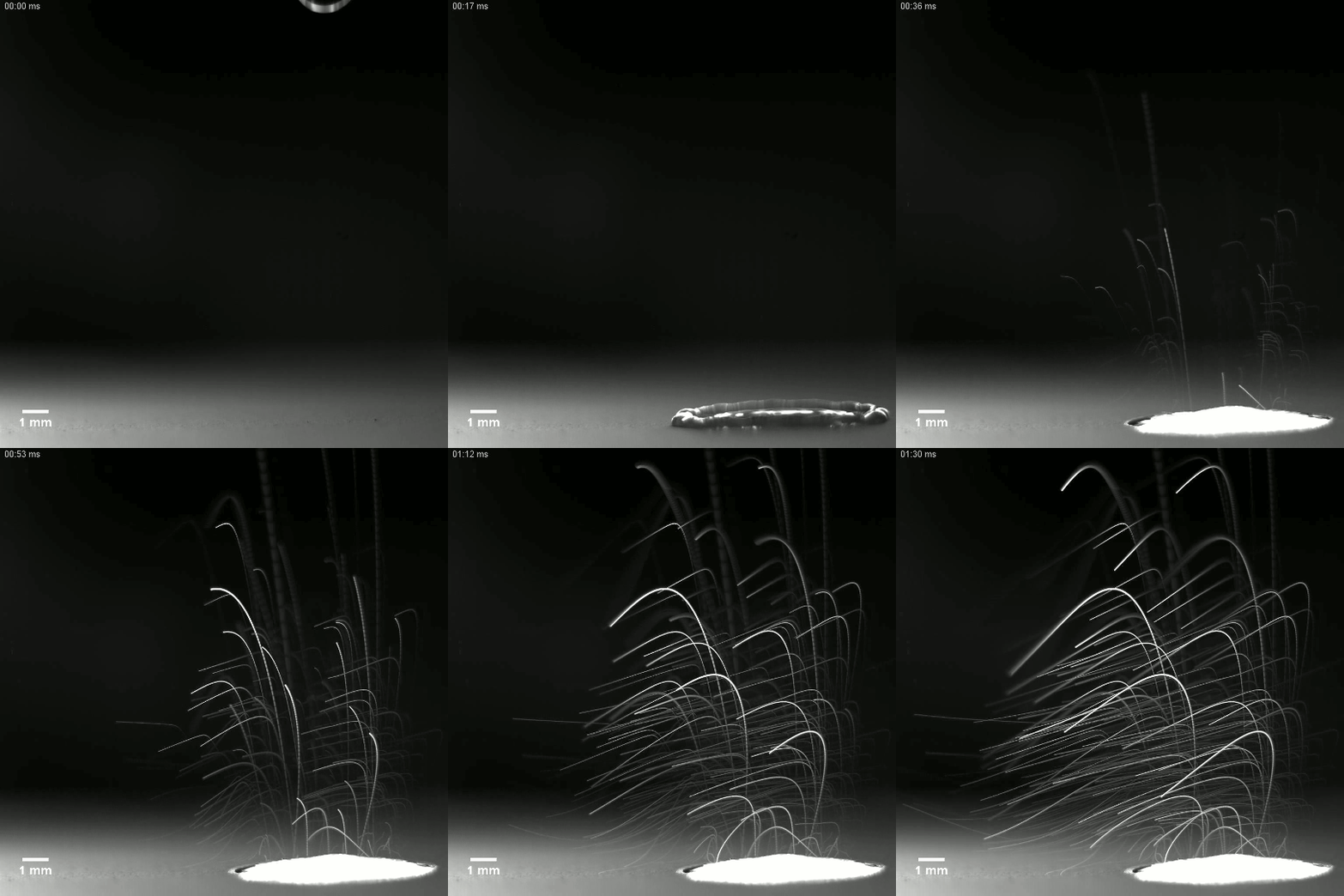
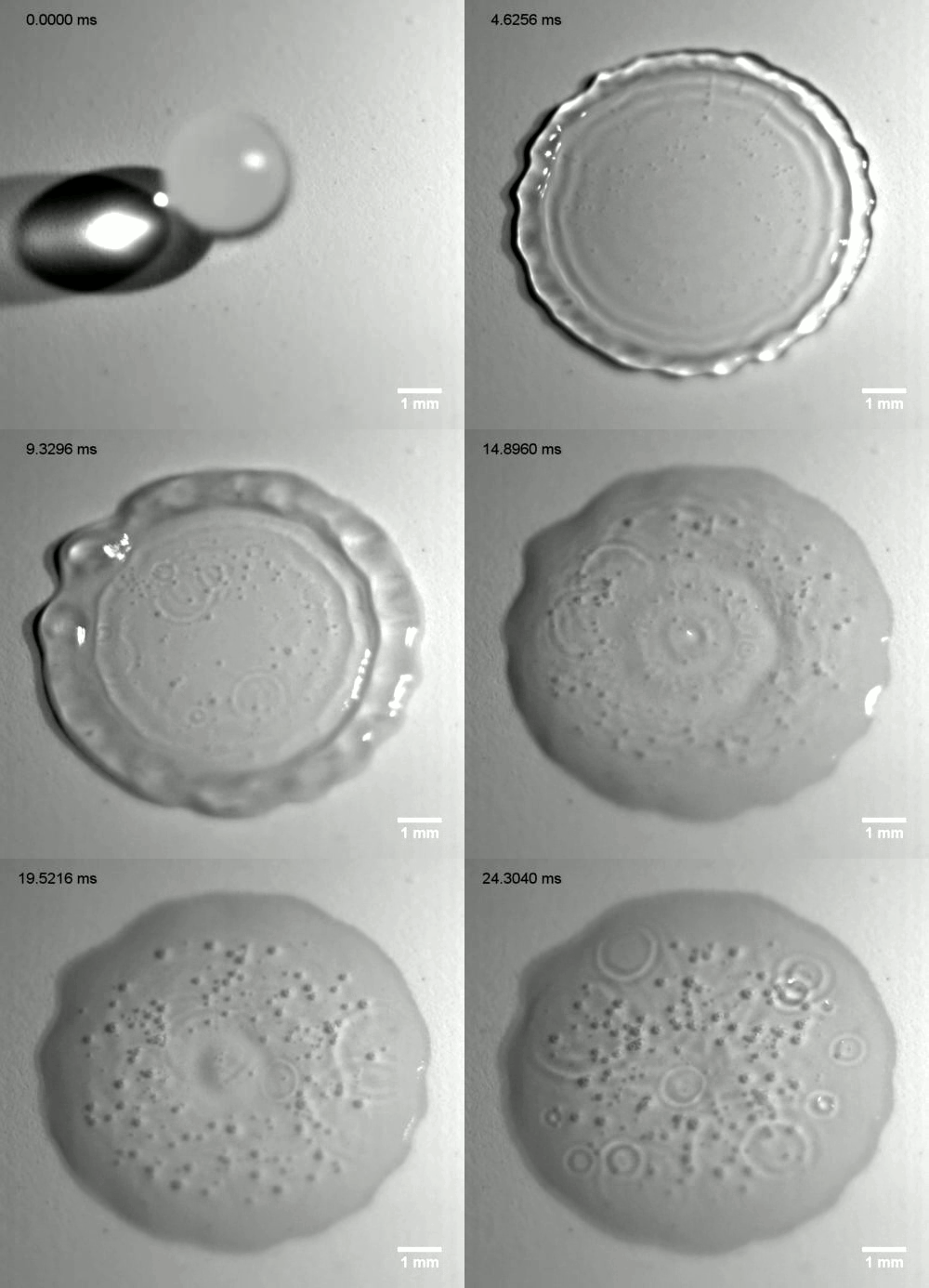
Rainfall may provide a mechanism for soil bacteria to spread. A new study examines how raindrops hitting infected soil can eject bacteria into the air. When drops fall at the rate of a light rainfall, they form tiny bubbles after impact (upper left). Those microbubbles rise to the top of the water and burst, sending extremely tiny droplets – or aerosols – spraying up into the air (upper right). Soil bacteria can hitch a ride on these aerosols, staying alive for up to an hour while the wind transports them to fresh, new soil. The researchers found that the most aerosols were produced when soil temperature was about 86 degrees Fahrenheit (30 degrees Celsius) – the temperature of tropical soils. Depending on the conditions, a single raindrop could aerosolize anything from zero to several thousands of soil bacteria. (Image and research credit: Y. Joung et al.; video credit: MIT News)

The Kamifusen
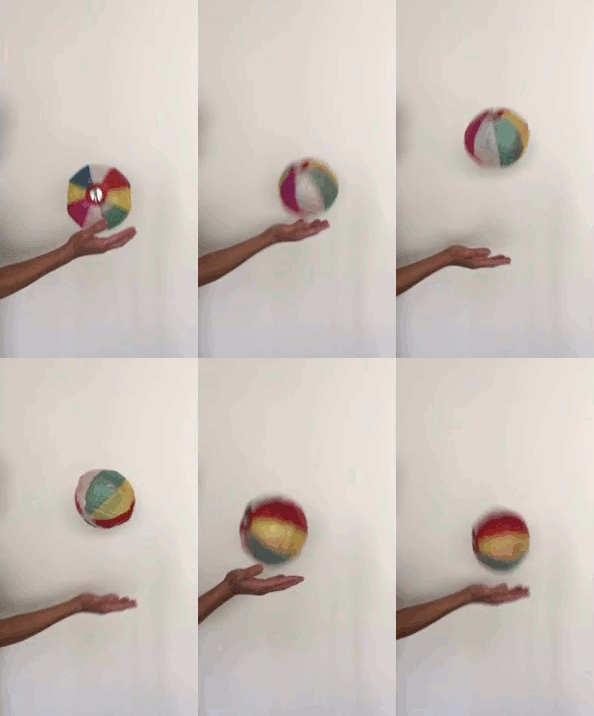
The kamifusen is a traditional Japanese toy made of colorful paper. It resembles a beach ball, but unlike that toy, the kamifusen has an open hole at one end. Given that hole, one might expect the toy to deflate when struck, but the opposite is true – a deflated kamifusen inflates itself when bounced. The key to this counter-intuitive behavior comes from a combination of fluid dynamics and solid mechanics.
When the kamifusen bounces off a player’s hand, it is compressed, which increases pressure inside the toy and forces some air out. Elastic waves rebound through the ball’s paper walls, much like seismic waves traveling outward from an earthquake. Those waves re-expand the toy’s walls, dropping the interior pressure and pulling air in from the outside. Although the pressure spike from impact is larger, its duration is short compared to the low pressure generated by the subsequent elastic waves. As a result, more air flows into the toy than is knocked out, and so the kamifusen inflates. For more, check out this explanation at Physics Today. (Image and research credit: I. Fukumori, source; submitted by E. van Andel)

Inside Singing
These are the vocal folds of a woman singing. Human speech (and song) results from interactions between elastic muscles and aerodynamics. As we exhale, the vocal folds are initially pushed apart, then the flow of air moving past creates low pressure (via the Bernoulli effect) that helps pull the folds together. As the folds close, high pressure again forms to force them open. This sets a cycle of oscillation or vibration that produces sound. To change the pitch of the sounds we create, we can lengthen or shorten the vocal folds or change their tension. In this respect, they behave somewhat similarly to the strings of a musical instrument. If you’d like to admire more vocal folds in action, check out this endoscopic video for four singers performing together. (Image credit: LinguaHealth, source)

Boulder Sorting on Asteroid Itokawa
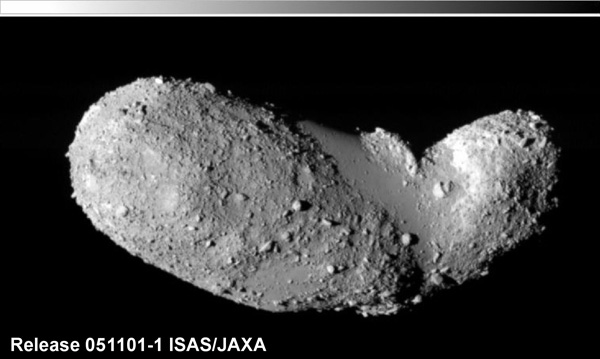
Itokawa is a small asteroid visited by the Japanese Hayabusa probe in 2005. Photographs of the asteroid revealed a surface covered in large boulders at high elevations and small pebbles in the valleys. The Brazil nut effect is often invoked to explain size separation in particle mixtures, but Itokawa is so small that any shaking sufficient to sort particles would likely exceed the asteroid’s meager escape velocity. Instead, researchers have suggested an alternative size sorting mechanism: ballistic sorting.
The idea of ballistic sorting is that pebbles that strike boulders will impact and bounce a long way, whereas pebbles that strike other pebbles are likely to rebound only a short way. In both experiments and simulations, the researchers found that this was the case and that mixtures of large and small particles tended to separate just as on the asteroid. The effect is possible on Earth as well, but Itokawa’s small gravitational acceleration makes for more effective size sorting. (Image credit: JAXA; research credit: T. Shinbrot et al.)

Self-Propelling Drops
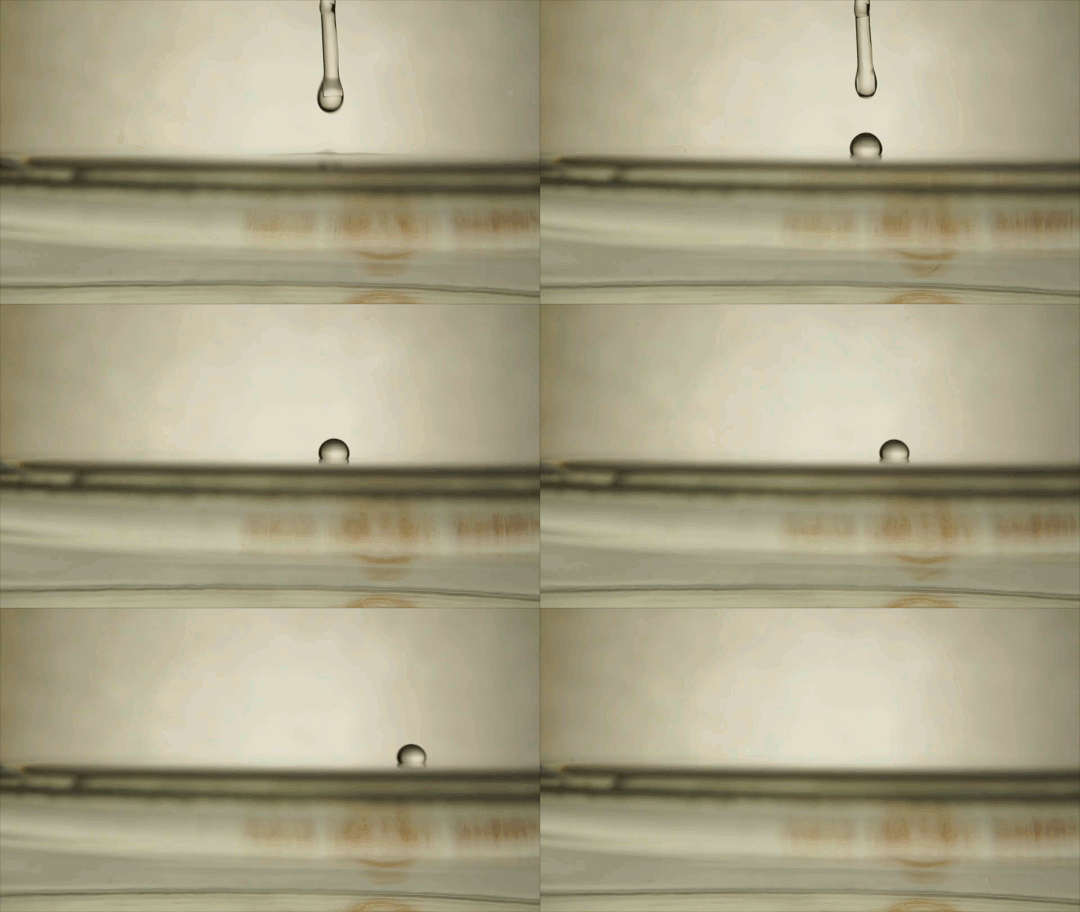
Droplets of acetone deposited on a bath of warm water can float along on a Leidenfrost-like vapor layer. The droplets are self-propelling, too, thanks to interactions between the acetone and water. Acetone can dissolve in water, and when acetone vapor beneath the drop gets absorbed into the water bath, it lowers the local surface tension. That drop in surface tension creates a pull in the direction of a higher surface tension; this is what is known as the Marangoni effect. Because of that flow in the direction of higher surface tension, the acetone drop accelerates away. (Image credit: S. Janssens et al., source)

Asperitas Clouds
This short timelapse captures an impressive display of asperitas clouds over Augusta, Georgia. Asperitas clouds, previously known as undulatus asperatus, are a new classification recommended by the Cloud Appreciation Society in 2009. Recently, the World Meteorological Organization indicated they would include the clouds in the their latest Cloud Atlas under the new name. Asperitas clouds form under conditions similar to those of mammatus clouds – in areas with stable, cool, sinking air near the outskirts of thunderstorms. Despite their ominous appearance, the clouds are not themselves an indicator of severe weather – just a spectacular display of our atmospheric dynamics. Happy World Meteorological Day! (Video credit: A. Walters; via Rebekah W/Flow Viz)

Using Jets to Find Food
Archer fish are well-known for their ability to hit aerial targets with perfectly aimed jets of water, as we’ve discussed previously. But a new study shows they use a similar technique to form underwater jets that help them uncover food. The researchers found that the fish altered the timing of their jet formation based on the type of substrate – fine sand, course sand, or mud – that the food pellet was hidden in. A great next step in this research would be using a technique like particle image velociometry (PIV) to measure the flow field directly and see to what extent the fish’s actions are altering the jet they produce. (Image and research credit: J. Dewenter et al.; GIF source: freshphotons)

Bottle Rocket Shock Diamonds
Mach diamonds or shock diamonds can often be seen in the exhaust of rocket engines. Here they’re shown in high-speed video of a bottle rocket’s launch. The rocket’s exhaust exits at a pressure that is higher than the surrounding atmosphere, which causes the exhaust to bulge outward and forms two expansion fans, seen in pink, to lower the pressure. The pressure actually drops too low, however, causing shock waves, seen in turquoise, to form in order to raise the exhaust’s pressure. This back-and-forth between shock waves and expansion fans continues, forming the diamond shapes we see. Each subsequent set gets weaker as the exhaust closes in on the right pressure, and ultimately the series of diamonds fades into turbulence. (Image credit: P. Peterson and P. Taylor, source)

Titan’s Bubbly Islands
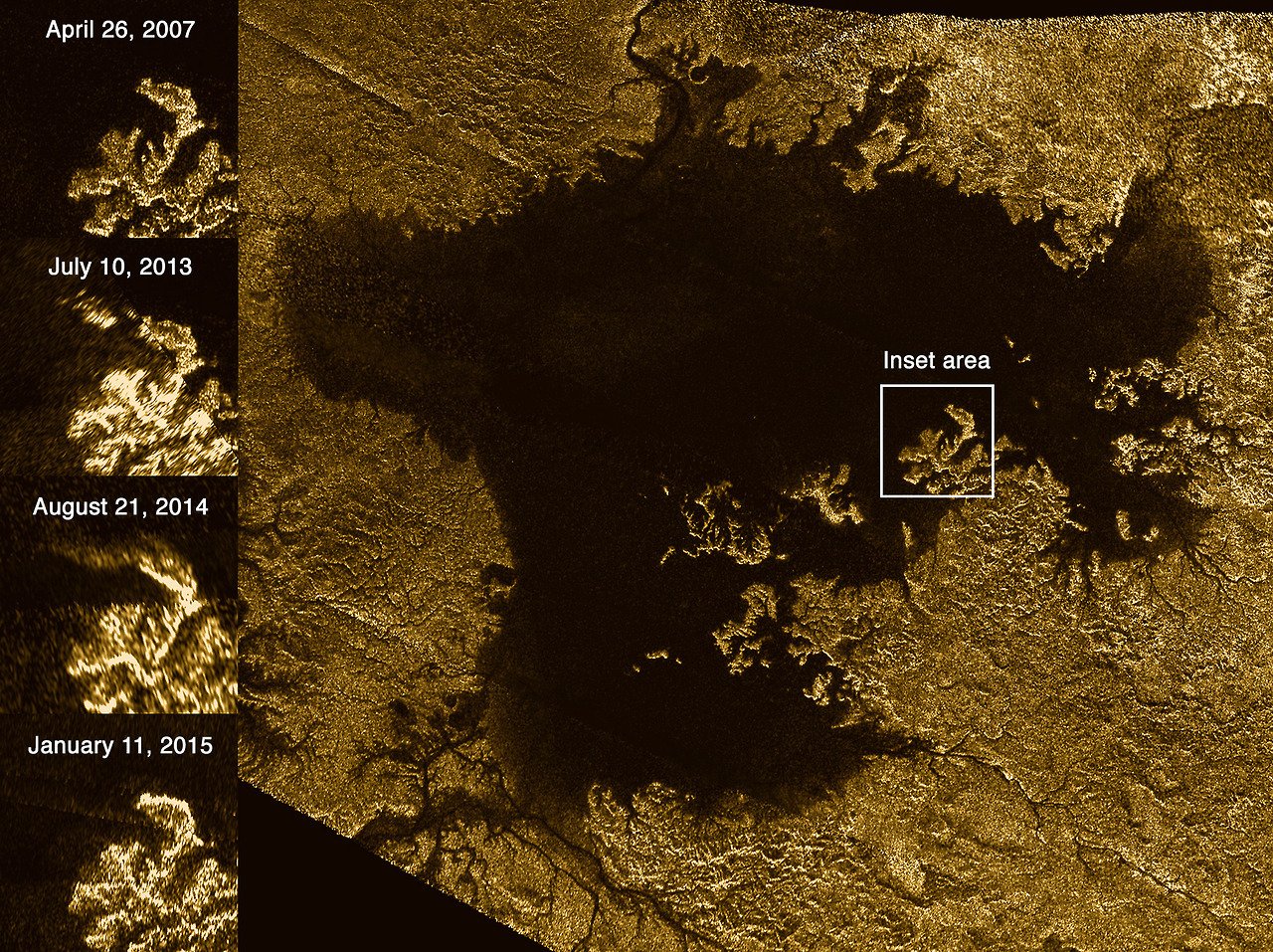
Titan, Saturn’s largest moon, is a fascinating world with remarkable similarities to our own. It is the only other world we know of with stable bodies of liquid at its surface. Unlike Earth, frigid Titan’s lakes and seas are filled with methane and ethane. Radar data from the Cassini mission has shown oddly changing shorelines on Titan, above, with islands that seem to magically appear and disappear over time.
Researchers at NASA’s Jet Propulsion Laboratory now think these islands may, in fact, be bubbles. As Titan’s lakes cool, they’re better able to absorb nitrogen gas, but when temperatures warm up, that gas comes out of solution and floats to the surface, much like the bubbles of carbon dioxide in a soda. If this hypothesis holds up, there are some interesting implications for Titan’s atmosphere. Here on Earth, bubbles popping in the ocean are a major source of aerosol particles. It’s possible migrating rafts of bubbles could behave similarly on Titan. (Photo credit: NASA/JPL-Caltech/ASI/Cornell; submitted by jpshoer)
I’m excited to announce I will be visiting JPL later this month (March 30th), where I have the honor of giving a Women’s History Month talk. If there are any JPLers who are FYFD fans, I hope to see you there. Be sure to RSVP to the ACW luncheon by the March 24th deadline.