Month: March 2017

  • Featured Video Play Icon

    Bursting Droplets

    Mixing multiple fluids can often lead to surprising and mesmerizing effects, whether it’s droplets that dance or tears along the walls of a wine glass. A recent paper highlights another such mixture-driven instability – the bursting of a water-alcohol droplet deposited on an oil bath. The Lutetium Project tackles the physics behind this colorful burst in the short video above. The behavior is driven by the quick evaporation rate of alcohol in the droplet and the way this changing chemical concentration affects surface tension in the droplet. Alcohol evaporates more quickly from the edges of the drop, creating a region of higher surface tension around the edge. This pulls fluid to the rim of the drop, where it breaks up into droplets that get pulled outward as the inner drop shrinks.

    The oil bath plays an important role in the instability, too. Without it, friction between the drop and a wall is too high for the droplet to “burst”. A thick layer of oil acts as a lubricant, allowing the escaping satellite drops to speed away. (Video and image credit: The Lutetium Project; research credit: L. Keiser et al.; submitted by G. Durey)

  • Breaking the Wave Speed Limit

    Breaking the Wave Speed Limit

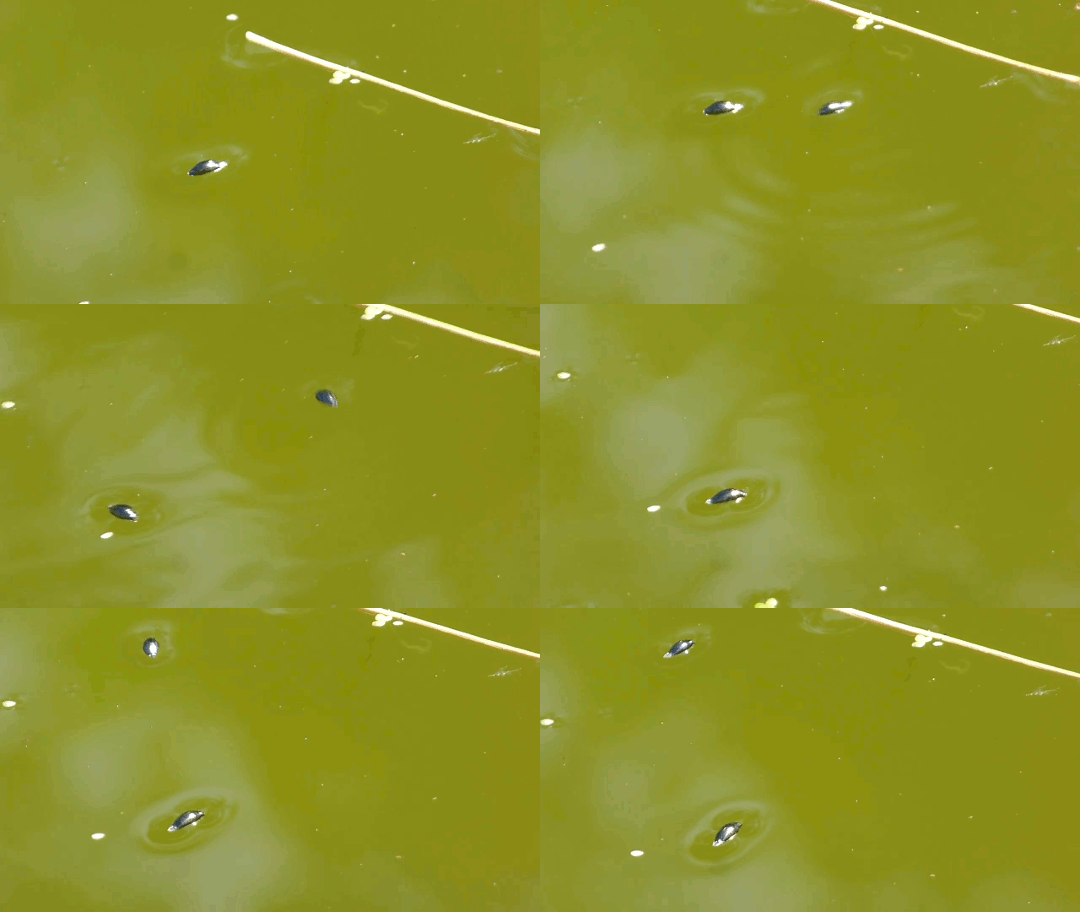
    Whirligig beetles are small surface swimming insects. As they race across the water surface, they create both visible and unnoticeable waves on the water. These waves are the result of both surface tension and gravity. Typically, it’s the wavelength of the gravity waves that limit a swimmer or boat’s speed. When the wavelength of the gravity waves a swimmer creates meets the size of the swimmer, the waves generated ahead of the swimmer start to reinforce the waves forming at the back of the swimmer. This traps the swimmer (or boat) in a trough between its bow and stern waves and limits the max speed of the swimmer since overcoming this critical hull speed requires excessive amounts of power.

    The tiny whirligig beetle overcomes this natural speed limit cleverly. It is smaller than the shortest possible gravity wave in water. Thus, it can never be trapped between its bow and stern waves! This allows the tiny swimmer to zip across the water’s surface at speeds above 0.5 m/s. That’s over 30 beetle body lengths per second! (Image credit: H. L. Drake, source; research credit: V. Tucker; submitted by Marc A.)

  • Featured Video Play Icon

    How Jet Engines Work

    Jet engines are a major part of aviation today, and this great video from the new LIB LAB project breaks down how jet engines operate. It focuses especially on the subject of combustion, in which fuel-air mixtures are burned to generate power and thrust. By breaking fuels down into simpler compounds, jet engines are able to accelerate exhaust gases, which creates thrust. They even provide instructions for an effervescence-driven bubble rocket so that kids can (safely!) experiment with propulsion at home. (Video credit: LIB LAB/Corvallis-Benton County Public Library)

  • Supporting Bubbles

    Supporting Bubbles

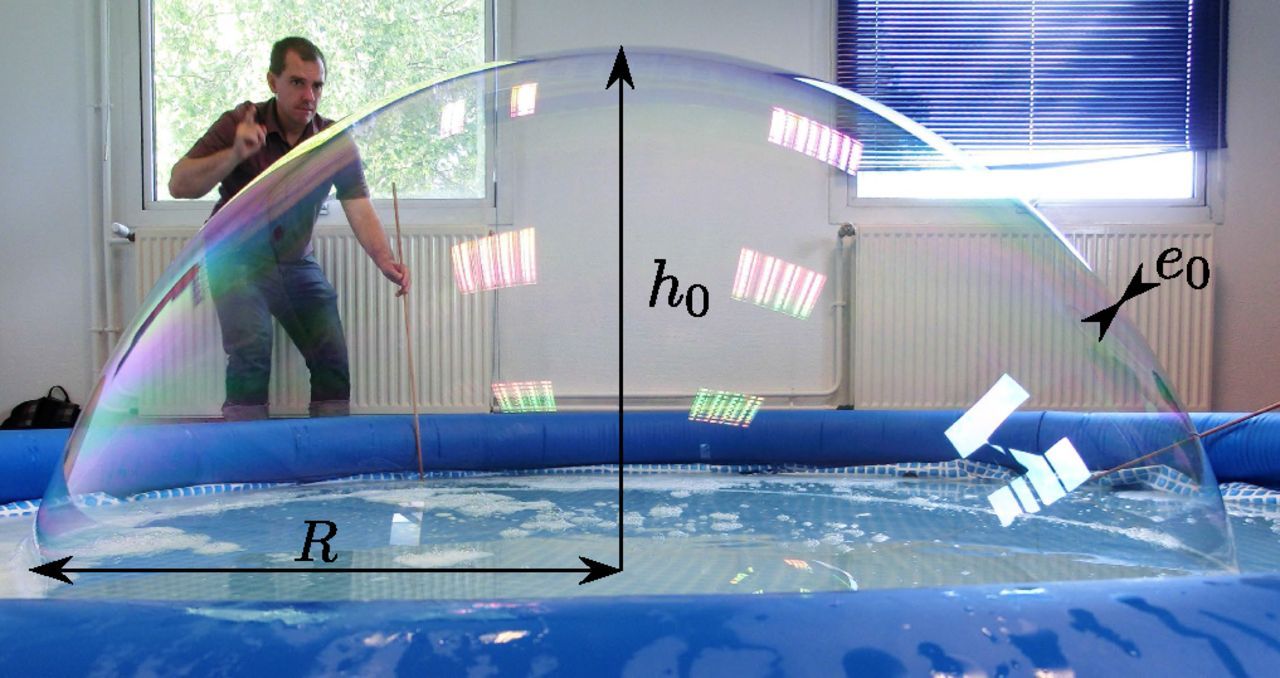
    Surface tension holds small droplets in a partial sphere known as a spherical cap. But when droplets become larger, they flatten out into puddles due to the influence of gravity. In contrast, soap bubbles remain spherical to much larger sizes. The bubble pictured above, for example, is more than 1 meter in radius and nearly 1 meter in height.

    There is a maximum height for a soap bubble, though, and it’s set by the physical chemistry of the surfactants used in the soap. To support itself, the bubble requires a difference in surface tension between the top and bottom of the bubble. A higher surface tension is necessary at the top of the bubble to help prevent fluid from draining away. The difference in surface tension between the top and bottom of the bubble can never be greater than the difference in surface tension between pure water and the soap mixture – thus those values set a maximum height for a bubble. The researchers found their bubbles maxed out at a height of about 2 meters, consistent with their theoretical predictions. (Image credit: C. Cohen et al.; via freshphotons)

  • Featured Video Play Icon

    Spillways

    Extensive rains in California have brought an unusual sight to Lake Berryessa – an overflowing spillway. The upper photo, taken in 2010, shows the concrete structure of the spillway’s entrance, known as a bellmouth – or, in the words of locals, a glory hole. When the water level rises above the concrete, water begins to cascade down the spillway to relieve flooding.

    The flow is rather mesmerizing and beautifully laminar until it’s fallen many feet down the hole. This is intentional on the part of the designers – at least the laminar part. It means that the flow velocity at the entrance is slow, so that animals (or trespassing people) nearby are not going to get sucked down the spillway a la Charybdis. Nevertheless, the spillway does make quick work of excess water. The New York Times reported that on February 21st about two million gallons (7.5 million liters) of water a minute flowed down the spillway. (Image credits: J. Brooks; T. Van Hoosear; video credit: Lake Berryessa News; submitted by Zach B.)