This spectacular Hubble image shows the Bubble Nebula. The source of this nebula is the star seen toward the upper left side of the bubble. This massive, super-hot star has ceased to fuse hydrogen and is now fusing helium, powering its way to a likely end as a supernova. As it burns, the star emits a stellar wind of gas moving at over 6.4 million kilometers an hour. As the flow moves outward, it encounters colder dense gases that it pushes along as it expands; this is the blue bubble surface that we see. The asymmetry of the bubble with respect to its source star is caused by the variation in the surrounding gas’s density. The bubble’s front moves more slowly in areas with more gas, thus making the bubble appear lop-sided. (Image credit: NASA; via Gizmodo)
Month: April 2016

Striking Oobleck
Mixing cornstarch and water creates a fluid called oobleck that has some pretty bizarre properties. Oobleck is a shear-thickening, non-Newtonian fluid, which means its viscosity increases when you try to deform it with a shearing, or sliding, force. But as the Backyard Scientist demonstrates above, striking oobleck with a solid object produces some spectacular and very non-fluid-like results. The golf ball’s impact blows the oobleck into pieces that look more like solid chunks than liquid droplets. This solid-like behavior occurs because the impact jams the suspended cornstarch particles together, creating a solidification front that travels ahead of the golf ball. Imagine how a snow plow pushes a denser region of snow ahead of it as it drives; the cornstarch behaves similarly but only in a region near the impact. Once that impact force dissipates, the particles unjam and the mixture responds fluidly again. (Image credit: The Backyard Scientist, source; research credit: S. Waitukaitis and H. Jaeger, pdf)

Emulsion Impact
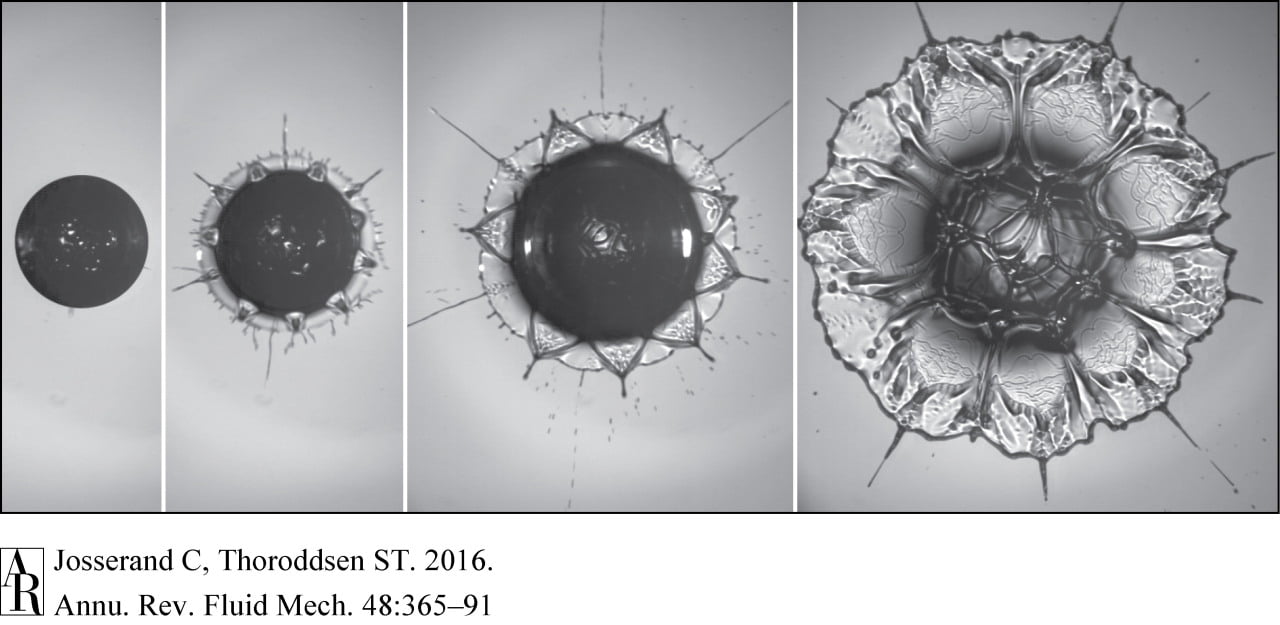
Emulsions – mixtures of two immiscible fluids – are quite common; the oil and vinegar combination used in many salad dressings is one. The image sequence above shows the first 800 microseconds of the impact of a similarly emulsified droplet. The outer drop, seen on the left, consists of a water/glycerin mixture, and inside the drop are 20 smaller perfluorohexane droplets. These smaller droplets are denser and tend to settle toward the bottom of the outer drop. When the compound droplet hits a solid surface, it spreads in a spectacular starburst pattern that depends on the number and location of interior droplets. You can see a similar impact in motion here. (Image credit: J. Zhang and E. Li; source: C. Josserand and S. Thoroddsen)

Mediterranean Currents
Ocean currents play a major role in the weather and climate of our planet. This video shows a simulation of the surface ocean currents in the Mediterranean and Atlantic over an 11-month period. Each second corresponds to 2.75 days. You’ll see many swirling eddies in the Mediterranean and more flow along the coastlines in the Atlantic. One observation worth noting: near the end of the video, you’ll notice that flow through the Strait of Dover between England and France changes its direction, flowing back and forth depending on tidal forces. In contrast, flow through the Strait of Gibraltar is always into the Mediterranean (within the timescale of the simulation, at least). This net in-flow to the Mediterranean is due in part to the warm waters there evaporating at a higher rate than the cooler Atlantic. (Video credit: NASA; via Flow Viz; h/t to Ralph L)
Bubbles and Films Merging
As we’ve seen before, a water droplet can merge gradually with a pool through a coalescence cascade. It turns out that the coalescence of a soap bubble with a soap film can follow a similar process! Initially, the bubble and film are separated by a thin layer of air. Once that air drains away and the bubble contacts the fluid, it starts to coalesce. But the bubble pinches off before its entire volume merges, leaving behind a daughter bubble with about half the radius of the previous bubble. This process repeats until the bubble is small enough that it merges completely. To see more great high-speed footage of this bubble merger, check out the full video below. (Image/video credit: D. Harris et al.)

A New Cloud
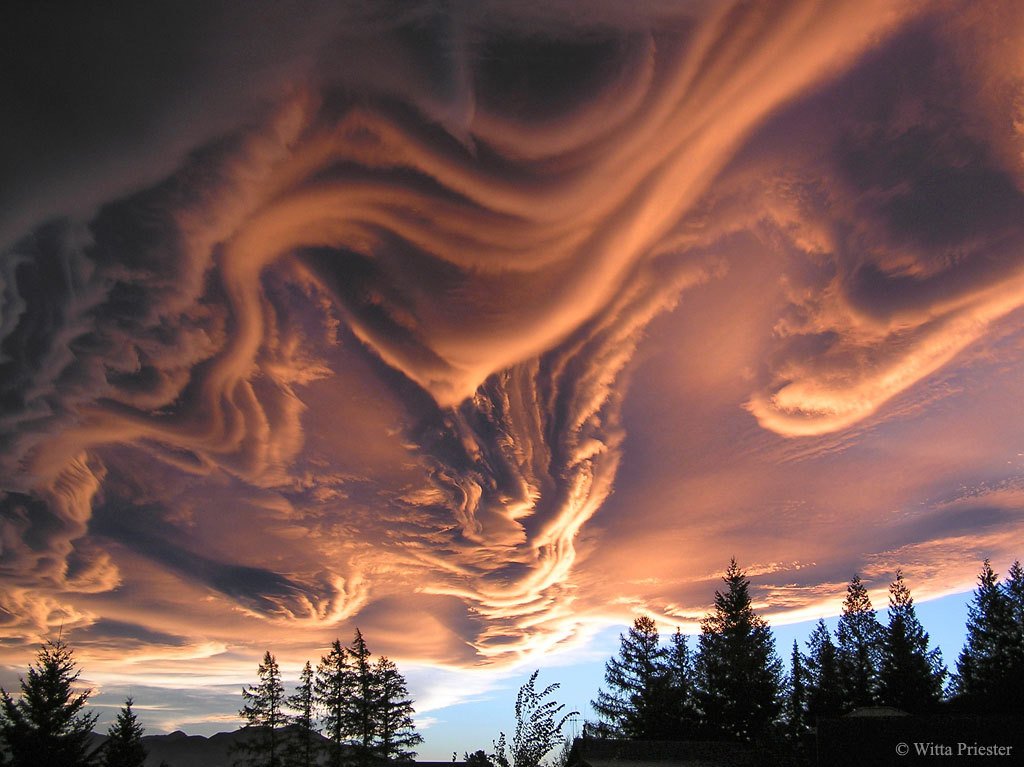
These unusual and spectacular clouds are known as undulatus asperatus. Though they have been proposed as a new type of cloud, they are as yet officially unrecognized. Despite their dramatic appearance, these clouds are not associated with storms. Instead, they’re thought to form in a process similar to mammatus clouds, where wind shear at the cloud level causes undulations to form. This wave-like structure is especially visible in the photo above thanks to a low sun angle illuminating the underside of the clouds. (Image credit: W. Priester; via APOD)

Coastal Upwelling
Cool temperatures and abundant nutrients make the waters off the western coast of North America especially biologically productive. This image is a composite of satellite data highlighting large phytoplankton blooms in the California Current. This current runs southward along the coastline, and, like other eastern boundary currents, it experiences strong upwelling, or rising of colder, nutrient-rich waters from lower depths. The upwelling is driven in part by Earth’s rotation. As the earth spins, Coriolis effects push the California Current out from the coast, allowing deeper waters to rise and fill the void. The cooler water provided by the upwelling is a major factor in the moderated climate along the West Coast. (Image credit: NASA/N.Kuring; via NASA Earth Observatory)

Crown Splash Sealing
A sphere falling into water generates a spectacular crown
splash at the surface. The object’s impact ejects a thin sheet of fluid
that rises vertically. The air pulled down into the cavity by the
sphere’s passage makes the air pressure inside the sheet lower than the
ambient air pressure on the exterior of the sheet. This pressure
difference is part of what draws the crown inward to seal the cavity. As
the splash collapses inward and seals, the liquid sheet starts to
buckle and wrinkle, leaving periodic stripes around the closing neck.
This so-called buckling instability occurs when the radius of the neck
collapses faster than the vertical speed of the splash. For more, see
the research paper or this award-winning video. (Image credit: J. Marston et al., source)Auroras From Space
NASA has released a jaw-dropping new compilation of Earth’s auroras viewed from the International Space Station. It’s available in up to 4K resolution, and I heartily recommend watching it fullscreen at the highest resolution you can comfortably manage. (To paraphrase: this is ultra high definition – it’s better resolution than real life!) I don’t think I’ve ever seen aurora footage that so clearly showed the fluid behavior of auroras when viewed from space. This flow-like quality is to be expected since the auroras occur due to ionized particles from the solar wind exciting atoms in our upper atmosphere in a magnetohydrodynamic dance that never gets too old to watch. (Video credit: NASA; via Gizmodo)
Boston area FYFDers: I’m giving a talk at Harvard tomorrow afternoon on science communication – Wed. April 20th, 4pm, Maxwell Dworkin, G115.

Pinning a Drop
The shape of a droplet sitting on a surface depends, in part, on its surface tension properties but also on the nanoscale roughness of the surface. Small variations in the height and shape of the surface will change the area a drop contacts as well as the contact angle the edge of the drop makes with the surface. If the contact line between the drop and surface stays the same as a droplet evaporates into the surrounding gas or dissolves into the surrounding liquid, then we say the drop is pinned. A pinned drop’s contact angle will decrease as the drop’s volume decreases. This strains the ability of the nanoscale roughness to keep the drop’s edge pinned. As individual points of contact fail, the drop’s edge may jump inward to a new contact point. This set of discrete jumps between pinned states is called a stick-jump or stick-slip mode. (Image credit: E. Dietrich et al., source; see also: E. Dietrich et al. 2015)