
If you’ve ever blown across the top of a bottle to make it play a note, then you’ve created a Helmholtz resonator. Air flow across the top of the bottle causes air in and around the bottle neck to vibrate up and down. Like a mass on a spring, the air oscillates with a particular frequency that depends on the system’s characteristics. We hear this vibration as a a deep hum, but in the high-speed video above, you’re actually seeing the vibration as smoke pulsing in and out of the bottle. Helmholtz resonance shows up more than just in blowing across beer bottles; it’s also a factor in many resonating instruments, like the guitar. To learn more about the physics and mathematics of the effect, check out this page from the University of New South Wales. (Video credit: N. Moore)
Month: February 2015

Testing a Supersonic Car
How do you test a supersonic car like the Bloodhound SSC in a wind tunnel? With free-flying objects like airplanes, wind tunnel testing is relatively straightforward. Mounting a stationary model in a supersonic flow gives an equivalent flow-field to that object flying through still air at supersonic speeds. The same does not hold true for the supersonic car, though, because you need to account for the effect of the ground on airflow. One option is to build a moving wall in the wind tunnel. For low-speed applications, this is feasible but incredibly complicated and very expensive. For supersonic speeds, it’s impossible. You could achieve the same moving-wall effect at supersonic speeds with a rocket sled, but that is also expensive and difficult to fit in most experimental facilities. The simplest solution is the one you see above – build two models and mount them belly-to-belly. Reflecting the models makes the plane of symmetry a stagnation plane, which, fluid dynamically speaking, acts like an imaginary ground plane relative to the model. For more on the project and the technique, check out this article. (Photo credit: B. Evans; via ThinkFLIP; submitted by G. Doig)

The Milk Crown
This frequently imitated photograph of a drop of milk splashing was taken by engineer Harold Edgerton in 1934. Edgerton pioneered the application of stroboscopic photography to everyday objects, allowing him to capture images with an effective shutter speed much faster than could be mechanically achieved. The photo captures the crown or coronet of a splash. The momentum of the incoming drop flings a thin sheet of liquid radially outward. The rim of this sheet breaks down into thin ligaments that eject tiny droplets at their tips when surface tension can no longer hold the milk together. (Image credit: H. Edgerton, via The Art Reserve; submitted by Vince G)

5 Years of SDO
NASA’s Solar Dynamics Observatory (SDO) is our premiere source for data on the sun. In honor of its five-year anniversary, NASA released this beautiful video compiling some of the highlights among the 2600 terabytes of data the spacecraft has recorded. SDO has captured some truly stunning footage over the years of sunspots, prominences, and eruptions. The latter two are examples of plasma flows and visible magnetohydrodynamics. SDO’s observations are also helping researchers determine what goes on just beneath the sun’s surface, where convection and buoyancy are major forces in the transport of heat generated from fusion in the star’s core. Incidentally, SDO’s launch featured some uncommonly stunning fluid dynamics as well. (Video credit: NASA Goddard)

Snowy Deserts
Windblown snow bears a certain resemblance to desert sands or a Martian landscape. Many of the same aeolian processes–like erosion, transport, and deposition–take place in each. The animation above shows an example of suspension, where fine snowflakes are lifted and carried along near the ground. Larger snowflakes may bounce or skip along the surface in a process called saltation. For more, check out some of the crazy things snow does or learn about how dunes form. (Image credit: Redemption Designs, source video)
Plasma
For those of us who are Earthbound, it’s easy to think of liquids and gases as being the most common fluids. But plasma–the fourth state of matter–is a fluid as well. Plasmas are essentially ionized gases, which, thanks to their freely flowing electrons, are electrically conductive and sensitive to magnetic fields. Their motions are described by a combination of the Navier-Stokes equations–the usual equations of motion for a fluid–and Maxwell’s equations–the equations governing electricity and magnetism. Studies of plasma motion often fall under the subject of magnetohydrodynamics and can include topics like planetary auroras, sunspots, and solar flares. (Video credit: SciShow)

Singing Toads
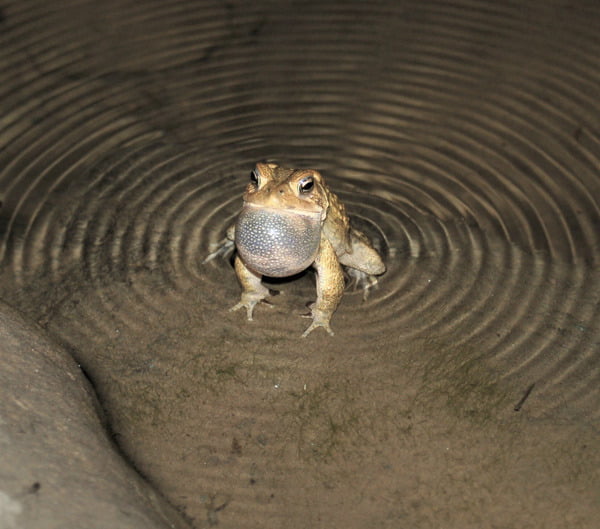
Many male frog and toad species sing during warmer months to attract mates. Some, like the American toad in the photo above, can be heard for an impressive distance. Here’s a video of an American toad in action. To sing, these amphibians close their mouth and nostrils, then force air from their lungs past their larynx and into a vocal sac. As with human sound-making, forcing air past the frog’s larynx vibrates its vocal cords and generates noise. That noise resonates in the vocal sac, amplifying the sound and driving the ripples seen in the photo. (Image credit: D. Kaneski; submitted by romannumeralfive)
Wingtip Vortices


Wingtip vortices are the result of high-pressure air from beneath a wing sneaking around the end of the wing to the low-pressure area on top. They trail for long distances behind aircraft, and are, most of the time, an invisible hazard for other aircraft. If you’ve ever sat in a line of airplanes waiting to take off and wondered why there is so much time between subsequent take-offs, wingtip vortices are the answer. The larger a plane, the stronger its vortices are and the greater their effect on a smaller craft. Much of the time between planes taking off (or landing) is to allow the vortices to dissipate so that subsequent aircraft don’t encounter the wake turbulence of their predecessor. Crossing the wake of another plane can cause an unexpected roll that pilots may not be able to safely correct, a factor that’s contributed to major crashes in the past. (Image credits: flugsnug, source video; submitted by entropy-perturbation)

Reader Question: Submarines

Reader elimik asks:
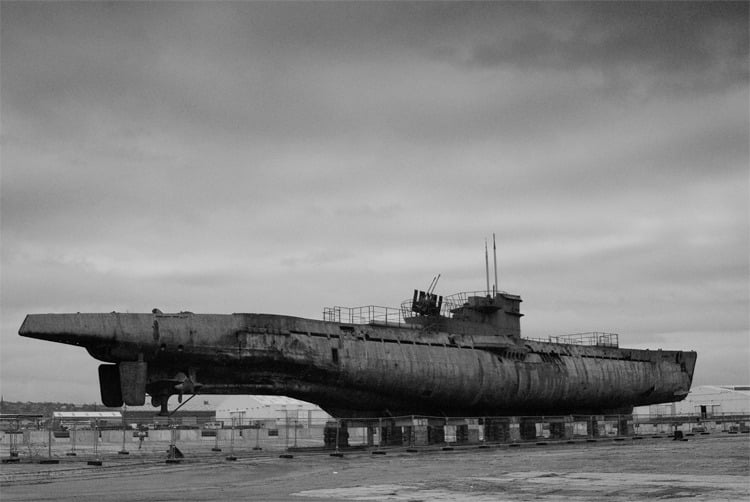
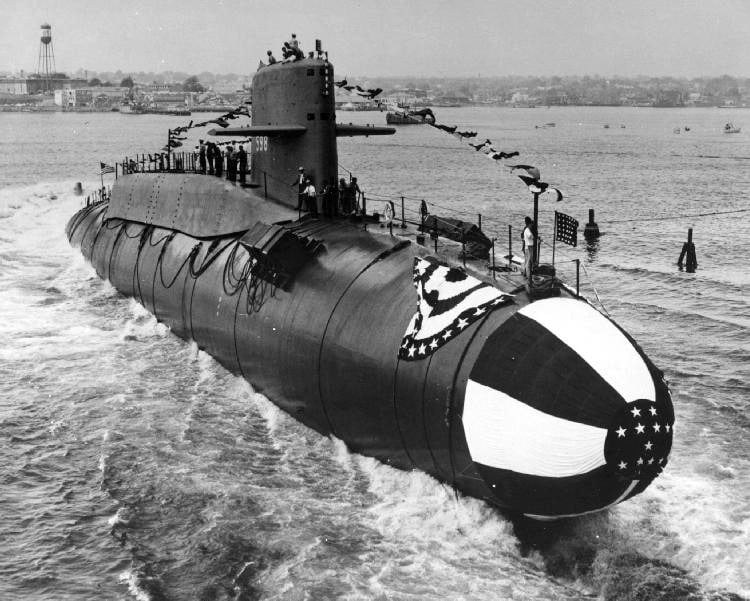
Why do modern submarines have round bows instead of pointy ones, like the early WWII ones?
Interestingly, there are more factors that affect this design choice than I originally thought! Perhaps the biggest factor, though, is propulsion. Although early submarines ran through several forms of propulsion from human power to steam, by World War II many subs were driven by diesel-power on the surface and relied on battery power when submerged. Power limitations meant that submarines of that era did most of their travel while at the surface, not underwater. As a result, the ships had better control and decreased drag with a pointed bow similar to that of a surface ship. It wasn’t until the advent of the nuclear-powered submarine that it became practical for submarines to spend most of their time submerged. Once fully-underwater travel was feasible (and, indeed, preferable), many subs transitioned to a blunter, rounded bow that’s more hydrodynamic underwater–and simultaneously more problematic control-wise when moving on the surface.
Another factor separating WW-era submarines and modern subs is the depth to which they submerge. The deeper a submarine dives, the greater the pressure it must withstand. Rounded or cylindrical shapes make much better pressure vessels because they distribute pressure evenly around a surface. Historically, many subs have balanced control and hydrodynamics against pressure requirements by having two hulls, an outer one for cutting through surface waters and an inner cylindrical one that bears the brunt of the hydrostatic pressure. As we developed stronger materials, though, submarines have achieved greater depths. The German Type VII submarine, the most common U-boat of WWII, had a test depth of 230 m, whereas today’s Los-Angeles-class U.S. submarine can operate at 290 m. (Each 10 meters of depth adds about one atmosphere’s worth of pressure.) The combination of nuclear power for subsurface propulsion and stronger materials that allow deeper dives enables many modern submarines to have a single hull–the rounded hydrodynamic and pressure-resistant bow we commonly see. (Image credits: U534 by P. Adams and USS George Washington by U.S. Navy)
Underwater Currents
Like the atmosphere, the ocean is constantly in motion, churned by currents that often go unnoticed by humans watching the surface. Filmmaker Julie Gautier and free diver Guillaume Néry demonstrate the power and speed of some of these underwater currents in the film above. The footage was shot in Tiputa Pass, part of an atoll northeast of Tahiti. In it, Néry serves as a human-shaped seed particle in the flow, illustrating just how swift the current is. (Video credit: J. Gautier; via Colossal; submitted by jshoer)



#mediaviewer/File:USS_George_Washington_(SSBN_589).jpg)