A liquid’s surface tension can have a big effect on its splashes. In this video, a 5-mm droplet hits a surface covered in a thin layer of a liquid with lower viscosity and surface tension. The result is a dramatic effect on the spreading splash. As the initial curtain grows and expands, the lower surface tension of the impacted fluid thins the splash curtain. Fluid flows away from these areas due to the Marangoni effect, causing holes to grow. The sheet breaks up into a network of liquid filaments and ejected droplets before gravity can even bring it all to rest. For more, see this previous post and review paper. (Video credit: S. Thoroddsen et al.)
Month: November 2013

Fire in Microgravity
In the movie “Gravity” Sandra Bullock’s character battles a fire aboard the International Space Station. Combustion is a huge concern in space habitats. Microgravity fires are challenging to detect and fight because they behave very differently in the absence of buoyancy. On Earth, buoyancy makes hot air rise from a flame while cooler air is pulled in near the base. This feeds fresh oxygen to the teardrop-shaped flame. In space, there is no buoyancy and flames are spherical. They also burn at lower temperatures and lower oxygen concentrations–so low, in fact, that the oxygen depletion necessary to extinguish a fire is lower than what humans require to survive.
No buoyancy makes it harder for fires to spread, but it also makes them harder to detect since smoke doesn’t rise toward a detector on the ceiling. Instead, fire detectors aboard the Space Station are housed in the ventilation system that moves air through the modules constantly. In the event of a fire, astronauts use a three-step fire suppression system. First, they shut off the ventilation system to delay the fire’s spread. Then they shut off power to the affected unit, and, finally, they use fire extinguishers on the flames. The Russian module is equipped with a foam extinguisher and the others use CO2 units. (Image credit: Warner Brothers)

Fluids Round-up – 2 November 2013
Fluids round-up time! Here are your latest links:
- Over at PhysicsFocus, Colin White discusses the Bernoulli fallacy and other zombie myths of physics. (Via @JenLucPiquant)
- Aviation Week has an exclusive look at Skunk Works’ SR-72 next-gen hypersonic aircraft.
- MinutePhysics asks if it’s better to walk or run through rain. This post has another take on the question.
- io9 describes why bubbles lose their color as they pop.
- Physics Buzz looks at knotted fluid vortices. They also have a nice write-up on the foaming of a struck beer, which we talked about last week.
- Enjoy the beauty of mathematics next to the physics they describe. (via io9)
- More fun fluids from Physics Buzz, this time looking at new tiny jellyfish-like flying robots.
- Remember the Chelyabinsk meteor from February? Discovery reports on an analysis of the air burst and its probability.
- Is there fluid mechanics in neck cracking? (?!?)
- New research shows that mesoscale self-assembly can be achieved using capillary charges.
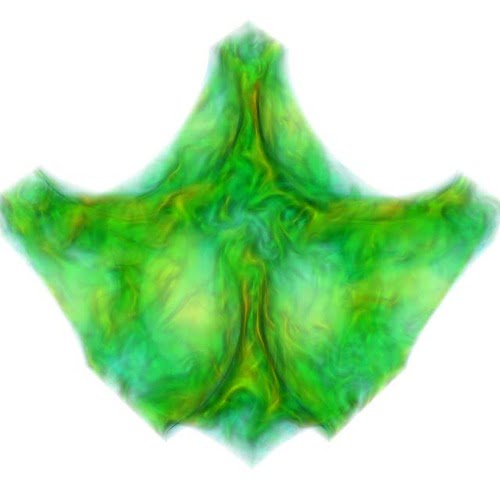
- Finally, our lead image shows a simulation of turbulent flow in a tightly packed lattice of spheres. It’s an entry from Argonne National Laboratory’s annual “Art of Science” contest. Take a look at the entries and vote for your favorites!
While not strictly fluid dynamical, I want to take a moment to talk about education. I receive a lot of stunned reactions and self-deprecation when people learn I study aerospace engineering. Many people say, “Oh, I could never do that!” or “You must be some kind of genius.” I’m not. It’s true that studying engineering and fluid dynamics involves a lot of math and some it is complex (no pun intended). There’s a lot of unfounded fear about science and math in our society, when really they are just skills that any of us can improve with practice and effort. So, for those out there who have ever thought, “I can’t do that, there’s too much math,” please watch this young woman address mathphobia. She sums up just about everything I’ve always wanted to tell you.(Photo credit: Argonne National Laboratory)Liquid Sculptures
[original media no longer available]
Water sculptures–a marriage of liquids, photography, and timing–are spectacular form of fluid dynamics as art. Artist Markus Reugels is a master of the form. This video captures the life and death of such water sculptures at 2,000 fps, beginning with the fall of the initial blue droplet. The droplet’s impact causes a rebounding Worthington jet, which reaches its pinnacle just as a second droplet strikes. The impact spreads into an umbrella-like skirt consisting of a thin, expanding liquid sheet with a thicker rim. The rim itself is unstable, breaking into regularly spaced filaments and tiny satellite droplets that shoot outward before the entire structure collapses into the pool. One especially cool aspect of watching this in video is seeing how the blue dye from each droplet spreads as the water splashes and rebounds. You can see the set-up Reugels uses for his photography here. (Video credit: M. Reugels and L. Lehner)