In water and other Newtonian fluids, a rising bubble is typically spherical, but for non-Newtonian fluids things are a different story. In non-Newtonian fluids the viscosity–the fluid’s resistance to deformation–is dependent on the shear rate and history–how and how much deformation is being applied. For rising bubbles, this can mean a teardrop shape or even a long tail that breaks up into fishbone-like ligaments. The patterns shown here vary with the bubble’s volume, which affects the velocity at which it rises (due to buoyancy) and thus the shear force the bubble and surrounding non-Newtonian fluid experience. (Video credit: E. Soto, R. Zenit, and O. Manero)
Month: August 2013

Bouncing in Lockstep
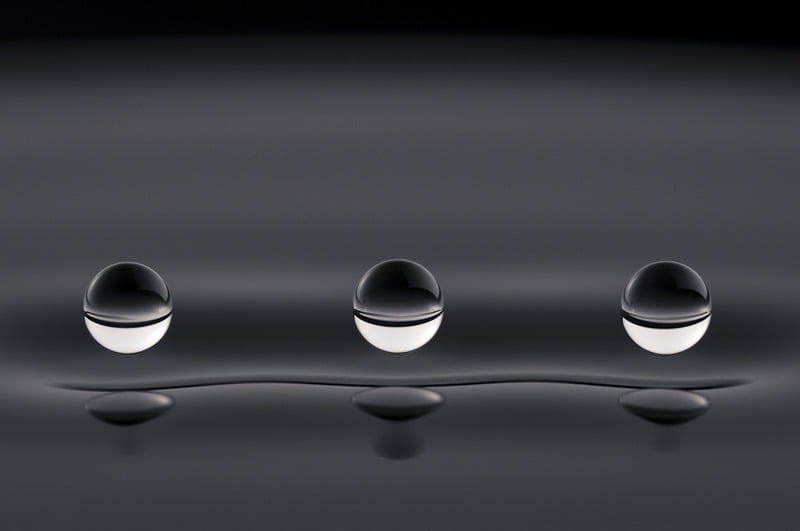
Droplets of silicone oil bounce on a pool of the same thanks to the vibration provided by a loudspeaker. Each droplet’s bounce causes ripples in the pool and the interference between these ripples fixes the droplets in lockstep with one another. As long as the vibration continues to feed the thin layer of air that separates the droplets from the pool during each bounce and no impurities break the surface tension at the interface, the droplets will bounce indefinitely on their liquid trampoline. Such systems can be used to observe quantum-mechanical behavior like wave-particle duality on a macro-scale. (Photo credit: A. Labuda and J. Belina)

Flow Over a Delta Wing
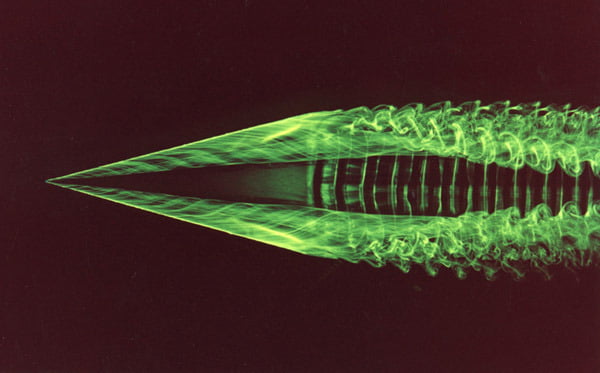
Fluorescent dye illuminated by laser light shows the formation and structure of vortices on a delta wing. A vortex rolls up along each leading edge, helping to generate lift on the triangular wing. As the vortices leave the wing, their structure becomes even more complicated, full of lacy wisps of vorticity that interact. Note how, by the right side of the photo, the vortices are beginning to draw closer together. This is an early part of the large-wavelength Crow instability. Much further downstream, the two vortices will reconnect and break down into a series of large rings. (Photo credit: G. Miller and C. Williamson)

Self-Assembling Ferrofluids
Ferrofluids–colloidal suspensions made up of ferromagnetic nanoparticles and a carrier liquid–are known for their interesting and sometimes bizarre behaviors due to magnetic fields. The video above shows how, when subjected to an increasing magnetic field, a single droplet of a ferrofluid on a superhydrophobic surface will split into several droplets. The process is called static self-assembly, and it results from the ferrofluid seeking a minimum energy state relative to the force supplied by the magnetic field. Change the magnetic field and the droplets shift to the next energy minimum. But what happens when you change the magnetic field continuously and too quickly for the droplets to respond? A whole different set of structures and behaviors are observed (video link). This is dynamic self-assembly, a different ordered state only achieved when the ferrofluid is forceably kept away from the energy minima seen in the first video. For more, see the additional videos and the original paper. (Video credit: J. Timonen et al.; via io9)
“Perpetual Puddle Vortex Experiment”
Anthony Hall’s “Perpetual Puddle Vortex Experiment” is an intriguing display of several physical mechanisms. What looks like a puddle is actually a vortex constantly sucking fluid down a hole in the table. The liquid is re-circulated into the puddle so it never disappears. The table itself is treated to be hydrophobic, causing the distinctive curvature and large contact angle of the puddle’s rim. The oils mixed in float on top, creating patterns of foam that visualize the swirling motions of the fluid as the vortex pulls it in. (Video credit and submission by: A. Hall)