We saw previously how vibrating a falling stream of water and filming it with a matching camera frame rate appears to “freeze” the falling liquid. This video shows the same illusion, now with a 24 Hz sine wave, which the falling water mimics. Vibrating the speaker that drives the water stream slightly slower or slightly faster than the camera frame rate makes the water appear to slowly fall or rise relative to its “frozen” wave state. This is a beat effect caused by the slight difference in frequency between the water and the camera. (Video credit: brusspup; via BoingBoing; submitted by many readers)
Month: March 2013

Inside a Blender
The fluid dynamics of a commercial-quality blender amount to a lot more than just stirring. Here high-speed video shows how the blender’s moving blades create a suction effect that pulls contents down through the middle of the blender, then flings them outward. This motion creates large shear stresses, which help break up the food, as well as turbulence that can mix it. But if you watch carefully, you’ll also see tiny bubbles spinning off the blades. These bubbles, formed by the pressure drop of fluid accelerated over the arms of the blades, are cavitation bubbles. When they collapse, or implode, they create localized shock waves that further break up the blender’s contents. This same effect is responsible for damage to boat propellers and lets you destroy glass bottles. (Video credit: ChefSteps; via Wired; submitted by jshoer)
Tuning Fork Fluids
This high-speed video shows a liquid crystal fluid vibrating on a tuning fork. As the surface moves, tiny jets shoot upward, sometimes with sufficient energy that the fluid column is stretched beyond surface tension’s ability to keep it intact, resulting in droplet ejection. The jets and surface waves create a mesmerizing pattern of fluid motion. (Video credit: J. Savage)
Breaking Up Falling Beads
In a stream of falling liquid, surface tension instabilities cause the fluid to break up into droplets. This video shows a similar experiment with a stream of glass beads, a granular material. The whole system is housed under a vacuum to eliminate the effects of air drag on the stream, and a camera rides alongside the stream to track the evolution of the falling material in a Lagrangian fashion. As with a liquid stream, we see the granular flow develop undulations as it falls, ultimately breaking up into clusters of beads. The authors suggest that nanoscale surface roughness and van der Waals forces may be responsible for the clustering behavior in the absence of surface tension. (Video credit: J. Royer et al.)

Shock Waves in Flight
Schlieren photography allows visualization of density gradients, such as the sharp ones created by shock waves off this T-38 aircraft flying at Mach 1.1 around 13,000 ft. Although shock waves are relatively weak at this low supersonic Mach number, they persist, as seen in the image, at significant distances from the craft. The sonic boom associated with the passage of such a vehicle overhead is due to the pressure change across a shock wave. The higher the altitude of the supersonic craft, the less intense its shock wave, and thus sonic boom, will be by the time it reaches ground level. (Photo credit: NASA)
Making Metal Water-Repellent
Chemical treatments can be used to render metals hydrophobic, causing water to bead on the surface rather than spreading to wet it. Treating the surface by immersing it in boiling water before applying the chemicals creates a nanoscale texture that accentuates the hydrophobicity. Even on a common metal like aluminum, this combination of texturing and chemical treatment leads to superhydrophobic behavior. Here the technique is demonstrated by spraying water droplets on a piece of treated aluminum. (Video credit: B. Rosenberg et al.; submitted by D. Quinn)

Turbulent Flames
The flames surrounding a burning tree stump flicker and billow in this image from photographer Serdar Ozturk. The chaotic motion of the flames is indicative of turbulence, a state of fluid flow known for its many scales. Note the range of lengthscales and structures in the fire. In turbulent flows, kinetic energy cascades from large scales, like the width of the top of the plume, down to the small scales, which may be even smaller than the wisps of flame at the edges of the fire. At the largest scales, the structures and behaviors we observe are all flow- and geometry-dependent, but theory predicts that, at the smallest scales, all turbulent flows look the same. (Photo credit: trashhand/Serdar Ozturk)
When Skittering Becomes Self-Propulsion
When liquids hit a surface much hotter than their boiling point, a thin layer of gas can form between the drop and surface, allowing the drop to glide along. This Leidenfrost effect is what makes drops of water skitter across a hot pan. But what happens when the pan isn’t flat? The video above shows a Leidenfrost drop on a ratchet-like surface. Instead of gliding or skittering randomly, the drop self-propels toward the steepest section of the ratchet This behavior allows researchers to design surfaces that guide the drops on an intended path. (Video credit: G. Lagubeau and D. Quéré)

Spiraling Out of Coils
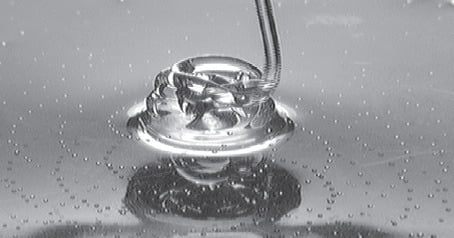
Anyone who has drizzled honey or another viscous fluid onto a surface is familiar with the rope-like coiling behavior of some liquids. But did you know that same instability can create spirals of bubbles like in this photo? Such behavior is only seen for a narrow range of parameters within the gravitational regime of liquid coiling. As the liquid falls, the center of coiling precesses along its own circle with a frequency much smaller than that of the coiling itself. This means that new coils do not fall exactly on top of old ones, trapping air bubbles between them. As the pile of coils collapses under gravity, the bubbles are carried outward, creating beautiful spiral patterns. (Photo credit: M. Habibi et al.)
Flapping Flags
Sometimes structural forces and aerodynamic forces combine to produce instabilities. One of the most common and familiar examples of this, a flag flapping in the breeze, remains extremely complex to analyze and describe. The flexibility of the flag, and its small but finite resistance to bending, combine with the variability of air flow around the flag to create a fascinating dance of effects. This same aeroelastic flutter can create disastrous results for structures and aircraft. For more on the flapping flag, see Argentina and Mahadevan (2004). (Video credit: S. Morris)