As of now, commenting has been added to FYFD via Disqus, which allows users to log in via Twitter, Facebook, etc. Hopefully, this will encourage greater interaction and discussion on the site. For example, if you have any suggestions for general audience fluid dynamics books, you can recommend them directly now!
Month: March 2011

Wright Brothers’ Wind Tunnel
A large part of the Wright Brothers’ ultimate success in creating the first powered heavier-than-air craft came as a result of work done in their homemade wind tunnel, shown above. In the aftermath of the failure of their 1901 Glider, the brothers decided that the lift and drag data they had used from Otto Lilienthal must be inaccurate. They built this wind tunnel and its force balances to measure lift and drag on two hundred different airfoils themselves and were rewarded with far more successful flights with their 1902 Glider, which led directly to the Wright Flyer in the following year. #

Pouring Paint
In this artwork by Holton Rower, paint (typically a non-Newtonian fluid) is poured down a rectangular prism; the result is a neat demonstration of shearing in laminar flows. Paint is usually shear-thinning, meaning that its viscosity decreases under shear; this is why the color stripes on the vertical panels expand more than those on the horizontal surfaces do. # (submitted by Stephan)

Hotwire Anemometry
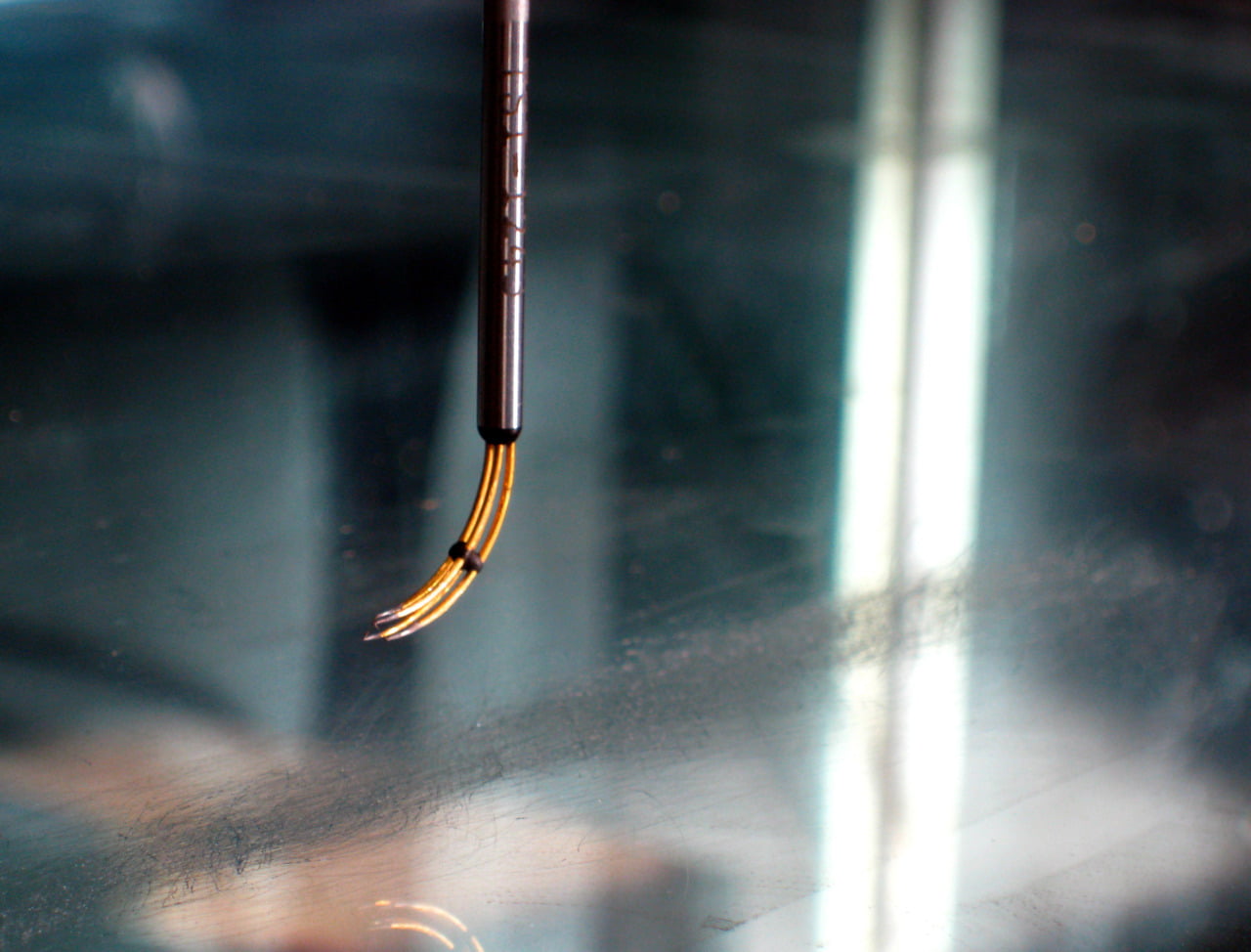
Hotwire anemometry is used in experimental fluid dynamics to measure velocities with high temporal resolution. The boundary layer crosswire probe shown here was used for turbulence research. Between the prongs, which are about the thickness of a sewing needle, are tiny wires about 3 microns in diameter. A human hair is about 80 microns in diameter. Hotwires actually measure voltage; when part of an electrical circuit, the hotwire’s temperature rises above ambient. As air flows over the wire, it cools, which causes the wire’s resistance to drop. By tracking this change in resistance, it is possible to determine the speed of the air moving over the wire.
Reader Question: General Audience Fluids Books
nothing43-blog-blog asks:
Do you know any good books on fluid dynamics? Not textbooks or handbooks, but more along the lines of what you’d find in the “popular science” section of the book store – accessible to a larger audience. Or maybe a good “history of fluid dynamics” book?
That’s a great question! To be honest, I really haven’t seen any general audience fluid dynamics books–fluid dynamics is a field I like to refer to as “the physics physicists gave up on”–but that doesn’t mean there aren’t any. I know fluid dynamics shows up in Feynman’s books (which are excellent reading regardless), and I read a great biography of G. I. Taylor written by G. K. Batchelor that discusses Taylor’s life and contributions to fluid mechanics through two World Wars and the aftermath. Van Dyke’s Album of Fluid Motion is a classic that’s not heavy on technical material. I’ll look into a couple of others as I get hold of them and post any suggestions I have. In the meantime, does anyone else have some general fluid dynamics reading suggestions?
Cornstarch Monsters
The patterns formed when vibrating a liquid on a speaker cone are standing waves known as Faraday waves. With a large enough amplitude, this produces some very cool effects with a shear-thickening non-Newtonian fluid like oobleck. (It would actually be interesting to see what happens when you vibrate a shear-thinning liquid like shampoo…) This video also details how you can set up this demonstration yourself at home.