Tag: vorticity

  • Featured Video Play Icon

    Vortex Ring Collisions

    One of the most enduringly popular submissions I receive is T. Lim’s experimental footage of two vortex rings colliding head-on. It’s an devilishly tough experimental set-up to master because perfectly aligning the rings is incredibly difficult. The pay-off, however, is huge because the breakdown of the colliding rings and their transformation into secondary rings is breathtaking. Destin at Smarter Every Day and his team have worked hard to recreate the experiment (top video), but they’re not the only ones – nor are they the first in decades – to do so.

    Ryan McKeown and a team at Harvard have a set-up of their own for vortex ring collisions, and you can see a little of it in action in the middle video. Ryan’s set-up is, frankly, incredible. It scans a light sheet through the vortex rings at high-speed, allowing him to capture the collision and break-up in minute detail in both space and time. What you see in the latter half of his video is a digital reconstruction of that data – not a simulation but real data! His work is capturing vortex collisions in unprecedented detail, allowing researchers to probe the smallest scales of the phenomenon.

    When two vortex rings approach one another, they can undergo what’s known as a vortex reconnection event. Bubbles rings are a great place to see this. The vortex cores get distorted when they’re close to one another due to the influence of the other vortex ring’s velocity field. This often stretches and flattens the vortex core. It’s impossible for the rings to simply break apart, though, (per Helmholtz’s second theorem). So when the original vortex rings thin to the point of breaking, they immediately reconnect to a piece of the other ring, creating a series of small vortex rings around the remains of the originals. The exact details of how this works are what investigators like Ryan and his colleagues are trying to understand. You can hear a little more about their work in my interview with Ryan in the bottom video, starting at ~2.54. (Video credits: Smarter Every Day, R. McKeown et al., and N. Sharp and T. Crawford; submission credit: a huge number of readers)

  • Caught in a Whirl

    Vortex rings may look relatively calm, but they are concentrated regions of intensely spinning flow, as this poor jellyfish demonstrates. The rings form when a high-speed fluid gets pushed suddenly (and briefly) into a slower fluid. In the case of this bubble ring, a burst of air is pushed by a diver into relatively still water. The vorticity caused by the two areas of fluid trying to move past one another forms the ring. Like a spinning ice skater who pulls his arms inward, the narrow core of the vortex spins fast due to the conservation of angular momentum. Meanwhile, the bubble ring moves upward due to its buoyancy, pulling nearby water in as it goes. This catches the hapless jellyfish (who relies on vortex rings itself) and gives it quite a spin. But. don’t worry, the photographer confirmed that the jelly was okay after its ride. (Video credit: V. de Valles; via Ashlyn N.)

  • In the Eye of a Hurricane

    In the Eye of a Hurricane

    Although eyes are common at the center of large-scale cyclones, scientists are only now beginning to understand how they form. Since real-world cyclogenesis is complicated by many competing effects, researchers look at simplified model systems first. A typical one uses a shallow, rotating cylindrical domain in which heat rises from below. The rotation provides a Coriolis force, which shapes the flow. In particular, it causes a boundary layer along the lower surface of the domain, creating a thin region where the flow moves radially inward. (Its opposite forms at the upper surface of the domain, sending flow radiating outward.) Like an ice skater spinning, the flow’s vorticity intensifies as it approaches the central axis of rotation. When the conditions are right, this intensely swirling boundary layer flow lifts up into the main flow, forming an eyewall. The eye itself, it turns out, is merely a reaction to the eyewall’s formation. (Image credit: S. Cristoforetti/ESA; research credit: L. Oruba et al.)

  • Fanning the Flame

    Fanning the Flame

    A fan’s blade passes through the hot air rising above a flame in this iconic image by high-speed photography pioneer Harold Edgerton. This photo uses an optical technique known as schlieren photography that makes density differences in transparent media like air visible. Because of its lower density, the hot plume of air above the flame rises. When the fan blade swings past, it sheds a vortex off its tip and the rising air from the flame gets pulled into the vortex to make it visible. To the left, a ghostly counter-rotating vortex sits on the opposite side of the fan blade. (Photo credit: H. Edgerton and K. Vandiver)

  • Jupiter’s Little Red Spot

    Jupiter’s Little Red Spot

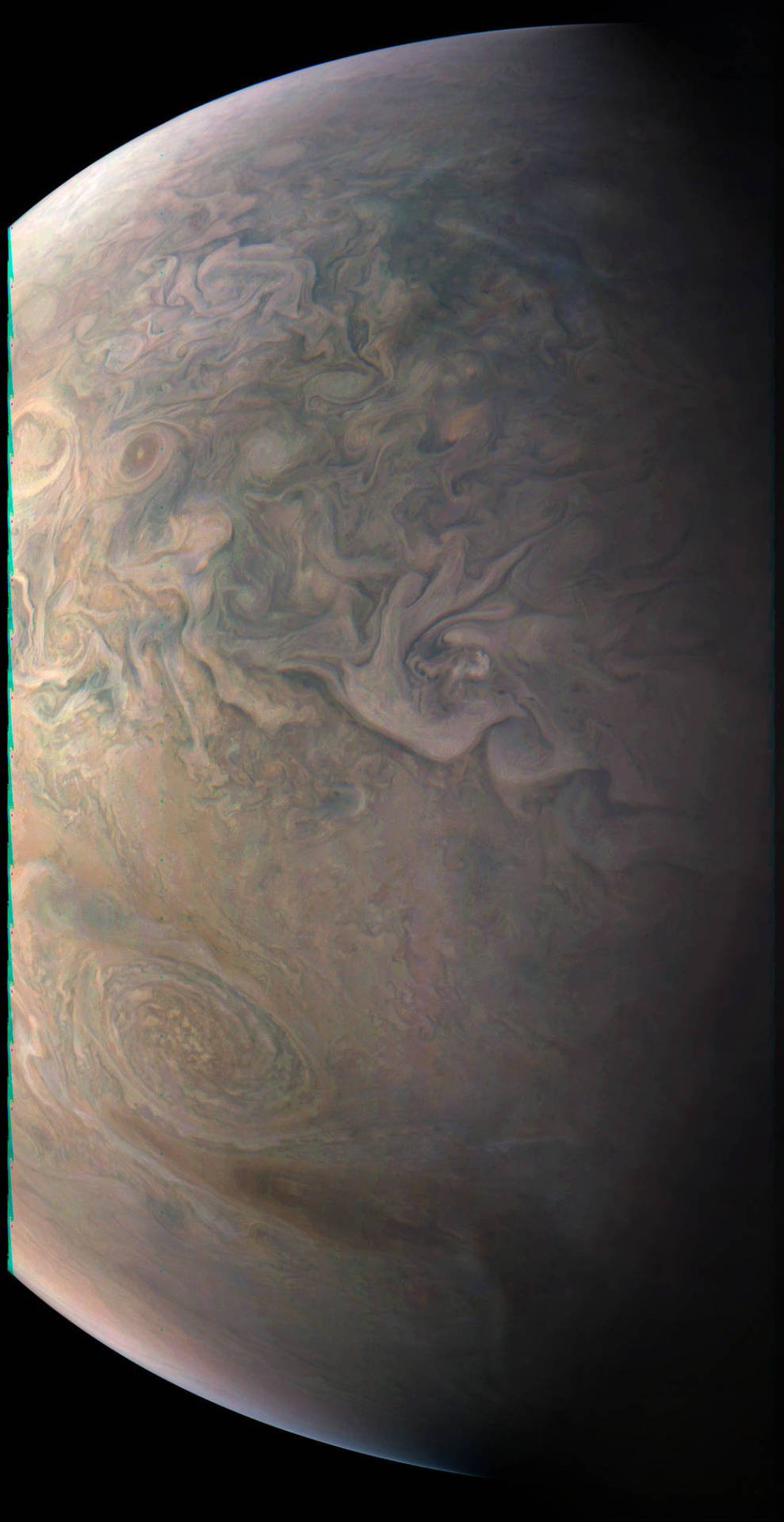
    The Juno mission has been revealing angles of Jupiter we’ve never seen before. This photo shows Jupiter’s northern temperate latitudes and NN-LRS-1, a.k.a. the Little Red Spot (lower left), the third largest anticyclone on Jupiter. The Little Red Spot is a storm roughly the size of the Earth and was first observed in 1993. As an anticyclone, it has large-scale rotation around a core of high pressure and rotates in a clockwise direction since it is in the northern hemisphere. Jupiter’s anticyclones seem to be powered by merging with other storms; in 1998, the Little Red Spot merged with three other storms that had existed for decades. (Image credit: NASA/JPL-Caltech/SwRI/MSSS/Gerald Eichstaedt/John Rogers; via Bad Astronomy)

  • Featured Video Play Icon

    “Gargantua”

    Peering into a vortex feels like staring into an abyss in the Julia Set Collective’s “Gargantua”. Like their previously featured works, this video uses a macro perspective on fluid phenomenon to create an alternate sense of scale. Instead of a whirlpool, we could be observing a wormhole. Part of this is a matter of fooling our brains with perspective, but it also works because, on some level, we recognize that these same fluid patterns occur at very different lengthscales and so it is believable that what we see is much bigger than in reality. (Video credit and submission: S. Bocci/Julia Set Collective)

  • Giant Vortex Cannon

    Giant Vortex Cannon

    Playing with a vortex cannon is a ton of fun, and they are remarkably easy to make. You can knock over cups or card houses, create art, or just try your best Big Bad Wolf impression. Or you can supersize things like one group in the Czech Republic did and build a 3m vortex cannon capable of firing 100m! (Seriously, watch it in action here.) And if you’d like to learn more about how vortex rings form and why they’re useful in nature and engineering, check out my vortex ring video. (Image credit: Laborky Cz, source; via Gizmodo)

  • “Catacomb of Veils”

    “Catacomb of Veils”

    Burning Man’s “Catacomb of Veils”, the largest sculpture burned in the 2016 event, produced a series of smoke tornadoes as it blazed. Like dust devils or fire tornadoes, these vortices are driven by hot, buoyant air rising – in this case, from the fire. As the surrounding air moves in toward the fire, any rotational motion, or vorticity, in the air is intensified due to conservation of angular momentum. That concentrates it into a vortex, which becomes visible when it picks up smoke. Simultaneously, the wind was blowing in a consistent direction, sending any new vortices generated marching downstream. You can watch even more vortices and some slow-motion footage of the burning in the full video by Mark Day.   (Image credit: M. Day, source; submitted by Larry B)

  • Dust Devils

    Dust Devils

    Dust devils, like fire tornadoes and waterspouts, form from warm, rising air. As the sun heats the ground to temperatures hotter than the surrounding atmosphere, hot air will begin to rise. When it rises, that air leaves behind a region of lower pressure that draws in nearby air. Any vorticity in that air gets intensified as it gets pulled toward the low pressure area. It will start to spin faster, exactly like a spinning ice skater who pulls in his arms. The result is a spinning vortex of air driven by buoyant convection. On Earth, dust devils are typically no more than a few meters in size and can only pick up light objects like leaves or hay. On Mars, dust devils can be hundreds of meters tall, and, though they’re too weak to do much damage, they have helpfully cleaned off the solar panels of some of our rovers! (Image credit: T. Bargman, source; via Gizmodo)

  • These Invertibrates May Help Robots Swim

    These Invertibrates May Help Robots Swim

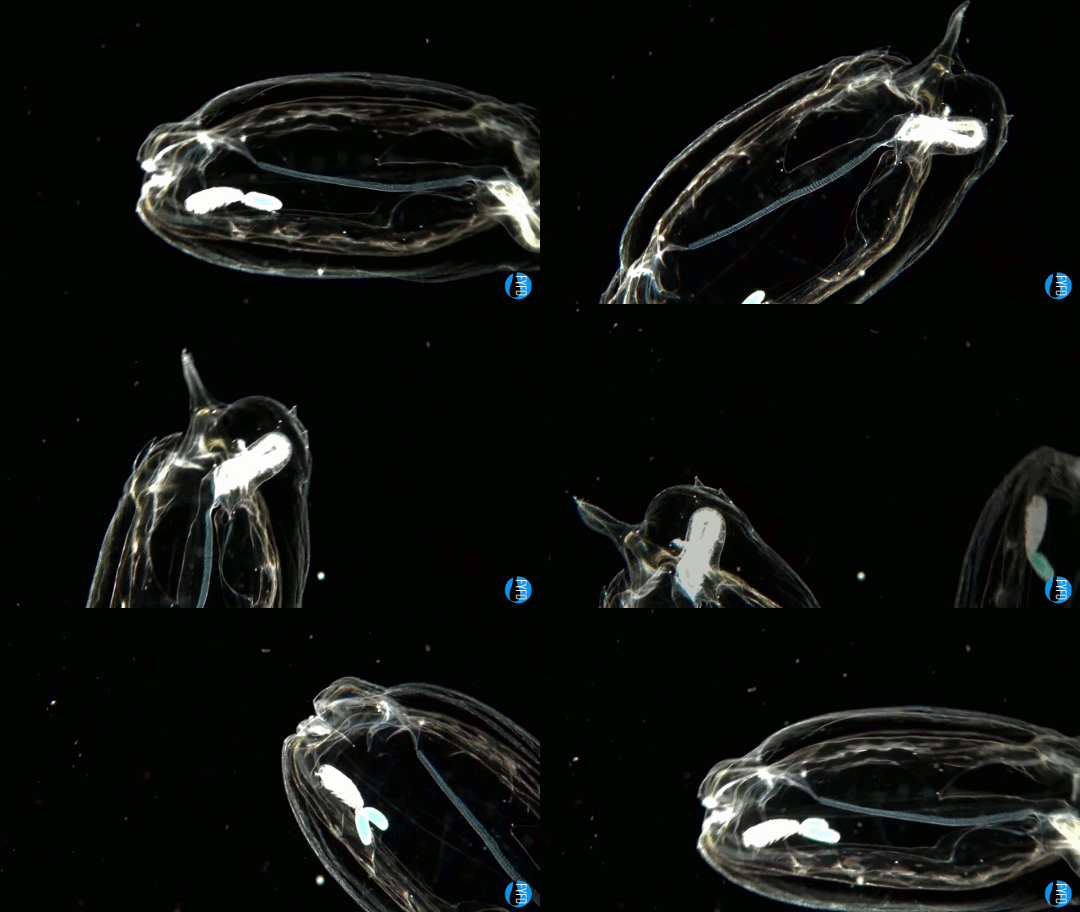
    New FYFD video! Learn all about salps, vortex rings, and underwater robots. Thanasi Athanassiadis takes me inside his lab and his newly published research into how proximity affects the thrust two vortex rings can produce.

    There are a ton of little things I love about how this video came out, especially the chalkboard animations. Check it the full video below and click through to the video description for lots more information about salps and vortex rings.

    (Image and video credits: N. Sharp and A. Athanassiadis; Original salp images: A. Migotto and D. Altherr)