Trees, blood vessels, and rivers all follow branching patterns that make their pieces look very similar to their whole. We call this repeating, self-similar shape a fractal, and this Be Smart video explores why these branching patterns are so common, both in living and non-living systems. For trees, packing a large, leafy surface area onto the smallest amount of wood makes sense; the tree needs plenty of solar energy (and water and carbon dioxide) to photosynthesize, and it has to be efficient about how much it grows to get that energy. Similarly, our lungs and blood vessels need to pack a lot of surface area into a small space to support the diffusion that lets us move oxygen and waste through our bodies. Non-living systems, like the branches of viscous fingers or river deltas or the branching of cracks and lightning, rely on different physics but wind up with the same patterns because they, too, have to balance forces that scale with surface area and ones that scale with volume. (Video and image credit: Be Smart)
Tag: trees

Surviving the Dry Season
The Zambezi River winds through eastern Africa, providing much-needed water to plants and animals there. But during the dry season, when rain and river water are scarce, most trees go bare. The apple ring acacia is the exception. These towering trees rely on their taproot, which delves 30 meters or more into the ground, to deliver an ongoing supply of water. Flush with water, the trees remain green, providing vital food and shade to animals during the harshest season of the year. (Image and video credit: BBC Earth)

Why Aren’t Trees Taller?
Trees are incredible organisms, with some species capable of growing more than 100 meters in height. But how do trees get so big and why don’t they grow even taller? The limit, it turns out, is how far fluid forces can win over gravity.
To live and grow, trees must be able to transport nutrients between their roots and their highest branches. As explained in the video, there are three forces that enable this transport inside trees: transpiration, capillary action, and root pressure. Of these, you are probably most familiar with capillary action, where intermolecular forces help liquids climb up the inside of narrow spaces, like the straw in your drink. Capillary action can’t lift liquids more than a few centimeters against gravity, though.
Similarly, root pressure is limited in how far it can raise liquids. Functionally, it’s pretty similar to the way a column of water or mercury can be held up by atmospheric pressure acting at the base of a barometer. But atmospheric pressure can only hold up 10.3 meters of water, so what’s a tree to do?
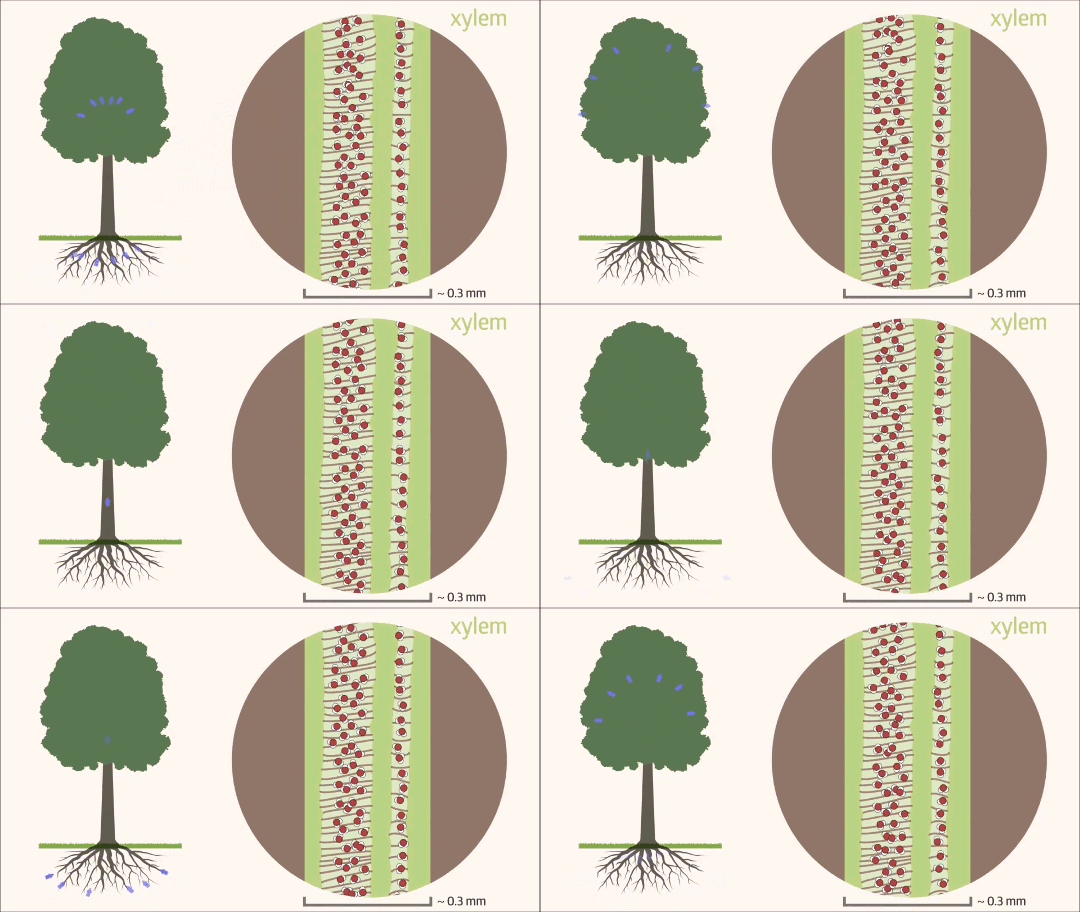
This is where transpiration — the most important force for sap transport in the tree — comes in. As water evaporates out of the tree’s leaves, it creates negative pressure that — along with water’s natural cohesion — literally drags sap up from the roots. It’s this massive pull that drives the flow and enables most of a tree’s height. (Image and video credit: TED-Ed)

Rivers in the Sky
The water cycle is quite a bit more complicated than what we learn in elementary school, and the environment around us contributes to that cycle in invisible but vital ways. In this video, Joe Hanson of It’s Okay to Be Smart pulls back the veil on this in the context of the Amazon river basin and how the Amazon rainforest itself creates an atmospheric river that carries more water than its namesake river.
Trees release water into the air almost constantly as they transpire. And to trigger that water to fall as rain, trees can release other compounds that serve as a nucleus around which raindrops can form. The condensing raindrops form clouds, which lower the air pressure and create winds, thereby creating an atmospheric river flowing from the Atlantic back up the Amazon River. That stream carries rain that feeds the rainforest and the Amazon River, continuing the cycle. (Video and image credit: It’s Okay to Be Smart)


How Trees Pull Water
Trees are incredible organisms, and the physics behind them baffled scientists until relatively recently. Inside trees, there is a constant flow of water up from the roots, through the xylem and out the leaves. We often think of atmospheric pressure and capillary action as the mechanisms for pushing water up against the force of gravity, but this is not how trees work. Instead, the evaporation of water from the tree’s leaves actually pulls the entire water column up the tree. Water molecules really like sticking to one another, which actually allows them to hold together under this tension.
The result of all this pulling is a negative pressure inside the tree, and, with some clever manipulation, it’s possible to measure just how negative the pressure inside a tree is using a device called a pressure bomb. You can see the whole process in action in the Science IRL video below. The magnitude of a tree’s negative pressure fluctuates over a day, depending on how quickly it’s losing water, but typical values can range from 2-3 atmospheres of negative pressure to 17 or more! To get the equivalent (positive) pressure, you’d have to be nearly 2.7 kilometers under water. (Image and video credit: Science IRL)