Tag: surfing

  • Tokyo 2020: Surf Physics

    Tokyo 2020: Surf Physics

    Surfing is making its Olympic debut this year with a shortboard competition held at Shidashita Beach, with the event’s timing determined by weather and wave quality. The fluid dynamics involved in surfing could easily fill their own series of posts, so we’ll just scratch the surface here. Check out the video embedded below for a nice overview.

    We sometimes think of waves as enormous walls of water moving on the ocean, but the truth is that individual water particles move very little when a wave passes. Instead waves are a method of transferring energy through the water, and surfers harness this energy while negotiating a delicate balance of forces between gravity, buoyancy, and hydrodynamics.

    So how do surfers catch a wave? After all, anyone who’s been to the beach or in a wave pool knows that waves can easily pass without carrying you along with them. To ride a wave, surfers orient themselves in the direction the wave is traveling, then they paddle to bring their velocity close that of the incoming wave. Their surfboard helps by providing a large surface for the water to push, accelerating the surfer as the wave approaches. The longer and larger a surfboard is, the less speed the surfer themself has to provide. This is one reason it’s easier to catch a wave on a longboard than on a shortboard. But shortboards — like those used by competitors in the Tokyo Olympics — are far more maneuverable, allowing surfers more freedom in the moves they choose to make as they ride. (Image credit: B. Selway; video credit: TED-Ed; see also M. Grissom and Science Connected)

  • Featured Video Play Icon

    “Dancing With Danger”

    Filmmaker Chris Bryan captures surfer Kipp Caddy as he rides an enormous wave in “Dancing With Danger.” Nothing quite captures the majesty of these powerful flows like high-speed videography. Enjoy the break, the spray, and those awesome rib vortices. (Image and video credit: C. Bryan)

  • Surfing Honeybees

    Surfing Honeybees

    Honeybees have superpowers when it comes to their aerodynamics and impressive pollen-carrying, but their talents don’t end in the air. A new study confirms that honeybees can surf. Wet bees cannot fly–their wings are too heavy for them to get aloft when wet–but falling into a pond isn’t the end for a foraging honeybee.

    Instead, the bee flaps its wings, using them like hydrofoils to lift and push the water. This action generates enough thrust to propel the bee three body lengths per second. It’s a workout the bee can only maintain for a few minutes at a time, but researchers estimate honeybees could cover 5-10 meters in that time. Once ashore, the bee spends a few minutes drying itself, and then flies away no worse for the wear. (Image and research credit: C. Roh and M. Gharib; via NYTimes; submitted by Kam-Yung Soh)

  • Reader Question: Waves Breaking

    Reader Question: Waves Breaking

    As a follow-up to the recent waves post, reader robotslenderman asks:

    What does it look like when the wave breaks? And why do waves sometimes push us back? Why are we able to ride them?

    I wasn’t able to find an equivalent breaking wave version of that dyed wave – side note: readers with flumes, please feel free to make one and share it! – but here’s an undyed breaking wave for our reference.

    Waves break, or get that white, frothy look, when they reach shallower water. In the previous post, the waves we saw were effectively deep-water waves, so they didn’t change in height as they rolled across the tank. Here there’s an incline to simulate a beach, which causes the water to slow down and steepen. That forms the characteristic curl of a plunging breaker, seen here.

    At the beach, a wave runs out of water to pass through and all the energy that wave was carrying has to go somewhere. Some is lost as heat, some turns into the sound of that classic crashing wave, and a lot of it gets dissipated as turbulence that pushes us, sand, shells, and anything else its way.

    As for why we can ride waves, there’s some special physics at play when it comes to surfing. To catch a wave, a surfer has to paddle hard to get up to the wave’s speed just as it reaches them. Too slow and the wave will just pass them by, leaving them bobbing more or less in place. (Image credit: T. Shand, source)

  • Kelly Slater’s Surf Ranch

    Kelly Slater’s Surf Ranch

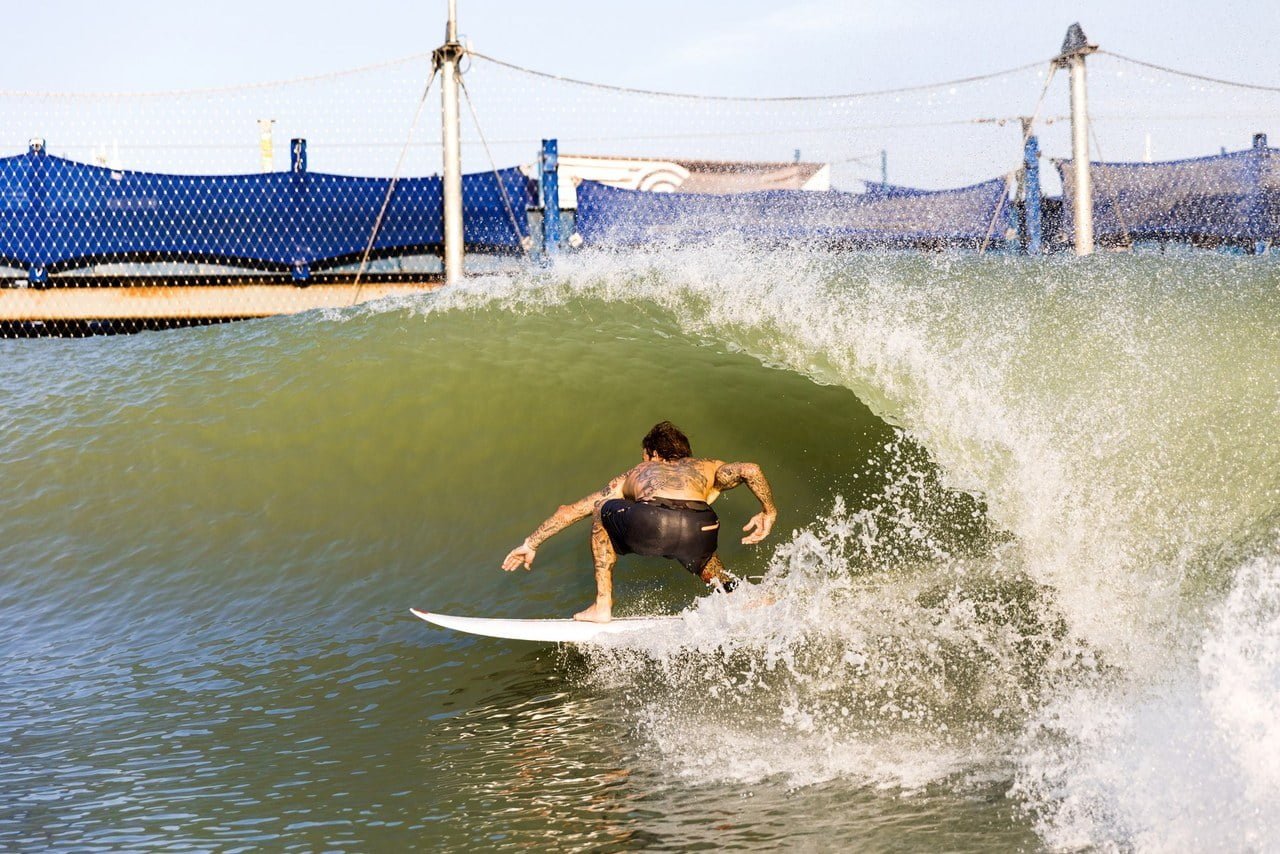
    Many of us who grew up visiting water parks instead of ocean beaches have spent time bobbing in a wave pool. They’ve been around for decades. But a new generation of wave pools are aiming for a different goal: the perfect surf wave. One of the foremost current facilities is Kelly Slater’s Surf Ranch, shown above. Here a hydrofoil (draped in blue tarps on the left) is pulled along an artificial lagoon to create dozens of wave profiles, all engineered to give surfers a long ride on the perfect solitary wave.

    Other facilities, like the surf ranch used by USA Surfing in Waco, Texas, design their waves with different goals in mind. The Waco wave pool uses air pressure to drive their waves, and aims for a larger quantity of shorter waves. They’re designed to help young surfers practice skills they’re working on, and to give them a place where they can experience waves like those they’ll face in the upcoming 2020 Olympics in Tokyo. (Image credit: R. Young/WIRED; CNet, source; submitted by Lionel V.)

  • Featured Video Play Icon

    Living Fluid Dynamics

    This short film for the 2016 Gallery of Fluid Motion features Montana State University students experiencing fluid dynamics in the classroom and in their daily lives. As in her previous film (which we deconstructed), Shanon Reckinger aims to illustrate some of our everyday interactions with fluids. This time identifying individual phenomena is left as an exercise for the viewer, but there are hints hidden in the classroom scenes. How many can you catch? I’ve labeled some of the ones I noticed in the tags. (Video credit: S. Reckinger et al.)

  • Pelican Surfing

    Pelican Surfing

    Birds can be incredibly clever about using their surroundings to enhance their flight. Pelicans will even surf! As a line of waves rolls toward shore, it pushes a small updraft ahead of it – just like a line of mountains creates a windy updraft. Pelicans save energy by riding the updraft just like a surfer would ride the swell. Once the wave breaks, the air and water become turbulent and less useful, so the pelican cuts away to find his next ride. (Image and submission credit: N. Yarvin, source)

  • Featured Video Play Icon

    Fish, Feathers, and Phlegm

    Inside Science has a new documentary all about fluid dynamics! It features interviews with five researchers about current work ranging from the physics of surfing to the spreading of diseases. Penguins, sharks, archer fish, 3D printing, and influenza all make an appearance (seriously, fluid dynamics has everything, guys). If you’d like to learn more about some of these topics, I’ve touched on several of them before, including icing, penguin physics, shark skin, archer fish, and disease transmission via droplets.  (Video credit: Inside Science/AIP)

  • Below a Surfer’s Wave

    Below a Surfer’s Wave

    From below a plunging breaking wave–the classic surfer’s wave–looks like a giant vortex tube. Smaller rib vortices, the rings around the main vortex in the photo above, can form where there are variations along the breaking wave. As the wave rolls on, it stretches the vorticity variations along the wave’s span. When stretched, vortices spin up and intensify; this is a result of conservation of angular momentum. Check out more amazing photos of waves in Ray Collins’ portfolio. (Photo credit: R. Collins; via The Inertia)

  • Reader Question: Wave Vortex

    Reader Question: Wave Vortex

    Reader unquietcode asks:

    I saw this post recently and it made me wonder what’s going on. If you look in the upper right of the frame as the camera submerges, you can see a little vortex of water whirring about. Even with the awesome power of the wave rolling forward a little tornado of water seems able to stably form. Any idea what causes this phenomenon?

    This awesome clip was taken from John John Florence’s “& Again” surf video. What you’re seeing is the vortex motion of a plunging breaking wave. As ocean waves approach the shore, the water depth decreases, which amplifies the wave’s height. When the wave reaches a critical height, it breaks and begins to lose its energy to turbulence. There are multiple kinds of breaking waves, but plungers are the classic surfer’s wave. These waves become steep enough that the top of the wave  overturns and plunges into the water ahead of the wave. This generates the vortex-like tube you see in the animation. Such waves can produce complicated three-dimensional vortex structures like those seen in this video by Clark Little. Any initial variation in the main vortex gets stretched as the wave rolls on, and this spins up and strengthens the rib vortices seen wrapped around the primary vortex. (Source video: B. Kueny and J. Florence)