
Many common fluids–like air and water–are Newtonian fluids, meaning that stress in the fluid is linearly proportional to the rate at which the fluid is deformed. Viscosity is the constant that relates the stress and rate of strain, or deformation. The term non-Newtonian is used to describe any fluid whose properties do not follow this relationship; instead their viscosity is dependent on the rate of strain, viscoelasticity, or even changes with time. A neat common example of a non-Newtonian fluid is oobleck, a mixture of cornstarch and water that is shear-thickening, meaning that it is resistant to fast deformations. Like the cornstarch-based custard in the video above, these fluids react similarly to a solid when struck, resisting changing their shape, but if deformed slowly, they will flow in the manner of any liquid.
Tag: strain

Viscous Dripping

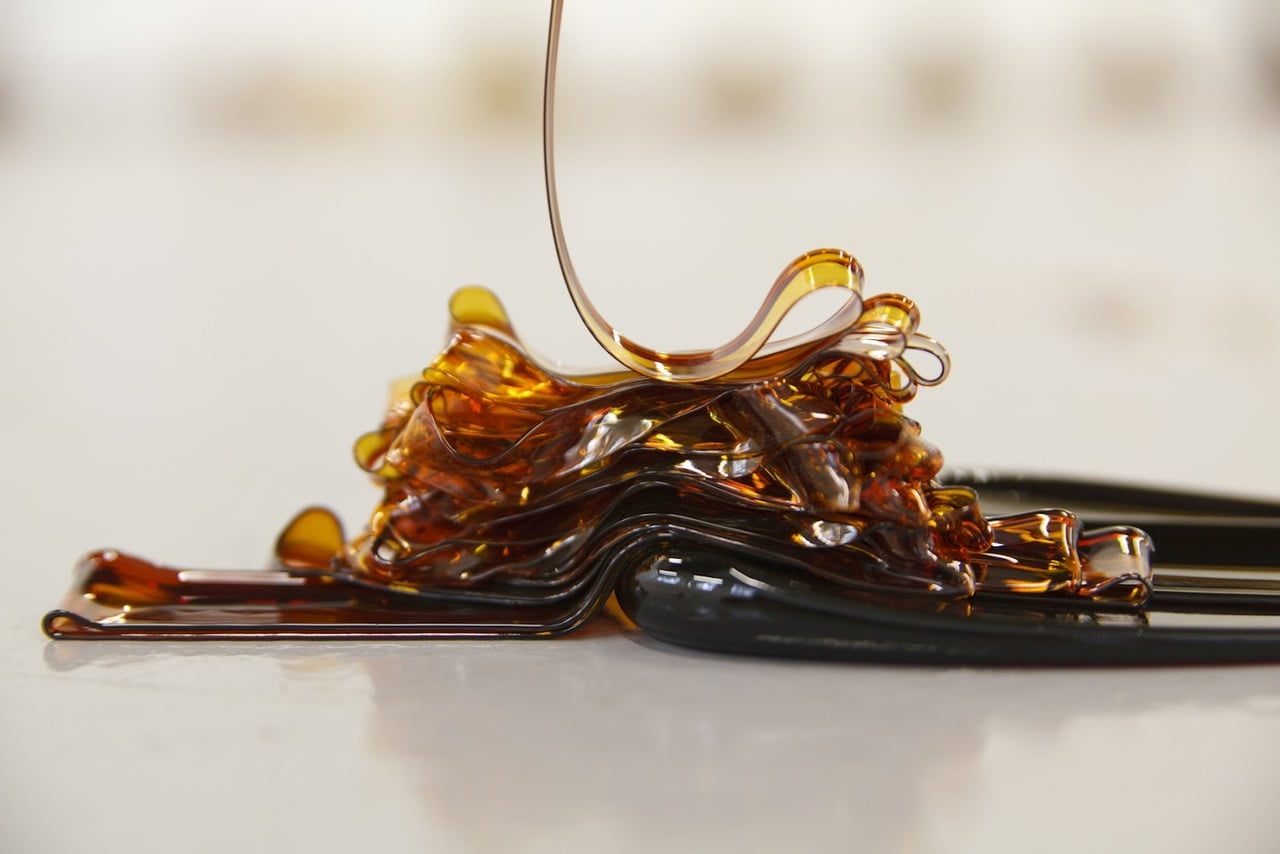


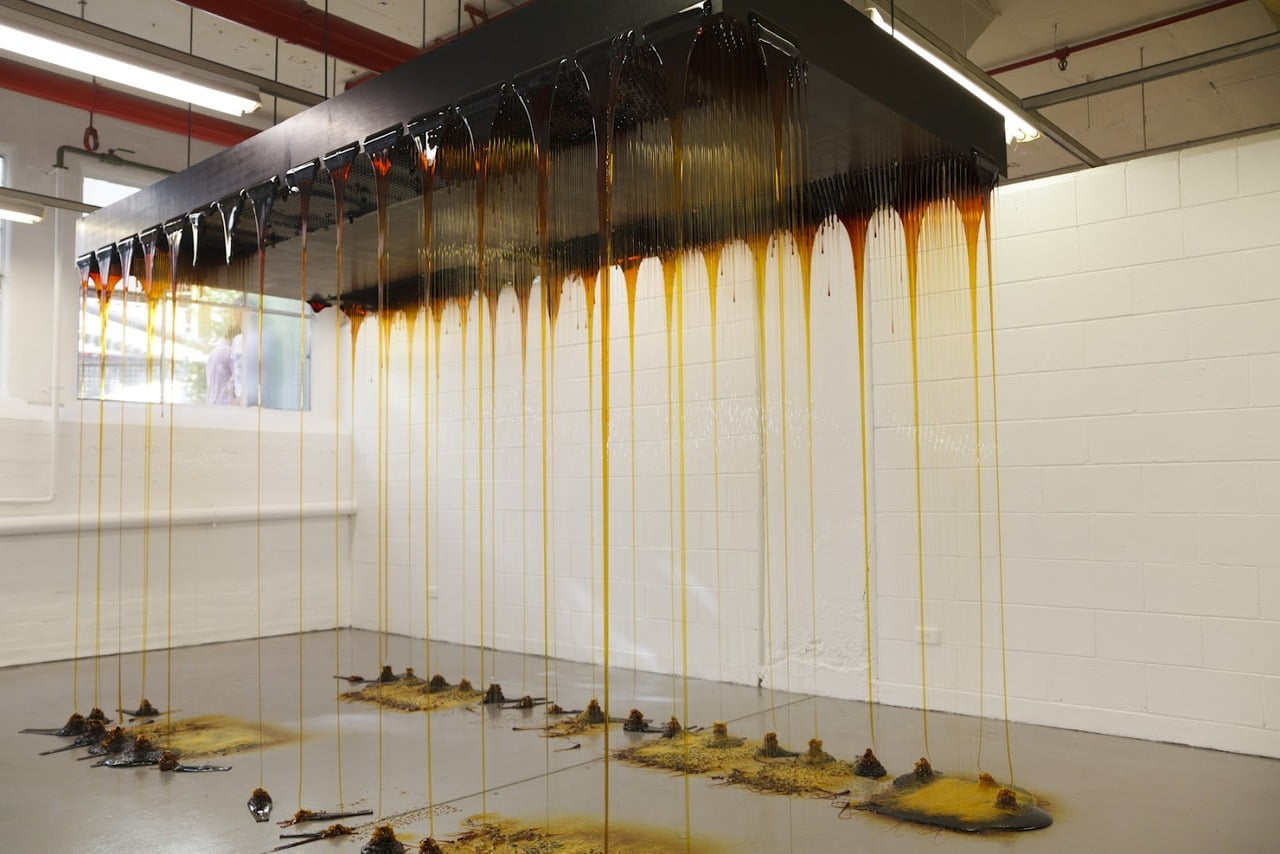

Artist Skye Kelly’s “Creep (strain)” sculpture shown above is made from toffee. The viscous fluid deforms under the force of gravity, resulting in elongated drips and slow jets that buckle and coil upon reaching the floor. (Photo credits: Skye Kelly; via freshphotons)

Fano Flow
Adding polymers to fluids can lead to strangely counter-intuitive behavior. Here two examples of bizarre extensional flow, sometimes called Fano flow, are shown. First, in the “tubeless siphon” fluid is drawn into a syringe from the level of the free fluid surface. When the syringe is raised above the free surface of the fluid, the polymer-laden fluid continues to flow upward and into the syringe. A similar effect is shown in the “open channel siphon” where, once initiated, the flow up and over the side of a beaker continues after the free surface of the fluid has fallen below the level of the beaker’s spout. In both of these cases, the cross-linking and entanglement of polymers within the fluid makes it capable of exerting normal stress when extensionally strained (e.g. stretching a rubber band). In other words, when the syringe is drawn out of the pool, the stretching of the fluid causes the polymers to exert a force that counteracts the weight of the fluid column, enabling the flow to continue upward despite gravity.