Tag: splashes

  • Rays in Craters

    Rays in Craters

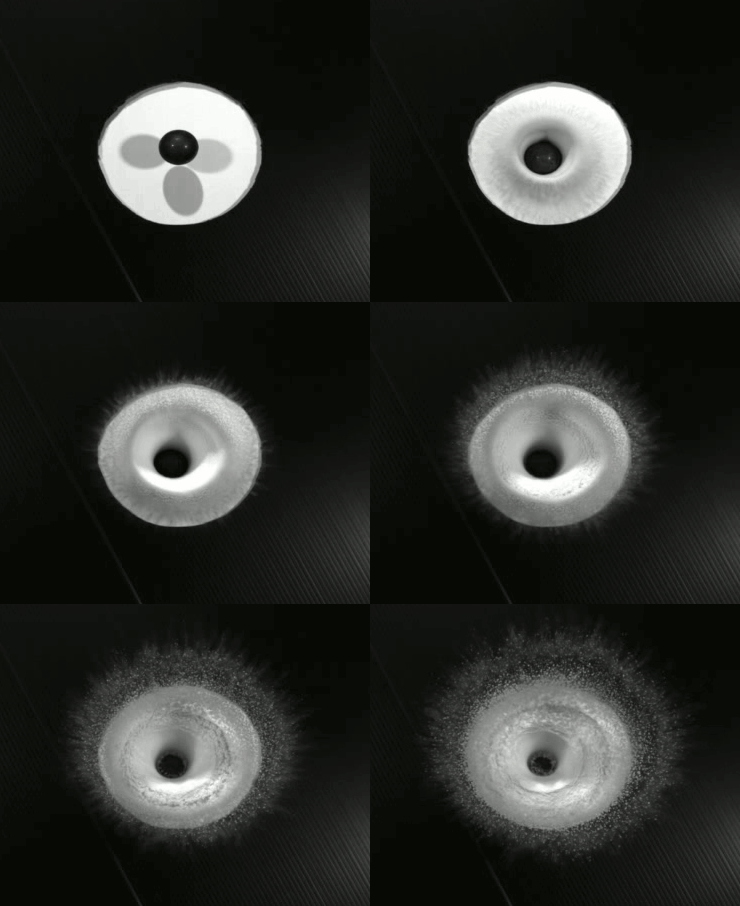
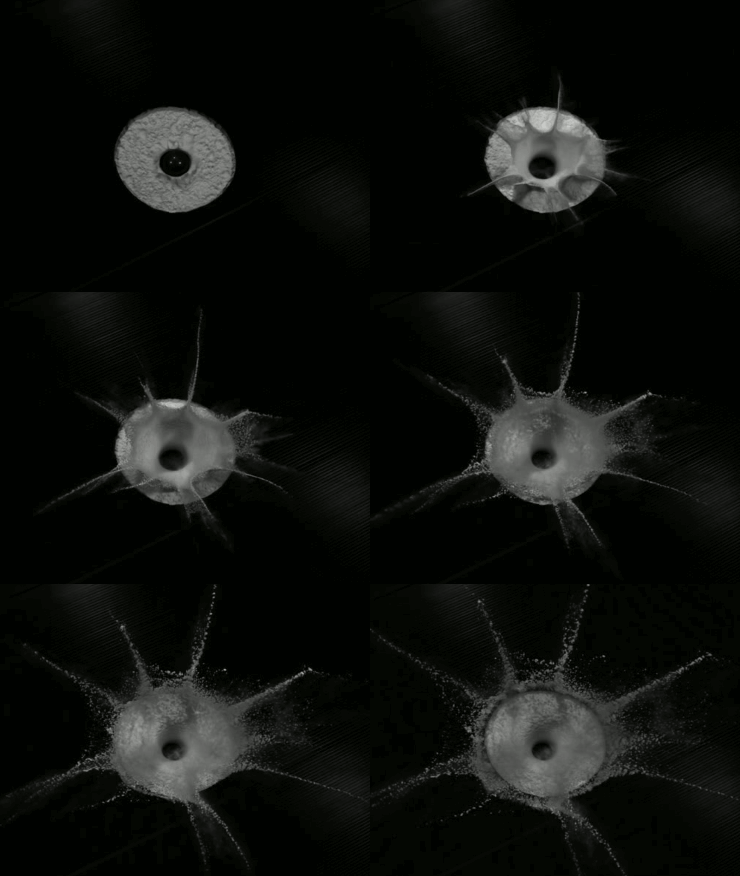
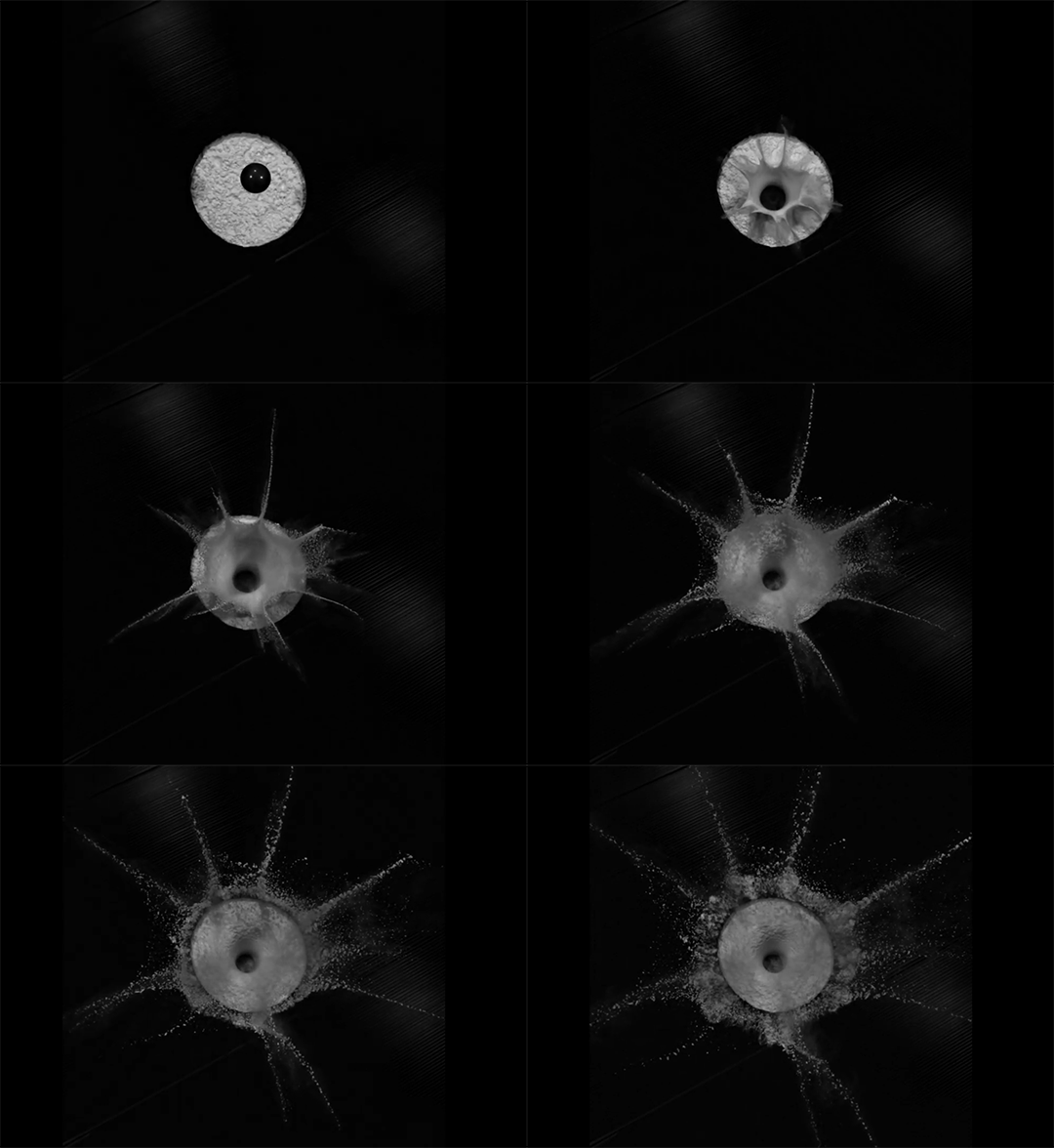
    On bodies around the solar system, there are craters marking billions of years’ worth of impacts. Many of these craters have rays–distinctive lines radiating out from the point of impact. But if you drop an object onto a smooth granular surface (upper left), the ejecta form a uniform splash with no rays. The impactor must hit a roughened surface (upper right) in order to leave rays. 

    Through experiment and simulation, researchers found that the rays emanate from valleys in the surface that come in contact with the impactor. Moreover, the number of rays that form depends only on the size of the impactor and the undulations of the surface. That means that, by knowing the topography of a planetary body and counting the number of rays left behind, scientists can now estimate what the size of the object that struck was! (Image, video, and research credit: T. Sabuwala et al.)

  • Water Impacts

    Water Impacts

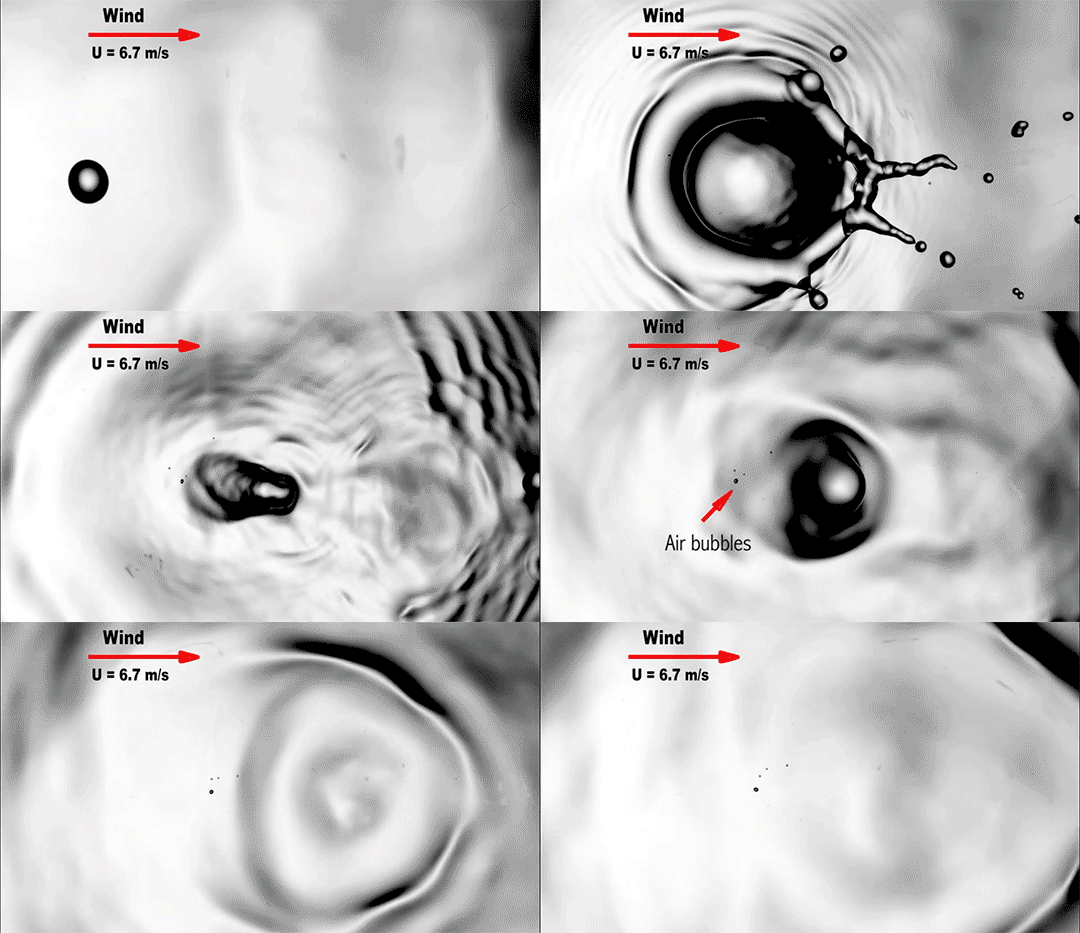
    In the clean and simplified world of the laboratory, a droplet’s impact on water is symmetric. From a central point of impact, it sends out a ring of ripples, or even a crown splash, if it has enough momentum. But the real world is rarely so simple.

    Here we see how droplets impact when the wind is blowing against them. The drops fall at an angle, creating an oblique cavity. Rings of ripples spread from the impact, but the ligaments of a splash crown form only on the leeward side. As the wind speed increases, so does the violence of the impact, eventually beginning to trap tiny pockets of air beneath the surface. Those miniature bubbles can spray droplets and aerosols into the air when they finally pop. (Image and video credit: A. Wang et al.)

  • Featured Video Play Icon

    Worthington and His Jets

    If you’ve been around fluid mechanics for very long, you’ve probably noticed that we like to name things after people. (Mostly dead, white guys, but that’s another subject.) Whenever someone describes or explains a new phenomenon, it tends to get their name attached to it. Some of the common names in fluid dynamics – Reynolds, Rayleigh, Kelvin, Taylor, von Karman, Prandtl – read like a who’s-who of nineteenth and twentieth century physics. This video gives some historical insight into a couple of those figures – particularly Arthur Worthington, who is known for his contributions to the understanding of splashes. Be sure to check out some of his awesome illustrations and photos. Can you imagine being able to piece together splash physics like that without high-speed video?! (Video credit: Objectivity; submitted by Kam-Yung Soh)

  • Entrained

    Entrained

    When an object hits water whether it draws air in with it depends on its shape, impact speed, and surface characteristics. In this experiment, though, there’s a bit of a twist. Here the sphere is passing through an interface with surfactants added. On the left, the sphere passes through smoothly without entraining air or creating a cavity. On the right, the same sphere impacts at the same speed but this time the interface is covered in a layer of bubbles. As a result, the sphere pulls a large air cavity into the water with it. Why the big difference?

    As the sphere passes through the bubbles, they burst, spraying the sphere with droplets. On impact, those droplets disrupt the layer of water traveling up the sides of the sphere, causing it to pull away from the surface and form a splash. Instead of smoothly coating the sphere in water, air can now stick to the sphere and get pulled in with it. (Image and research credit: N. Speirs et al., source)

  • Stone Skipping Physics

    Stone Skipping Physics

    The current record for stone-skipping is about 88 skips. For most of us, that’s an unimaginably high number, but according to physicists, human throwers may top out around 300 or 350 skips. In the video above and the accompanying article, Wired reporter Robbie Gonzalez explores both the technique of a world-record-holding skip and the physics that enable it.

    The perfect skip requires many ingredients: a large, flat rock with good edges; a strong throw to spin the rock and hold it steady at the right angle of attack; and a good first contact with the right entry angle and force to set up the skips’ trajectory. The video is long, but it’s well worth a full watch. It gives you an inside look both at a master skipper and at the experts of skipping science. (Video and image credit: Wired; see also: Splash Lab, C. Clanet et al.; submitted by Kam-Yung Soh)

    ETA: Wired’s embed code is acting up, so if you can’t see the stone skipping video here, just go to the article directly.

    Heads up for those going to the APS DFD meeting! You can catch my talk Monday, Nov. 19th at 5:10PM in Room B206. I’ll be talking about how to use narrative devices to tell scientific stories. I’ll be around for the whole meeting, so feel free to come say hi!

  • Using Paper to Avoid Splashback

    Using Paper to Avoid Splashback

    Daily life and countless pool parties have taught us all that objects falling into water create a splash. Sometimes that splash is undesirable, and while there are many ways to tune a splash – by adding surfactants or changing the fluid’s viscosity – there’s a relatively common one that’s escaped scientific study until now. Researchers looked at how splashes change when you add a thin, penetrable fabric – commonly known as toilet paper – to the water surface. 

    Now, the common assumption is that adding a sheet of toilet paper can prevent splashback, but the story is not quite that simple. On the left, you see a splash generated without toilet paper. Because the ball is hydrophilic (water-loving), it does not pull any air into a cavity as it passes. There’s a nice axisymmetric Worthington jet formed, and it doesn’t splash very high, although some of the satellite droplets go quite a bit higher.

    On the right, we see a splash with a single sheet of toilet paper. In this case, the impact of the sphere penetrates the paper, and the way the paper deforms causes air to get sucked down into a cavity behind the ball. That creates a wider, amorphous jet that rebounds higher than the jet in clean water, though it does not shed satellite drops. 

    The researchers found that single and even double sheets of toilet paper can actually increase the height of the splash jet if the object penetrates them. The hole the object makes actually helps focus the jet. Adding a couple more layers, though, can eliminate splashing completely. (Image and research credit: D. Watson et al.)

  • A Viscous Splash

    A Viscous Splash

    The splash of a drop may be commonplace, but it is still a mesmerizing and fertile phenomenon. When it comes to splashing, scientists are still learning how to predict the outcome. Here a drop of silicon oil impacts a film of silicon oil with an even higher viscosity. The momentum of that impact creates a crater and a splash curtain that rises and expands from the initial point of impact. Because the film viscosity is higher than the drop’s, the evolution of the corona slows down. Eventually, surface tension and gravity start pulling the splash curtain back down as the crater collapses. Meanwhile at the top of the splash, capillary forces pull fluid into the rim, which becomes unstable and grows cusps that eventually eject a cloud of smaller droplets. (Image and research credit: H. Kittel et al., source)

  • Craters and Rays

    Craters and Rays

    The history of our solar system is written in impact craters, but these craters have been remarkably mysterious for years. Scientists knew that you could recreate many of their features by dropping solid objects into granular materials like sand, but this did not produce the distinctive rays that we see around many real craters (bottom image, Mars). It was only by watching videos of schoolchildren recreating these experiments that scientists discovered what they’d been doing wrong: they’d smoothed the sand’s surface first. 

    It turns out that when you smooth the sand before impact (top left), you get an even ejecta curtain with no rays. But when the surface is uneven, as it is in kids’ experiments or on actual planetary bodies, suddenly rays form (top right). The object’s impact creates a shock wave in the granular medium, which becomes a rarefaction (i.e., expansion) wave when it reaches the surface. This is what actually ejects material. The uneven surface focuses those rarefaction waves, creating the distinctive ejecta rays. (Image credit: T. Sabawala et al., source; NASA; research credit: T. Sabawala et al.; via Jennifer O.)

  • Sandy Splashes

    Sandy Splashes

    Sand and other granular materials can be strikingly fluid-like. Here the impact of a solid sphere on sand generates a splash remarkably similar to what’s seen with water. When the ball hits, it creates a crater in the surface and sends up a bowl-like spray of sand. As the ball continues falling through the sand, the grains try to fill the empty space left behind. The walls of sand collapsing around the void meet somewhere between the surface and the depth of the ball. This generates the tall jet we observe, as well as a second one under the surface that we can’t see. We know that collapse traps an air bubble under the surface because of the eruption that occurs as the jet falls. That’s the air bubble reaching the surface. (Image credit: T. Nguyen et al., source; see also R. Mikkelsen et al.)

  • Rim Break-Up

    Rim Break-Up

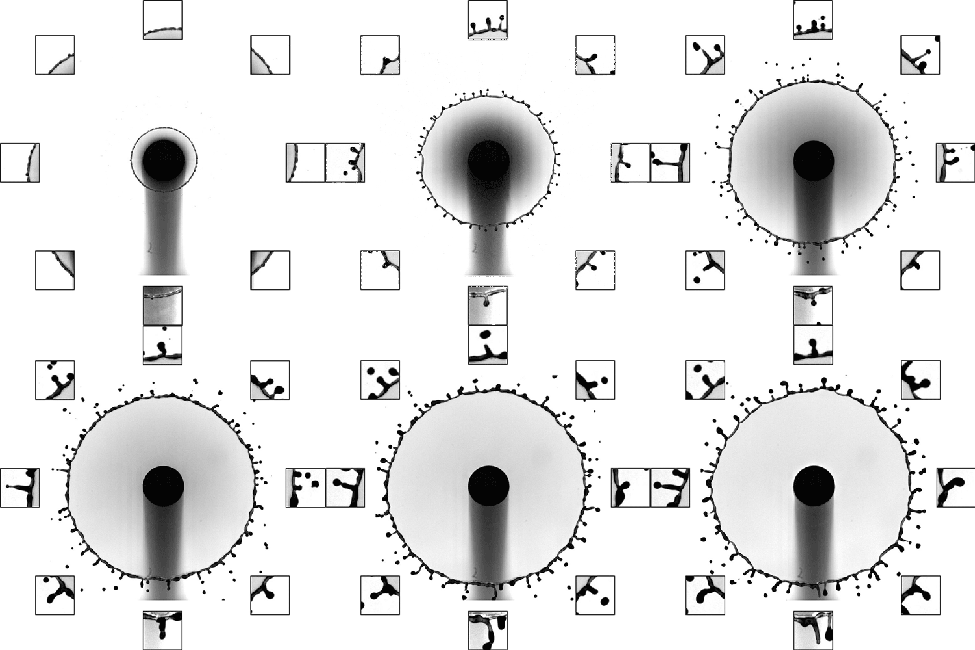
    Splashing drops often expand into a liquid sheet and spray droplets from an unstable rim. Although this behavior is key to many natural and industrial processes, including disease transmission and printing, the physics of the rim formation and breakup has been difficult to unravel. But a new paper offers some exciting insight into this unsteady process. 

    The researchers found that if they carefully tracked the instantaneous, local acceleration and thickness of the rim, it always maintained a perfect balance between acceleration-induced forces and surface tension. That means that even though different points on the rim appear very different, there’s a universality to how they behave. They found that this rule held over a remarkably large range of situations, including across fluids of different viscosities and splashes on various surfaces. (Image and research credit: Y. Wang et al.; via MIT News; submitted by Kam-Yung Soh)