So much goes on in our daily lives that we never see. But with the power of the smartphones in our pockets, we can catch more than ever before, as illustrated in this video. Here a researcher uses the standard “slo-mo” (240 fps) video mode on a smartphone to look at the flow from a typical kitchen faucet. Household faucets often have an aerator that adds air bubbles to the flow, something that’s particularly visible in slow motion at high flow rates. What you can see depends on more than just the frame rate, though. Without strong illumination — provided in this case by sunlight — you could easily miss the cloud of droplets ejected by the faucet. (Image and video credit: M. Mungal)
Tag: science

Under the Sea
Deep below the ocean surface, light is in short supply. But dive photographer Steven Kovacs specializes in capturing the ethereal creatures that live in this darkness. Many of his subjects are larval fish, whose forms defy our hydrodynamic expectations. Why would young (presumably less energetic) fish have so many long, drag-inducing appendages? Clearly there’s more to life under the sea than streamlining alone!
Perhaps our instincts are wrong and these shapes are not as detrimental as they look at first glance. Flexibility can make a drastic difference in hydrodynamics, after all. And some of these species are preparing themselves for a life not spent entirely underwater, anyway. (Image credit: S. Kovacs; via Colossal)

When Rivers Jump
Avulsions — sudden changes in the course of a river — are a river’s equivalent of an earthquake, and they can be similarly devastating for those in the river’s path. In a recent study, authors combed through 50 years’ worth of satellite data to catalog over 100 avulsions and categorize them into three regimes. About a quarter of the observed avulsions took place in the river delta’s fan, where the river spreads out once it exits a canyon or valley. These avulsions, they found, occur when rivers lose confinement and sediment can build up.

This animation of satellite images shows the sudden avulsion — a dramatic change in the river’s course — that took place on the Kosi River in 2008. Among the other observations, the team linked avulsion location to the river’s flow properties. Most of these remaining avulsions took place in the river’s backwater region, where the river begins to slow down before its outlet. The last category of avulsion took place far upstream of the backwater region on rivers with high sediment flows. During flood conditions, erosion can travel far upstream on these rivers, causing avulsions in unexpected places. Changes in sediment load due to human activities, like deforestation, could even cause rivers to change from the backwater regime to the high-sediment load one. (Image credit: top – R. Simmon/USGS, bottom – S. Brooke et al.; research credit: S. Brooke et al.; via AGU Eos; submitted by Kam-Yung Soh)

Fish-Scale Tides
On 31 July 2022, an unusual tidal phenomenon, a fish-scale tide, took place on the Qiantang River’s estuary in Zhejiang Province, China. Here are a couple videos. I’ve not found any explanations for it thus far, so I’m assembling my own. The Qiantang River and its estuary, Hangzhou Bay, are home to the world’s largest tidal bores, reaching 9 meters in places. That means the area regularly sees trains of large waves moving upstream against the normal current.
The area is also known to have rotating currents, meaning that the tide does not simply move inland and then smoothly reverse direction. Instead, a rotating current can change its direction of flow over the course of a tidal cycle without changing its speed. Taken together, this makes the Qiantang River region perfect for winding up with groups of waves colliding at oblique angles, similar to a cross sea. I believe that’s what’s going on here with the fish-scale tide. Two sets of tidal-bore-induced waves are colliding at an angle, creating some gnarly conditions and a very cool pattern. (Image credit: VCG; submitted by Antony B.)

Liquid-in-Liquid Printing
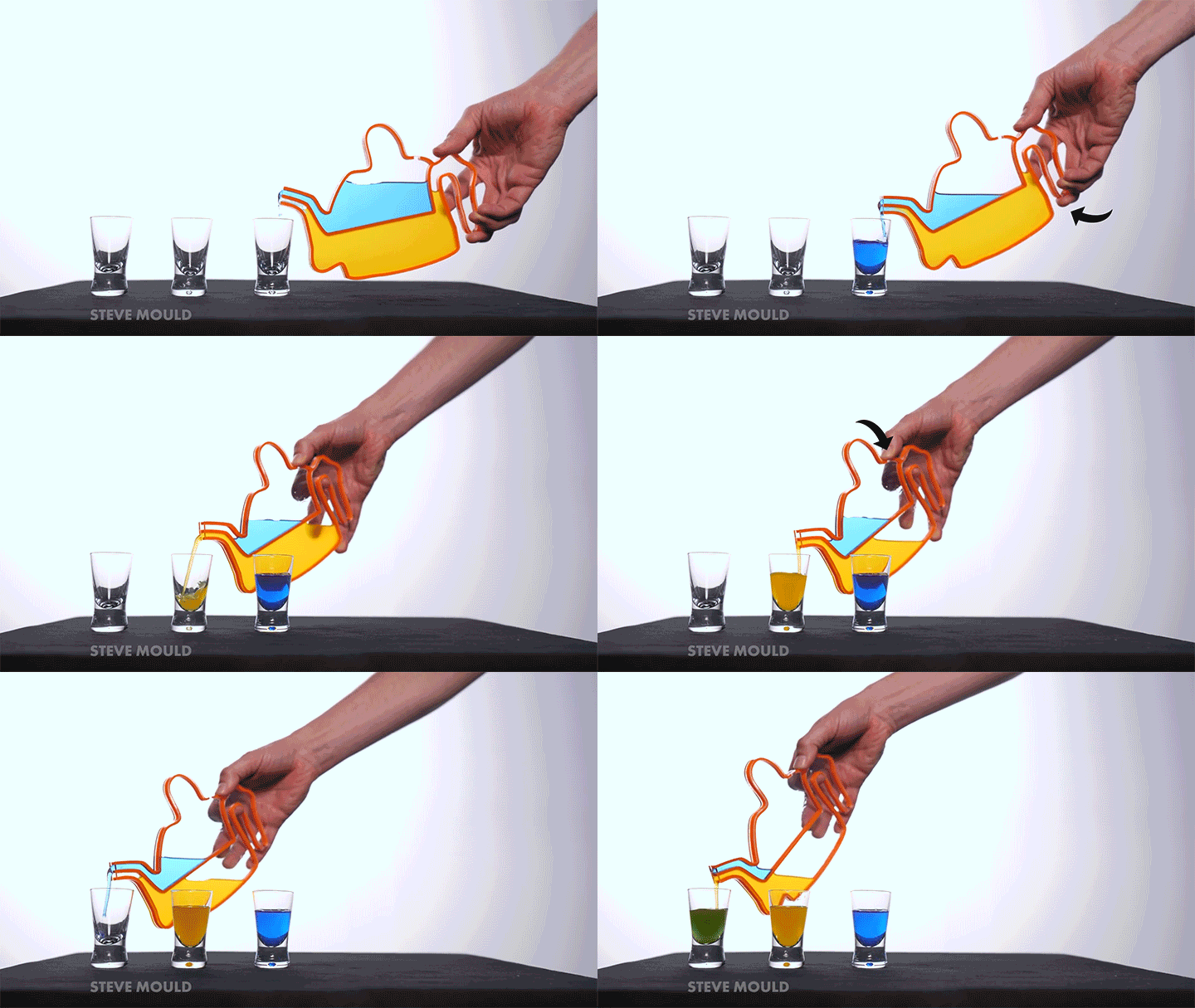
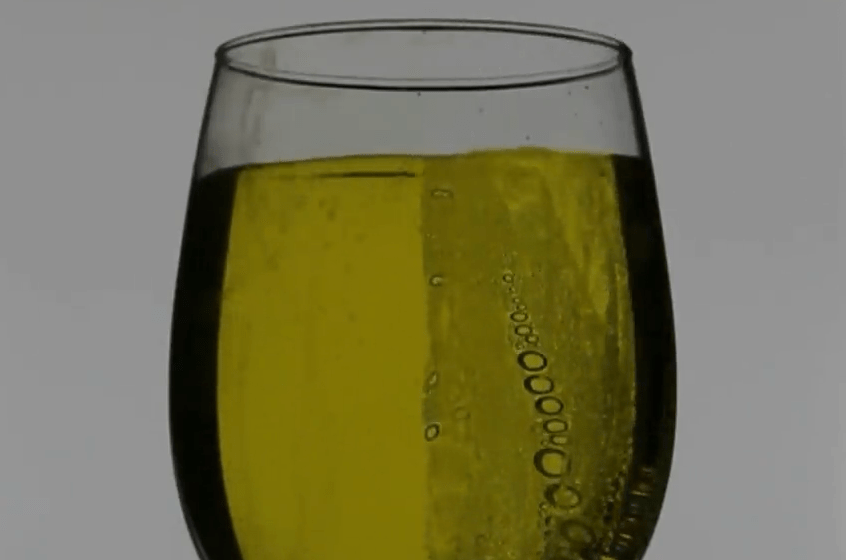
With 3D printing and other recent technologies, manufacturing options are always in flux. Here, researchers explore a method for printing a liquid inside of a liquid. Their materials are specially chosen such that the injected liquid forms an emulsion at its interface with the surrounding fluid. Once injection ends, the interface forms a wrinkly, viscoelastic skin that acts like a tube. As shown below, the tube is robust enough that it can be pumped full of yellow-dyed water without any loss of structure. (Image and research credit: P. Bazazi et al.)

Groundwater-Structure Interactions
Groundwater can sometimes wind up in unexpected places, given the way it interacts with subsurface structures. In this Practical Engineering video, Grady discusses the paths that groundwater takes around structures and how civil engineers account for groundwater-related forces on dams and other buildings. As always, he illustrates with excellent model demos, allowing viewers to see groundwater interactions for themselves. (Image and video credit: Practical Engineering)

Saffman-Taylor Instability
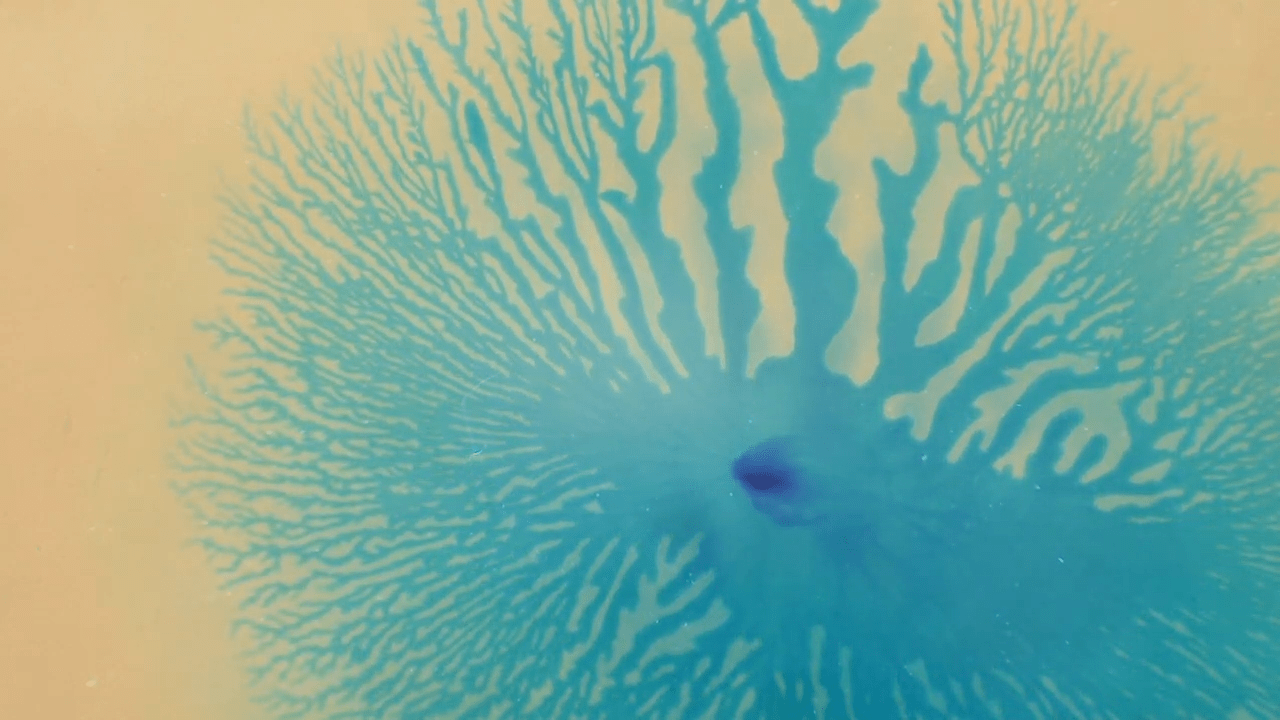
Air and blue-dyed glycerin squeezed between two glass plates form curvy, finger-like protrusions. This is a close-up of the Saffman-Taylor instability, a pattern created when a less viscous fluid — here, air — is injected into a more viscous one. If you reverse the situation and inject glycerin into air, you’ll get no viscous fingers, just a stable, expanding circle. Although you sometimes come across this instability in daily life — like in a cracked smartphone screen — the major motivation for studying this phenomenon historically has been oil and gas extraction. (Image credit: T. Pohlman et al.)

Inhibiting Marine Lightning
Thunderstorms over the ocean have substantially less lightning than a similar storm over land. Scientists wondered whether this difference could be due to lower cloud bases over the ocean or differences in the cloud droplets’ nuclei. But a new study instead implicates coarse sea spray as the deciding factor. By tracking the full lifetime of storm systems through remote sensing, the team found that fine aerosols can increase lightning activity over both land and ocean. But adding coarse sea salt from sea spray reduced lightning by 90% regardless of fine aerosols. With sea salt in the mix, clouds seem to develop fewer but larger condensation droplets, providing less opportunity for the electrification necessary to generate lightning. (Image credit: Z. Tasi; research credit: Z. Pan et al.)

Rain-Driven Prey Capture
Pitcher plants often entice their insect victims with sweet nectar before trapping them in inescapable viscoelastic goo. But some species go even further. Nepenthes gracilis, a species native to Southeast Asia uses its leafy springboard to lure its prey. Once an ant crawls to the underside of the leaf, a falling rain drop will spell its doom. When drops hit the leaf, it deflects down and jerks up, thanks to its shape and stiffness. The motion catapults insects into the pitcher, where digestive fluids await. While we’ve seen some fast-moving plants before, this is a rare example of a plant with an externally-driven speed mechanism. With it, the pitcher plant doesn’t have to wait or expend any metabolic effort to reset for the next insect. (Image credit: GFC Collection/Alamy; research credit: A. Lenz and U. Bauer; via New Scientist)