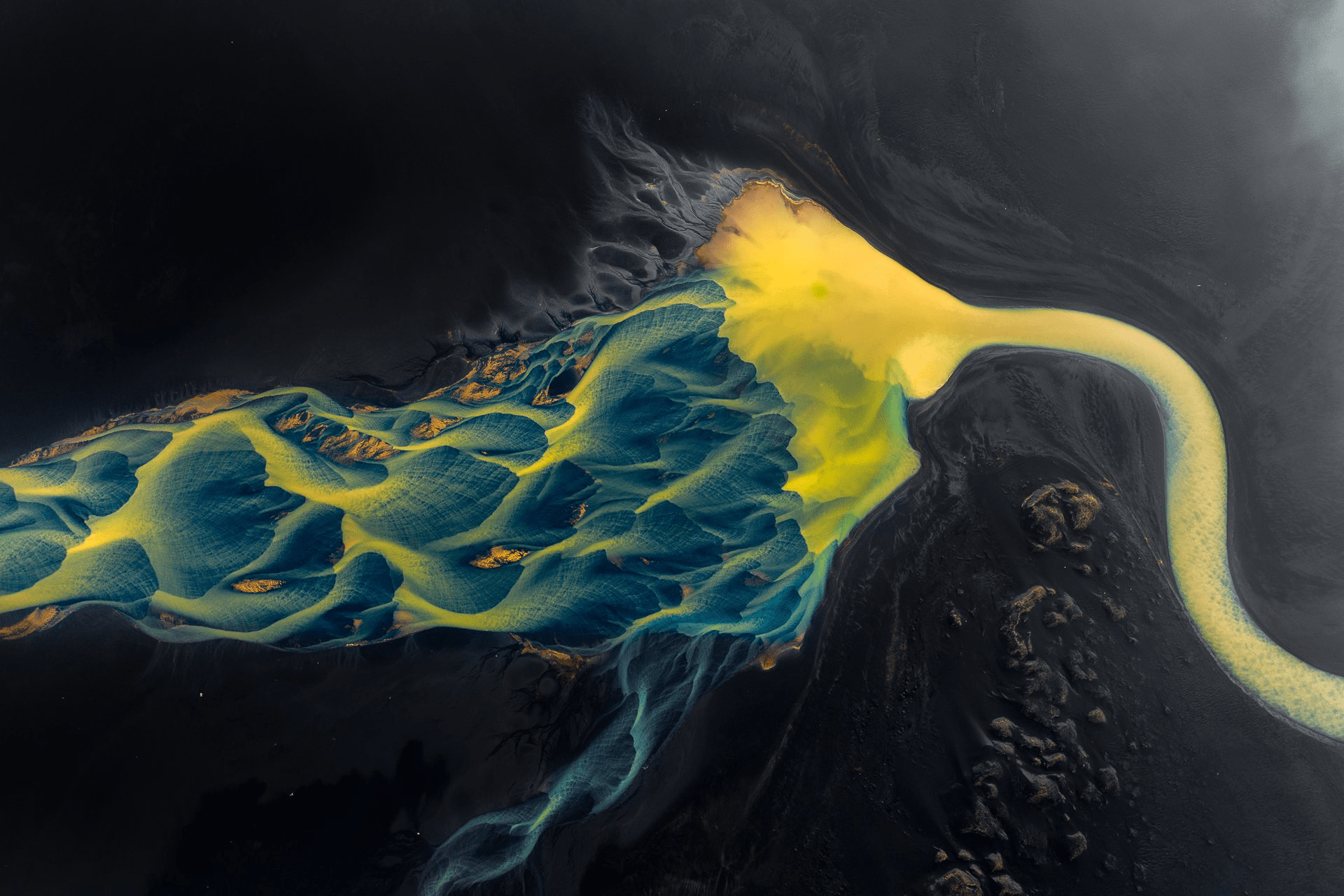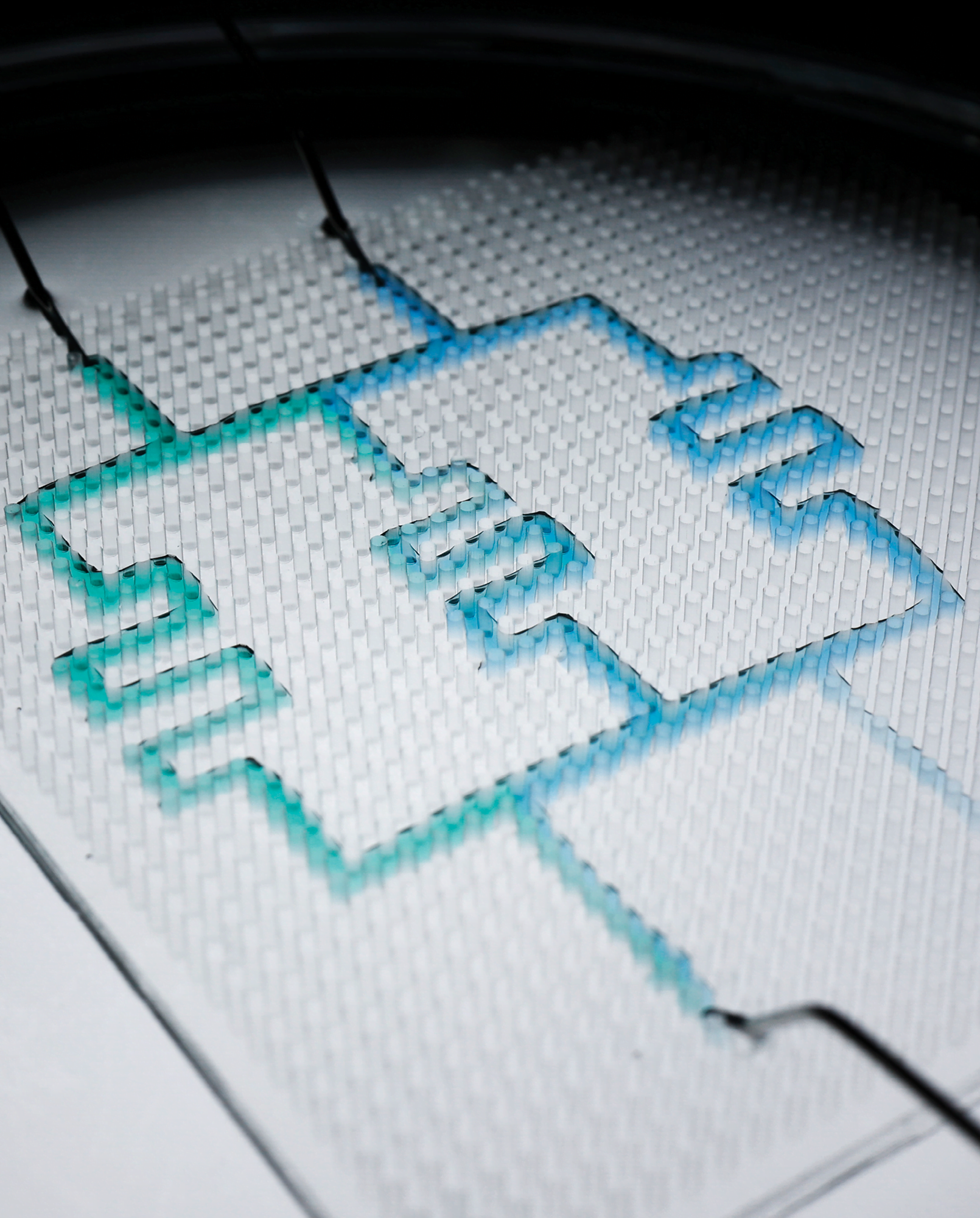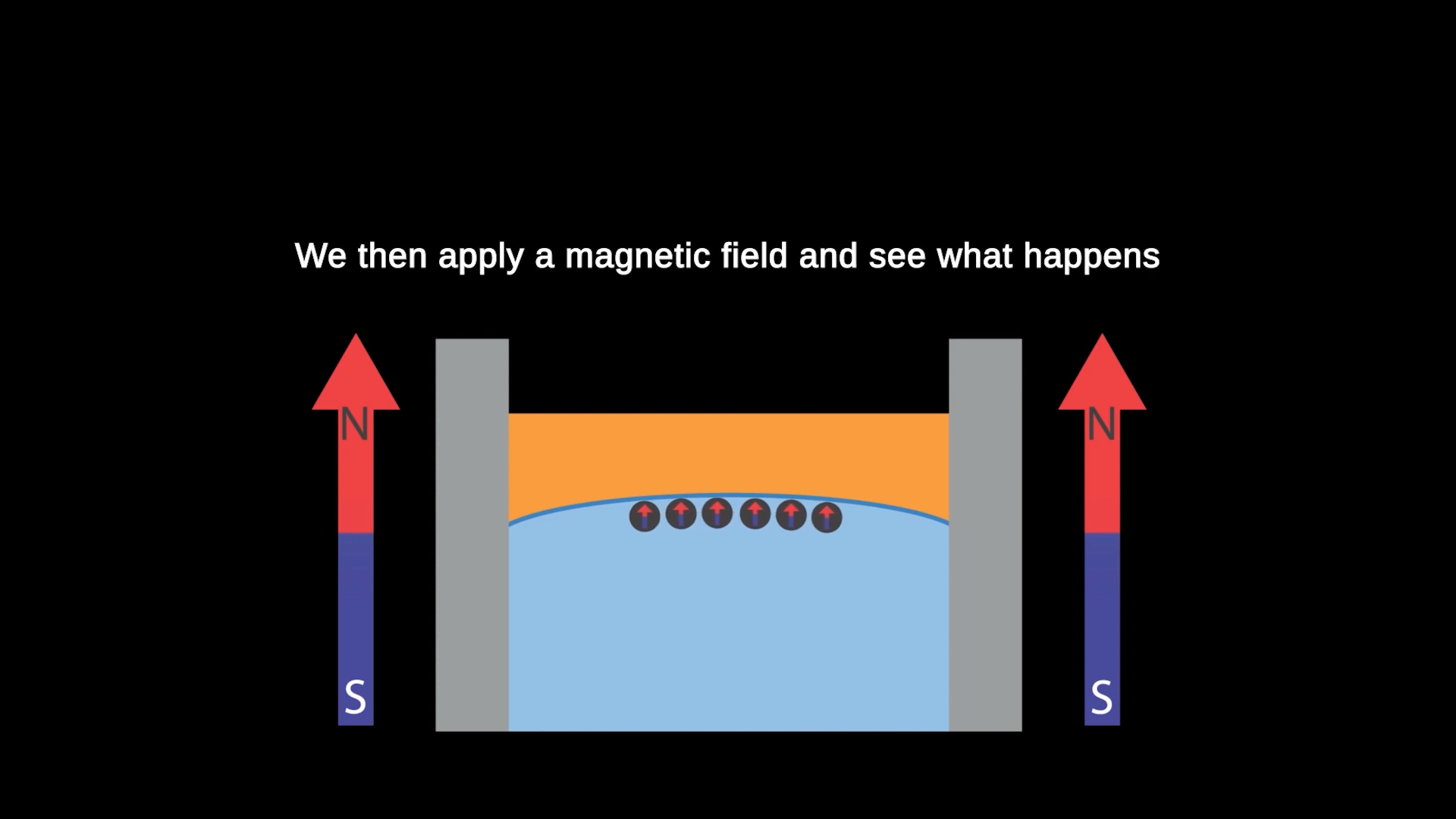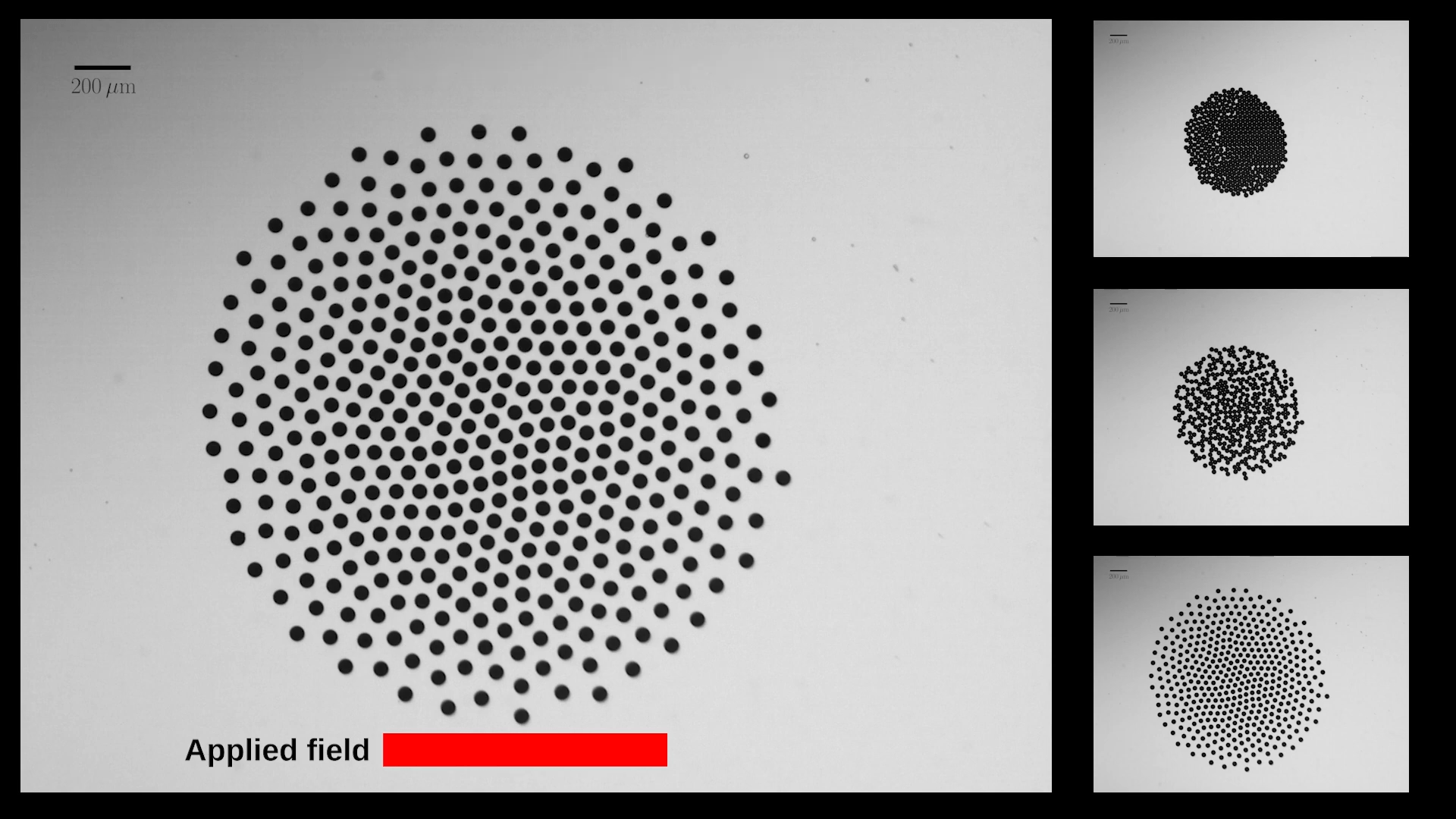
Our landscapes have changed dramatically over the last 200 years of urban development, but traces of the land’s past still remain. Many streams and rivers that once ran on the surface persist in underground culverts. Bruce Willen’s “Ghost Rivers” installation highlights the path of one such waterway, Sumwalt Run, which flows across what is now the Remington and Charles Village neighborhoods of Baltimore. The project includes ten installations that describe the hidden water and its history as well as a wavy, blue line that marks its path. (Image credits: Public Mechanics and F. Hamilton, see alt text; installation: B. Willen; via Colossal)
Tag: science

Water Reduces Coffee’s Charge
Grinding coffee beans builds up electrical charge as the beans fracture into smaller and smaller pieces. The polarity of the charge depends on the bean’s moisture content; lighter roasts tend toward a positive charge, and darker roasts skew negative. The finer the grind, the stronger the electrical charge and the greater the problem of clumping grains becomes. Adding a few drops of water to the beans before grinding, researchers found, drastically reduces the electrical charge and clumping. This, the team reports, would let espresso lovers brew a stronger cup with less material. A well-compacted bed of unclumped grains has less void space, which slows down water’s percolation and increases the amount of coffee the water can extract. The authors encourage readers to try adding water in their own home brews, but they caution that coffee mass and grind setting should also be variables in the experiment. (Image credit: N. Van; research credit: J. Harper et al.; via APS Physics)

Visualizing Changes
This rather mesmerizing video by Michiel de Boer uses a video editing technique to highlight movement and changes in video clips. From falling rain to rising mist to passing footsteps, the relatively simple technique visualizes all kinds of motion. De Boer calls it “motion extraction,” but it’s essentially a way to play with autocorrelation, a mathematical technique often used in fluid dynamics. It’s especially prevalent in turbulence, where it helps researchers identify parts of the flow that are closely related to one another. (Video and image credit: M. de Boer; via Colossal)

Reimagining Mars’ Interior
Older models of Mars assumed a liquid metal core beneath a solid mantle of silicates, but recent studies indicate that structure is missing at least one layer. Using data from the InSight lander’s seismometer, two teams independently calculated that a liquid silicate layer must surround the planet’s core. In September 2021, three meteorite pieces impacted Mars far from the InSight lander’s position. Since the Mars Reconnaissance Orbiter could exactly pinpoint the impact location, researchers were able to calculate just how long it took seismic waves from the impact to reach the lander.
Like on Earth, Mars has two varieties of seismic wave: transverse S-waves that only travel through solids and longitudinal P-waves that travel through both liquid and solid layers. S-waves reflect off any liquid-solid boundary, following a different path to a seismometer than P-waves that refract across the boundary and travel through liquid. For more of the story behind this discovery, check out this article at Physics Today. (Image credit: Mars – NASA/JPL-Caltech/University of Arizona, illustration – J. Sieben/J. Keisling; research credit: H. Samuel et al. and A. Khan et al.; via Physics Today)

An illustration of Mars’ interior and the paths followed by seismic waves before InSight picked them up. 
Upwelling at Cabo Frio
The shores of the Brazilian state of Rio de Janeiro boast turquoise waters, white sands, and green lagoons, but European explorers discovered the waters around one promontory were unusually cold, leading to the name Cabo Frio. The chilly waters can be 8 degrees Celsius cooler than nearby surface temperatures, thanks to cold water upwelling near the coast. The upwelling is wind-driven; the dominant northeasterly winds push water out to sea, allowing colder waters to rise from the deep. (Image credit: L. Dauphin; via NASA Earth Observatory)

A map of sea surface temperatures near Cabo Frio in Brazil. 
Flexy Fur Foils Fouling
Inspired by a muddy hike with a dog, today’s study looks at how fur in a flow can shed dirt and debris. Researchers placed beaver, coyote, and synthetic hairs in a flow chamber with a slurry of titanium dioxide particles in water. After 24 hours, they counted the particles stuck on each hair. The more flexible a hair, the cleaner it stayed. Long hairs collected fewer particles per unit surface area than short ones, thanks to their larger deflection in the flow. The effect, they discovered, is a bit like when paint or glue dries on your hand. The more you move and flex your skin, the harder it is for crusty material to stick. This self-cleaning with flex and flow occurs in nature, too: the only furry mammal with consistently dirty fur is the notoriously inactive sloth. (Image credit: T. Umphreys; research credit: M. Krsmanovic et al.; via APS Physics)

Parting a Flame
A sheet of flame splits around a cylinder in this Gallery of Fluid Motion poster. Looking at the image sequences, you can see how the flames lift up as they flow around the cylinder, following the arms of a horseshoe vortex. Researchers study situations like this one to better understand how wildfires move as they encounter obstacles. Understanding and predicting how fires flow is increasingly important with more wildfires encountering human-built infrastructure. (Image credit: L. Shannon et al.)

The Miscible Faraday Instability
Vibrate a pool of water in air and the interface will form a distinctive pattern of waves called the Faraday instability. But what happens when you vibrate the interface between two fluids that can mix? That’s the question at the heart of this video. The researchers consider the situation both in simulation and experiment, showing how what begins as a smooth interface quickly becomes a thick turbulent mixture. Since the thickness of that mixing layer can be predicted theoretically, this set-up could be useful in industrial applications where mixing is needed. (Video, image, and research credit: G. Louis et al.)

Fire in Ice
This false-color satellite image of Malaspina Glacier (Sít’ Tlein) is a riot of color. Composed of coastal/aerosol, near infrared, and shortwave infrared bands from Landsat 9, the colors highlight features otherwise hard to identify. Watery features appear in reds, oranges, and yellows; vegetation is green and rock appears in blue. The glacier covers more than 4000 square kilometers, an area larger than the state of Rhode Island. The dark lines atop the glacier are moraines, where rock, soil, and other debris has been scraped up along the glacier’s edge. Over time, changes in the glacier’s velocity cause the moraines to fold and shear, creating the zigzag pattern seen here. (Image credit: W. Liang; via NASA Earth Observatory)