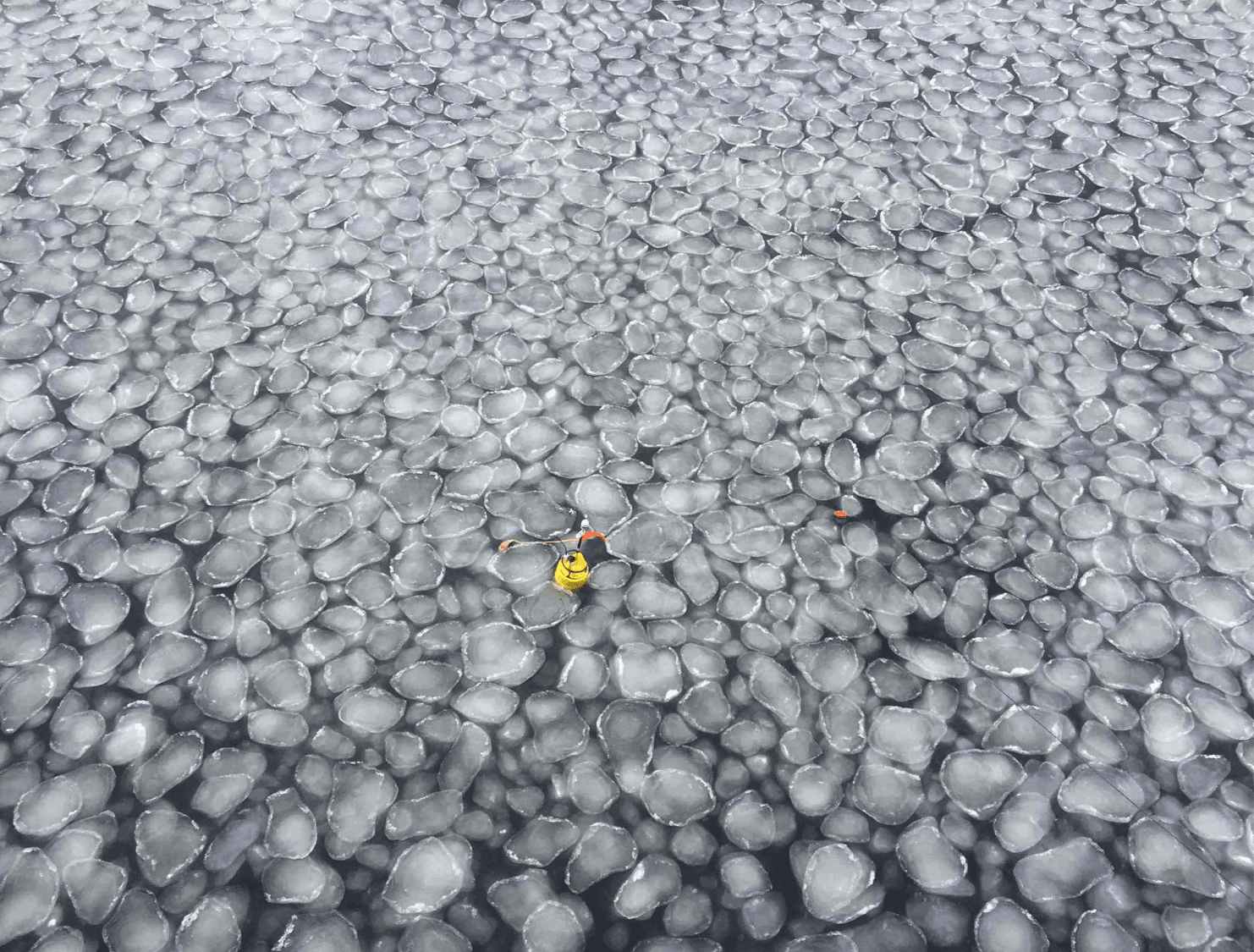
While much attention is given to the summer loss of sea ice, the birth of new ice in the fall is also critical. Ice loss in the summer leaves oceans warmer and waves larger since wind can blow across longer open stretches. Those warmer waters and more dynamic waves affect how ice forms once autumn sets in. Higher waves mean that ice tends to form in “pancakes” like those seen here. Pancake ice is small — typically under 1 meter wide — and can only be observed from nearby, since they’re smaller than typical satellite resolution. Only once there’s enough pancake ice to dampen the waves will the pieces begin to cement together to form larger pieces that will form the basis of the year’s new ice. (Image credit: M. Smith; see also Eos)
Tag: science

“Visions in Ice”
The glittering blue interior of an ice cave sparkles in this award-winning image by photographer Yasmin Namini. The cave is underneath Iceland’s Vatnajokull Glacier. Notice the deep scallops carved into the lower wall. This shape is common in melting and dissolution processes. It is unavoidable for flat surfaces exposed to a melting/dissolving flow. (Image credit: Y. Namini/WNPA; via Colossal)
Fediverse Reactions
-

Crowd Vortices
The Feast of San Fermín in Pamplona, Spain draws crowds of thousands. Scientists recently published an analysis of the crowd motion in these dense gatherings. The team filmed the crowds at the festival from balconies overlooking the plaza in 2019, 2022, 2023, and 2024. Analyzing the footage, they discovered that at crowd densities above 4 people per square meter, the crowd begins to move in almost imperceptible eddies. In the animation below, lines trace out the path followed by single individuals in the crowd, showing the underlying “vortex.” At the plaza’s highest density — 9 people per square meter — one rotation of the vortex took about 18 seconds.

The team found similar patterns in footage of the crowd at the 2010 Love Parade disaster, in which 21 people died. These patterns aren’t themselves an indicator of an unsafe crowd — none of the studied Pamplona crowds had a problem — but understanding the underlying dynamics should help planners recognize and prevent dangerous crowd behaviors before the start of a stampede. (Image credit: still – San Fermín, animation – Bartolo Lab; research credit: F. Gu et al.; via Nature)
Fediverse Reactions
-

A Stellar Look at NGC 602
The young star cluster NGC 602 sits some 200,000 light years away in the Small Magellanic Cloud. Seen here in near- and mid-infrared, the cluster is a glowing cradle of star forming conditions similar to the early universe. A large nebula, made up of multicolored dust and gas, surrounds the star cluster. Its dusty finger-like pillars could be an example of Rayleigh-Taylor instabilities or plumes shaped by energetic stellar jets. (Image credit: NASA/ESA/CSA/JWST; via Colossal)
Fediverse Reactions
-

Slipping Ice Streams
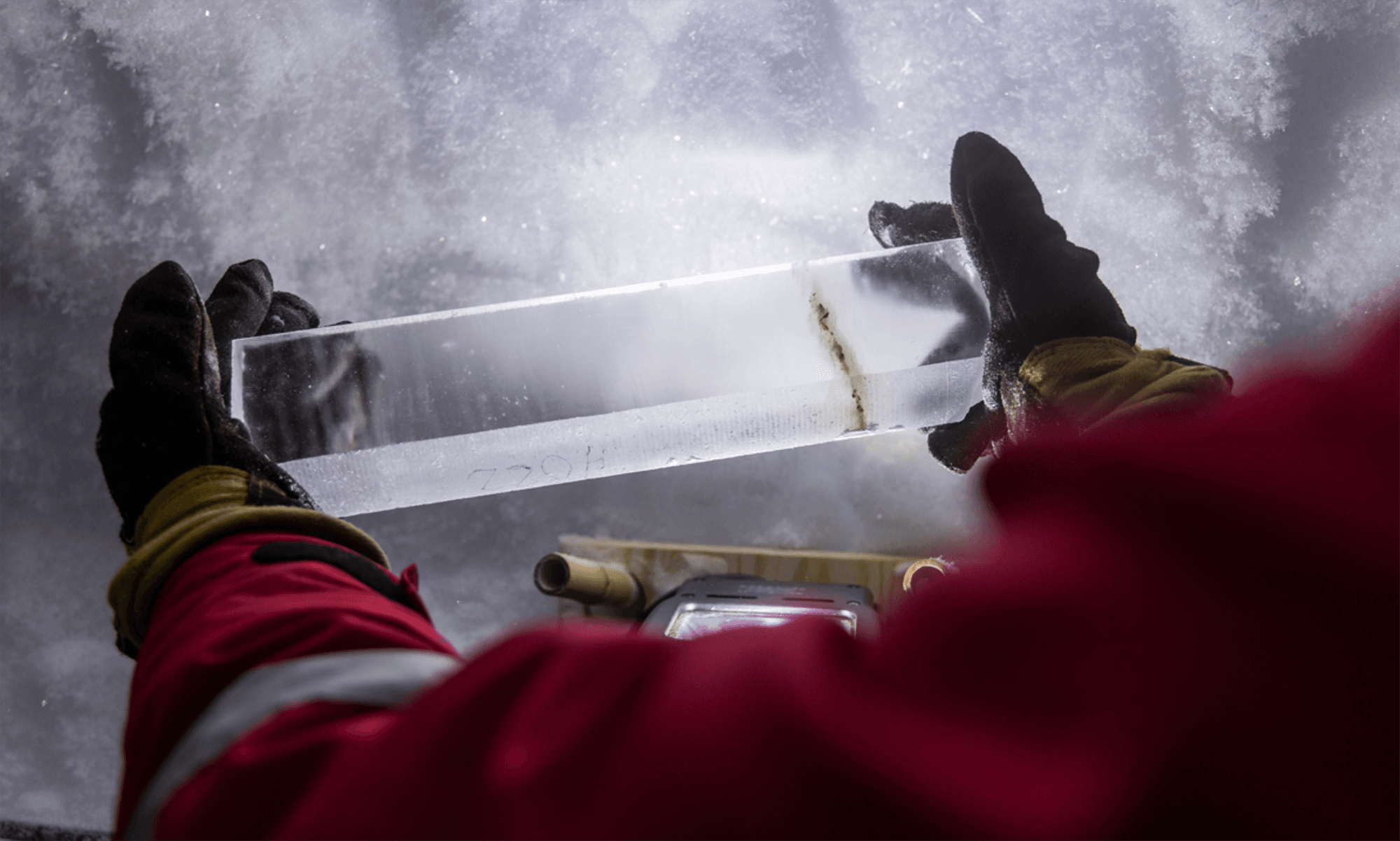
The Northeast Greenland Ice Stream provides about 12% of the island’s annual ice discharge, and so far, models cannot accurately capture just how quickly the ice moves. Researchers deployed a fiber-optic cable into a borehole and set explosive charges on the ice to capture images of its interior through seismology. But in the process, they measured seismic events that didn’t correspond to the team’s charges.
Instead, the researchers identified the signals as small, cascading icequakes that were undetectable from the surface. The quakes were signs of ice locally sticking and slipping — a failure mode that current models don’t capture. Moreover, the team was able to isolate each event to distinct layers of the ice, all of which corresponded to ice strata affected by volcanic ash (note the dark streak in the ice core image above). Whenever a volcanic eruption spread ash on the ice, it created a weaker layer. Even after hundreds more meters of ice have formed atop these weaker layers, the ice still breaks first in those layers, which may account for the ice stream’s higher-than-predicted flow. (Image credit: L. Warzecha/LWimages; research credit: A. Fichtner et al.; via Eos)
Fediverse Reactions
-
Imaging a New Era of Supersonic Travel
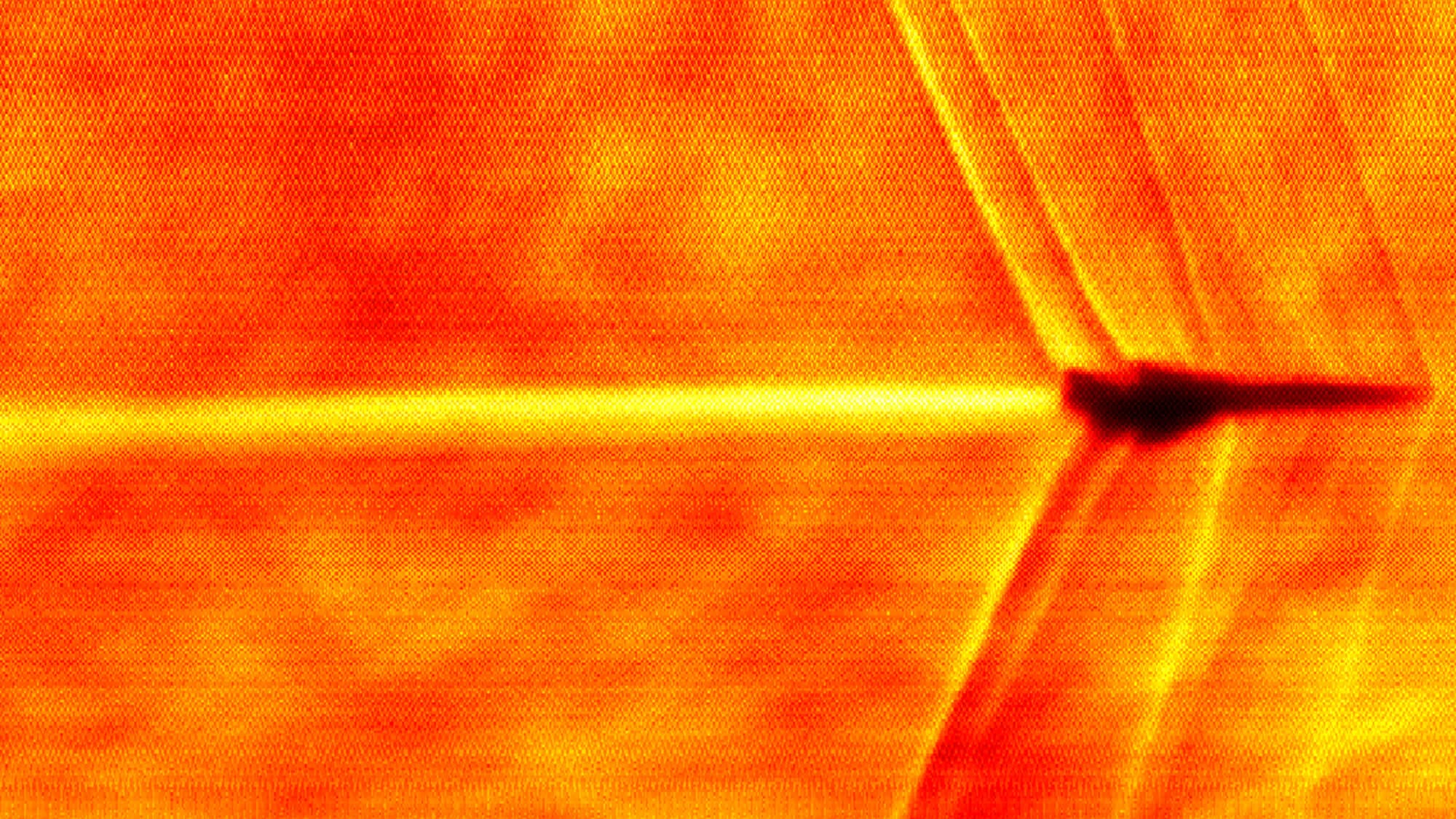
Supersonic commercial travel was briefly possible in the twentieth century when the Concorde flew. But the window-rattling sonic boom of that aircraft made governments restrict supersonic travel over land. Now a new generation of aviation companies are revisiting the concept of supersonic commercial travel with technologies that help dampen the irritating effects of a plane’s shock waves.
One such company, Boom Supersonic, partnered with NASA to capture the above schlieren image of their experimental XB-1 aircraft in flight. The diagonal lines spreading from the nose, wings, and tail of the aircraft mark shock waves. It’s those shock waves’ interactions with people and buildings on the ground that causes problems. But the XB-1 is testing out scalable methods for producing weaker shock waves that dissipate before reaching people down below, thus reducing the biggest source of complaints about supersonic flight over land. (Image credit: Boom Supersonic/NASA; via Quartz)

Fediverse Reactions
-

“The Ballet of Colors”


Thomas Blanchard’s short film “The Ballet of Colors” plunges viewers into a warm spectrum of roiling oil and paint. Fluid dynamically speaking, it could be subtitled “the Plateau-Rayleigh instability” thanks to its focus on retracting paint ruptures and ligaments breaking into droplets. Unlike some other videos of this genre, Blanchard uses a high-speed camera here, filming the action at 1,000 frames per second, and the result is smooth, crisply focused, and absolutely delectable. (Video and image credit: T. Blanchard et al.)
Fediverse Reactions
-

Filtering by Sea Sponge
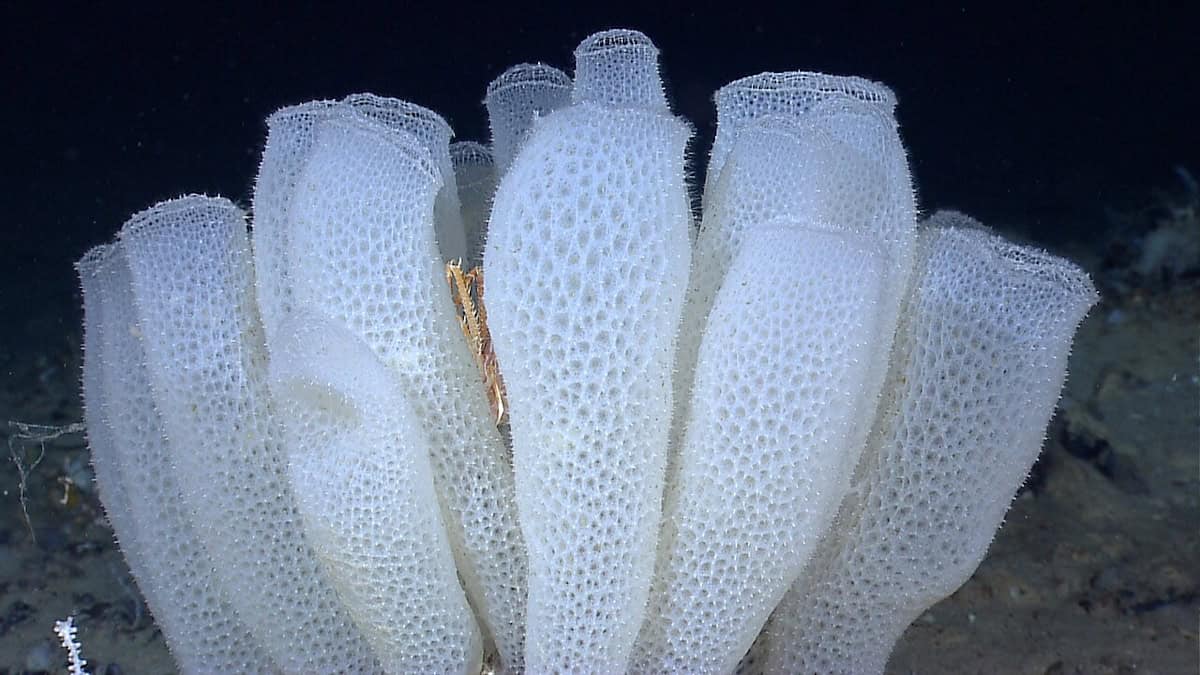
Gathering oil after a spill is fiendishly difficult. Deploying booms to corral and soak up oil at the water surface only catches a fraction of the spill. A recent study instead turns to nature to inspire its oil filter. The team was inspired by the Venus’ flower basket, a type of deep-sea sponge with a multi-scale structure that excels at pulling nutrients out of complex flow fields. The outer surface of the sponge has helical ridges that break up the turbulence of any incoming flow, helping the sponge stay anchored by reducing the force needed to resist the flow. Beneath the ridges, the sponge’s skeleton has a smaller, checkered pattern that further breaks up the flow as it enters into the sponge’s hollow body. Within this cavity, the flow is slower and swirling, giving plenty of time for nutrients in the water to collide with the nutrient-gathering flagellum lining the sponge.
By mimicking this three-level structure, the team built a capable oil-capturing device that can filter even emulsified oil from the water. They swapped the flagellum with a (replaceable) oil-adsorbing material and found that their filter captured more than 97% of oil across a range of flow conditions. (Image credit: NOAA; research credit: Y. Yu et al.; via Physics World)
Fediverse Reactions
-
Salt Affects Particle Spreading


Microplastics are proliferating in our oceans (and everywhere else). This video takes a look at how salt and salinity gradients could affect the way plastics move. The researchers begin with a liquid bath sandwiched between a bed of magnets and electrodes. Using Lorentz forcing, they create an essentially 2D flow field that is ordered or chaotic, depending on the magnets’ configuration. Although it’s driven very differently, the flow field resembles the way the upper layer of the ocean moves and mixes.
The researchers then introduce colloids (particles that act as an analog for microplastics) and a bit of salt. Depending on the salinity gradient in the bath, the colloids can be attracted to one another or repelled. As the team shows, the resulting spread of colloids depends strongly on these salinity conditions, suggesting that microplastics, too, could see stronger dispersion or trapping depending on salinity changes. (Video and image credit: M. Alipour et al.)
Fediverse Reactions
-

Derecho-Induced Skyscraper Damage
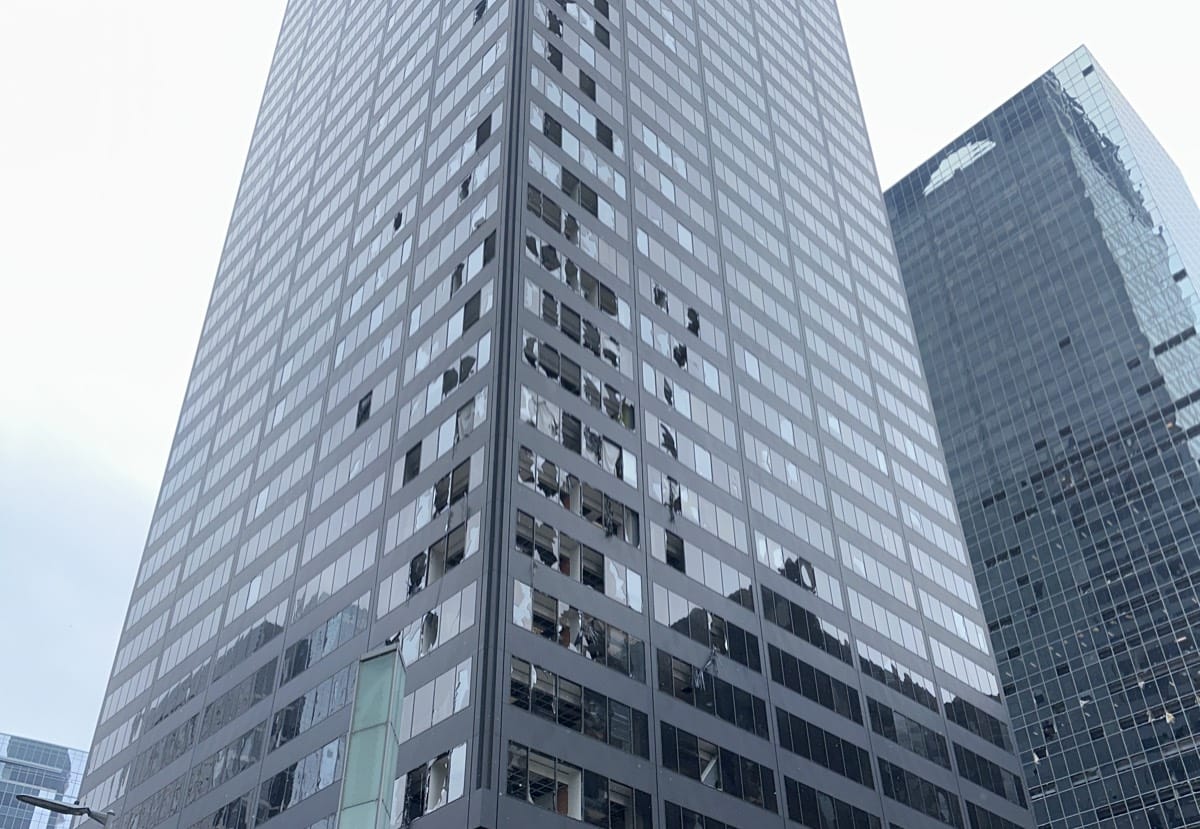
Derechos are short-lived, intense wind storms sometimes associated with thunderstorms. Last spring, such a storm passed through Houston, leaving downtown skyscrapers with more damage than a hurricane with comparable wind speeds. Now researchers believe they know why a derecho’s 40 meter per second winds can badly damage buildings built to withstand 67 meter per second hurricane winds.
In surveying the damage to Houston’s skyscrapers, the team noted that broken windows were concentrated in areas that faced other tall buildings. In a wind facility, the team explored how skyscrapers interfered with each other, based on their separation difference. They looked both at conditions that mimicked a hurricane’s winds as well as the downbursts — strong downward wind bursts — that are found in derechos.
The researchers found that downbursts in between nearby buildings caused extremely strong suction forces along a building’s face — even compared to the forces seen with higher hurricane-force winds. Currently, these buildings are designed for hurricane-like conditions, but the team suggests that — at least in some regions — designers will need to take into account how downburst wind patterns affect a skyscraper, too. (Image credit: National Weather Service; research credit: O. Metwally et al.; via Ars Technica)
Fediverse Reactions
-