Tag: science

  • Featured Video Play Icon

    Inside a Metal Vortex

    What do you get when you combine liquid gallium, a blender, and a special probe lens? Some pretty wild slow-mo video of a liquid metal vortex, courtesy of the Slow Mo Guys. This video is almost as notable for its set-up as it is for the high-speed footage, given the lengths Gav and Dan go to in order to get the shot! (Image and video credit: The Slow Mo Guys)

  • Neptune’s Seasonal Changes

    Neptune’s Seasonal Changes

    Ice giant Neptune orbits our sun once every 165 years, meaning that each season on the planet lasts about 41 years here on Earth. Currently, the side of Neptune facing us is entering early summer, but a recent survey of atmospheric measurements show that Neptune’s stratosphere is experiencing some unexpected changes. Between 2003 and 2018, the team found that global stratospheric temperatures actually decreased by 8 degrees Celsius. Even more dramatically, Neptune’s southern pole warmed by a full 11 degrees Celsius between 2018 and 2020. Both results hint that atmospheric patterns on the planet may be far more complex than current models assume. (Image credit: NASA/JPL; research credit: M. Roman et al.; via Physics World)

  • Featured Video Play Icon

    Escaping the Flood

    Fire ants clump together into giant rafts to stay alive during floods. But these rafts won’t form with just any number of ants. Researchers found that individual ants will actually kick one another away. It’s not until there are about ten ants that the raft formation becomes stable. In this video, the team lays out their experiments and models for fire ant rafting, showing that capillary action helps draw the raft together and individual ants’ activity can destabilize rafts if they’re too small. (Image and video credit: H. Ko and D. Hu)

  • “Metamorphe”

    “Metamorphe”

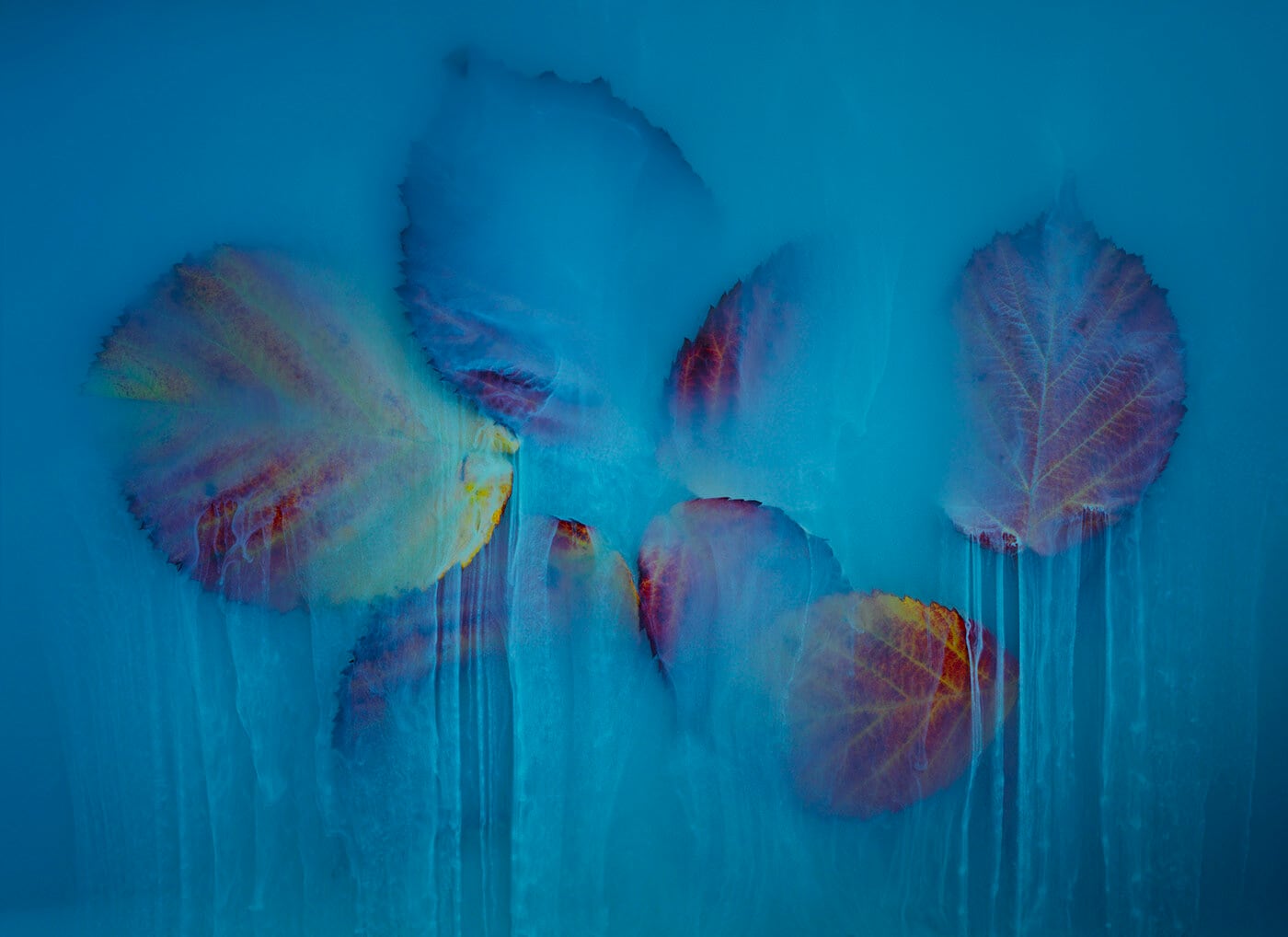
    A smoke-like haze drifts over surreal landscapes in the “Metamorphe” series by Reuben Wu and Jenni Pasanen. Though fluidic in appearance, these pieces are a merger between Wu’s drone light photography and Pasanen’s AI-assisted digital creations. Even so, the images are extremely evocative of fluid motion, connected as they are to human senses (like smell, hearing, and touch) that often rely directly on fluid dynamics. For more, check out the artists’ sites and Instagram. (Image credits: R. Wu and J. Pasanen; via Colossal)

  • Swimming Together

    Swimming Together

    Scientists have long pondered the possibilities of hydrodynamic benefits to the ways fish school. But most analyses of schooling have assumed a fixed spacing that’s far more orderly than what we observe in nature. In this experiment, researchers instead used a pair of robotic swimmers (essentially hydrofoils) to explore a range of swimming formations. What they found was a map of places where a second swimmer could easily “lock in” to a position relative to the leader and have their positioning stabilized by interactions with the leader’s wake (lower image). Interestingly, the beneficial regions extend much further downstream for fish positioned diagonally to the leader than they do for one directly following. With such a wide range of easily-stabilized following positions, it’s no wonder that schools of fish are amorphous instead of strictly crystalline! (Image credit: top – S. Pena Lambarri, map – J. Newbolt et al.; research credit: J. Newbolt et al.)

    The shaded areas of this map represent areas where a second swimmer can passively "lock-in" relative to the leader's position, shown in gray. This data is based on tests with robotic swimmers.
    The shaded areas of this map represent areas where a second swimmer can passively “lock-in” relative to the leader’s position, shown in gray. This data is based on tests with robotic swimmers.
  • Featured Video Play Icon

    How Dunes Form

    On its face, the idea that sand and wind can come together to form massive mountainous dunes seems bizarre. But dunes — and their smaller cousins, ripples — are everywhere, not just on Earth but on other planetary bodies where fine particles and atmospheres interact. In this video, Joe Hanson gives a great overview of sand dynamics, beginning with what sand is, how it moves, and what it can ultimately form. It’s well worth a watch, even if you know a little about dunes already; I know I learned a thing or two! (Image and video credit: Be Smart)

  • You’re Drunk, Toadlet

    You’re Drunk, Toadlet

    Most frogs and toads are excellent jumpers, taking off and landing with a control and grace that rivals elite athletes. Not so for the pumpkin toadlet. These species have become so miniaturized that the structures of their inner ears are too narrow for the fluid flow that helps frogs (and humans!) orient themselves in space. So while the toadlet certainly can jump, it careens through the air drunkenly and lands in any old direction. It’s hard not to laugh at their belly flops, somersaults, and straight-up head-first crashes. Fortunately, being so small, these landings don’t seem to hurt the toadlets, but one imagines they’re unpleasant nevertheless. Left to their own devices, the pumpkin toadlet prefers walking, slowly, like a chameleon; it might be the only way to stay within the limits of its inner ear. (Image credits: top – S. Kikuchi, others – R. Essner, Jr. et al.; research credit: R. Essner, Jr. et al.; via The Atlantic; submitted by Kam-Yung Soh)

  • Featured Video Play Icon

    Rifts in Rafts

    A raft of particles floating on water has some natural cohesion from particle attraction and capillary action. But when the raft is pulled apart, what happens? Does it break cleanly in one spot? Does it stretch and deform? That’s what this video explores. It turns out that the speed you pull the raft at determines how it holds together. Every particle cluster has a preferred relaxation rate, and by choosing the pulling speed, you determine which relaxation rate — and therefore cluster size — can survive most effectively. (Image and video credit: K. Tô and S. Nagel)

  • Aqueous Chandeliers

    Aqueous Chandeliers

    Colorful dyes falling through water form chandelier-like, branching shapes. These formations are the result of a slight density difference between the heavier dyes and the surrounding water. As the dye falls, Rayleigh-Taylor instabilities cause the mushroom-like blobs and their branches. With creativity and photographic skill, Mark Mawson turns these ephemeral shapes into bold liquid sculptures, frozen in time. See more of his work in these previous posts, on his website, and on Instagram. (Image credit: M. Mawson)

  • Listening to the Sizzle

    Listening to the Sizzle

    The sizzle of frying food is familiar to many a cook, and that sound actually conveys a surprising amount of information. In this study, researchers suspended water droplets in hot oil and observed their behavior, both with high-speed video and with microphones. They found that these vaporizing drops created three types of cavities in the oil: an exploding cavity that breaks the surface, an elongated cavity that remains submerged, and an oscillating cavity that breaks up well below the surface. All three cavities flung oil droplets upward, and all three were acoustically distinct from one another. That means, as the authors suggest, that it might be possible to measure the aerosol droplets generated during frying simply by listening! (Image credit: fries – W. Dharma, others – A. Kiyama et al.; research credit: A. Kiyama et al.; via Cosmos; submitted by Kam-Yung Soh)