Blackwater rivers, like the Suwannee River in Florida, carry waters so laden with organic material that they’re dyed a deep, dark brown. For the Suwannee, most of this material comes from the rich peat deposits of the Okefenokee Swamp that lies upstream. As vegetation in the swamp decays, tannins from the plants dissolve into the water, giving it its distinctive color, which the river maintains along its full 400-kilometer journey to the Gulf of Mexico. The dark waters of the river act as a tracer, revealing how the fresh river water mixes with the ocean in the enhanced-color satellite image above. It’s amazing to see how far the river’s influence spreads before delicate wisps of color pierce the darkness. (Image credit: U.S. Geological Survey; via NASA Earth Observatory)
Tag: satellite image

Glinting Off Waves
Sunglint on the ocean surface can sometimes reveal different patterns in wave conditions. In the satellite photo above, we see the Canary Islands with wavering silvery wakes stretching to the southwest. The predominant wind direction over the islands is from the northeast. The rocky islands act as a wind-break, redirecting the flow and shadowing the ocean in their wake from much of it. As a result, fewer waves are stirred up in the islands’ wakes, thereby changing the local surface reflection properties and making this image possible. (Photo credit: NASA Earth Observatory)

Stirred Up Sediment
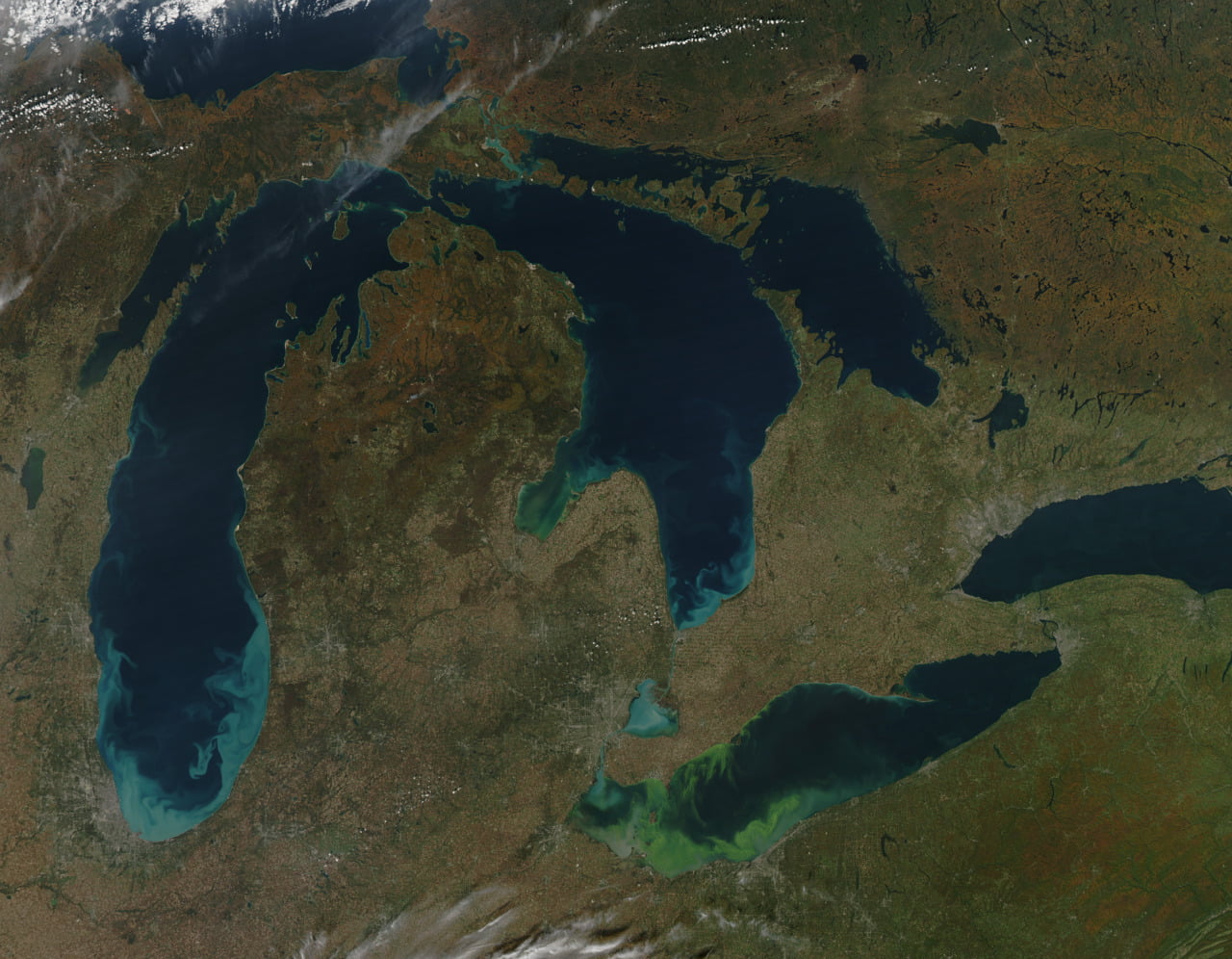
Swirls of blue in the Great Lakes mark locations of recent autumn storms whose winds have stirred up sediment in the lakes. The silt and quartz sand acts as a tracer particle, making visible the circulation patterns of the lakes. In contrast, the green streaks mark locations of calmer winds and warmer temperatures where algae blooms have grown. Note the fundamental dissimilarity in their structures. Blue eddies turn over and mix in a fashion reminiscent of convective instabilities while the green blooms are far more uniform in structure. #

Island Vortices
The von Karman vortex street isn’t just found in the wake of cylinders in a lab. Wind moving over islands frequently creates the effect, as in this MODIS Aqua image of the coast of Baja California, Mexico. #