Shovel-nosed snakes and sandfish lizards both swim through granular materials like sand. Researchers at Georgia Tech used x-rays to observe their subsurface motions. Despite their different shapes, the long, slender snake and the shorter, wider lizard both move under the sand by projecting traveling waves along their bodies. The snake’s long, skinny body allows it to have more bends along its length, which increases its transport efficiency because it allows the snake to move mostly through the tunnel created by its head’s passage. In contrast, the sandfish’s motions fluidize the sand around it, enabling it to swim. Although the snake is faster, both animals have optimized their motions for fast, low-energy transit according to their body type. (Video credit: Georgia Tech; research credit: S. Sharpe et al.; via io9)
Tag: sand

Dancing Sands
Here a collection of dry grains are vertically vibrated, creating a series of standing waves on the surface of the sand. The shapes of these Faraday waves are dependent upon the frequency of the vibration. Despite the solid nature of sand particles, this behavior is much the same as the behavior of a vibrated fluid.

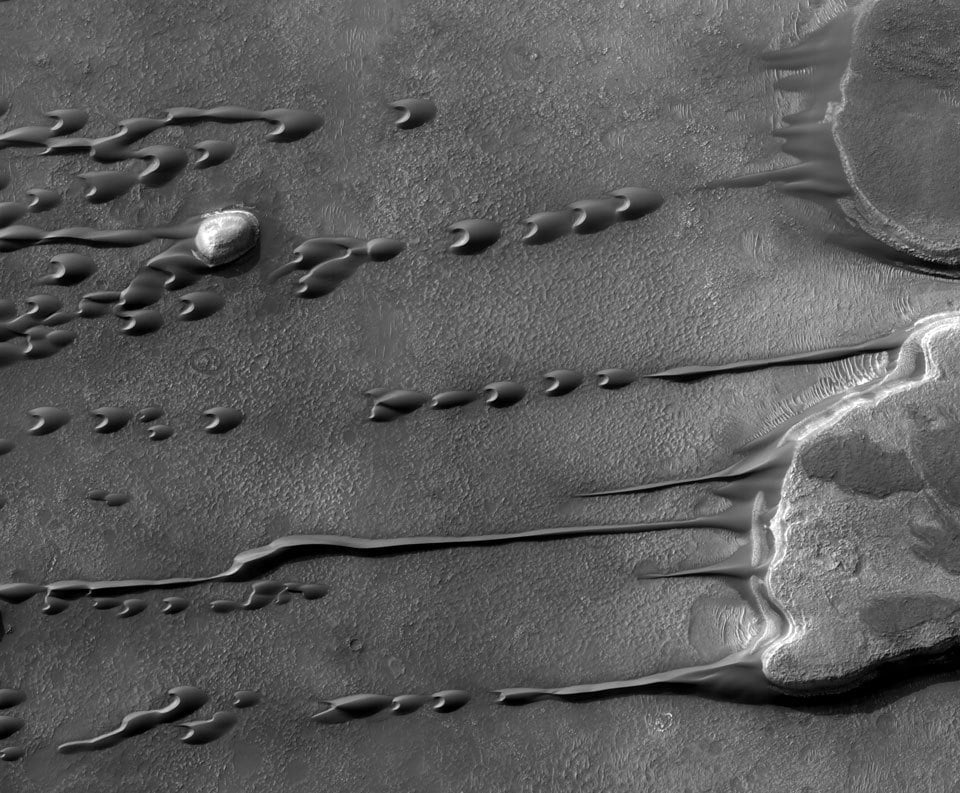
Barchan Dunes
The winds of Mars create sand dunes that seem to flow like a liquid across the planet’s surface. Here the wind blows from right to left around the flat top mesas on the right side of the image. The dark, arc-shaped dunes formed in the wake of the mesas are called barchans and can move downstream remarkably intact, even able to cross paths with other dunes. (Photo credit: MRO, NASA; via APOD)
Granular Eruptions
Granular flows, which are made up of loose particles like sand, often display remarkably fluid-like behavior. Here researchers explore the behavior of granular flows when a solid impacts them at high speed. The sand, unlike a fluid, does not have surface tension, yet we still observe many of the same behaviors. Like a fluid, the sand splashes and creates cavities and jets as it deforms around the fallen object. The sand even “erupts” as submerged pockets of air make their way back to the surface.

Singing Dunes
Some sand dunes can “sing”, but not because of the wind! When loose sand slides down over harder, packed sand, a standing wave is formed, causing the entire surface of the dune to vibrate on a single frequency. We hear this as a musical note – typically an E, F, or G. (via io9)
(Image credit: C. Larson)
Swimming Sandfish Lizards
Sandfish lizards can “swim” through granular flows like sand using an undulating, sinusoidal motion. Having studied this motion, engineers have built a robot that swims similarly through large glass beads and have now created a numerical simulation of the physics that matches the measured forces on the swimmer to within 8%. This type of flow is, in some respects, tougher than actual fluids because individual particles have to followed, while in most of fluid mechanics, we can use the continuum assumption to treat a liquid or gas as a continuous medium. #
Fluidized Sand
What’s shown in this video are some pretty spectacular demonstrations of fluidization, where a gas is introduced at the bottom of a bed of granular particles–like sand. At the critical gas velocity, the aerodynamic forces exerted on each particle by the gas will balance the gravitational force on the particle and it will become suspended. All of a sudden, the macroscopic behavior of the solid particles will be like that of a fluid; you can even make it “boil”!