Tag: renewable energy

  • Featured Video Play Icon

    Creating Biofuel

    One production technique for biofuel converts agricultural waste through pyrolysis. These systems heat biomass particles in a mixture of sand and nitrogen gas until the biomass particles release tar and syngas, a key ingredient of biofuel. All this heating and mixing takes place in a fluidized bed, where the injected nitrogen gas helps the particle mixture move like a fluid.

    Building prototypes of these systems can be costly, so industry has largely relied on computational studies to predict performance. But capturing the complicated physics behind turbulent gas and particle interactions is tough, and some models discard key information in favor of faster and cheaper simulations. In this study, the authors found that clustering between particles has a major effect on syngas production, something that industrial studies must account for. 

    This is one of the challenges of computational fluid dynamics; although the codes have become more and more accessible over time, getting reliable results still requires a solid understanding of the strengths and limitations of each model used. (Image, video, and research credit: S. Beetham and J. Capecelatrosource; submitted by Jesse C.)

  • Vertical Axis Wind Turbines

    Vertical Axis Wind Turbines

    Most people are familiar with the propeller-like shape of conventional wind turbines. These turbines can be more than 100m tall and can generate several megawatts apiece, but placing them in arrays requires a lot of open space because flow downstream of one turbine will interfere with the efficiency of the next. Vertical axis wind turbines (VAWT), like those shown in the photo above, are smaller and produce a fraction of the power of their larger horizontal-axis counterparts, but VAWTs can be placed much closer together. In fact, putting them in closely spaced arrays can actually increase their output through flow synergies. Researchers hope that eventually VAWT arrays will be able to produce significantly more power per land area than conventional wind turbines. (Image credit: Texas A&M Corpus Christi)

  • Tip Vortex

    Tip Vortex

    Smoke released from the end of a test blade shows the helical pattern of a tip vortex from a horizontal-axis wind turbine. Like airplane wings, wind turbine blades generate a vortex in their wake, and the vortices from each blade can interact downstream as seen in this video. These intricate wakes complicate wind turbine placement for wind farms. A turbine located downstream of one of its fellows not only has a decreased power output but also has higher fatigue loads than the upstream neighbor. In other words, the downstream turbine produces less power and will wear out sooner. Researchers visualize, measure, and simulate turbine wakes and their interactions to find ways of maximizing the wind power generated. (Photo credit: National Renewable Energy Laboratory)

  • Wave Tank

    Wave Tank

    A new wave tank facility opening at the University of Edinburgh promises new capabilities to simulate ocean wave behavior. The circular 25m diameter wave tank is lined with 168 wave makers and is equipped with 28 submerged flow-drive units. Together, these allow the tank to simultaneously simulate nearly any wave type as well as tidal currents up to 1.6 m/s. The facility is intended for 1/20th scale modeling; projected to full-size, this means that the tank is capable of making waves representative of 28 m high ocean waves and tidal currents in excess of 12 knots. It’s expected to be particularly valuable in the development and testing of wave and tidal motion generators for clean energy. For more, see BBC News and FloWave’s own website.  (Image credit: Brightspace/BBC News; submitted by srikard)

  • Featured Video Play Icon

    Harnessing Ocean Waves

    Ocean waves contain substantial amounts of energy, and many projects are underway to harness them as renewable energy sources. Most of these projects use the motion caused by waves to generate electrical energy. In this example, a flexible carpet is attached to hydraulic pumps. As the waves move over the carpet, it oscillates, raising and lowering the piston of the pumps. This adds hydraulic pressure to the discharge lines that run from the wave carpet to the shore. Once on dry land, that hydraulic pressure can be converted to electrical energy. This design addresses one of the major challenges in ocean-wave-energy technologies–namely how to safely transmit power from the wave farm to the shore. (Video credit: University of California Television)

  • Tubercles and Turbines

    Tubercles and Turbines

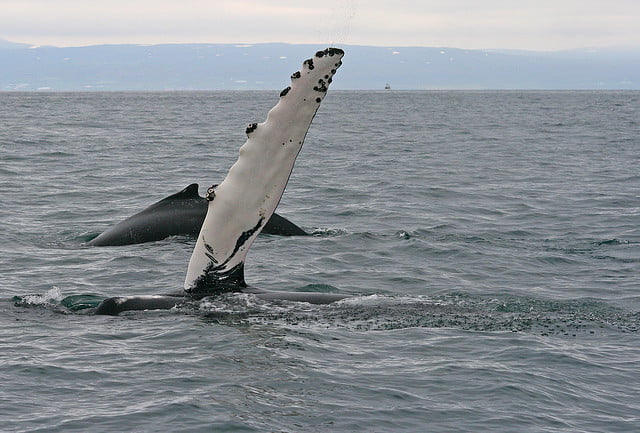
    The flippers of humpback whales include bumps–called tubercles–on their leading edges. The tubercles create vortices that prevent the boundary layer from separating, which causes stall and a loss of lift. New research shows that adding similar bumps to the leading edge of tidal turbine blades results in greater energy production at low flow speeds compared to conventional designs. See Scientific American for more. #