Tag: Rayleigh-Taylor instability

  • Liquid Antispiral

    Liquid Antispiral

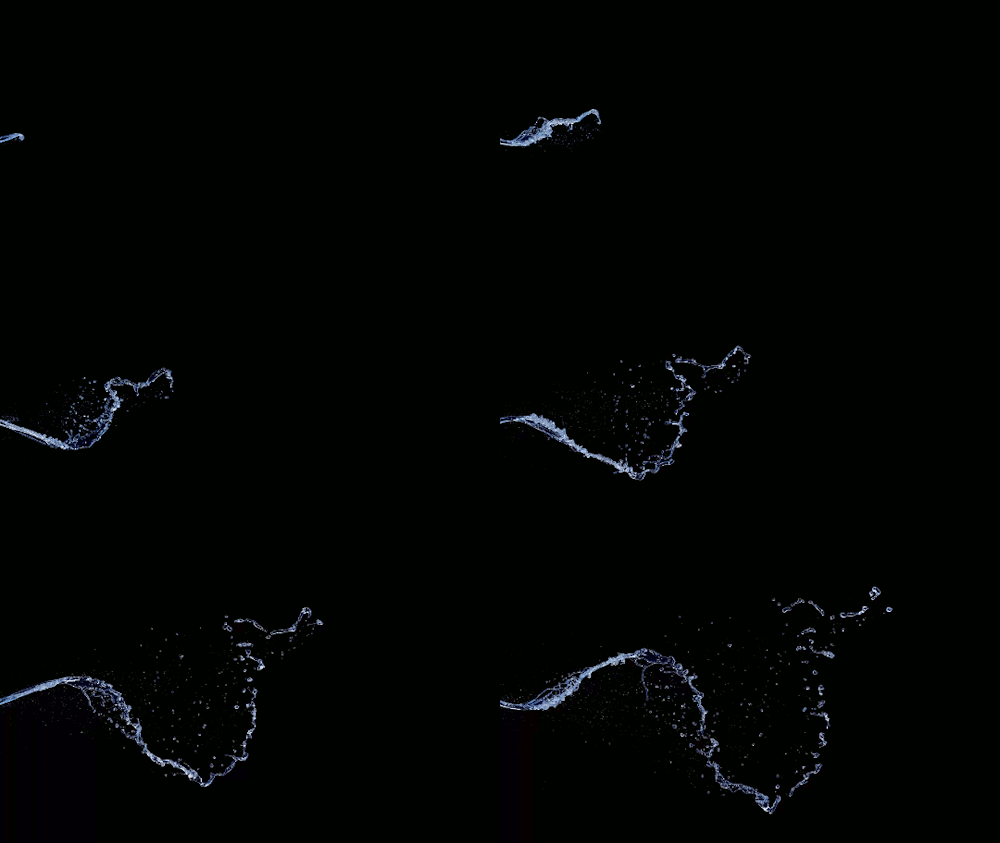
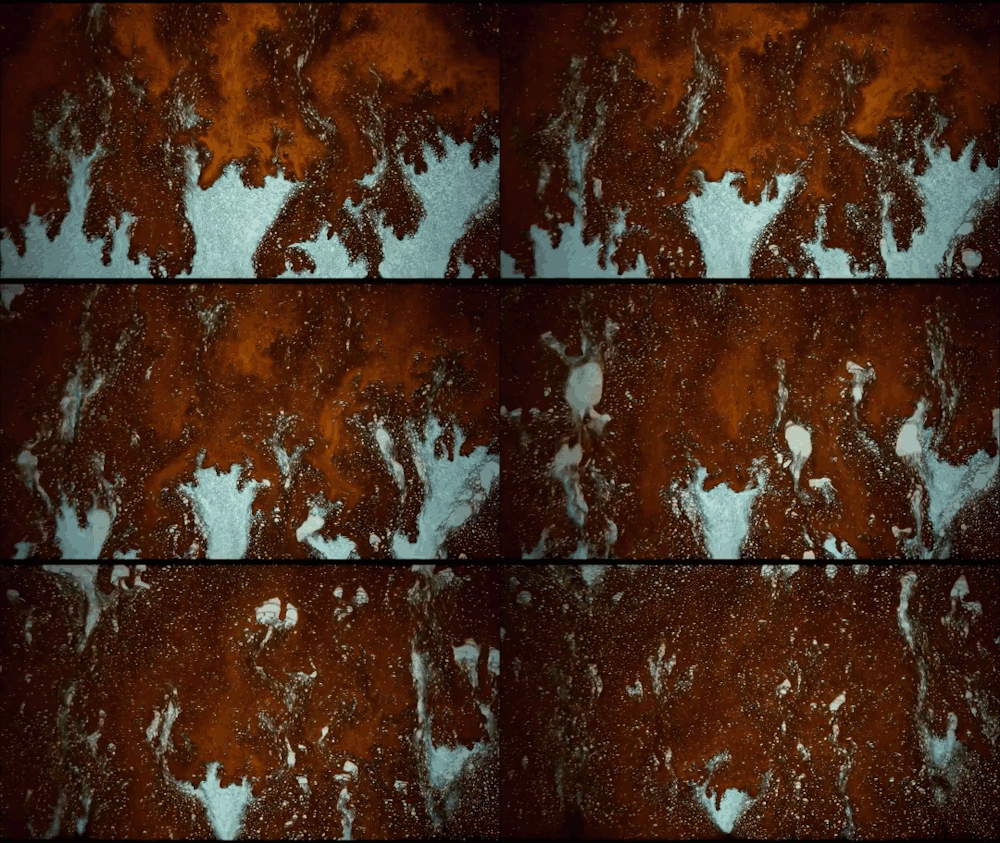
    Spiral formations are common in nature, from galaxies to chemical reactions. But most examples in nature rotate such that their arms trail the direction of rotation. Viewed side-on, this makes the arms appear to spiral outward from the the center. The opposite – an antispiral, where the arms appear to be drawn in toward the center – also exists, but there are far fewer examples. Which is why it’s notable that physicists have described a new one, seen above.

    You’re watching silicone oil draining through a plate with an array of holes in it. There’s a reservoir of oil on top supplying a constant flow rate. The patterns that form in this system vary widely – they can form between one and six arms – but the results are always antispirals. The driving mechanism seems to be the periodic nature of the discharge from individual holes, which is caused by a Rayleigh-Taylor instability. Hopefully systems like this can shed some light on why spirals are often preferred over antispirals. (Image and research credit: H. Yoshikawa et al.; via APS Physics)

  • Using Instabilities for Manufacturing

    Using Instabilities for Manufacturing

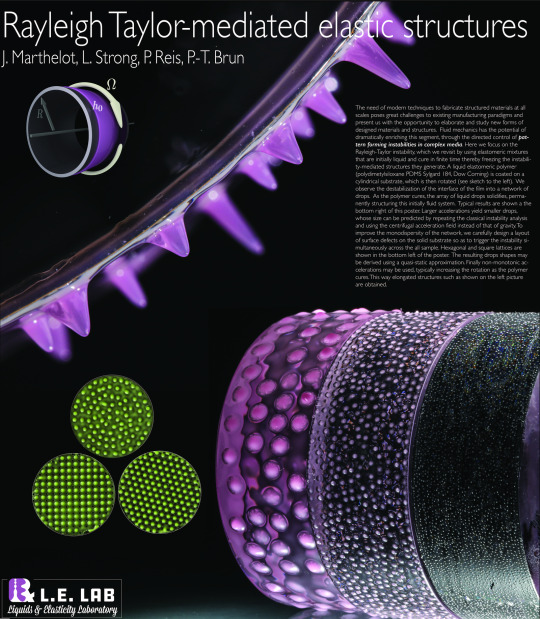
    Manufacturing textured, flexible surfaces can be difficult, but researchers are exploring ways to use fluid dynamical instabilities to make the process easier. They begin with a pourable polymer mixture that cures and solidifies over time. By putting the mixture on a cylinder and rotating it, engineers trigger the Rayleigh-Taylor instability – the same instability that makes dense fluids sink into lighter ones. Here, the instability is driven not only by gravity but by the added acceleration caused by centrifugal force. It causes the fluid film to drain and form arrays of droplets, which then cure into dimples. The researchers can control the size, shape, and spacing of the droplets by changing parameters like the spin rate. And by repeating the process multiple times on the same piece, they can build up spikier shapes, like the ones shown on the poster below. (Image and research credit: J. Marthelot et al., poster)

    image

    Reminder for those at the APS DFD meeting! My talk is tonight at 5:10PM in Room B206. You’ll probably want to come early if you want a seat!

  • Bringing the Stars Home

    Bringing the Stars Home

    One of my favorite aspects of fluid dynamics is the way that the same patterns and phenomena appear over and over again – sometimes in the most unexpected places. That’s the theme of my new article in American Scientist, which focuses on the connections between our daily lives and the stars:

    “Solar energy arises from nuclear fusion reactions in the core, but that energy is buried hundreds of thousands of kilometers beneath the surface, and most of the Sun’s overlying gas is nearly opaque; it hinders light from passing through, like a blanket thrown over a flashlight. Clearly the Sun does shine—but how? For the answer, you can simply go to your kitchen, fill a kettle, and flip on a burner.” #

    Click-through to read the full article. (Image credit: N. Sharp, Big Bear Solar Observatory, J. Blom, NASA/ESA, J. Straccia, NASA/JPL/B. Jonsson)

  • Featured Video Play Icon

    “Le Temps”

    Thomas Blanchard is back with another beautiful music video. This one features ink cascading over various shapes underwater. Lots of tiny mushroom-shaped Rayleigh-Taylor instabilities here caused by the ink’s greater density compared to the surrounding water. There are also some lovely examples of transitional flow, especially around the spheres. Initially, flow over the spheres looks completely smooth and laminar. But, on the latter half of the sphere, where the flow is under increasing pressure, you see disturbances growing until little fingers of ink break away entirely. Be sure to watch the whole video; you don’t want to miss this! (Video and image credit: T. Blanchard)

  • Convection Without Heat

    Convection Without Heat

    We typically think of convection in terms of temperature differences, but the real driver is density. In the animations above, cream sitting atop a liqueur is undergoing solutal convection – no temperature difference needed! The alcohol in the liqueur mixes with the cream to form a lighter mixture that rises to the surface. The lower surface tension of the alcohol is also good at breaking up the cream, forming little cells. As the alcohol in those cells evaporates, the cream gets heavier and sinks down into the liqueur, where it can pick up more alcohol, rise back to the surface, and begin the cycle again. (Image credit: J. Monahan et al., source)

  • Breaking With a Wave

    Breaking With a Wave

    For rocket combustion and other applications, like watering your lawn with a hose, a stream of fluid may need to be broken up into droplets. While simply spraying a liquid jet will make it break up, waving that jet back and forth will break it up faster. A recent study simulated this problem numerically to determine the exact mechanisms driving that break-up. The researchers found two major culprits.

    The first is a Kelvin-Helmholtz, or shear-based, instability. When a jet leaves the nozzle, there’s friction between it and the comparatively still air surrounding it. This creates tiny ripples in the surface that eventually grow into the distortions we can see, and it’s found in all jets, regardless of their side-to-side motion.

    The second culprit, which is only found in the oscillating jet, is a Rayleigh-Taylor instability. By moving the jet side-to-side, you’re driving the dense liquid into less dense air, which creates a different set of disturbances that also help break up the jet. The final result: swinging the jet side-to-side breaks it into smaller droplets faster. (Image and research credit: S. Schmidt et al.)

  • Featured Video Play Icon

    “Water Ballet”

    Artist Kamiel Rongen uses common substances like paint, oil, eggs, and even air freshener to create what he calls “water ballet.” His videos are full of ethereal and surreal landscapes full of color and motion. Buoyancy (or the lack thereof) plays a major role in his work – fluids often spurt upward like alien creatures emerging from a chrysalis. I’ve been debating with myself whether the fluids are actually rising or if they’re falling in front of an upside-down camera, and I’m not completely certain either way! I think that’s a testament both to Rongen’s artistry and to the awesome physics involved. Check out the full video below and you can see many more examples of Rongen’s work on his website. (Image and video credit: K. Rongen; h/t to James H.)

  • Dissolving Candy

    Dissolving Candy

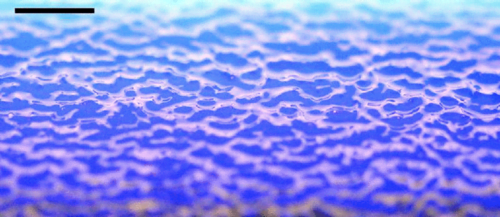
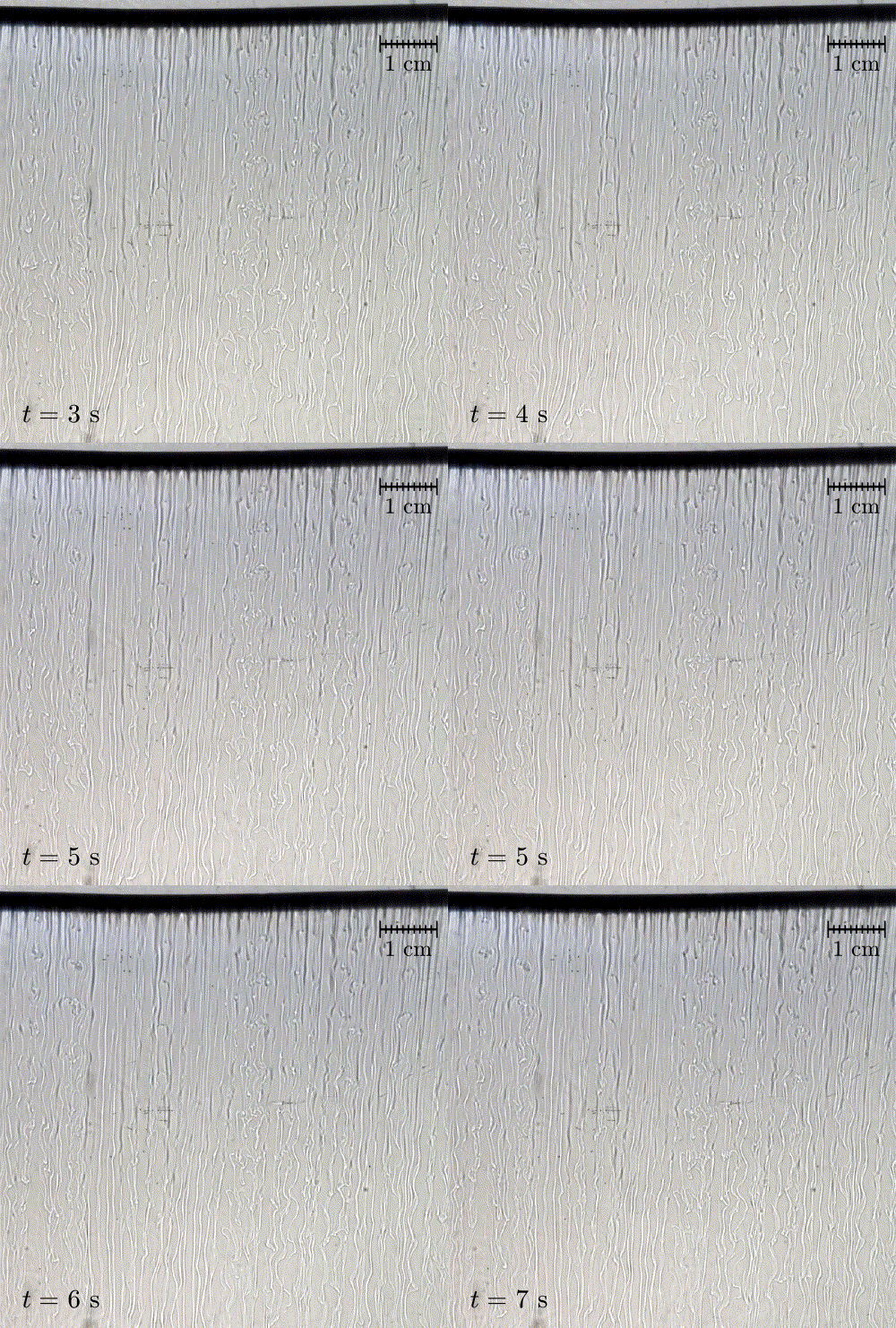
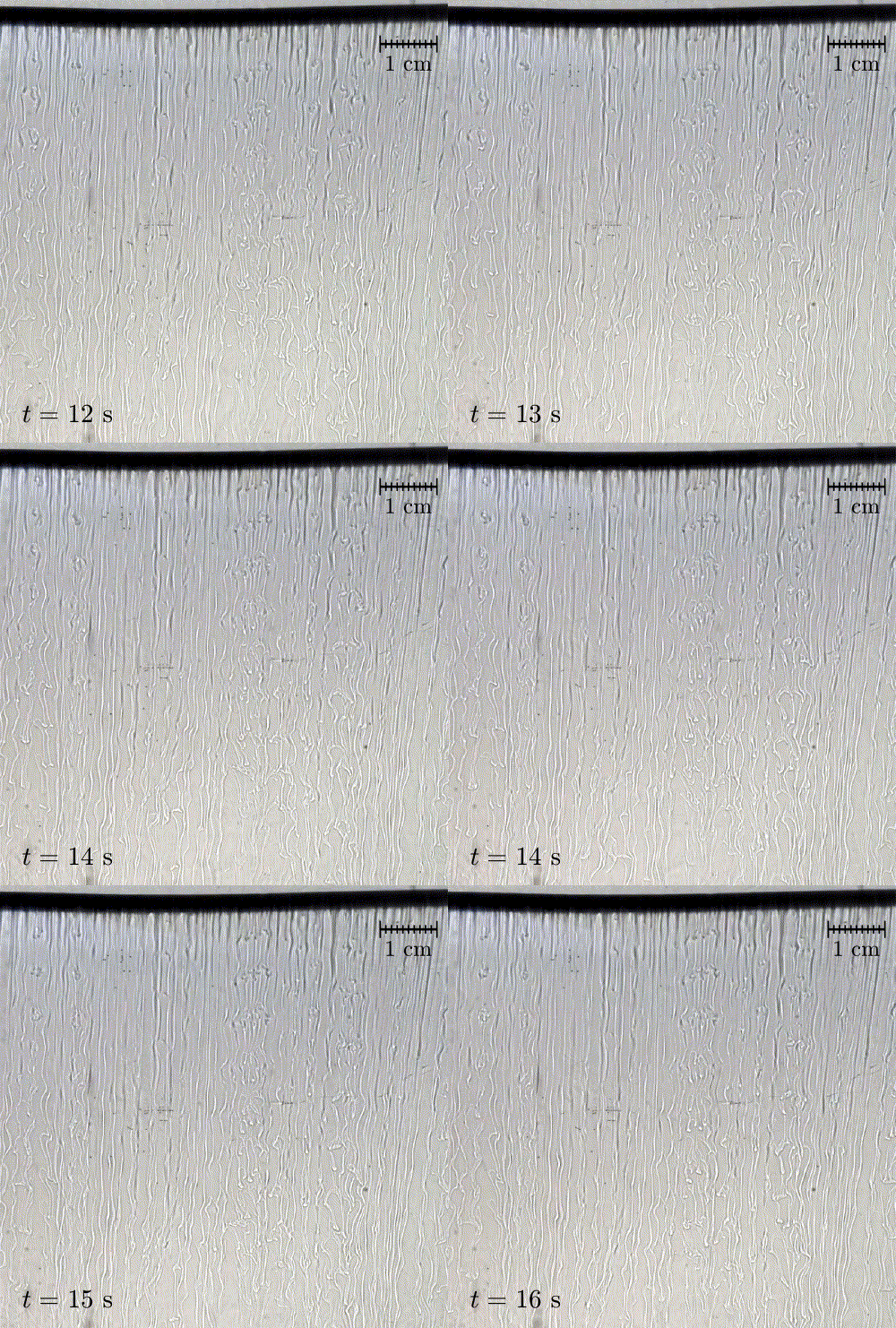
    In nature, solid surfaces often evolve over time in conjunction with the flows around them. This is how stalactites, canyons, and hoodoos all form and change over time. Here researchers examine a surface formed from hard candy that is dissolving from below. Over time, the initially flat surface develops a pitted appearance (top image, scale bar is 1 cm) with roughness that is approximately 1 mm in scale. Flow visualization (bottom row) suggests that these pits result from local flow where narrow, millimeter-sized dense plumes fall away from the surface. 

    As material dissolves from the candy, it forms a dense layer of sugar-water mixture near the solid surface. Once that layer grows to a critical thickness, it will be too unstable for viscosity to counter. At that point, the Rayleigh-Taylor instability takes over, causing the dense sugar-water layer to break up into narrow, sinking plumes. Although each area is evolving independently, the rate at which material dissolves is uniform everywhere, so the dissolving body retains the same shape over time. (Image and research credit: M. Davies Wykes et al., source)

  • Impressionist Foams

    Impressionist Foams

    Imagine taking two panes of glass and setting them in a frame with a small gap between them. Then partially fill the gap with a mixture of dye, glycerol, water, and soap. After turning the frame over several times, the half of the frame will be filled with foamy bubbles. When you flip it again, the dyed glycerol-water will sink and penetrate the bubble layer, creating complex and beautiful patterns as it mixes. Some of the bubbles may get squeezed together until they coalesce into larger bubbles that shoot upward thanks to their increased buoyancy. Other smaller bubbles will wend their way upward as neighboring fluid shifts. If you examine the tracks left by individual bubbles, you can find patterns reminiscent of Impressionist paintings, as seen at the end of this Gallery of Fluid Motion video. (Image credit: A. Al Brahim et al., source)

  • Featured Video Play Icon

    “Ink in Motion”

    In this short film, the Macro Room team plays with the diffusion of ink in water and its interaction with various shapes. Injecting ink with a syringe results in a beautiful, billowing turbulent plume. By fiddling with the playback time, the video really highlights some of the neat instabilities the ink goes through before it mixes. Note how the yellow ink at 1:12 breaks into jellyfish-like shapes with tentacles that sprout more ink; that’s a classic form of the Rayleigh-Taylor instability, driven by the higher density ink sinking through the lower density water. Ink’s higher density is what drives the ink-falls flowing down the flowers in the final segment, too. Definitely take a couple minutes to watch the full video. (Image and video credit: Macro Room; via James H./Flow Vis)