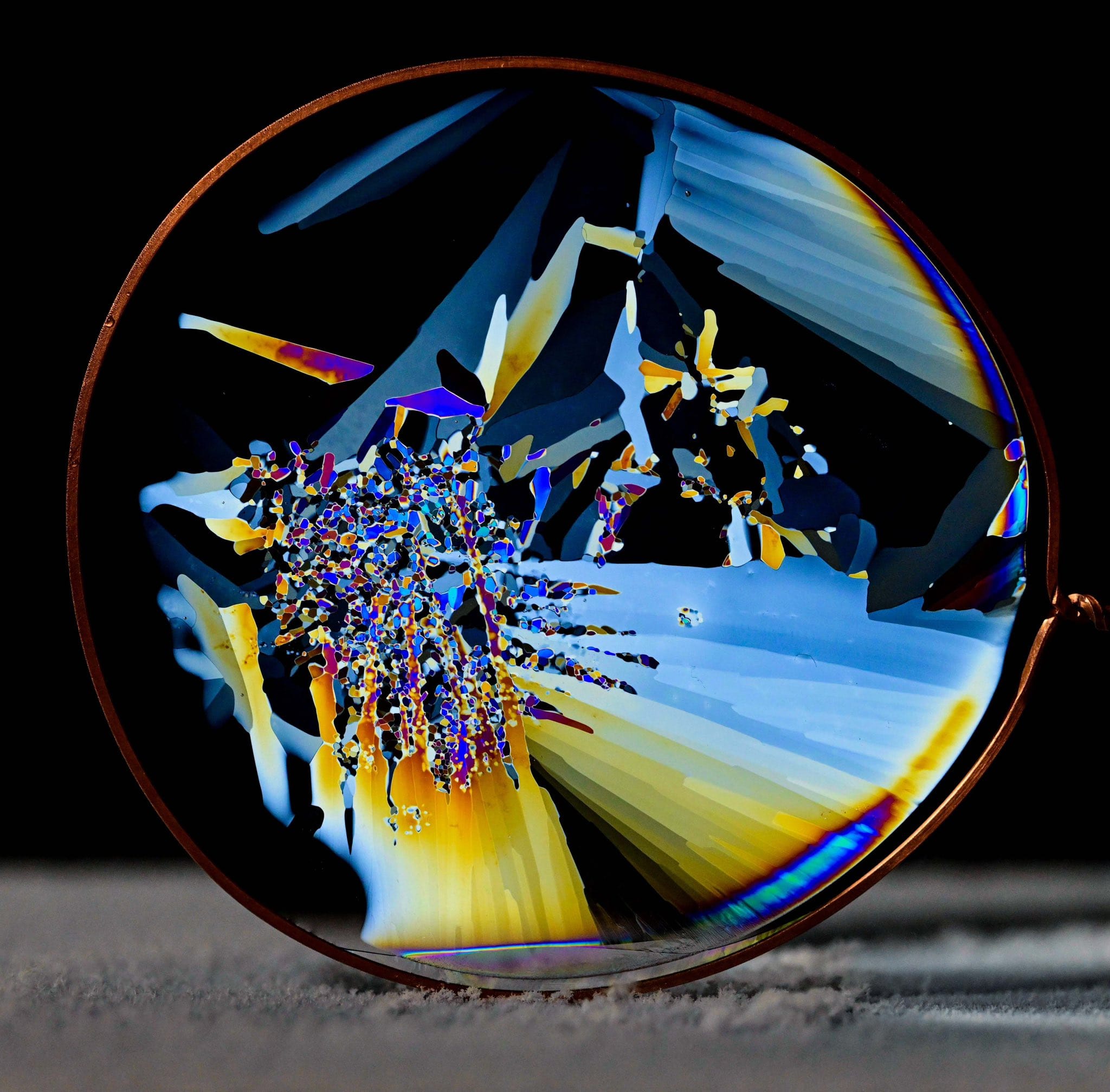
Astronaut Don Pettit is back in space, and that means lots of awesome microgravity experiments. Here, he grew thin wafers of ice in microgravity in a -95 degree Celsius freezer. Then he took the ice wafers and photographed them between crossed polarizers, creating this colorful image. The colors highlight different crystal orientations within the ice and give us a hint about how the freezing front formed and expanded. I can’t wait to see more examples! (Image credit: D. Pettit/NASA; via Ars Technica; submitted by J. Shoer)
Tag: polarized light

An Intro to Liquid Crystals


There’s a good chance that the screen you’re using to read this uses liquid crystals, but how much do you know about this ubiquitous technology? Liquid crystals are fluids made up of molecules that orient into crystalline structures. Their usefulness for displays comes from the way they interact with light, changing the polarization of light based on their orientation. This Lutetium Project video is a great introduction to liquid crystals and some of their important properties, and, as always with LP videos, the journey is a beautiful one. (Image and video credit: The Lutetium Project)
Want to learn how to promote your research in traditional media and online? This Friday Tom Crawford and I are presenting a free webinar on the topic as part of the Fluid Mechanics Webinar Series. Be sure to register ahead of time for the link and tune in at 4pm GMT (11am EST) on Friday. See you there!
Colorful Dissipation


Colorful eddies swirl in this short video from photographer Karl Gaff. Formed near the boundary at the bottom of the frame, these eddies act to dissipate some of the energy in the flow. Structures like these are key in turbulent flows, where energy must pass from large eddies to smaller and smaller ones until they reach a size where viscosity can extinguish them. (Video, image, and submission credit: K. Gaff)
P.S. – Today’s post is FYFD’s 2,500th! Crazy, right? That means we have a pretty enormous archive. Want to explore? Click here for a random post.
Visualizing Fish Wakes
This novel flow visualization technique uses dilute solutions of the tobacco mosaic virus (TMV). These rod-shaped particles align with shear and produce a birefringent interference pattern visible when viewed between crossed polarizing filters. The intensity of the light is related to the magnitude of shear. The technique is benign to the fish but enables researchers to see fluid motion around fish that other techniques cannot capture. #
Flow Visualization
[original media no longer available]
This video gives a neat introduction to some common and uncommon techniques used to visualize fluid flows.


