The ESA’s Solar Orbiter captured this beautifully detailed video of our sun‘s corona last September. The Solar Orbiter took this footage from about 43 million kilometers away, a third of the distance between the sun and the Earth. Scattered across the visible surface are fluffy, lace-like features known as coronal moss. Along the curving horizon, gas spires called spicules stretch up to heights of 10,000 kilometers. The video also highlights a “small” eruption of plasma that is nevertheless larger than the entire Earth. We can even see evidence of coronal rain, denser and darker clumps of plasma that gravity pulls back toward the sun. (Video and image credit: ESA; via Colossal)

Tag: plasma

Our Sun’s Corona Unfurled
This clever image is actually two solar eclipses stacked atop one another. The bottom half of the image shows the sun‘s corona — its wispy, dramatic outer atmosphere — during the a 2017 total solar eclipse, and top half shows a 2023 total solar eclipse. In both, the corona has been unwrapped from around the sun’s circumference and project instead into a rectangle.
The 2017 eclipse took place near the minimum of the sun’s solar cycle and appears relatively tranquil. The 2023 eclipse, in contrast, came near solar cycle’s maximum and shows a far more chaotic and turbulent environment. Notice the bright pink solar prominences dotting the mid-line and the field of shadowy plasma loops above them. (Image credit: P. Ward; via APOD)

“Emerald Roots”
As charged particles from the solar wind bombard the upper atmosphere, a glowing plasma forms and dances in the sky. The green light of the plasma reflects off moistened sand, rippled by the passage of wind and tide. Each component seems simple, but this striking image contains hidden depths of fluid dynamics. Magnetohydrodynamics govern the aurora’s dance; the sand’s self-organization mirrors dune physics; and even the rocky outcropping in the background was carefully shaped by erosive forces from wind and water. Truly, fluid dynamics are found everywhere. (Image credit: L. Tenti; via 2023 Astronomy POTY)

“A Sun Question”
The sun‘s surface and atmosphere are endlessly dynamic, with magnetic lines, plasma, and convection creating a constant churn. In this photo by astrophotographer Eduardo Schaberger Poupeau, a curving question-mark-like filament appears above the sun’s surface. Even with decades of high-resolution data from recent solar probes, we struggle to understand the complex physics that feed structures like these. (Image credit: E. Poupeau; via 2023 Astronomy POTY)

Lagoon Nebula
Some 4,100 light years away in the Sagittarius constellation, a stellar nursery births new stars. Known as Messier 8, or the Lagoon Nebula, this region is one of the most visible nebulas from Earth. It is filled with turbulent gases and dark strands of dust. Near the centerline of the image is the bright, hourglass shape of the NGC 6530 star cluster. Its intense ultraviolet light ionizes surrounding gases, creating the distinctive red glow surrounding the nebula. (Image credit: J. Drudis and C. Sasse; via APOD)

Red Sprites
Sprites, or red sprites, are high-altitude electrical discharges in the atmosphere. Although sometimes called upper-atmospheric lightning, sprites are a cold plasma phenomenon. They often occur in clusters, as in this photo by Angel An, which won in the Skyscapes category of the 2023 Astronomy Photographer of the Year competition. Sprites, which last only a millisecond or so, take place during intense thunderstorms, but, unlike our more familiar lightning, sprites move upward from the storm toward the ionosphere. They can occur on Venus, Saturn, and Jupiter as well, although sprites have only been observed directly on Earth and Jupiter. (Image credit: A. An; via Colossal)

Solar Coronal Heating
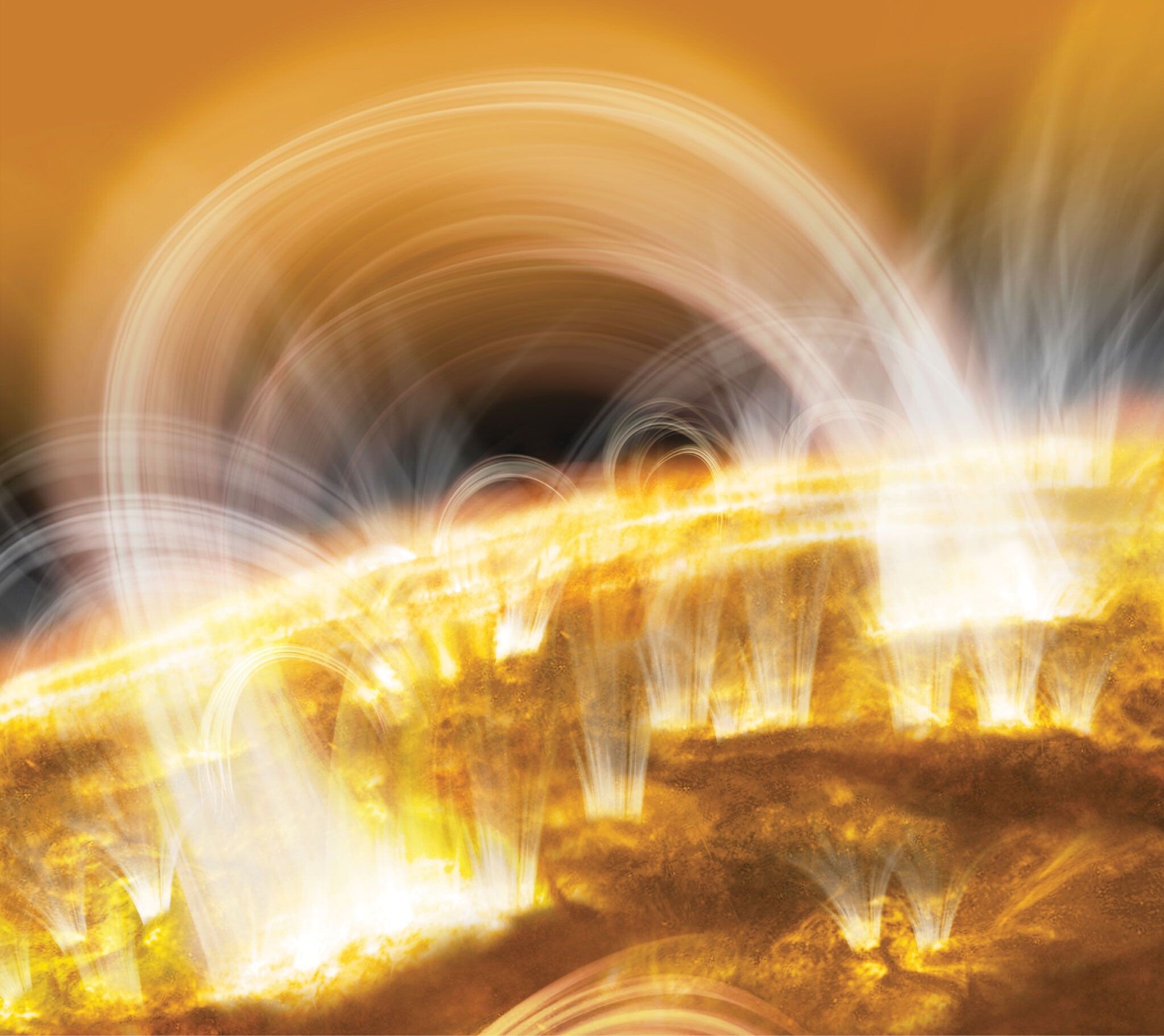
Our Sun‘s visible surface, the photosphere, is about 5800 Kelvin, but the temperature of the wispy corona is far hotter, reaching a million Kelvin in some places. Why the corona is so hot remains something of a mystery. Scientists have theorized multiple culprits for the extreme temperatures found in the corona, but the full details of the phenomenon are still unclear.
Recent solar missions and observations are increasingly identifying small but widespread solar activities, like the nanoflares shown above. Unlike the monstrous coronal loops researchers focused on previously, these flares are tiny and occur in regions without discernible solar flare activity. The nanoflares are brief but they can reach temperatures above a million Kelvin. Since nano- and even picoflares have been observed across the full Sun, they likely play a significant role in the overall picture of coronal heating. (Image credit: ISAS/JAXA; see also L. Sigalotti and F. Cruz)

“Fusion of Helios”
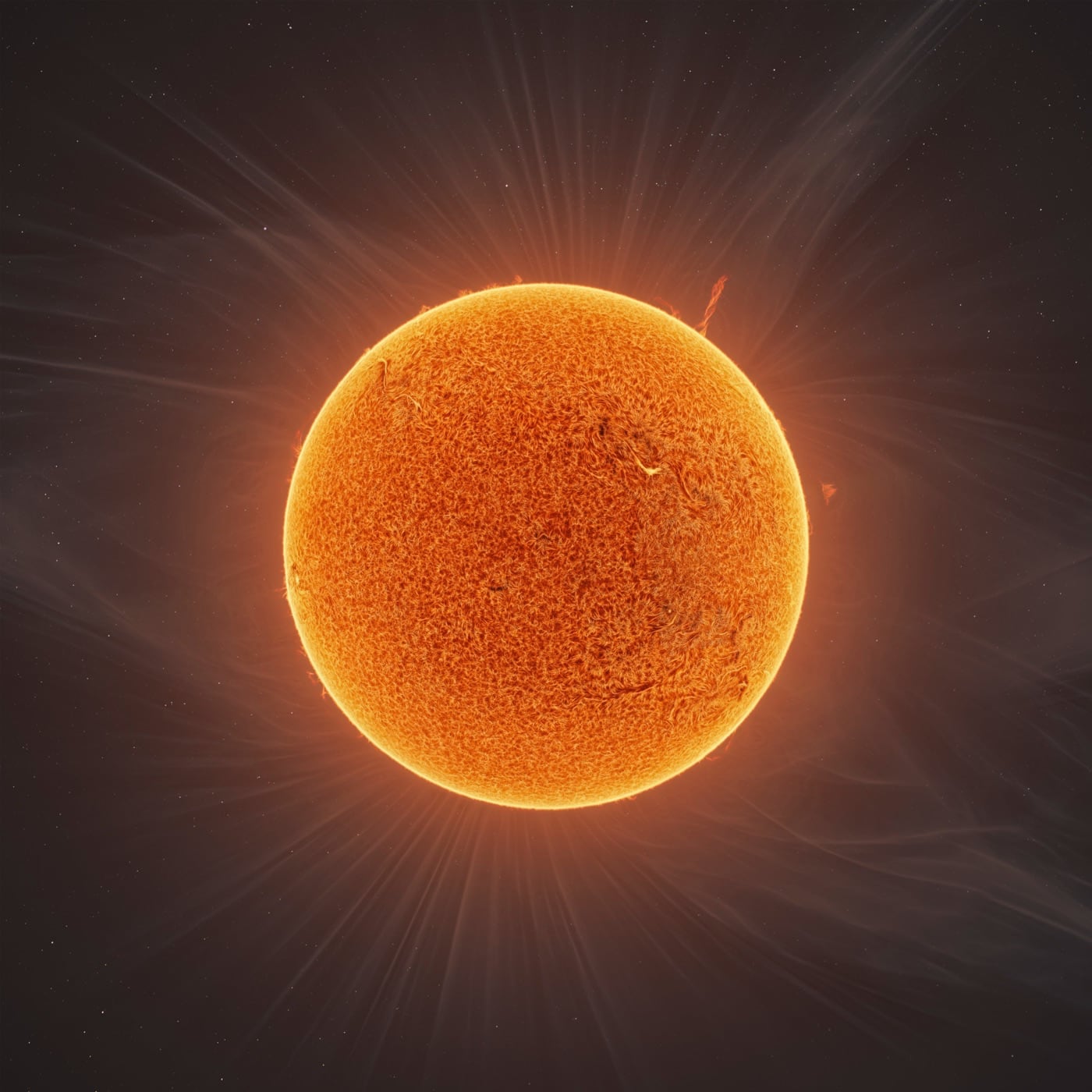
Built from approximately 90,000 individual images, “Fusion of Helios” reveals the wisp-like corona of our Sun. Astrophotographers Andrew McCarthy and Jason Guenzel joined forces to combine eclipse images with data from NASA to build this fusion of art and science. Jets of plasma, known as spicules, dot the sun’s surface, and a towering tornado of plasma shoots off one side. For scale, that vortex stretches as far as 14 Earths stacked atop one another. (Image credit: A. McCarthy and J. Guenzel; via Colossal)

Escaping the Sun
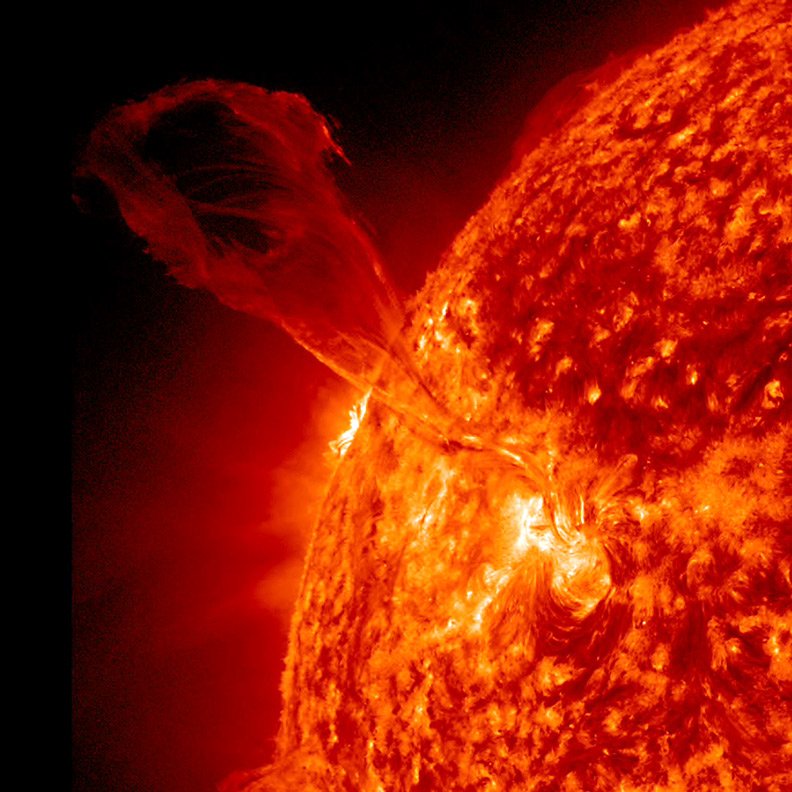
One enduring mystery of the solar wind — a stream of high-energy particles expelled from the sun — is how the particles get accelerated in the first place. The sun frequently belches out spurts of plasma, but without further momentum, that material simply falls back to the sun’s surface under the star’s gravity. Mechanisms like shock waves can further accelerate particles that are already moving quickly, but they cannot explain how the particles get going in the first place.
A recent study used supercomputers to tackle this challenging problem in turbulent plasma physics. Each simulation tracked nearly 200 billion particles, requiring tens of thousands of processors. The results showed that turbulence itself provides the necessary initial acceleration and serves as the first step to getting particles moving fast enough to escape the sun. (Image credit: NASA SDO; research credit: L. Comisso and L. Sironi; via Physics World)

Coronal Heating
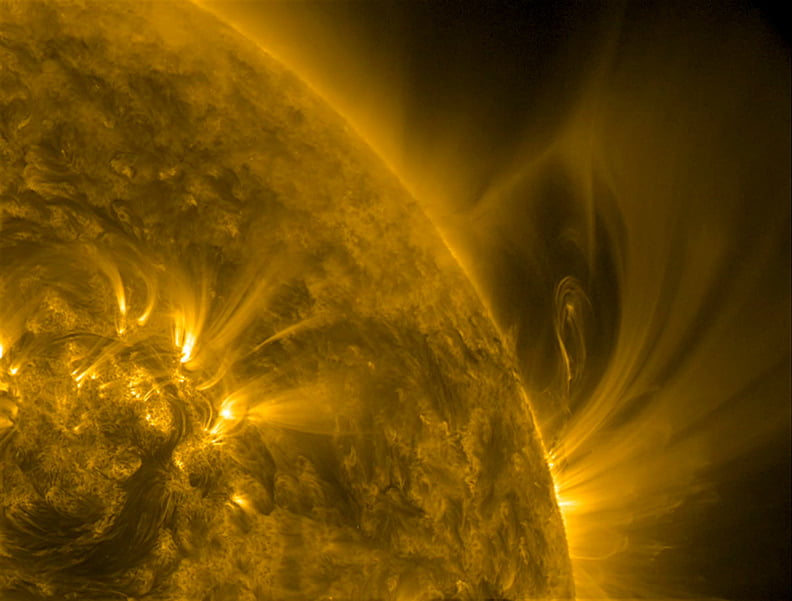
Compared to its interior, the surface of our sun is a cool 6,000 degrees Celsius. But beyond the surface, the sun’s corona heats up dramatically through interactions between plasma and strong magnetic fields. The exact mechanisms of this interaction have been mostly theoretical thus far, but a recent laboratory experiment has validated a part of that theory.
One explanation for coronal heating posits that the strong magnetic fields can accelerate magnetohydrodynamic waves called Alfvén waves to speeds faster than sound, and that at this crossover point, changes occur in the waves’ behavior. Using liquid rubidium, researchers were able to observe this crossover under laboratory conditions, confirming that the Alfvén waves change at the speed of sound in exactly the manner predicted by theory. (Image credit: NASA SDO; research credit: F. Stefani et al.; via Physics World)