Tag: plants

  • Mimicking Plant Movement

    Mimicking Plant Movement

    Many plants control the curvature of their leaves by selectively pumping water into cells that line the outer surface. This swelling triggers bending. Engineers created their own version of this structure by 3D-printing trapezoidal shapes onto a fabric. Then, they heat sealed a second layer of fabric over this, creating airtight channels. When inflated, these channels make the structure bend, allowing them to create complex shapes by selectively inflating different areas. (Image credit: T. Gao et al.; via GoSM)

  • Spreading the Word

    Spreading the Word

    Just as prairie dogs bark to warn the colony of danger, many plants can signal their neighbors when they’re under attack. This thale cress releases calcium when caterpillars eat it; neighboring plants pick up the chemical signal and pass it along. To better understand how the signal gets passed, researchers genetically modified this plant to fluoresce when extra calcium is on the move. It’s incredible to watch the flow from one side of a leaf to another. (Image and research credit: Y. Aratani et al.; via Colossal)

  • Dandelion Seeds

    Dandelion Seeds

    Each seed on the head of a dandelion has a preferred wind direction, according to new research. Seeds facing the breeze are most likely to release from the head, with those facing other directions holding on tens to hundreds of times harder — until their breeze comes along. To measure the force needed to pluck a dandelion seed, researchers superglued a fine wire to individual seeds and pulled from different directions. This seed-by-seed removal mimics winds from varying angles and allowed the researchers to test the directional dependence of seed release. With seeds poised to release in every direction, the dandelion ensures its successful spread. (Image credit: S. Chaudhry; research credit: J. Shields and C. Roh; via Science News; submitted by Kam-Yung Soh)

  • Featured Video Play Icon

    “Reconfiguring It Out”

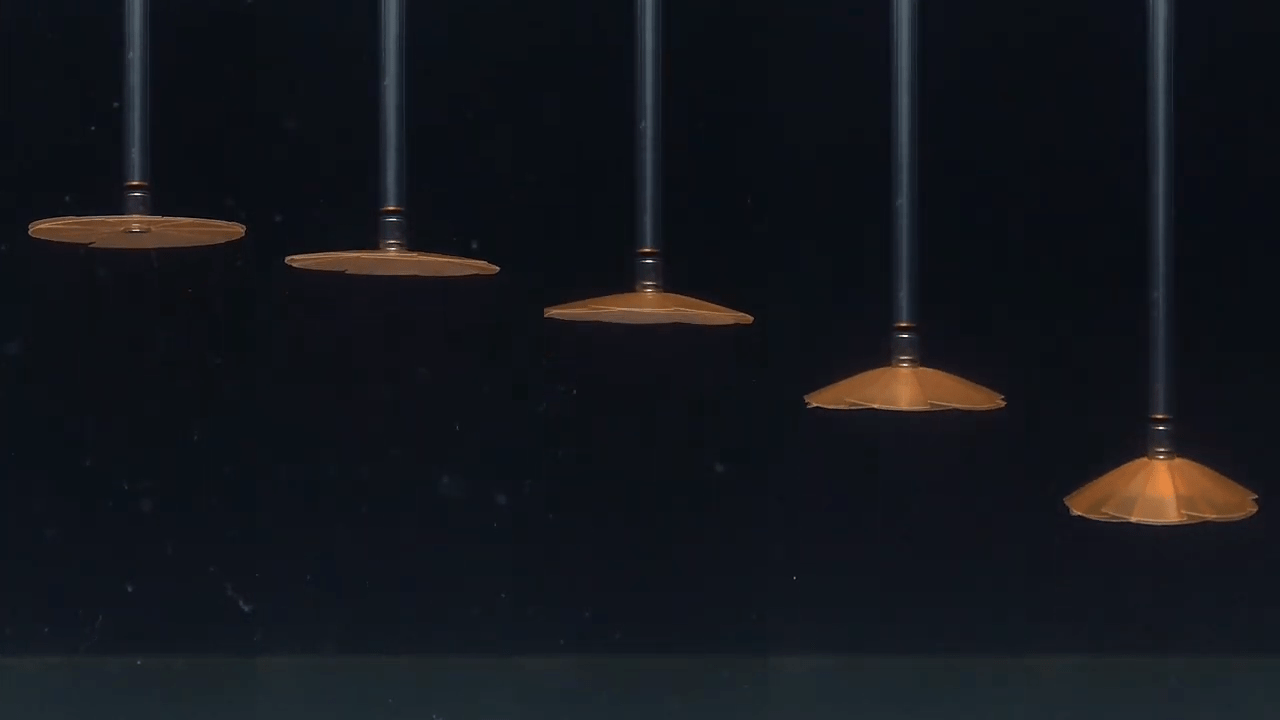
    Leaves flutter and bend in the breeze, changing their shape in response to the flow. Here, researchers investigate this behavior using flexible disks pulled through water. The more flexible the disk and the faster the flow, the more cup-like the disk’s final shape. Adding tracer particles to the water allows them to visualize the flow behind the disk. Every disk leaves a donut-shaped vortex ring spinning in its wake, but the more reconfigured the disk, the narrower the vortex. This, ultimately, reduces drag on the disk. That’s why trees in heavy winds streamline their branches and leaves; that flexibility lowers the drag the tree’s roots have to anchor against. (Image and video credit: M. Baskaran et al.)

  • Rain-Driven Prey Capture

    Rain-Driven Prey Capture

    Pitcher plants often entice their insect victims with sweet nectar before trapping them in inescapable viscoelastic goo. But some species go even further. Nepenthes gracilis, a species native to Southeast Asia uses its leafy springboard to lure its prey. Once an ant crawls to the underside of the leaf, a falling rain drop will spell its doom. When drops hit the leaf, it deflects down and jerks up, thanks to its shape and stiffness. The motion catapults insects into the pitcher, where digestive fluids await. While we’ve seen some fast-moving plants before, this is a rare example of a plant with an externally-driven speed mechanism. With it, the pitcher plant doesn’t have to wait or expend any metabolic effort to reset for the next insect. (Image credit: GFC Collection/Alamy; research credit: A. Lenz and U. Bauer; via New Scientist)

  • Featured Video Play Icon

    “The Green Reapers”

    This short film from artist Thomas Blanchard focuses on carnivorous plants and their prey. These plants — including Venus fly traps, sundews, and pitcher plants — rely on fluids both to attract and capture their prey. Plants like the Venus fly trap build turgor pressure in their cells to move and prop open their leaves. Once triggered, a mechanical release allows the fluid pressure to snap the trap closed. Sweet-smelling fluids invite insects in, only to become nightmarishly difficult to escape once prey try to unstick themselves from the highly viscoelastic liquids. (Video and image credit: T. Blanchard; via Colossal)

  • Marshland Wave Damping

    Marshland Wave Damping

    Coastal marshes are a critical natural defense against flooding. The flexible plants of the marsh both slow the water’s current and help damp waves. As a result of that hydrodynamic dissipation, marshes help protect against erosion and reduce the magnitude of flooding events. But coastal managers looking to maintain or improve their marshes in order to mitigate climate-change-driven storms need to be able to predict what level of vegetation they need.

    To that end, a team of researchers has built a new model to better capture the flow effects of marsh grasses. Building from an individual, flexible plant (as opposed to a rigid cylinder, as grass is often represented), the authors constructed a model able to predict wave dissipation for many marsh configurations, which should help better predict the infrastructure changes needed in different coastal regions. (Image credit: T. Marquis; research credit: X. Zhang and H. Nepf; via APS Physics)

  • Featured Video Play Icon

    Why Watering Globes Are Hard to Fill

    If you’re leaving home for a few days and want to keep your houseplants happy, you may have tried using a watering globe – those glass bulbs with long stems that slowly release water for your plant. And if you have used one, you’ve probably noticed what a pain it can be to fill. Pour water down the neck too quickly and you’ll get splashed by a sheet of water blown back at you.

    That splashback happens for the same reason that blowing across the top of a bottle plays an audible note: you’re compressing the air inside the container. When water tries to pour continuously down the watering globe’s neck, it can block the escape path needed by the air already in the globe. The increasing weight of water atop that volume of air compresses it, raising its pressure until it’s eventually high enough that it blows all the water back out the neck and into your face.

    The best method to ensure that doesn’t happen is to fill the globe slowly. Try tilting it at an angle and letting only a small stream of water fall into it such that there’s always an escape route for the air. (Image and video credit: E. Challita et al.)

  • Featured Video Play Icon

    Sundews Weaponize Viscoelasticity

    In nutrient-poor soils, carnivorous plants like the cape sundew supplement their diets by eating insects. To entice their prey, the cape sundew secretes droplets of sugary water. But unwary insects who land to feed soon find themselves unable to pull away from this viscoelastic liquid. Complex molecules in the fluid grant it elasticity, so when insects pull against it, the liquid stretches and pulls back instead of breaking up. Other carnivorous plants, like the pitcher plant, use similar non-Newtonian tricks to trap insects. (Video and image credit: Deep Look)

  • Mossy Vortex Rings

    Mossy Vortex Rings

    Many plants have evolved an ability to move remarkably quickly. Often, this capability is driven by water. Here we see the moss Sphagnumaffine, which disperses its spores explosively. The process is triggered by the spore capsule gradually drying out; its shape changes from round to cylindrical, pressurizing the capsule. Once the internal pressure is high enough to overcome the strength of the capsule’s upper membrane, the capsule bursts, sending a plume of spores aloft. The sudden release of spore-laden air forms a vortex ring, which lifts the spores higher far more efficiently than they would be otherwise. (Image credit: capsule dry-out – J. Edwards et al., spore dispersal – J. Edwards et al. 2010; research credit: J. Edwards et al.)