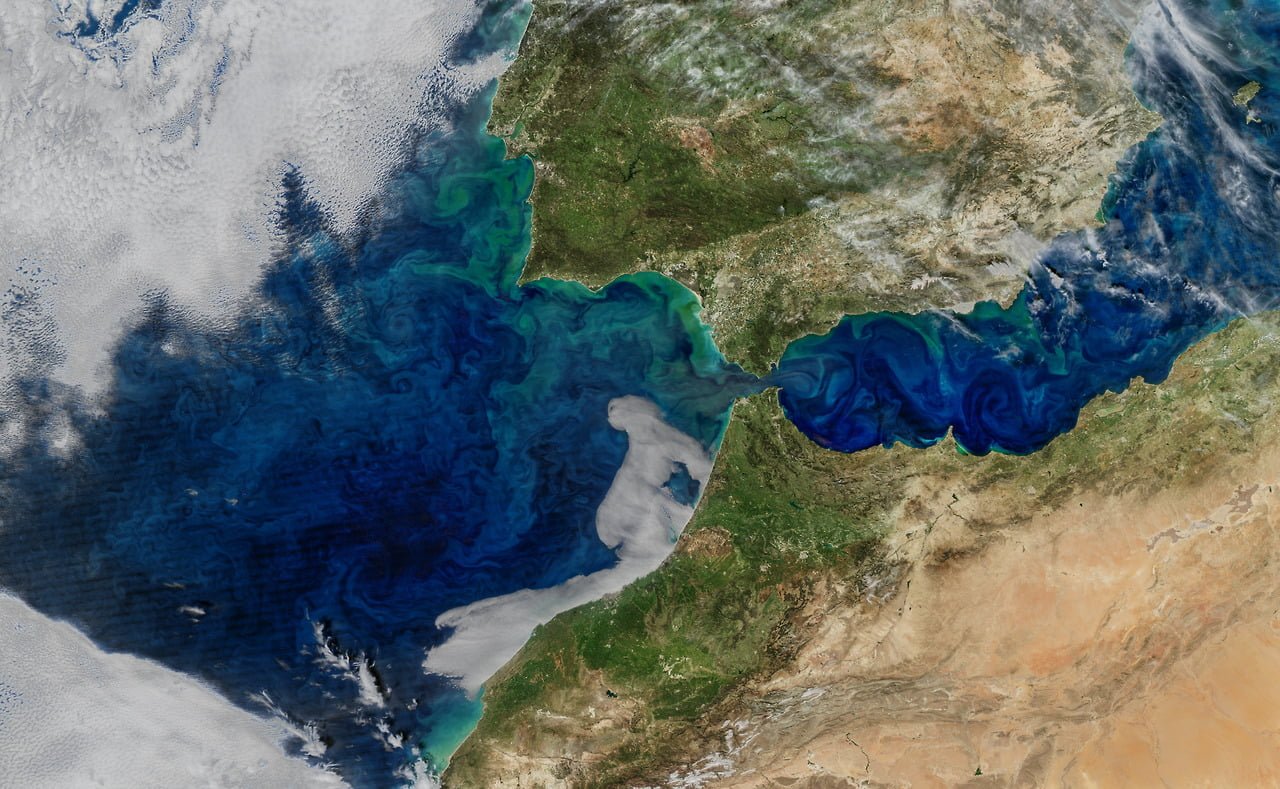
Swirls of phytoplankton make this satellite image of Gibraltar look like an Impressionist painting. The photo is a composite of data from several instruments, with colors enhanced to highlight features of the phytoplankton blooms. The tiny plankton act as tracer particles that reveal some of the complex flow between the North Atlantic and the Mediterranean. Although narrow, the Strait at Gibraltar has deep and complex terrain that was formed during a breach flood event millions of years ago. Water flowing through that terrain sets up enormous and complicated waves well beneath the ocean surface. These drive some of the turbulence that we see here as the blue swirls east of the Strait. (Image credit: NASA/N. Kurig; via NASA Earth Observatory)
Tag: phytoplankton

Coastal Upwelling
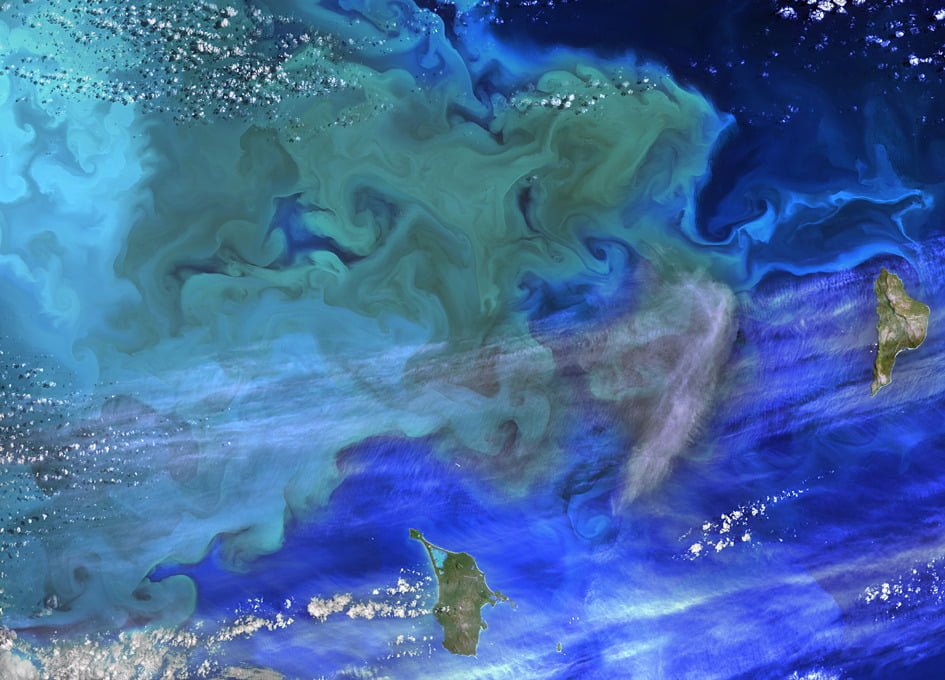
Cool temperatures and abundant nutrients make the waters off the western coast of North America especially biologically productive. This image is a composite of satellite data highlighting large phytoplankton blooms in the California Current. This current runs southward along the coastline, and, like other eastern boundary currents, it experiences strong upwelling, or rising of colder, nutrient-rich waters from lower depths. The upwelling is driven in part by Earth’s rotation. As the earth spins, Coriolis effects push the California Current out from the coast, allowing deeper waters to rise and fill the void. The cooler water provided by the upwelling is a major factor in the moderated climate along the West Coast. (Image credit: NASA/N.Kuring; via NASA Earth Observatory)

Phytoplankton Flows
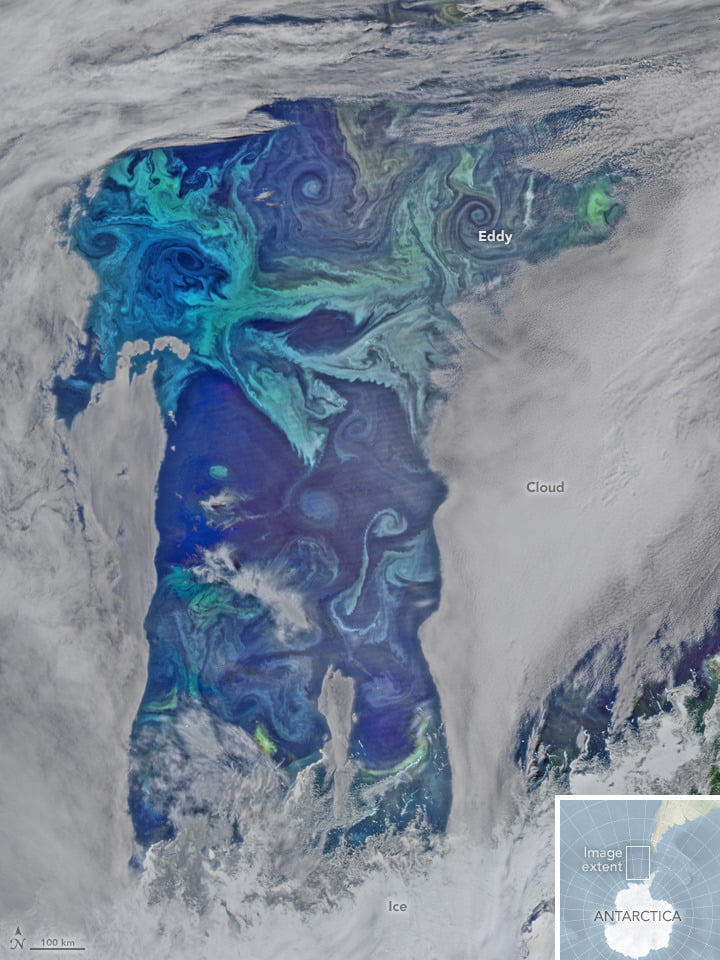
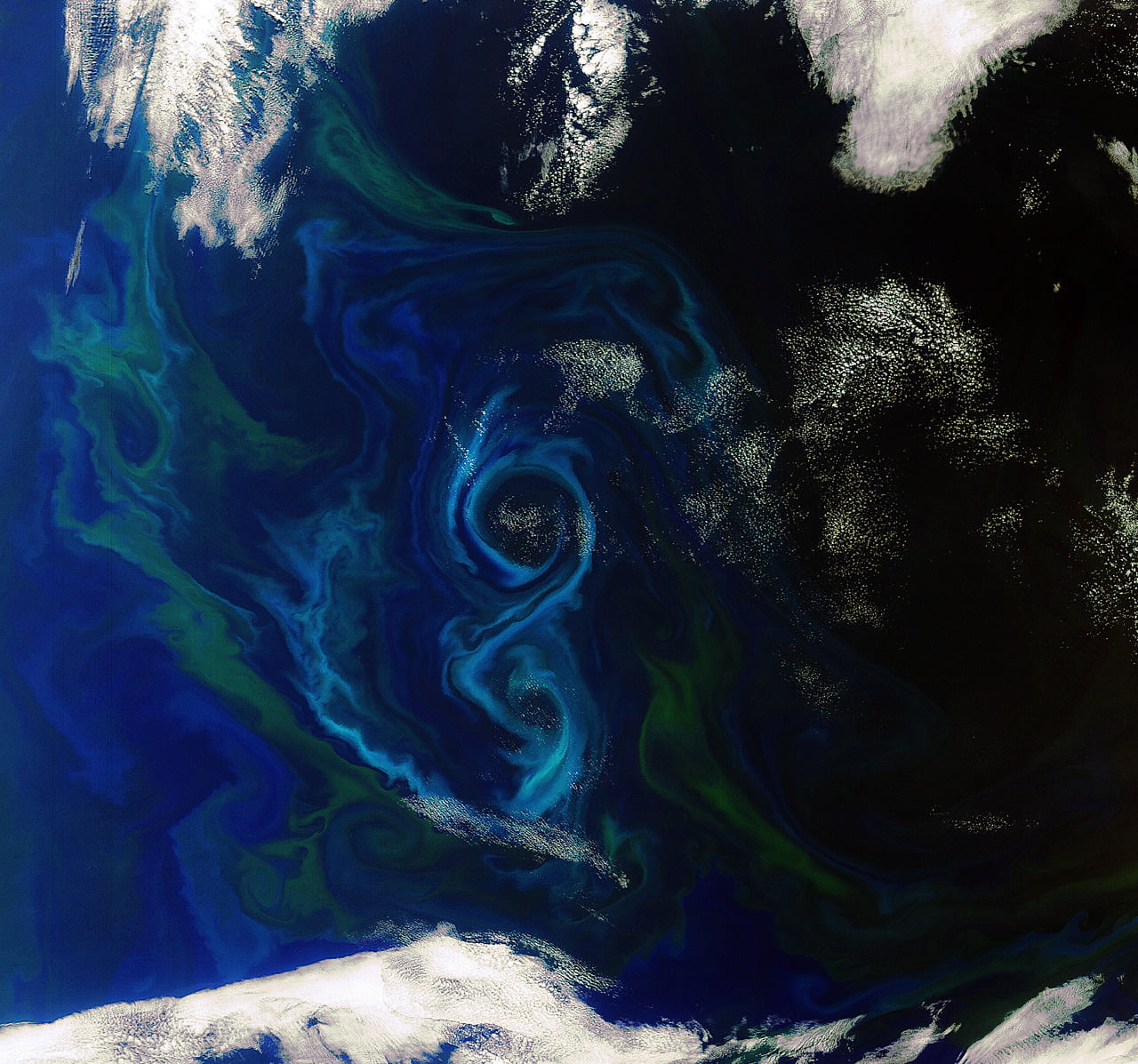
Phytoplankton, tiny plant-like organisms that live in ocean waters, act like nature’s tracer particles, making visible flows that would otherwise go unnoticed. In this satellite imagery, a phytoplankton bloom in the Southern Ocean off the coast of Antarctica highlights the turbulence of this region. Strong, steady winds and currents are typical for this area, which helps drive heat exchange between the ocean and atmosphere. The swirling eddies we see – many of them 100 km across! – are evidence of that turbulence. They’re also a sign of nitrogen and other nutrients getting mixed up in the action; it’s these nutrients that help generate the bloom in the first place. (Image credit: N. Kuring/NASA Earth Observatory)

Phytoplankton Bloom
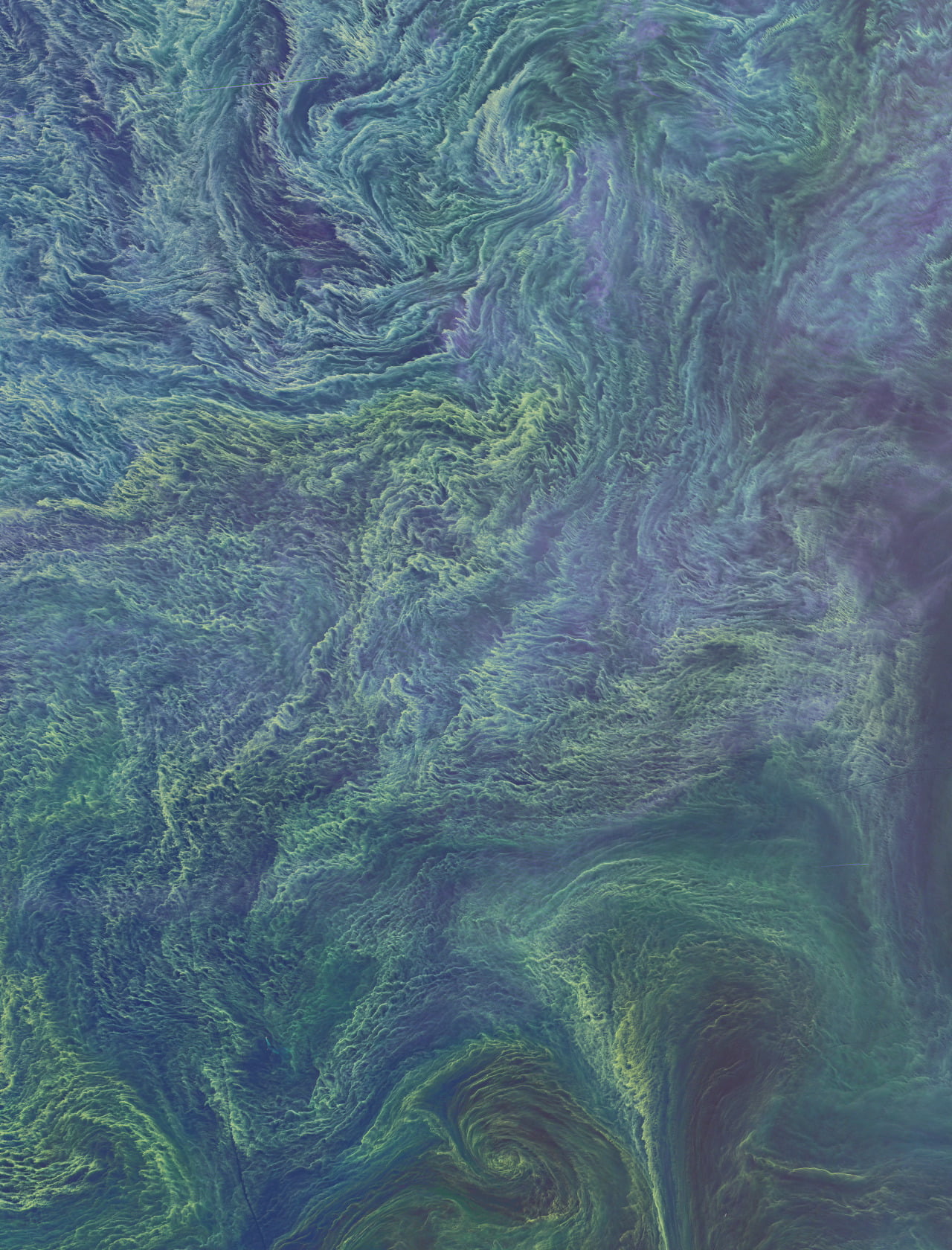
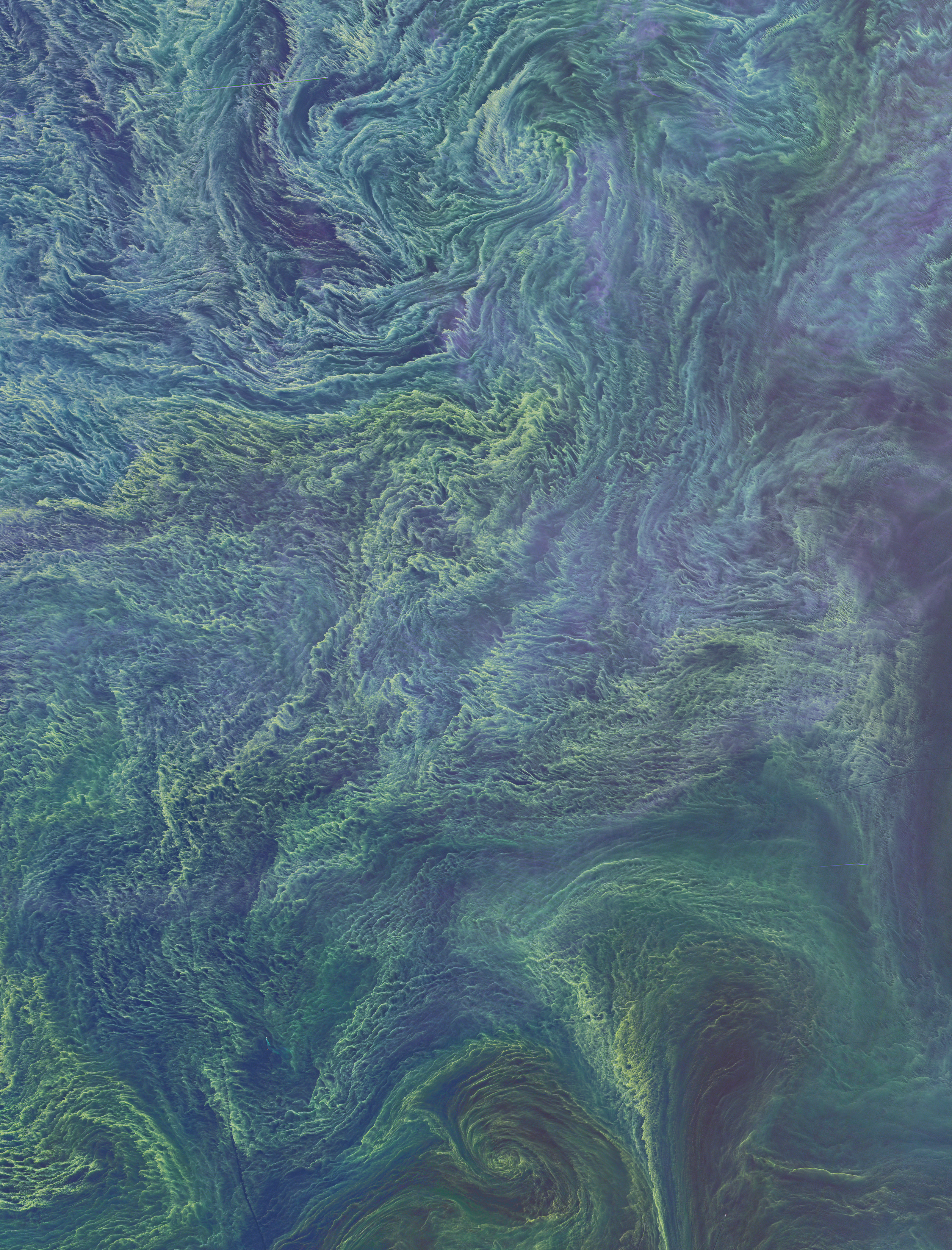
This incredible false-color satellite image shows a cyanobacteria phytoplankton bloom in the Baltic Sea. The image is roughly 900 km across and is beautifully detailed. Check out the full resolution version. The tiny phytoplankton act like tracer particles in the flow, sketching out the massive whorls as well as the tiny lacy wisps that make up the turbulent sea. Beautiful as they appear from orbit, such massive blooms can be dangerous to animal life, depriving large areas of the oxygen other animals need to survive. In recent years more and more large phytoplankton blooms are happening around the world as agricultural and industrial run-off supply waters with excess nitrogen and other nutrients favored by the phytoplankton. (Image credit: NASA Earth Observatory)

Phytoplankton Blooms
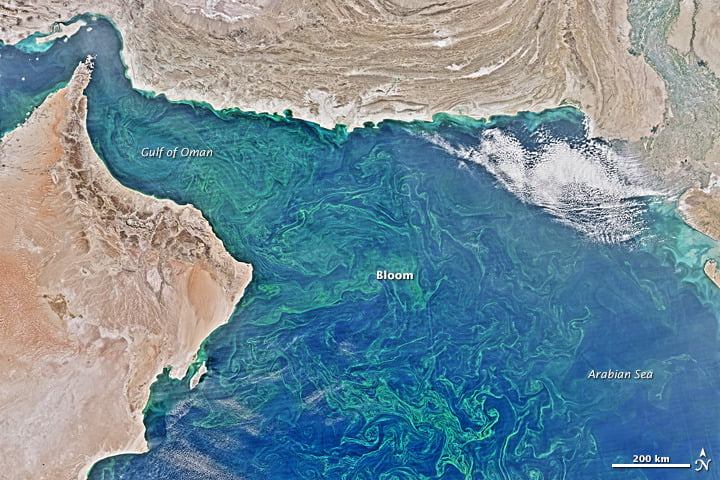
When the right nutrients come together in coastal waters, it can feed a phytoplankton bloom large enough to be visible to satellites. The phytoplankton themselves are microscopic organisms that are easily carried along by oceanic flows. In fluid dynamics terms, they are passive scalars or seed particles–additives that reveal the structure of the flow without altering it. Here the phytoplankton uncover the large-scale turbulent structure of flow in the Arabian Sea. Check the scale in the lower right. Many of the green eddies and swirls in this satellite image are hundreds of kilometers across. Yet, if we could zoom way in, we would still see turbulence acting on scales down to the millimeter length or below. This incredibly large range of length scales–eight or more orders of magnitude here–is a common characteristic of turbulence and part of what makes it such a challenge to understand or model. (Image credit: NASA Earth Observatory)

Phytoplankton Flow Viz
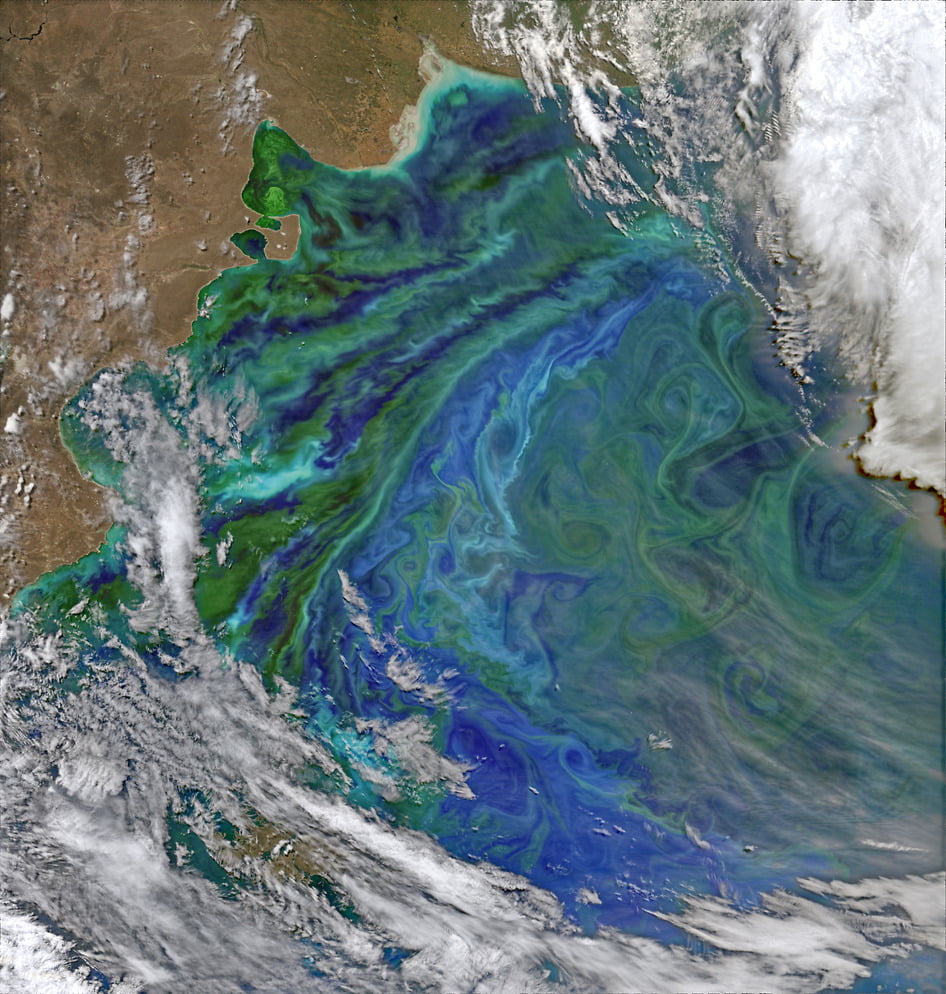
Nutrient-rich waters off Patagonia in South America blossom with phytoplankton in this satellite image. When present in large quantities, these microscopic photosynthesizers lend a green hue to the water. They act as seed particles in the flow, highlighting the currents and flow that carry them. If you check out the full resolution version of the photo, you can admire the rich detail in the whorls of ocean mixing. There even seem to be Kelvin-Helmholtz-like instabilities creating trains of vortices along the interface between separate bands. (Photo credit: NASA/ASU; via SpaceRef; submitted by jshoer)

Phytoplankton Bloom
In satellite imagery the blue and green whorls of massive phytoplankton blooms stand out against the ocean backdrop. These microscopic organisms are part of a delicate predator-prey balance and can be very sensitive to nutrient concentrations and other environmental conditions. Their individual size is negligible, but in a bloom phytoplankton are numerous enough that they act as seed particles for the flow. As a result, differing concentrations of phytoplankton reveal the swirling, turbulent mixing of ocean waters. (Image credit: NASA/USGS; via SpaceRef; submitted by jshoer)
Sedimentary Swirls
Local currents swirl sediments and phytoplankton blooms in this satellite image of the Tarut Bay in Saudi Arabia. Such blooms typically occur where nutrients are being washed together, thereby creating a kind of natural flow visualization of currents and matter flow in the ocean. (Photo credit: NASA Earth Observatory)

Visualizing Ocean Currents
Researchers used computational models of ocean currents to produce this video visualizing worldwide ocean surface currents from June 2005 through December 2007. Dark patterns under the ocean are representative of ocean depths and have been exaggerated to 40x; land topography is exaggerated to 20x. Notice the wide variety of behaviors exhibited in the simulation: some regions experience strong recirculation and eddy production, while others remain relatively calm and unmoving. Occasionally strong currents sweep long lines across the open waters, carrying with them warmth and nutrients that encourage phytoplankton blooms and other forms of ocean life. (Video credit: NASA; submitted by Jason S)

Oceanic Swirls
Mixing of surface waters with deeper ocean currents brings together the minerals and nutrients used by phytoplankton, resulting in gorgeous swirls of color in the ocean. These phytoplankton blooms are most common in the spring and summer, and while lovely, can be harmful to other marine life, either through the production of toxins or by depleting the waters of oxygen. Because the phytoplankton move according to the wind and waves, they can also form a sort of natural flow visualization. (Photo credit: ESA)
———-
While FYFD is not blacking out for SOPA/PIPA, we would like to take a moment to register our protest and encourage those of you who are Americans to take a moment to let Congress know that you don’t approve of these bills. Although we agree that protection of copyright holders rights is important, the measures proposed in these bills reach far beyond that line. FYFD, as a site that reposts photos and videos primarily created by others, could be taken down as a result of these bills, despite the purpose of the website as a tool for educational outreach and dissemination of science. Please support a free and uncensored Internet!