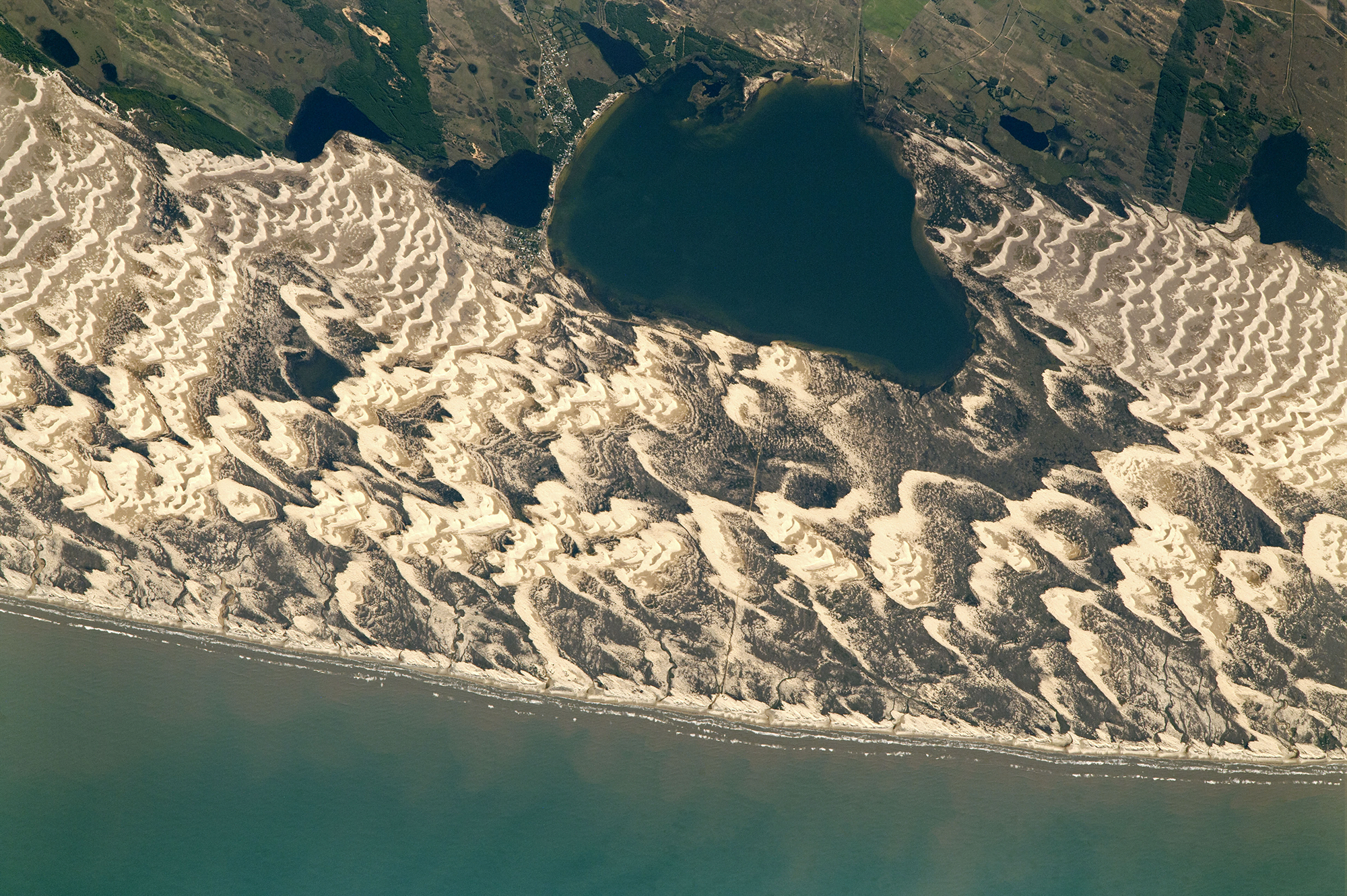
Barchan dunes collide in this astronaut image of Brazil’s southern coastline. Barchan (pronounced “bar-kahn”) dunes are crescent-shaped; their tips point downwind into their direction of travel. When many barchan dunes overlap, they coalesce into a dune field like the one seen here. A dune’s speed depends on many factors, including the wind speed, dune size, and its proximity to other dunes. In experiments, dunes have even chased one another and changed speeds to avoid collision. (Image credit: NASA; via NASA Earth Observatory)
Tag: physics

“Aquakosmos”


Colorful chandeliers, passing spirits, sprouting mushrooms, and fountains of falling ink appear in Christopher Dormoy’s “Aquakosmos.” Driven by the slight density difference between ink and water, many of these elaborate shapes result from the Rayleigh-Taylor instability. Anytime you see mushroom-like plumes and chandelier-like splitting vortex rings, there’s probably a Rayleigh-Taylor instability behind it. Check out the full video above, and, if you want to give this kind of flow visualization a try yourself, a glass of water and vial of food coloring is a great place to start. (Video and image credit: C. Dormoy)

Stopping a Bottle’s Bounce
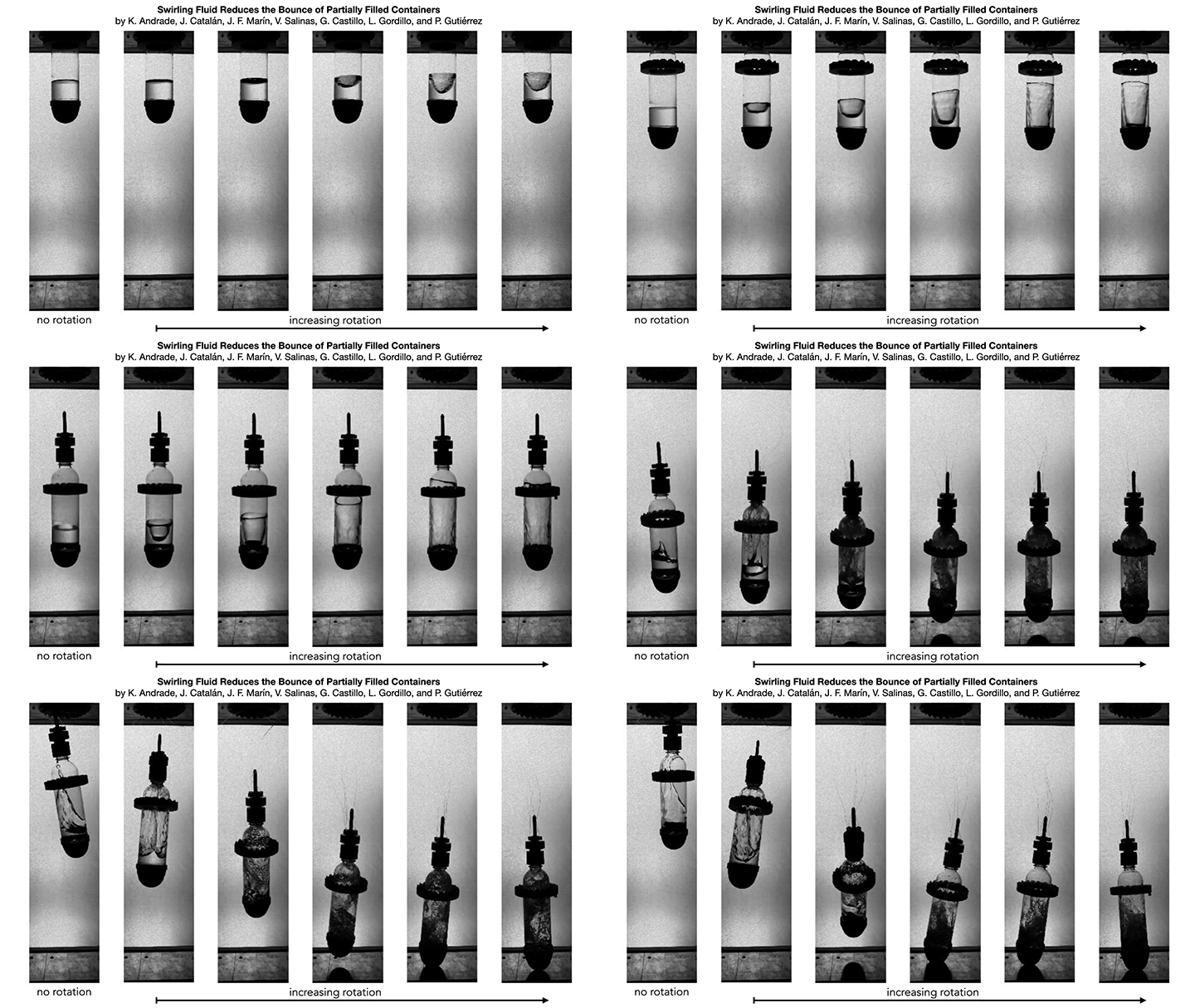
A few years ago, the Internet was abuzz with water bottle flips. Experimentalists are still looking at how they can arrest a partially fluid-filled container’s bounce, but now they’re rotating the bottles vertically rather than flipping them end-over-end. Their work shows that faster rotating bottles have little to no bounce after impacting a surface.

This image sequence shows how water in a rotating bottle moves during its fall (top row) and after impact (bottom row). Water climbs the walls during the fall, creating a shell of fluid that, after impact, forms a central jet that arrests the bottle’s momentum. The reason for this is visible in the image sequence above, which shows a falling bottle (top row) and the aftermath of its impact (bottom row). When the bottle rotates and falls, water climbs up the sides of the bottle, forming a shell. On impact, the water collapses, forming a central jet that shoots up the middle of the bottle, expending momentum that would otherwise go into a bounce. It’s a bit like the water is stomping the landing.
The authors hope their observations will be useful in fluid transport, but they also note that this bit of physics is easily recreated at home with a partially-filled water bottle. (Image and research credit: K. Andrade et al.; via APS Physics)
Mitigating Urban Floods


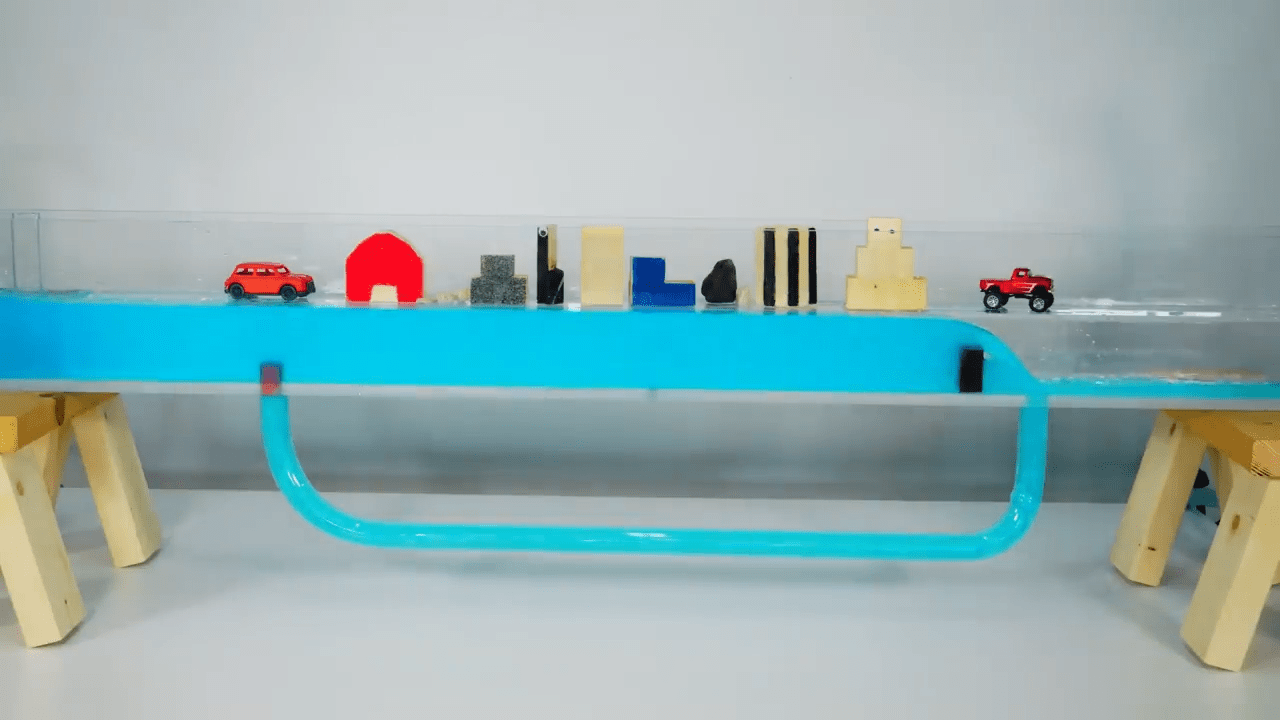
For densely-populated urban areas, floods are one of the most damaging and expensive natural disasters. We can’t control the amount of rain that falls, so engineers need other ways to mitigate damage. It’s not usually possible to remove people and property from floodplains, so instead civil engineers look below the surface, building flood tunnel networks to alleviate floodwaters. In this Practical Engineering video, Grady demonstrates how these systems work and what some of their challenges are. (Video and image credit: Practical Engineering)

Weathering Spilled Oil
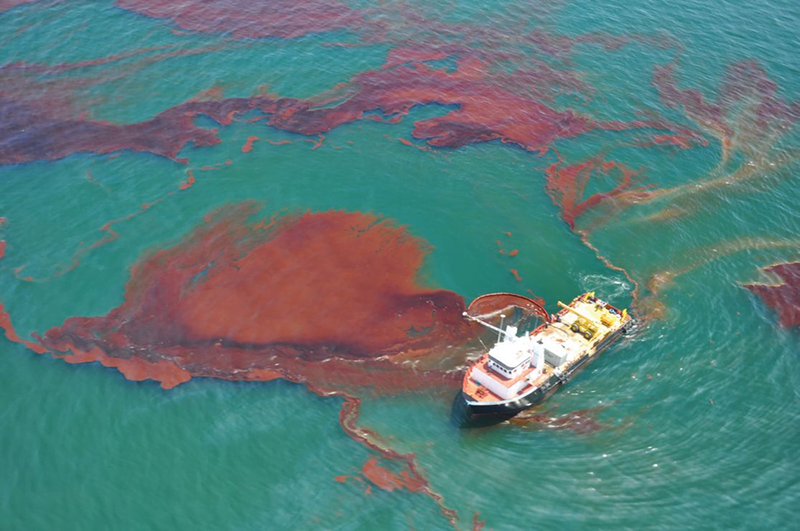
As long as we continue to extract and transport oil, marine oil spills will continue to be a problem. Recent work shows that spilled oil weathers differently depending on both sunlight and water temperature. When exposed to sunlight, crude oil undergoes chemical reactions that can change its makeup. Researchers studied the mechanical properties of crude oil samples kept at different temperatures in both sunlight and the dark.
They discovered that sunlight-exposed crude oil kept at a high temperature had twice the viscosity of a sample kept in the dark at the same temperature. In contrast, the high-temperature sunlit sample’s viscosity was 8 times lower than a sunlit sample kept at a lower temperature. That’s quite a large difference, and it implies that tropical oil spills may behave quite differently than Arctic ones. Cold-water spills will entrain and dissolve less than warm-water ones, so there may be more surface oil to collect at high-latitude spills. The differences in viscosity may also necessitate different spill mitigation techniques. (Image credit: NOAA; research credit: D. Freeman et al.; via APS Physics)

Rolling Over Wisconsin
Although they may look sinister, roll clouds like this one are no tornado. These unusual clouds form near advancing cold fronts when downdrafts cause warm, moist air to rise, cool below the dew point, and condense into a cloud. Air in the cloud can circulate around its long horizontal axis, but the clouds won’t transform into a tornado. Roll clouds are also known as Morning Glory clouds because they often form early in the day along the Queensland coast, where springtime breezes off the water promote their growth. The clouds do form elsewhere, though; this example is from Wisconsin in 2007. (Image credit: M. Hanrahan; via APOD)

Diving From Above
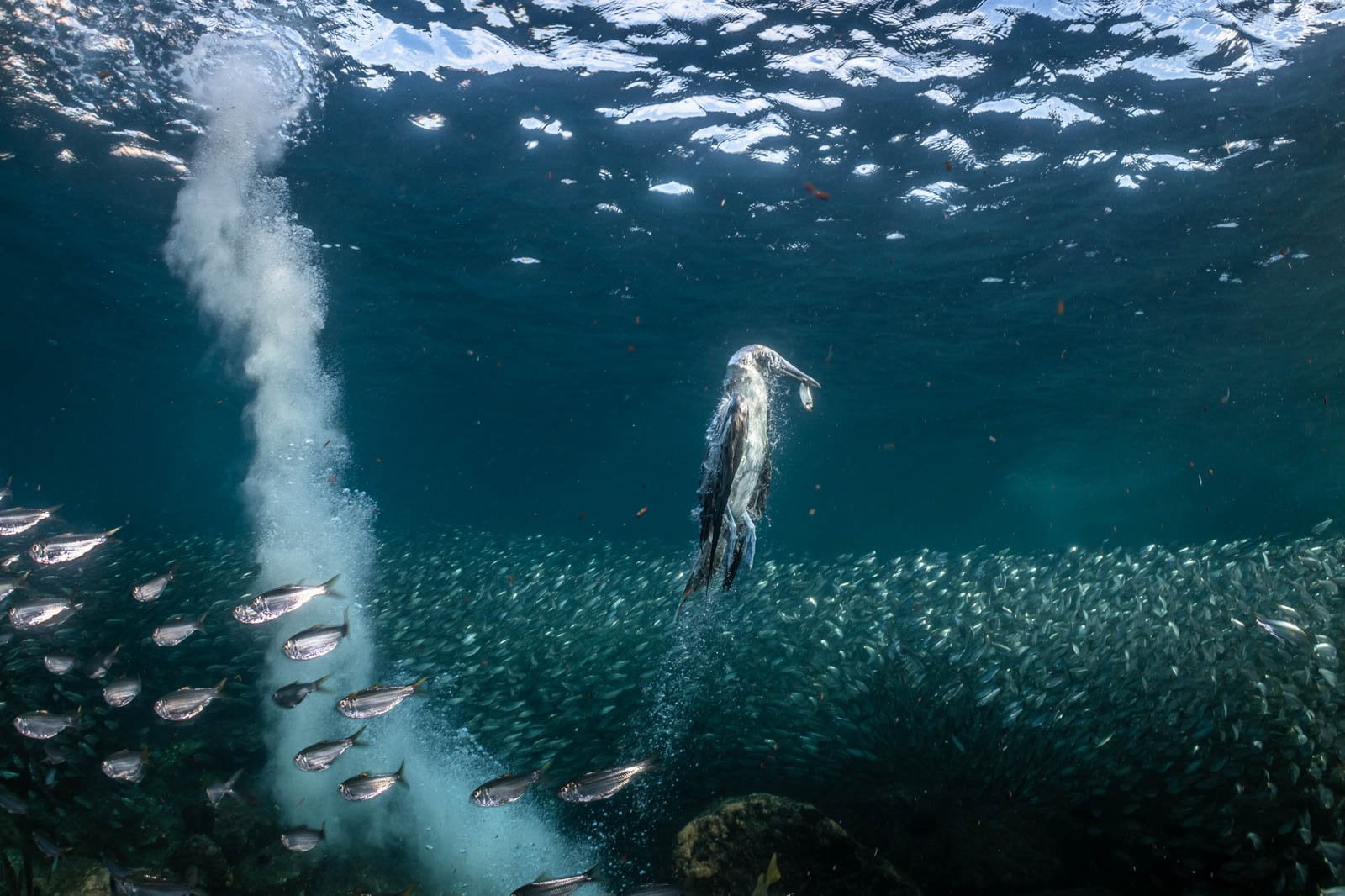
Blue-footed boobies, like many other seabirds, climb to a particular altitude before folding their wings and diving head-first into the water. This acrobatic feat balances the bird’s force of impact and the depth it can reach to ensnare fish swimming there. It’s an incredible process to watch, a fascinating one to study, and, here, a beautiful glimpse of the natural world from a perspective we don’t typically see. (Image credit: H. Spiers, Bird POTY; via Colossal)

Butterfly Scales
Catch a butterfly, and you’ll notice a dust-like residue left behind on your fingers. These are tiny scales from the butterfly’s wing. Under a microscope, those scales overlap like shingles all over the wing. Their downstream edges tilt upward, leaving narrow gaps between one scale and the next. Experiments show that, although butterflies can fly without their scales, these tiny features make a big difference in their efficiency.

At the microscale, a butterfly’s scales overlap like roof shingles but are tilted upward, leaving cavities in the downstream direction. When air flows over the scales, tiny vortices form in the gaps between. These laminar vortices act like roller bearings, helping the flow overhead move along with less friction and, thus, less drag. Compared to a smooth surface, the scales reduce skin friction on the wing by 26-45%. (Image credit: butterfly – E. Minuskin, scales – N. Slegers et al., experiment – S. Gautam; research credit: N. Slegers et al. and S. Gautam; via Physics Today)

This lab-scale experiment shows how air moves over butterfly scales. As flow moves from left to right, small persistent vortices form in the gaps between scales. These act like roller bearings that reduce the skin friction from air moving past. Fishing With Mucus


The scaled wormsnail isn’t much for travel. It lives its whole life cemented to a rock in the tidal lands. And when you can’t go out for food, you have to wait for the food to come to you. During high tides, the snail lets out tendrils of mucus that capture bits of kelp, plankton, and whatever else the water brings. The snails haul their catch directly into their mouths, relying on the mucus’s impressive viscoelasticity to withstand the journey. (Video and image credit: Deep Look)

Drag Is Greatest Before Submersion
A new study shows that partially submerged objects can experience more drag than fully submerged ones. This unexpected result comes from the excess fluid that piles up ahead of the object, as seen in the image above, where flow is moving from left to right. The experiments used centimeter-sized spheres and showed that the maximum drag on a nearly-submerged sphere could be 300-400% greater than the drag on a fully submerged sphere.
Even more surprisingly, they found that water-repellent hydrophobic coatings — which are often suggested for drag reduction — actually increased the drag even further on partially submerged spheres. That’s because the water-repelling coating caused an even larger build-up of fluid ahead of the sphere, increasing the pressure on the front side of the sphere and creating even more drag. Spheres with a hydrophilic coating had less water build-up and thus lower drag.
The study suggests that — at the centimeter-scale — drag physics at the air-water interface may be more complicated than we assume. (Image and research credit: R. Hunt et al.; via Physics World; submitted by Kam-Yung Soh)